Contents13 sections
Luteinizing hormone (LH) is best known for its role in the menstrual cycle, ovulation and pregnancy. It matters just as much for men: LH is the signal that tells the testes to make testosterone.
When LH is low, testosterone and fertility can fall with it. When LH is high, it usually means the testes or ovaries are not responding the way they should. That is why LH is one of the first hormones a doctor checks when testosterone is low or a woman is not ovulating.
This guide covers what LH does, normal LH levels in men and women, what makes LH high or low, and the evidence behind the ways to increase it: diet and lifestyle, clomiphene and enclomiphene, aromatase inhibitors, kisspeptin and gonadorelin. It also explains why hCG, often listed as an LH booster, works differently.
Key Takeaways
- LH is made by the pituitary gland. In men it tells the Leydig cells in the testes to make testosterone; in women a mid-cycle LH surge triggers ovulation.
- Measuring LH next to testosterone shows where a problem sits: high LH with low testosterone points to the testes, while low or normal LH with low testosterone points to the pituitary or hypothalamus.
- Clomiphene, enclomiphene and aromatase inhibitors raise your own LH by blocking or lowering estrogen’s brake on the brain. Kisspeptin and pulsed gonadorelin act further upstream.
- hCG does not raise LH. It mimics LH at the testes, so testosterone rises while the body’s own LH falls further.
- Excess body fat, severe dieting, short sleep, heavy drinking, opioids and anabolic steroids can all suppress LH. Fixing the cause comes first, and any drug treatment should follow a proper diagnosis.
What Is Luteinizing Hormone?
Luteinizing hormone (LH) is a glycoprotein hormone that is secreted along with follicle-stimulating hormone (FSH) by the anterior pituitary gland. [1]
LH release is stimulated by gonadotropin-releasing hormone (GnRH) from the hypothalamus, which arrives in pulses, and inhibited by estrogen in females and testosterone in males. [1] There is one important exception in women: in the middle of the cycle, high estrogen levels switch from braking LH to triggering it, which produces the LH surge.
Functions of Luteinizing Hormone
LH contributes to the maturation of primordial germ cells in both sexes. [1]
In men, LH causes the Leydig cells of the testes to produce testosterone. [1] Much of that testosterone stays inside the testes, where very high local levels are needed for sperm production.
In women, LH stimulates the ovary to produce steroid hormones. [1] The mid-cycle LH surge triggers ovulation, and LH then supports the corpus luteum, which makes the progesterone that prepares the lining of the uterus for implantation.
Normal Luteinizing Hormone Levels
LH is measured with a blood test and reported in international units per liter (IU/L). Reference ranges differ slightly between labs, so compare your result with the range printed on your own report. Typical ranges are: [2]
| Group | Typical LH range (IU/L) |
|---|---|
| Women, weeks 1-2 of the cycle | 1.37-9.0 |
| Women, week 2, just before ovulation | 6.17-17.2 |
| Women, weeks 3-4 of the cycle | 1.09-9.2 |
| Women, after menopause | 19.3-100.6 |
| Men | 1.42-15.4 |
The onset of the LH surge precedes ovulation by 35-44 hours, and the peak LH level precedes ovulation by 10-12 hours. [3] This surge is what home ovulation tests detect in urine.
A single result is only part of the picture. LH is released in pulses, so levels move during the day, and the number has to be read alongside testosterone in men or the cycle day in women.
How LH Boosts Testosterone Production
LH travels in the blood to the testes and binds to LH receptors on the Leydig cells, which respond by making testosterone. GnRH from the hypothalamus controls how much LH the pituitary releases.
During puberty, rising LH starts testosterone production, while FSH acts on the Sertoli cells that support sperm production. Sperm production needs both: FSH and high testosterone levels inside the testes.
The system runs on negative feedback. When testosterone falls, the hypothalamus and pituitary release more GnRH and LH. When testosterone rises, it suppresses GnRH and LH again. Part of this brake comes from estradiol, which the body makes from testosterone, as the aromatase inhibitor studies below show.
This loop explains most of what follows. Anything that weakens the brake raises LH, and anything that adds testosterone from outside, such as TRT or anabolic steroids, shuts LH down.
Causes of High Luteinizing Hormone Levels
High LH usually reflects sex organs that cannot produce enough steroid hormones to maintain the reproductive process. This is typical when the testes or ovaries are not able to produce enough testosterone or estrogen, so the pituitary keeps pushing. [4]
Genetic Conditions
Turner syndrome in females and Klinefelter syndrome (an extra X chromosome) in males are examples of genetic conditions associated with high LH levels. [2]
Ovulation Problems and Menopause
High LH can mean you are not ovulating. In a woman of childbearing age, this can point to a problem with the ovaries, such as primary ovarian insufficiency. In older women, high LH is a normal sign that menopause has started or is approaching.
Polycystic Ovary Syndrome (PCOS)
Polycystic ovary syndrome is a hormonal disorder common among women of reproductive age. Women with PCOS may have irregular periods or excess androgen levels, and the ovaries may develop many small collections of fluid and fail to release eggs regularly. [2] Many women with PCOS have raised LH, often high relative to FSH, which pushes the ovaries to make extra androgens.
Testicular Damage
Damage to the testes from chemotherapy, radiation, infection such as mumps, injury or heavy alcohol use can raise LH. The pituitary pushes harder because the testes no longer respond. This is called primary hypogonadism.
Causes of Low Luteinizing Hormone Levels
Low LH can mean your pituitary gland is not making enough LH to drive the changes in your body that support sexual development and maintain reproductive health. [4]
Congenital Conditions
Kallmann syndrome is congenital hypogonadotropic hypogonadism with low serum testosterone, FSH and LH, together with midline defects such as anosmia (a missing sense of smell). [2]
Pituitary and Hypothalamic Disorders
Tumors, injury, surgery or radiation affecting the pituitary or hypothalamus can lower LH. A high prolactin level, from a prolactin-secreting tumor (prolactinoma) or from some medicines, also suppresses GnRH and LH.
Men with total testosterone below 150 ng/dL in combination with a low or low-normal LH should have a pituitary MRI regardless of prolactin levels, because this pattern can point to a non-secreting pituitary adenoma. [5]
Medicines, Body Fat and Energy Deficit
Many cases of low LH in adults are functional, meaning the axis is healthy but something is holding it down:
- Testosterone, anabolic steroids and SARMs: these act on the androgen receptor and suppress LH through negative feedback.
- Opioids: long-term opioid use suppresses GnRH and LH, and low testosterone is common in men on long-term opioid therapy.
- Obesity: excess body fat is linked with low testosterone and low or inappropriately normal LH, partly because fat tissue converts testosterone into estradiol.
- Severe calorie restriction and heavy training: low energy availability slows GnRH and LH pulses. In women this causes missed periods (functional hypothalamic amenorrhea); in men it lowers testosterone.
- Serious illness and high-dose glucocorticoids: both can suppress the hypothalamus and pituitary.
Functional causes like these are often reversible once the cause is removed.
Hypogonadism and Luteinizing Hormone
In men, serum testosterone levels typically begin to decline in the fifth decade of life and are usually accompanied by rising FSH and stable or increased LH. [6]
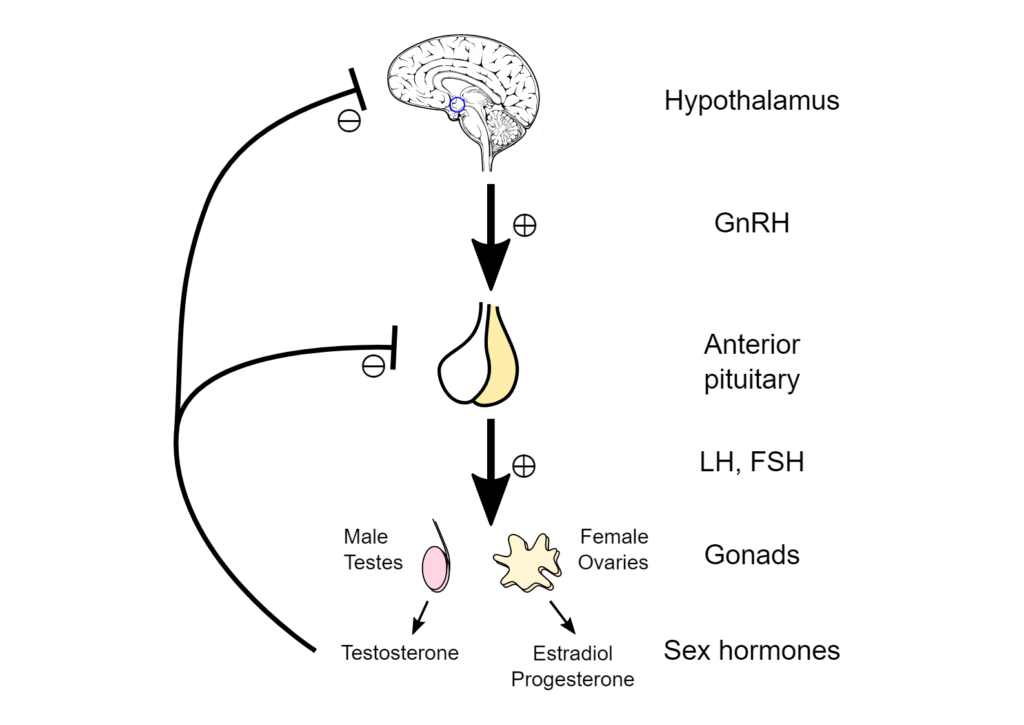
Hypogonadism is impaired testicular function due to a problem within the testes (primary hypogonadism) or a problem within the hypothalamic-pituitary-gonadal axis (secondary hypogonadism). [1]
Endocrine Society guidelines recommend measuring LH and FSH to tell the two apart. Men with primary hypogonadism have low testosterone levels with elevated LH and FSH, whereas men with secondary hypogonadism have low testosterone with low or inappropriately normal LH. [7]
| Pattern | Testosterone | LH and FSH | Where the problem is |
|---|---|---|---|
| Primary hypogonadism | Low | High | Testes |
| Secondary hypogonadism | Low | Low or inappropriately normal | Pituitary or hypothalamus |
Hypogonadal men have low serum testosterone and impaired sexual maturity, which can cause symptoms such as low libido, depression, an increase in body fat and weaker erections. [1]
Patients with secondary hypogonadism usually have a problem with GnRH signaling, which lowers FSH and LH secretion. That drop contributes to both low testosterone and reduced sperm production. [1]
Because LH is secreted in pulses, serum LH in men with secondary hypogonadism may be below the normal range or in the low-normal range, but inappropriately low for the low testosterone level. [7]
In complete idiopathic hypogonadotropic hypogonadism (for example, Kallmann syndrome) and in severe gonadotropin suppression, LH pulses may be absent or markedly reduced, and these men usually have very low testosterone and LH. [7]
Testosterone Replacement Therapy and LH Levels
Exogenous testosterone suppresses LH secretion and thereby lowers the high intratesticular testosterone levels that sperm production depends on. [8] This is why men on TRT often notice their testes shrink and their sperm counts fall, and why some add hCG to keep the testes working (see how to increase sperm count while on TRT).
In primary hypogonadism, where LH starts out high, normalization of the serum LH level may be used to judge whether testosterone replacement is adequate, whichever preparation is used. [8]
How To Increase Luteinizing Hormone Levels
The right approach depends on why LH is out of range. If LH is already high because the testes or ovaries are failing, as in primary hypogonadism or menopause, raising it further will not help. If LH is low or inappropriately normal, the first step is to look for a cause that can be fixed: excess body fat, a large calorie deficit, opioids or anabolic steroids, a high prolactin level or a pituitary problem.
Medical options then fall into two groups: those that make your own pituitary release more LH, and those that stand in for LH. The table sums them up.
| Option | How it works | Effect on your own LH | Status |
|---|---|---|---|
| Weight loss (if overweight) | Less estradiol made in fat tissue | May rise | Lifestyle; human data mostly measure testosterone |
| Clomiphene | Blocks estrogen receptors in the hypothalamus and pituitary | Rises | Approved for female infertility; off-label in men |
| Enclomiphene | The anti-estrogen isomer of clomiphene | Rises | Tested in human trials; not FDA-approved |
| Anastrozole, letrozole | Lower the estradiol made from testosterone | Rises | Approved for breast cancer; off-label in men |
| Kisspeptin | Switches on the GnRH neurons in the hypothalamus | Rises, short-lived | Investigational |
| Gonadorelin | Synthetic GnRH acting on the pituitary | Rises if pulsed; falls if continuous | Pulsatile pumps used for hypogonadotropic hypogonadism |
| hCG | Activates the LH receptor directly | Falls | Prescription; used for male hypogonadotropic hypogonadism and fertility treatment |
Diet and Lifestyle
No food or supplement has been shown to reliably raise LH in healthy people. What the evidence does support is removing the things that suppress it:
- Lose excess body fat. Obesity is a common cause of low testosterone with low or normal LH in men, and weight loss raises testosterone. Estrogen feedback is part of the reason: in severely obese men with low testosterone, lowering estradiol with letrozole raised both LH and testosterone. [9]
- Eat enough. Long, aggressive diets and very high training loads slow GnRH and LH pulses. Restoring energy intake is the main treatment for missed periods caused by low energy availability in women, and testosterone in men usually recovers once calories return.
- Sleep 7-9 hours. Testosterone rises during sleep and peaks in the morning. In a study of healthy young men, one week of sleeping five hours a night lowered daytime testosterone by 10-15%.
- Limit alcohol. Heavy drinking damages the testes directly and also disrupts the hypothalamus and pituitary.
- Review your medicines. Opioids, glucocorticoids, drugs that raise prolactin (including some antipsychotics) and any testosterone, anabolic steroid or SARM can suppress LH. Do not stop a prescribed medicine without talking to your doctor.
- Correct deficiencies. Zinc deficiency is linked to low testosterone, and in a small study, giving zinc to older men with marginal deficiency raised their testosterone. There is no good evidence that extra zinc raises LH or testosterone when zinc levels are already normal. Vitamin D trials in men have given mixed results.
Two foods come up in LH research. Onion is thought to work by increasing LH production and reducing reactive oxygen species in the testes, [10] but this evidence comes mainly from animal studies, not people. In an observational study, total and high-fat dairy intake was positively associated with serum LH. [11] That is a link, not proof that eating dairy raises LH.
Selective Estrogen Receptor Modulators (SERMs)
SERMs block the negative feedback of estradiol (E2) on the hypothalamus, which increases LH production and, downstream, testosterone production. [10] Because they work through the body’s own axis, they only help when the pituitary and testes are intact. They do not fix primary hypogonadism.
Clomiphene Citrate
Clomiphene citrate is a SERM that has been used to treat infertility in both sexes for over 50 years. [12] It blocks estrogen receptors in the hypothalamus and pituitary, which increases GnRH, LH and FSH release and raises the body’s own testosterone production. [13]
In men, clomiphene is used off-label to treat hypogonadism and male infertility. It works by stopping estradiol, which the body makes from testosterone, from binding to its receptors in the hypothalamus. [6] It is a less expensive alternative to testosterone replacement, with the added benefit of preserving fertility. [12]
Doses used in studies of men are mostly 25-50 mg, taken daily or every other day. Clomiphene is a mix of two isomers, enclomiphene and zuclomiphene. Zuclomiphene has a long half-life, builds up over time and has weak estrogen-like effects, which may explain some side effects such as mood changes. Visual disturbances are an uncommon but known side effect and a reason to stop the drug. Our Clomid guide covers its use after steroid cycles.
 SERMs & AIs
Overview
- Form: Oral capsules (25 mg each, 60 capsules)
- Researched Dosage: 25 mg to 50 mg daily for PCT
- Typical Cycle: 4-6 weeks
- Cost: $69.95
- Stacking Options: Tamoxifen, HCG, Enclomiphene
Pros
- A SERM that blocks estrogen at the hypothalamus, prompting the body to make more LH, FSH and its own testosterone.
- Studies in men with low testosterone found it raised testosterone while preserving sperm production, unlike TRT.
- It is oral, inexpensive and has been in medical use since 1967, so its effects are well documented.
Cons
- About a third of each dose is zuclomiphene, a long-lasting isomer linked to mood swings, irritability and low mood.
- Blurred vision, floaters and light sensitivity have been reported; visual symptoms are a reason to stop.
- It is FDA-approved only for female infertility, so use in men is off-label, and this product is sold for research use only.
Enclomiphene
Enclomiphene is the trans-isomer of clomiphene, the part responsible for its anti-estrogen effect on the hypothalamus and pituitary. Taking it on its own avoids the slow buildup of zuclomiphene.
In clinical trials in men with secondary hypogonadism, enclomiphene citrate at 12.5-25 mg a day raised LH, FSH and testosterone into the normal range while sperm counts were maintained. Testosterone gel, used as a comparison, raised testosterone too but lowered LH, FSH and sperm counts.
Enclomiphene has not been approved by the FDA as a treatment for low testosterone. Read our enclomiphene guide for the full research, side effects and dosing data.
Aromatase Inhibitors
Aromatase is the enzyme that converts testosterone into estradiol. It is present in the testes, brain, fat tissue, muscle, hair and blood vessels. Selective aromatase inhibitors block this conversion, which is why they are used as an alternative way to raise testosterone. [6]
Men taking the aromatase inhibitor anastrozole show how strongly estrogen brakes LH. As their estradiol falls, the pituitary responds more strongly to GnRH, and LH pulse frequency also increases, which suggests estrogen acts at the hypothalamus as well. [9]
A study of letrozole in severely obese men with hypogonadism showed a significant rise in LH and testosterone and a fall in estradiol from baseline. Men with normal testosterone also show increases in LH and testosterone in response to anastrozole, and aromatase inhibitors raise testosterone and lower estradiol in men with low testosterone. [9]
Aromatase inhibitors are approved for breast cancer and are used off-label in men. Pushing estradiol too low harms bone density, libido and body composition, so their use needs blood-test monitoring. See anastrozole for men for more.
 Peptides
Overview
- Form: Oral Capsule
- Dosage: 0.5mg 1-2 times weekly
- Typical Cycle: As needed based on blood work (best for managing sides on cycle)
- Cost: $64.03
- Stacking Options: Testosterone enanthate or cypionate
Pros
- Well-established efficacy — ATAC trial showed superior disease-free survival versus tamoxifen in postmenopausal hormone-receptor-positive breast cancer
- Substantially lower risk of endometrial cancer and thromboembolic events than tamoxifen
- Once-daily oral dosing, few significant drug interactions
Cons
- Accelerated bone mineral density loss, with elevated fracture risk over years of use
- Arthralgia and joint stiffness are common and a frequent reason patients stop treatment
- Ineffective in premenopausal women unless ovarian function is suppressed, since it only blocks peripheral aromatisation
Kisspeptin
Kisspeptin is a hormone made in the hypothalamus that switches on the GnRH neurons, so it sits one step above GnRH in the chain. People born with faulty kisspeptin signaling, such as mutations in the kisspeptin receptor, do not go through puberty normally and have hypogonadotropic hypogonadism. That is how its role was discovered.
In human research studies, kisspeptin-10 and kisspeptin-54 given by injection or infusion raise LH quickly in healthy men, and kisspeptin-54 has been tested in IVF as a trigger for final egg maturation. The effect of a single dose is short-lived, and in some studies repeated dosing made the response fade.
Kisspeptin is an investigational compound. It is not approved for any treatment, and the products sold online as research peptides are unregulated. Our kisspeptin-10 guide covers the research in more detail.
Gonadorelin (GnRH)
Gonadorelin is a synthetic form of GnRH, identical to the hormone the hypothalamus makes. It acts directly on the pituitary to release LH and FSH, and it lasts only minutes in the blood.
How it is given decides what it does. Natural GnRH arrives in pulses roughly every one to two hours, and pulsed gonadorelin from a small pump mimics this. Giving hypogonadal patients pulsatile GnRH, or LH (or hCG) together with FSH, can start sperm production and increase sperm count. [1] Continuous exposure does the opposite: the pituitary stops responding and LH falls, which is how long-acting GnRH agonists such as leuprolide shut down testosterone in prostate cancer.
Some TRT clinics prescribe gonadorelin injections two or three times a week as an alternative to hCG. That schedule is far from the pulsed pattern used in clinical treatment, and evidence that it keeps the testes working is limited. See our gonadorelin guide for more.
hCG: Mimics LH Instead of Raising It
hCG is often listed as a way to increase LH, but it does not do that. Human chorionic gonadotropin is a hormone made by the placenta in pregnancy. It is so similar to LH that it binds the same receptor and stimulates the Leydig cells in the testes to produce testosterone. [14] It also lasts much longer in the body than LH.
Because the testosterone and estradiol it produces feed back on the brain, hCG actually lowers the body’s own LH. Its value is that it does LH’s job in the testes when the pituitary is not doing it. In causes of male infertility such as Kallmann syndrome or hypogonadotropic hypogonadism, a lack of LH can be overcome by drugs that activate the LH receptor. [6]
Men on TRT use hCG to maintain testicular size and sperm production, and it is used after testosterone or steroid use to restart sperm production. A 2015 study of 49 men found that 3,000 IU of hCG every other day, combined with other fertility drugs, supported recovery of spermatogenesis without significant adverse effects. [14]
In women, hCG is used in fertility treatment to trigger final egg maturation and ovulation, standing in for the natural LH surge.
Raising LH in Women
In women, the aim is rarely to raise LH as a number. It is to restore regular cycles and ovulation, and the approach depends on the cause:
- Low energy availability, stress or heavy training: LH pulses slow down and periods stop (functional hypothalamic amenorrhea). The main treatment is eating enough, regaining weight if needed and easing training.
- PCOS: LH is often already high. When the goal is pregnancy, current international guidelines recommend letrozole as the first-line drug to induce ovulation, with clomiphene as an alternative.
- Hypothalamic or pituitary causes: fertility specialists use pulsatile GnRH when the problem is in the hypothalamus, or gonadotropins. Human menopausal gonadotropin (hMG) supplies FSH and LH activity directly to stimulate the ovaries, and hCG is used to trigger ovulation.
The Bottom Line
LH is the signal that keeps testosterone and fertility running, and the right way to raise it depends on why it is low.
- Read LH next to testosterone. High LH with low testosterone points to the testes; low or normal LH points to the pituitary or hypothalamus, and only that second pattern responds to raising LH.
- Fix what suppresses it first: excess body fat, severe dieting, short sleep, heavy drinking, opioids and outside androgens all hold LH down.
- Clomiphene, enclomiphene and aromatase inhibitors raise your own LH, kisspeptin and pulsed gonadorelin act further upstream, and hCG replaces LH rather than raising it. All of them need a doctor and blood-test monitoring.
Frequently Asked Questions
Disclaimer
Please read carefully
The information on this site is for educational and informational purposes only, and is not medical advice. Always consult a qualified healthcare professional before using any supplement or medication, or making changes to your health, fitness, or nutrition routine.
Not medical advice
Content here is not a substitute for professional medical advice.
Consult your doctor
Talk to your doctor before starting any supplement or new routine.
Use at your own risk
We are not responsible for adverse effects from acting on this.
Do your research
Make informed decisions about your own health.
No guarantees
Individual results vary. No claims about outcomes.
Important — Never disregard professional medical advice or delay seeking it because of something you read here. If you think you may have a medical emergency, call your doctor or your local emergency number right away.