

Contents13 sections
Pramiracetam and phenylpiracetam are two of the most talked-about racetams, the family of synthetic nootropics that started with piracetam. Both are sold online for focus and memory, but they feel different, work differently and are used at very different doses.
Pramiracetam is a fat-soluble, non-stimulating racetam developed by the drug company Parke-Davis and studied mainly for memory. Phenylpiracetam is a stimulating racetam from Russia, where it is a prescription medicine, and it is banned in competition by the World Anti-Doping Agency (WADA).
This guide compares what each one does, what the human studies actually show, the doses used in studies and commonly reported by users, side effects and legal status, so you can see which one fits which goal.
Key Takeaways
- Pramiracetam is a non-stimulating racetam used for focus and memory; phenylpiracetam is a stimulating racetam used for alertness and mental energy.
- Human evidence for both is thin: a few small pramiracetam trials and mostly small Russian clinical studies of phenylpiracetam in patients, none in healthy people looking for an edge.
- Doses differ a lot: pramiracetam studies generally used about 1,200 mg a day, while Russian clinical use of phenylpiracetam is about 100-200 mg a day.
- Phenylpiracetam is on the WADA Prohibited List as a stimulant (fonturacetam), banned in competition, so drug-tested athletes should not use it.
- Neither is FDA-approved or studied long-term in healthy people. Common side effects are headaches and poor sleep; phenylpiracetam also brings restlessness and fast tolerance.
What Are Racetams?
Racetams are a family of synthetic compounds that share the same core structure as piracetam, the first of them, developed in the 1960s. They are among the best-known nootropics, compounds taken to support focus, memory and mental performance.
The family is older than its evidence base. Piracetam is the most studied. Newer racetams, including pramiracetam and phenylpiracetam, have only a handful of small human studies, and much of what is known about how they work comes from animal research.
How Pramiracetam and Phenylpiracetam Work
Racetams don’t share one clear mechanism, and these two take different routes. Both reach the brain after being swallowed, as many drugs do, so that alone doesn’t set them apart. What matters is what they do once they get there.
Pramiracetam: The Acetylcholine Route
In rat studies, pramiracetam increased high-affinity choline uptake (HACU) in the hippocampus. This is the step that limits how quickly nerve cells can make acetylcholine, a neurotransmitter involved in memory, learning and attention. Pramiracetam does not appear to bind strongly to the main neurotransmitter receptors, and it does not act like a classic stimulant. It is much more fat-soluble than piracetam and is used at lower doses.
Phenylpiracetam: The Dopamine Route
Phenylpiracetam is piracetam with an added phenyl ring. This makes it more fat-soluble, which is thought to help it enter the brain, and it is active at a small fraction of piracetam’s dose. It is a mix of two mirror-image forms. In rat studies, the R-form was the more active of the two and blocks the dopamine transporter, which raises dopamine signalling. That probably explains much of its stimulating, motivating feel.
Effects of Pramiracetam
Users describe pramiracetam as clean and non-stimulating: it doesn’t feel like caffeine, and people mostly take it for sustained focus, memory and verbal recall during long work or study sessions. These are user reports. No trial has tested pramiracetam in healthy adults who want better focus.
Benefits of Pramiracetam: What the Studies Show

Pramiracetam has been prescribed in Italy (as Pramistar) for memory and attention problems in older adults. The human research behind it is small:
- Memory after brain injury: a small placebo-controlled study published in the journal Brain Injury in 1991 gave pramiracetam to young men with memory and cognitive problems after head injury or oxygen deprivation (anoxia). Memory scores were better on pramiracetam than on placebo. It was a very small study, so it is a promising signal rather than proof.
- Drug-induced amnesia: in a small study in healthy volunteers, pramiracetam partly countered the memory loss caused by scopolamine, a drug used in research to bring on temporary amnesia.
- Alzheimer’s disease: small trials in people with Alzheimer’s disease did not show a clear benefit.
You will often read that pramiracetam helps stroke recovery. Most of the stroke and neuroprotection research in this family is on piracetam, not pramiracetam, and those findings can’t simply be carried over. Some users also report less mental fatigue on pramiracetam, but its effects on mood and anxiety haven’t been studied.
For a deeper look at this compound, see our full guide to pramiracetam powder.
Effects of Phenylpiracetam
Phenylpiracetam, also called fonturacetam or carphedon, was developed in the Soviet Union at Moscow’s Institute of Biomedical Problems, which works on space medicine. In Russia it is sold as the prescription medicine Phenotropil. Users describe it as clearly stimulating: more alertness, motivation and mental energy, and for some, more drive in training.
It is on the WADA Prohibited List as fonturacetam, one of the non-specified stimulants (section S6.A), and is banned in competition. That listing reflects its stimulant effect. It is not a sign of quality or proven benefit.
Benefits of Phenylpiracetam: What the Studies Show

Most of phenylpiracetam’s human evidence comes from Russian clinical studies in patients. Russian clinical research has reported benefits in patients with cognitive problems linked to brain disorders such as cerebrovascular disease, and Phenotropil is prescribed in Russia for problems such as fatigue and poor concentration.
These studies are small, mostly published in Russian and often lack a placebo group, and none tested healthy people. Animal studies suggest effects on memory, activity and brain-cell protection, but those effects haven’t been confirmed in humans. There is no good evidence that it helps in Alzheimer’s disease.
Users widely report that its effect fades within days of daily use, which is why most take it only occasionally, on demanding days. This comes from user reports; tolerance hasn’t been studied.
Pramiracetam vs. Phenylpiracetam: Side by Side
Here is how the two compare on the points that matter most when choosing between them.
| Feature | Pramiracetam | Phenylpiracetam |
|---|---|---|
| Character | Non-stimulating; focus and memory | Stimulating; alertness, motivation, mental energy |
| Main proposed mechanism | Raises high-affinity choline uptake (rat studies) | R-form blocks the dopamine transporter (rat studies) |
| Human evidence | A few small trials: memory after brain injury, scopolamine amnesia; no clear benefit in Alzheimer’s | Small Russian clinical studies in patients |
| Doses used in studies | About 1,200 mg a day, in two or three doses | About 100-200 mg a day (Russian clinical use) |
| Tolerance | Not well described | Builds within days of daily use (user reports) |
| Medical use | Prescribed in Italy (Pramistar) | Prescription medicine in Russia (Phenotropil) |
| FDA status | Not approved | Not approved |
| WADA | Not named on the list | Prohibited in competition (S6.A stimulant) |
In practice, the difference comes down to how they are used:
- Pramiracetam: users pick it for long stretches of study or detailed work, where steady focus and recall matter more than energy. Its effect is subtle, and it is often taken daily for a few weeks.
- Phenylpiracetam: users pick it for occasional days that need alertness and drive, such as a deadline or a hard training session. Its effect is felt quickly, but tolerance means it works best when used sparingly.
Pramiracetam vs Phenylpiracetam: Side Effects and Safety
Neither compound has been studied long-term in healthy people. Side effects reported in studies and by users are mostly mild, but product quality is a real risk: as research chemicals, powders and solutions are not regulated, so purity and strength can vary.
- Headaches: the most common complaint with both. Users often add a choline source to prevent them. This is based on user reports and the acetylcholine theory, not on trials.
- Poor sleep: especially with phenylpiracetam taken after midday, but pramiracetam can also cause insomnia.
- Restlessness, irritability and anxiety: mainly with phenylpiracetam and more likely at higher doses. As a stimulant, it may also raise heart rate and blood pressure.
- Stomach upset: reported with pramiracetam, particularly on an empty stomach.
- Tolerance and a crash: users of phenylpiracetam report fading effects with daily use and tiredness or low mood as it wears off.
People who are pregnant or breastfeeding, have heart disease or high blood pressure, have anxiety or another psychiatric condition, or take prescription drugs that act on the brain should avoid both or speak with a doctor first. Drug-tested athletes should avoid phenylpiracetam entirely.
Choosing Between Pramiracetam and Phenylpiracetam
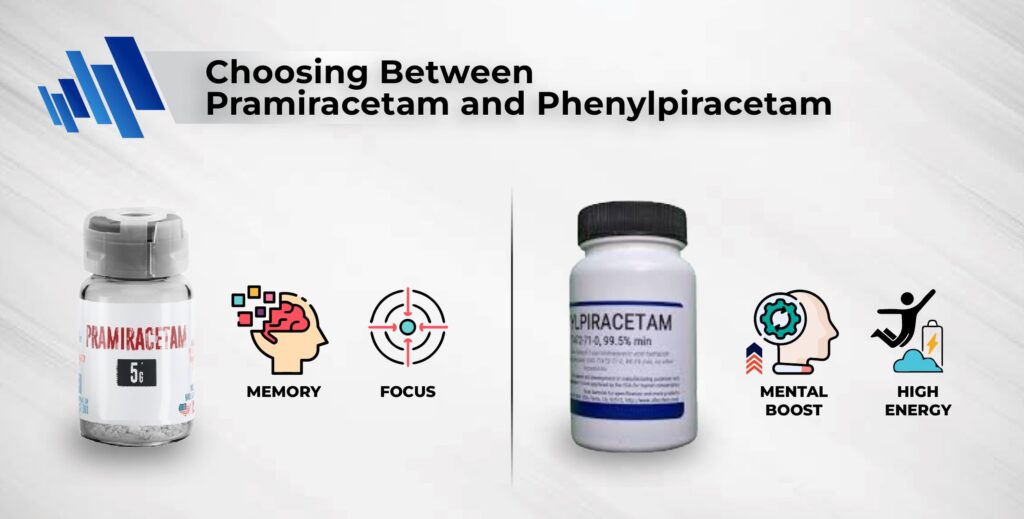
Based on how each one is used and what the evidence shows, this is how they line up:
- Sustained focus, memory and verbal tasks: Pramiracetam
- Occasional alertness and mental energy: Phenylpiracetam
- Use on most days over several weeks: Pramiracetam, because tolerance to phenylpiracetam builds quickly
- Drug-tested athletes: not phenylpiracetam; check pramiracetam with your federation before using any unapproved drug
Some users alternate the two, taking pramiracetam on most days and phenylpiracetam only now and then. There is no research on combining or alternating them, so this approach has not been shown to be safe or more effective. Response also varies a lot from person to person.
Doses Used in Studies and Commonly Reported Doses
Neither compound has an approved dose for healthy people. The figures below are doses used in clinical studies and doses commonly reported by users. They are not recommendations.
Pramiracetam Dosage
Clinical studies generally used about 1,200 mg a day, split into two or three doses. Commonly reported doses in nootropic communities are lower, about 250-600 mg once or twice a day, taken in the morning and early afternoon. Because pramiracetam is fat-soluble, users usually take it with a meal that contains some fat.
Phenylpiracetam Dosage
In Russian clinical use, phenylpiracetam is given at about 100-200 mg a day, in one or two doses, as a course of a few weeks rather than indefinitely. Commonly reported doses are 100-200 mg, taken in the morning and only on some days because of tolerance. Taken late in the day, it often disrupts sleep.
| Compound | Doses used in studies | Commonly reported doses | Timing | Notes |
|---|---|---|---|---|
| Pramiracetam | About 1,200 mg a day, in two or three doses | 250-600 mg, once or twice a day | Morning and early afternoon, with food | Subtle effect; often taken daily for a few weeks |
| Phenylpiracetam | About 100-200 mg a day (Russian clinical use) | 100-200 mg per dose, on some days only | Morning only | Tolerance builds within days of daily use |
Stacking
Both are often taken with a choline source such as alpha-GPC or citicoline, on the theory that racetams increase the brain’s demand for acetylcholine. Users report fewer headaches with a choline source, but this hasn’t been tested in trials.
Some users also combine them with other racetams such as aniracetam. There is no research on these combinations, and more compounds mean more chances of side effects. For other combinations and how the racetams differ, see our guide to the best racetam nootropics and stacks.
Where to Buy Pramiracetam and Phenylpiracetam
Outside the countries where they are prescribed, both are sold as research chemicals, so quality varies between sellers. If you buy, choose a vendor that publishes independent lab tests (certificates of analysis) for each batch, and keep in mind that a certificate shows what is in the product, not that it is safe to take.
SwissChems, one of Muscle & Brawn’s partners, sells racetams and other nootropics as research compounds.

Pros
- Exceptional purity & testing (≥98%)
- Pharmaceutical-style packaging for stability
- Broad catalog across peptides & nootropics
- Strong reputation & consistency across years
Cons
- Some items frequently out of stock due to high demand
- Limited long-term data for some compounds
The Bottom Line
Pramiracetam is the calmer, memory-focused racetam and phenylpiracetam the stimulating, occasional-use one, but both rest on thin human evidence.
- Pramiracetam’s best human data are a few small trials on memory after brain injury and drug-induced amnesia; it showed no clear benefit in Alzheimer’s disease.
- Phenylpiracetam is a Russian prescription medicine with a stimulant effect; tolerance builds quickly, and WADA bans it in competition.
- Neither is FDA-approved or studied long-term in healthy people, and the doses here come from studies and user reports, not medical advice.
Frequently Asked Questions
Disclaimer
Please read carefully
The information on this site is for educational and informational purposes only, and is not medical advice. Always consult a qualified healthcare professional before using any supplement or medication, or making changes to your health, fitness, or nutrition routine.
Not medical advice
Content here is not a substitute for professional medical advice.
Consult your doctor
Talk to your doctor before starting any supplement or new routine.
Use at your own risk
We are not responsible for adverse effects from acting on this.
Do your research
Make informed decisions about your own health.
No guarantees
Individual results vary. No claims about outcomes.
Important — Never disregard professional medical advice or delay seeking it because of something you read here. If you think you may have a medical emergency, call your doctor or your local emergency number right away.