
Contents16 sections
Racetams are a family of synthetic compounds that share the same basic chemical structure as piracetam, the first of them. They are among the best-known nootropics, taken in the hope of better memory, focus, learning and mood.
Each racetam works a little differently, and the evidence behind them varies a lot. Piracetam has decades of research behind it; most of the others rest on animal studies, a handful of small human trials in patients and a great many user reports.
This guide compares the eight racetams most often used as nootropics: what each is used for, commonly reported doses, what the studies actually show, popular stacks, side effects and legal status.
Key Takeaways
- Racetams share a common chemical core with piracetam, but each acts differently; most are thought to work partly through the brain’s acetylcholine and glutamate systems.
- None of the racetams in this guide is approved by the FDA, and the FDA does not accept piracetam as a dietary supplement ingredient. Several are prescription drugs in other countries.
- Piracetam is by far the most studied. For the others, human data come mostly from small, older trials in patients, not in healthy people.
- Phenylpiracetam is the most stimulating racetam and is on the WADA Prohibited List, banned in competition.
- Common doses, choline add-ons and stacks such as the PAO stack come from user experience and have not been tested in trials.
What Is a Racetam?
Racetams are a group of synthetic compounds built around the same chemical core, a pyrrolidone ring. They are best known as nootropics: substances taken in the hope of improving memory, learning, focus or mood.
The first racetam, piracetam, was synthesized in 1964 at the Belgian drug company UCB, in work led by Corneliu Giurgea, who later coined the word “nootropic” to describe it. Many related compounds have been made since.
They all share piracetam’s basic structure, but small changes to the molecule change how strong they are, how long they last and how they feel. Not every racetam is a nootropic: levetiracetam and brivaracetam, for example, are prescription epilepsy drugs.
Which racetam people choose usually depends on the goal. Some, such as piracetam, are mild and are said to build up over one to two weeks. Others, such as phenylpiracetam, have a noticeable stimulant-like effect within an hour. Users often describe this as feeling smoother than caffeine, but that has not been compared in controlled studies.
How Do Racetams Work?
Despite decades of use, how racetams work is still not fully understood, and the mechanisms differ from one compound to the next. Most of what is known comes from animal and cell studies.
The most consistent theme is the cholinergic system, which makes and uses acetylcholine, a chemical messenger that is important for attention, learning and memory. Depending on the compound, racetams have been shown in animals to change how acetylcholine receptors respond or to increase the uptake of choline, the raw material for acetylcholine, into nerve cells.
Other mechanisms reported in research include:
- Glutamate signaling: aniracetam, and more weakly piracetam, make AMPA glutamate receptors more responsive, a process linked to learning and memory formation.
- Cell membranes: piracetam appears to improve the fluidity of nerve cell membranes, an effect seen mainly in aged brain tissue.
- Blood flow: piracetam affects red blood cells and platelets in ways that may improve blood flow through small vessels.
- Calcium channels: in cell studies, nefiracetam boosts certain calcium channels and nicotinic acetylcholine receptors.
Because racetams are thought to lean on acetylcholine, many users add a choline source, on the theory that racetams raise the brain’s demand for choline. The idea is widespread, but it has not been tested in controlled studies (see the stacks section below).
Are Racetams Safe?
In short-term studies, racetams have generally been well tolerated, and they have low toxicity in animals. The human safety data, though, are uneven. Piracetam has been prescribed in Europe for decades and has a known side-effect profile. The newer racetams have far less human data, and there are almost no long-term studies of any racetam in healthy people.
Reported side effects usually ease with a lower dose or after stopping. A bigger practical risk is product quality: in the US, racetams are sold online as research chemicals with no regulatory oversight, so the purity and dose in a product may not match its label.
People who should be especially careful with racetams, or avoid them, include:
- Anyone who is pregnant or breastfeeding
- People with kidney disease, as piracetam is cleared by the kidneys
- People with bleeding disorders or who take blood thinners, as piracetam affects platelet function
- People with anxiety, insomnia or heart conditions, in the case of the stimulating racetams (phenylpiracetam, pramiracetam and oxiracetam)
- Anyone taking prescription drugs that act on the brain, including dementia drugs that raise acetylcholine, as interactions have not been studied
- Competitive athletes, in the case of phenylpiracetam
Are Racetams Legal?
None of the racetams in this guide is approved by the FDA for any use. They are not controlled substances under US federal law, but they are not legal dietary supplements either: the FDA has sent warning letters to companies selling piracetam as a supplement, stating that it is not a lawful dietary ingredient. That is why racetams are mostly sold as “research chemicals” in the US.
Outside the US, rules vary. Piracetam is a prescription medicine in many European countries, and phenylpiracetam is a prescription drug in Russia, sold as Phenotropil. Check the law where you live before buying or traveling with any racetam.
For athletes, the key point is that phenylpiracetam is on the World Anti-Doping Agency (WADA) Prohibited List as a stimulant, banned in competition. It appears on the list as 4-phenylpiracetam (carphedon). The other racetams in this guide are not named on the list.
Because racetams are sold as research chemicals, no regulator checks what is in them, and testing of cognitive-enhancement supplements has found unlisted and wrongly dosed racetams. Outside the US, Noopept (covered below) is registered as a medicine in Russia.
The 8 Best-Known Racetam Nootropics
Below are the eight racetams most often used as nootropics, in alphabetical order. The doses are those used in studies, where they exist, or doses commonly reported by users. They are not recommendations: none of these compounds has an approved dose for cognitive enhancement in healthy people.
1. Aniracetam
Aniracetam was developed by Hoffmann-La Roche in the 1970s. It is fat-soluble and short-acting, and it is often described as stronger than piracetam per milligram, although no good human studies have compared the two directly. It also has very low oral bioavailability: most of a dose is broken down in the liver, and some of its effects may come from its breakdown products.
Users take it mainly for mood, anxiety and focus, and describe a calm, sociable kind of focus rather than stimulation. That is why it is popular with students (see our guide to the best nootropics for focus).
Evidence: In mice, aniracetam reduced anxiety-like behavior in three different anxiety models. Human trials have mostly been small and in older adults with cognitive decline. A study in healthy adult mice found no effect on learning or behavior, a reminder that benefits in an impaired brain may not carry over to a healthy one.
Commonly reported dose: 750-1,500 mg/day, split into two or three doses; some users report up to 3,000 mg/day. Trials in older adults mostly used 1,500 mg/day.
2. Coluracetam
Coluracetam (MKC-231) was developed in Japan. In rats with damaged acetylcholine-producing nerves, it increased the uptake of choline into nerve cells and improved learning. It was later tested in people as a possible treatment for major depression with anxiety, but it has not been approved for any condition.
Users take it mainly for mood and memory. Claims that it sharpens vision or color perception come from user reports, not from studies.
Evidence: Mostly animal data. The human data are limited to small early-stage trials.
Commonly reported dose: 3-35 mg/day, split into up to three doses. This is a very small amount, which is hard to measure accurately from powder.
3. Fasoracetam
Fasoracetam (NS-105) was first developed in Japan as a possible treatment for vascular dementia, but development for that use was stopped. In animal studies, it acts on metabotropic glutamate receptors and increases GABA-B receptors, which may explain why users describe it as calming rather than stimulating, with better concentration and easier learning of new material.
Evidence: Its best-known human study was a small open-label trial in teenagers with ADHD who carried variants in glutamate receptor genes. Symptoms improved, but there was no placebo group. It has not been studied for cognitive enhancement in healthy people.
Commonly reported dose: 20-100 mg/day, split into two doses.
Doses Used in Studies
The only modern human dosing data come from the ADHD trial above, in adolescents under medical supervision. The doses commonly reported online are far lower, typically 10 to 30 mg a day, and are not based on any study.
4. Nefiracetam
Nefiracetam (DM-9384) is one of the less common racetams. It was developed in Japan and studied in people with depression or apathy after a stroke. In cell studies, it boosts certain calcium channels and nicotinic acetylcholine receptors.
Users take it mainly for mood, motivation and memory, and some who have tried both prefer it to aniracetam for mood. Users also report that it takes about a week of daily use before the effects are noticeable.
Evidence: Trials in post-stroke depression and apathy gave mixed results, and it was never approved. Claims about its effects on mood in healthy people come from user reports.
Commonly reported dose: 100-900 mg/day, split into two doses. The post-stroke trials used doses at the upper end of that range.
5. Oxiracetam
Oxiracetam is piracetam with an added hydroxyl group. It is water-soluble and users describe it as mildly stimulating, with effects on focus, mental energy and logical thinking. Many users take it about an hour before they need to focus, for example before an exam.
Evidence: In rat brain tissue, oxiracetam enhanced long-term potentiation, a process involved in forming memories. Clinical trials, mostly in older adults with dementia, gave mixed results, and there is little data in healthy people.
Commonly reported dose: 800-1,400 mg/day, split into two or three doses. Users usually avoid taking it within about six hours of bedtime, as it can disrupt sleep.
Doses Used in Studies
Commonly reported doses are 1,200 to 2,400 mg a day, split between morning and early afternoon. The dementia trials used doses in a similar range in older patients; there is no studied dose for healthy adults.
6. Phenylpiracetam
Phenylpiracetam is piracetam with an added phenyl group. It was developed in the Soviet Union in the 1980s and is prescribed in Russia as Phenotropil. It is the most stimulating of the common racetams: users report that it acts within an hour, lasts longer than most other racetams and lifts both mental and physical energy.
That stimulant effect makes it popular with students and athletes, and it is the reason WADA bans it in competition. Users also report less anxiety, better mood and better short-term memory, but these claims rest mainly on Russian clinical studies, which are small and mostly not available in English, and on user reports.
Some users find the effects too strong, and tolerance builds quickly with daily use, so many take it only occasionally.
Commonly reported dose: 100-200 mg/day, often starting at 100 mg; reported doses rarely go above 600 mg/day.
7. Piracetam
Piracetam is the original racetam and by far the most studied. It is mild per milligram, which is why its doses are much higher than those of the other racetams. That is not an absorption problem, as is sometimes claimed: piracetam is water-soluble and almost fully absorbed when taken by mouth.
It is inexpensive and is often the first racetam people try. Users take it for memory and longer focus, and report that effects build over one to two weeks rather than being felt right away. In Europe it is prescribed for certain conditions, such as a movement disorder called cortical myoclonus.
Evidence: A Cochrane review of trials in people with dementia or cognitive impairment concluded that the evidence does not support its use for those conditions. An older, small study in healthy students reported better verbal learning after two weeks of use, but good modern trials in healthy people are lacking.
Commonly reported dose: 1,600-4,800 mg/day, split into three doses.
Doses Used in Studies
Trials in cognitive impairment typically used 2.4 to 4.8 g a day, split into two or three doses. The European label for cortical myoclonus allows up to 24 g a day under medical supervision. Commonly reported doses among nootropic users fall in a similar range, about 1.6 to 4.8 g a day.
In trials it was generally well tolerated; reported side effects include nervousness, agitation, weight gain and drowsiness. It is cleared by the kidneys and affects platelet function, so its European label warns about kidney disease and bleeding risk. Many users add a choline source to avoid headaches; that practice comes from user reports, not from trials.
8. Pramiracetam
Pramiracetam is a fat-soluble racetam developed in the late 1970s. Users describe it as one of the strongest racetams for focus and memory, with a driven, productive feeling. In rats, it increases the uptake of choline in the hippocampus, a brain area central to memory.
Users report that the effects last many hours, so it is usually taken early in the day to avoid sleep problems.
Evidence: In a small placebo-controlled study of young men with memory problems after a head injury, pramiracetam improved memory. In healthy volunteers, it partly reduced the memory loss caused by scopolamine, a drug that blocks acetylcholine. A small trial in Alzheimer’s disease found no benefit.
Commonly reported dose: 600-1,200 mg/day, split into two doses taken early in the day.
Doses Used in Studies
There is no well-established human dose. Commonly reported doses are 400 to 1,200 mg a day, split into two doses and usually taken with a meal. The small clinical trials do not establish a dose or long-term safety for healthy adults.
Beyond Racetams: Noopept, NSI-189, 9-Me-BC and Dihexa
These four compounds are often sold and discussed alongside racetams, but none of them is a racetam in the strict sense. Their human evidence is thinner still, and for two of them it does not exist.
Noopept (Omberacetam): Not Technically a Racetam
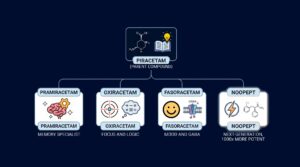
Noopept is grouped with racetams because its uses overlap, but chemically it is a synthetic dipeptide: it lacks the pyrrolidone ring that defines the racetam class. It was developed in Russia in the 1990s and is registered there as a medicine for cognitive disorders. It is dosed in milligrams rather than grams; the popular claim that it is “1,000 times more potent than piracetam” comes from animal comparisons of effective doses, not from human trials.
How It Works
After it is absorbed, Noopept is broken down into cycloprolylglycine, a peptide the brain makes naturally, which has shown anti-anxiety and protective effects in animal studies. In rats, Noopept increased the expression of BDNF and NGF in the hippocampus. These two growth factors support the survival and plasticity of neurons. They are animal findings; they have not been measured in people.
What People Use It For
Users who want racetam-like effects on memory and focus at a milligram dose, and people who have tried piracetam and want something with a different mechanism.
Doses Used in Studies
Russian clinical studies in patients with mild cognitive problems after vascular disease or brain injury used 20 mg a day, taken as 10 mg twice daily, which is also the usual dose on the Russian label. Those studies were small, and there are no large placebo-controlled trials. Commonly reported doses among users are 10 to 30 mg a day; the cycling schedules seen online come from user practice, not research.
NSI-189: Studied for Depression, Not Neurogenesis in People
NSI-189 is not a racetam. Neuralstem developed it as a treatment for major depression after screening compounds for their ability to stimulate new neurons in lab-grown human hippocampal stem cells. In mice it increased hippocampal neurogenesis and hippocampal volume. That is where the “neurogenesis compound” label comes from, and it is lab and animal data only.
The human trials tell a more modest story:
- Phase 1b (Fava et al., Molecular Psychiatry, 2016): 24 patients with major depression, not healthy volunteers, took 40 mg once, twice or three times a day, or placebo, for 28 days. It was a small safety study. The treated groups improved on some depression and cognitive scales, but the trial was too small to show efficacy, and no neurogenesis was measured.
- Phase 2 (Papakostas et al., Molecular Psychiatry, 2020): about 220 outpatients with major depression took 40 mg or 80 mg a day, or placebo, for 12 weeks. It missed its primary endpoint, the clinician-rated depression score. Some secondary measures, including some cognitive tests, favoured the 40 mg dose, but secondary results from a trial that missed its main goal are exploratory.
So NSI-189 has been tested in people with depression at 40 to 120 mg a day. It has not been shown to grow new brain tissue in humans, and it has not been tested as a cognitive enhancer in healthy people.
How It Works
In lab and mouse studies, NSI-189 stimulated the growth of neural stem cells in the hippocampus, the brain region most involved in memory and spatial navigation and one that tends to shrink in chronic depression. The exact mechanism has not been worked out. Whatever it does, it produces no acute effect: the trials measured change over four to twelve weeks.
Doses Used in Studies
40, 80 and 120 mg a day for 28 days in the Phase 1b trial, and 40 or 80 mg a day for 12 weeks in Phase 2, all in people with depression. There is no studied dose for healthy users, and safety data beyond twelve weeks are lacking. Depression and the cognitive problems that come with it are best treated with a doctor, using approved options.
9-Me-BC: The Dopaminergic One (Animal Data Only)
9-Methyl-beta-carboline (9-Me-BC) works on the dopamine system rather than the glutamate and acetylcholine systems targeted by racetams. That is why it is discussed for motivation and drive rather than memory. There are no human studies of it at all.
How It Works
In cell cultures, 9-Me-BC increased the number and branching of dopamine-producing neurons and the expression of tyrosine hydroxylase, the enzyme that limits how much dopamine is made (Hamann et al., Neurochemistry International, 2008). It also inhibits MAO-A and MAO-B, the enzymes that break dopamine down, and raised the production of nerve growth factors in lab studies.
In rats, it improved spatial learning and raised dopamine levels in the hippocampus (Gruss et al., Journal of Neurochemistry, 2012), and in rat models of Parkinson’s disease it had restorative effects on damaged dopamine neurons. User reports describe a gradual return of motivation rather than an acute lift, but there is no human trial to check that against.
Doses and Safety
No human data. There is no studied human dose, and the doses circulating online are anecdotal. Its MAO-inhibiting activity is the main known concern: combining MAO inhibitors with serotonergic drugs and supplements such as SSRIs, SNRIs, tryptophan or 5-HTP can cause serotonin syndrome, and that risk should be assumed here. Some users also report sensitivity to sunlight, which has not been studied. Long-term safety is unknown.
Dihexa: The Most Potent in the Lab, With No Human Trials
Dihexa (PNB-0408) was developed from angiotensin IV by Joseph Harding and colleagues at Washington State University. In a 2013 paper (McCoy et al., Journal of Pharmacology and Experimental Therapeutics), it was about seven orders of magnitude, roughly 10 million times, more potent than BDNF at promoting new connections between neurons in a cell-culture assay. That figure comes from a dish, and potency in a dish does not translate into effects in a living brain.
In rats, Dihexa reversed memory deficits caused by the drug scopolamine and improved spatial learning in aged animals, and it is orally active and reaches the brain. There are no human trials of any phase.
How It Works
A follow-up study from the same group (Benoist et al., Journal of Pharmacology and Experimental Therapeutics, 2014) found that Dihexa binds hepatocyte growth factor (HGF) and boosts signalling through its receptor, c-Met, which helps form and maintain synapses.
HGF/c-Met is also a well-known cancer pathway: overactive c-Met signalling drives the growth and spread of many types of tumour. No study has shown that Dihexa causes cancer, but none has tested its long-term safety either, and this is the main theoretical concern.
Doses
No human data. There is no studied human dose, oral or topical, and the doses posted online are not based on human studies. Nothing about Dihexa’s effects or safety in people is known from trials.
Racetams Compared
There is no single best racetam: each one is used for a different goal, and the evidence behind them varies. This table summarizes the eight.
| Racetam | Most often used for | Commonly reported dose | Human evidence |
|---|---|---|---|
| Piracetam | Memory, longer focus | 1,600-4,800 mg/day | Most studied; no clear benefit in dementia |
| Aniracetam | Mood, anxiety, focus | 750-1,500 mg/day | Small trials in older adults; anxiety data in mice |
| Oxiracetam | Focus, logical thinking | 800-1,400 mg/day | Mixed results in dementia trials |
| Pramiracetam | Memory, focus | 600-1,200 mg/day | Small head-injury trial; no benefit in Alzheimer’s |
| Phenylpiracetam | Energy, motivation | 100-200 mg/day | Russian clinical use; little data in English |
| Nefiracetam | Mood, motivation | 100-900 mg/day | Mixed results after stroke |
| Coluracetam | Mood, memory | 3-35 mg/day | Mostly animal data |
| Fasoracetam | Calm focus | 20-100 mg/day | One small open-label ADHD study |
Best Racetam by Goal
Based on user reports and the limited research, these are the racetams most often chosen for four common goals.
Best Racetam for Motivation: Phenylpiracetam
Phenylpiracetam is the racetam most often chosen for motivation and energy. Users report more drive, focus and physical energy, without the jittery feeling they associate with strong coffee. Its stimulant effect is documented in animal studies and in Russian clinical use, but there are no good English-language trials of motivation or performance in healthy people.
Tolerance builds quickly, and it is banned in competitive sport, which rules it out for tested athletes.
Best Racetam for Mood: Nefiracetam
Nefiracetam is the racetam users most often name for mood, describing calmer focus, fewer mood swings and a clearer head. Aniracetam is the other common choice. The human evidence for mood is limited to trials in people with depression or apathy after a stroke, and those results were mixed.
Best Racetam for Anxiety: Aniracetam
Aniracetam is the racetam most often used for anxiety, from social anxiety to stress around work or exams. In a mouse study, it reduced anxiety-like behavior in three different anxiety models, and the effect was linked to the acetylcholine, dopamine and serotonin systems.
That is animal data. There are no good trials of aniracetam for anxiety in people, and it is not a substitute for treatment of an anxiety disorder.
Best Racetam for Memory: Pramiracetam
Pramiracetam is the racetam users most often choose for memory and for focus on demanding material. Among the newer racetams, it has some of the more convincing human data, from the small head-injury study described above, but that study was in people with memory problems, not in healthy people.
Piracetam has far more research overall, but most of it is in older adults or people with brain conditions, and the results are mixed. For a closer look at the two strongest options, see pramiracetam vs phenylpiracetam.
Best Starting Point: Piracetam
Piracetam is the best-documented starting point: the longest safety record, the most human data and the most predictable profile. Any effect takes weeks rather than days, and expect subtle effects at best, since trials in healthy adults have not shown reliable benefits.
A Note on 9-Me-BC, NSI-189 and Dihexa
9-Me-BC is discussed for this, but it has no human data and real interaction risks from MAO inhibition. Low motivation that lasts for weeks can be a symptom of depression, which has effective, approved treatments.
NSI-189 has been studied only in depression, and its main trial missed its primary endpoint. Dihexa has no human data. Neither has any evidence as a cognitive enhancer in healthy people.
Racetam Side Effects
Racetams are reported to be well tolerated at common doses, but side effects do occur. The most commonly reported are:
- Headaches
- Nausea or an upset stomach
- Dizziness
- Insomnia, particularly with phenylpiracetam, pramiracetam and oxiracetam taken later in the day
- Nervousness, irritability or anxiety, mainly with the stimulating racetams
- Drowsiness or tiredness in some users
Piracetam’s prescribing information, based on clinical use, lists nervousness, overactivity, weight gain and drowsiness among its side effects.
Many users believe racetam headaches come from low choline, and report that adding a choline source helps. The idea fits with how racetams are thought to work, but it has not been tested in studies. Headaches that persist, or come with other symptoms, are a reason to stop.
Best Racetam Stacks
Choline and Racetam Stack
The most common addition to any racetam is a choline source. The three most popular, chosen because they reach the brain well and have effects of their own, are:
- Alpha-GPC: 150-300 mg, twice a day
- Citicoline (CDP-choline): 250-500 mg, twice a day
- Centrophenoxine: 150-500 mg, twice a day (a compound made from DMAE, rather than a direct choline source)
These are commonly reported doses. Users combine them with any racetam in the hope of extra benefit and fewer headaches, but the combination has not been studied.
PAO Stack
Some users combine several racetams. The best-known combination is the PAO stack: piracetam, aniracetam and oxiracetam. The idea is to pair the memory effects users report from piracetam with aniracetam’s reported effects on mood and anxiety and oxiracetam’s effects on focus and logical thinking.
A commonly reported version is:
- 1,600 mg piracetam
- 400 mg aniracetam
- 400 mg oxiracetam
- 500 mg Alpha-GPC
No study has tested racetams in combination, so any “synergy” is based on user experience. Combining compounds also makes it harder to tell which one is causing an effect or a side effect, which is why experienced users usually try each one on its own first.

Pros
- Exceptional purity & testing (≥98%)
- Pharmaceutical-style packaging for stability
- Broad catalog across peptides & nootropics
- Strong reputation & consistency across years
Cons
- Some items frequently out of stock due to high demand
- Limited long-term data for some compounds
Which Racetam Is Best?
It depends on what “best” means. If it means the strongest effect people feel, users most often name phenylpiracetam. Unlike piracetam, which is said to take a week or two, its effects are felt within an hour.
That strength comes with trade-offs. Users report that tolerance builds within days of daily use, so many take it only one or two days a week, when they want extra energy and focus. Some find it lets them cut back on caffeine on those days, but it is stimulating and can disrupt sleep.
If “best” means best studied, the answer is piracetam, although even its evidence in healthy people is thin. For most people, the more useful question is which racetam fits their goal, and which unknowns they are willing to accept.
Sourcing: What to Ask For
If you research these compounds, the biggest practical unknown is what is actually in the container. Ask the seller for a certificate of analysis for the specific lot you would receive, check that it comes from an independent lab and that the lot number and test date match, and remember that a certificate does not show that a compound is safe or effective.
SwissChems, a Muscle & Brawn partner, sells nootropics alongside its peptides and SARMs. It publishes a purity specification on its listings and states that batches are third-party tested, but lot-matched certificates are supplied on request rather than published for every product, so ask for the certificate for your lot before you order. Our SwissChems review covers its testing, pricing and the FDA warning letter it received in December 2024. The current partner code and discount are on our SwissChems brand page.
The Bottom Line
Racetams are a family of related compounds with different effects, but none is FDA-approved and the evidence that they enhance cognition in healthy people is thin.
- Piracetam is the most studied racetam; the others rely mostly on small or older trials in patients, animal studies and user reports.
- The doses and stacks in this guide are commonly reported or study doses, not advice, and racetam combinations have never been tested.
- In the US, racetams are unapproved and sold as research chemicals without quality control, and phenylpiracetam is banned in competition by WADA.
Frequently Asked Questions
Disclaimer
Please read carefully
The information on this site is for educational and informational purposes only, and is not medical advice. Always consult a qualified healthcare professional before using any supplement or medication, or making changes to your health, fitness, or nutrition routine.
Not medical advice
Content here is not a substitute for professional medical advice.
Consult your doctor
Talk to your doctor before starting any supplement or new routine.
Use at your own risk
We are not responsible for adverse effects from acting on this.
Do your research
Make informed decisions about your own health.
No guarantees
Individual results vary. No claims about outcomes.
Important — Never disregard professional medical advice or delay seeking it because of something you read here. If you think you may have a medical emergency, call your doctor or your local emergency number right away.