Contents12 sections
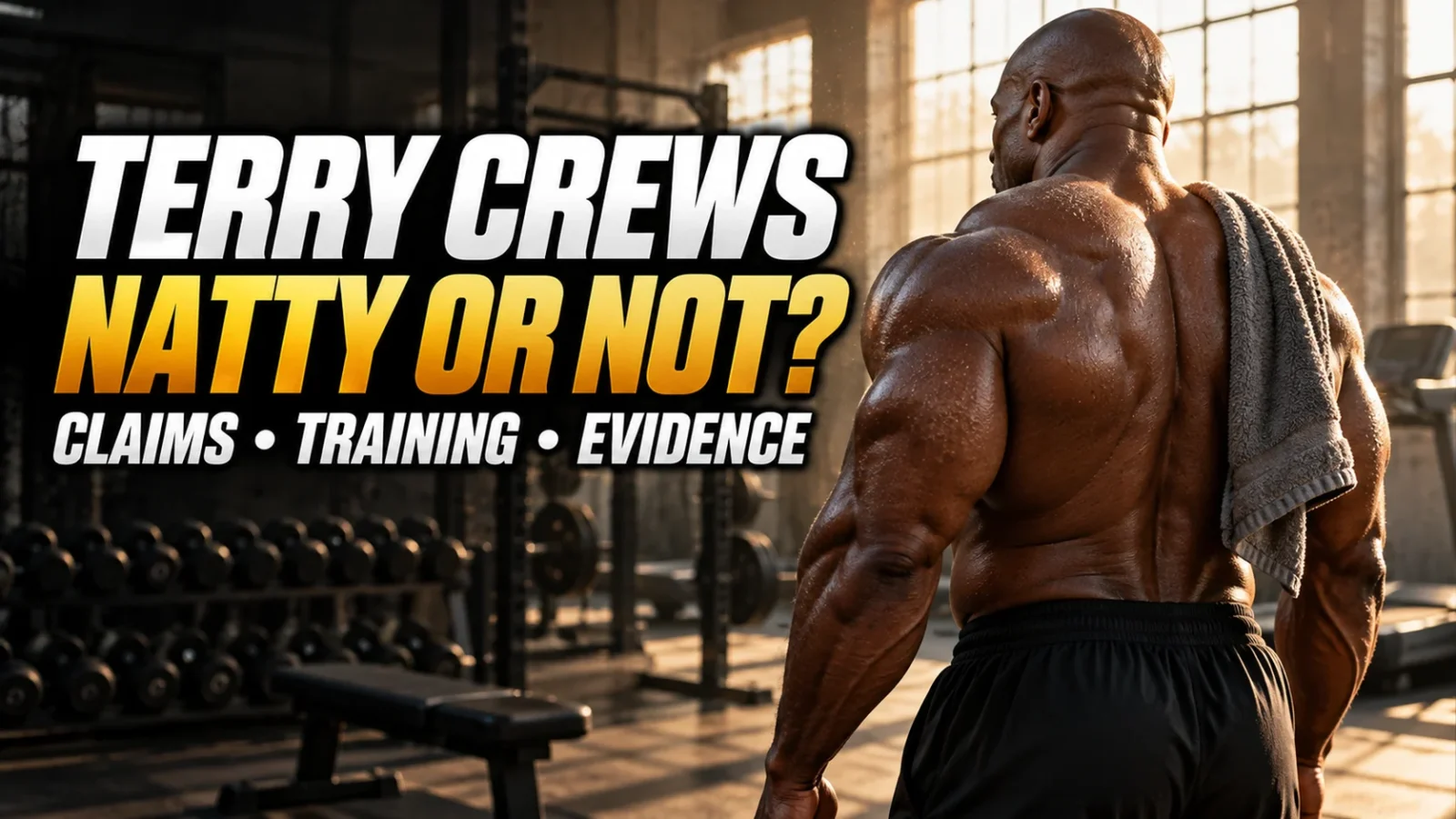
Terry Crews has said publicly that he is natural, most notably in a 2011 Facebook post, and there is no failed drug test, admission or credible report of steroid use on public record. His physique is exceptional, especially for a man in his late fifties, but most of what we can see fits elite genetics, a professional football background and decades of consistent training. Appearance alone cannot settle the question either way.
Crews was born in Flint, Michigan, on July 30, 1968. He played college football at Western Michigan University, was drafted by the Los Angeles Rams in 1991 and spent the rest of the decade in professional football before retiring in 1997. He then built a second career as an actor in films such as White Chicks, The Longest Yard, Idiocracy and The Expendables, and in the TV series Everybody Hates Chris and Brooklyn Nine-Nine. In 2019 he became the host of America’s Got Talent.
Because his muscles are part of his on-screen persona, from the bouncing pecs to the Old Spice commercials, the “is Terry Crews on steroids?” question has followed him for years. Here is what he has said, how he trains and eats, and how the public evidence actually stacks up.
Key Takeaways
- Terry Crews said publicly in a 2011 Facebook post that he is natural. There is no failed test, admission or credible report of steroid use on public record.
- He played professional football from 1991 to 1997, when the NFL already tested for anabolic steroids. No positive test of his has ever been reported, although testing in that era was limited.
- His estimated FFMI lands roughly between 24 and 27 depending on his true weight and body fat, around the commonly cited natural ceiling of 25. That raises fair questions but proves nothing.
- His habits (lots of cardio, an eight-hour eating window, moderate body fat) and a broadly stable size across two decades fit a lifelong natural athlete better than a typical enhanced look.
- The fair verdict: plausibly natural, with elite genetics and an athlete’s history. Photos and FFMI estimates cannot confirm it; only testing can.
Terry Crews Stats and Career Overview
| Detail | Information |
|---|---|
| Full Name | Terry Alan Crews |
| Date of Birth | July 30, 1968 |
| Age | 58 |
| Hometown | Flint, Michigan |
| Height | Commonly listed at 6’2″ (188 cm) |
| Weight | Not officially confirmed; reports vary, most often around 230-245 lbs (104-111 kg) |
| College | Western Michigan University (football) |
| NFL | Drafted by the Los Angeles Rams in 1991; teams included the Rams, San Diego Chargers, Washington and Philadelphia Eagles; retired in 1997 |
| Position | Linebacker / defensive end |
| Known For | White Chicks, Everybody Hates Chris, The Expendables, Brooklyn Nine-Nine, Old Spice commercials, America’s Got Talent host |
| Natural Claim | Public Facebook post, 2011 |
| Failed Drug Tests | None publicly reported |
What Terry Crews Has Said About Steroids
The clearest statement on record is a 2011 post on his Facebook page in which Crews said he was natural. It was not an answer to an interviewer’s question. He raised the subject himself.
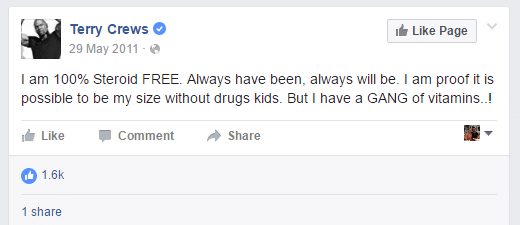
That carries some weight, for two reasons:
- His income doesn’t depend on a natural label. Crews is paid as an actor, comedian and TV host. A fitness influencer whose whole brand is “drug-free” has a strong financial reason to deny use; Crews has much less of one.
- A false public claim would be a risk. Volunteering a natural claim that later turned out to be untrue would cost a mainstream star far more than staying silent would.
Still, a denial is not proof. Plenty of athletes and actors have denied steroid use and later admitted it or been caught. The 2011 post is one data point in his favour, not a verdict. It is also more than a decade old, and as far as we know he has not publicly discussed testosterone replacement therapy (TRT) either way.
The Athlete Behind the Actor
The most important context in the Terry Crews steroids debate is that he was a professional football player long before he was an actor. That changes what counts as “too big to be natural”.
NFL Background
Crews played college football at Western Michigan and was drafted by the Rams in 1991. Even a late-round pick is, by definition, among a tiny fraction of the strongest, fastest and most muscular young men in the country. The NFL selects for exactly the traits that make someone gain muscle easily: a big frame, a high proportion of fast-twitch fibre and a strong response to heavy training.
It also means he has been training hard since his high school and college football years, so roughly four decades. Natural lifters keep making small gains for many years, and muscle built in your twenties is easier to hold on to than to build from scratch. Animal studies suggest muscle fibres keep the extra nuclei they gain during growth even after a long break from training, which may help explain “muscle memory”; how strongly this applies in humans is still debated.
Drug Testing in His Playing Days
The NFL had been testing players for anabolic steroids since the late 1980s, so Crews played his whole career under a testing programme. No positive test of his has ever been reported. That said, testing in the 1990s was far less sophisticated than it is today, and the league did not test for growth hormone until the 2010s. Passing 1990s testing supports his claim; it doesn’t prove it.
Genetics Vary by Individual
How much muscle a person can build differs enormously from one individual to the next. In one of the largest training studies on this, 585 untrained men and women followed the same 12-week arm-training programme, and the change in biceps size ranged from slightly negative to nearly 60%.
Someone who made it to the NFL is very likely at the high end of that range. That is not a claim about any group of people; it is about one man who was selected, over and over, for his physical gifts.
How Terry Crews Trains
Crews has talked openly about his training for years, and the theme is consistent: he trains almost every day and treats cardio as seriously as weights. In an interview with Bodybuilding.com he said he does a lot of cardio to keep his heart healthy, and argued that many lifters who look strong are not as healthy as they appear because they neglect it.
That fits his physique: he usually carries moderate body fat with good muscle shape rather than the extreme, dry conditioning of a stage bodybuilder.
Does All That Cardio Hurt Muscle Growth?
For most lifters, not much. A meta-analysis of concurrent training found that combining cardio with weights can blunt gains, but the effect depends mainly on how much is done and which type: high volumes of running interfered more than cycling. Moderate cardio alongside a solid lifting programme is compatible with building and keeping a lot of muscle, as Crews’ own physique shows.
A Training Template for a Similar Physique
This is not Crews’ exact routine, which he has never published in full. It is a research-backed way to build the same kind of look: a big chest, round shoulders, thick arms and a strong heart.
| Day | Focus | Examples |
|---|---|---|
| Day 1 | Chest and shoulders | Bench press, incline dumbbell press, overhead press, lateral raises |
| Day 2 | Legs | Squats, Romanian deadlifts, leg press, calf raises |
| Day 3 | Cardio | 30-45 minutes of moderate cycling, rowing or incline walking |
| Day 4 | Back and arms | Pull-ups, rows, barbell curls, close-grip bench press |
| Day 5 | Full body plus conditioning | Deadlifts, dips, farmer’s carries, short intervals |
| Days 6-7 | Active recovery | Walking, mobility, light cardio |
A dose-response meta-analysis found that 10 or more hard sets per muscle group per week produced more growth than lower volumes, so aim for that for the chest, shoulders and arms if those are your priorities. Progressive overload matters more than the exact exercise list.
Terry Crews’ Diet: Intermittent Fasting
Crews is one of the best-known celebrity advocates of intermittent fasting. He has described skipping breakfast and eating all of his food within an afternoon-to-evening window of about eight hours, then fasting for the rest of the day.
The research broadly backs that up. In an eight-week study of resistance-trained men, a 16:8 time-restricted eating schedule reduced fat mass while fat-free mass and strength were maintained, compared with a normal eating schedule. Fasting does not build muscle by itself, though. What matters most is total calories and enough protein; a large meta-analysis found that gains in muscle from added protein levelled off at around 1.6 g per kg of body weight per day.
If you want to try his approach, our guide to intermittent fasting for bodybuilding covers eating windows, meal timing around training and how to hit your protein target in fewer meals.
Physique Analysis: What His Body Does and Doesn’t Show
Size and FFMI
The Fat-Free Mass Index (FFMI) compares lean mass to height. A 1995 study of 157 male athletes, both steroid users and non-users, proposed an FFMI of about 25 as the practical upper limit for drug-free men. Crews’ weight and body fat have never been officially confirmed, so the best we can do is a range:
| Assumed weight (6’2″) | At 12% body fat | At 15% body fat |
|---|---|---|
| 220 lbs (100 kg) | 24.4 | 23.5 |
| 235 lbs (107 kg) | 26.1 | 25.1 |
| 250 lbs (113 kg) | 27.7 | 26.8 |
Figures are height-adjusted (normalized) FFMI. At the weights most often reported for him, his estimate sits around or just above 25. That is the strongest physical argument for questioning his natural status, but it is weaker than it looks:
- The inputs are guesses. A 15 lb error in weight or a few points of body fat moves the result by more than one full point.
- The same 1995 paper noted that Mr. America winners from before the steroid era averaged close to 25, so elite natural physiques do reach that range.
- Research on drug-tested American college football players has found a meaningful share above 25, which suggests the cut-off is not a hard ceiling for large, athletic men like Crews.
Vascularity
Crews is not especially veiny for a man of his size, and some fans treat that as proof he is natural. It isn’t. How visible your veins are depends mostly on body fat, genetics, vein size, a recent pump, temperature and hydration. Steroids can make some users more vascular, but plenty of enhanced lifters carrying a bit of body fat show few veins, and some natural lifters are very vascular. His moderate vascularity mainly tells us he doesn’t diet down to extreme leanness. Our guide on how to increase vascularity explains what actually drives it.
Classic Side-Effect Markers
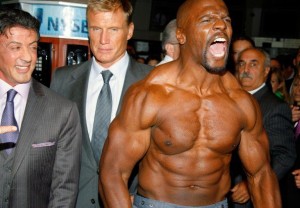
His many shirtless appearances don’t show the markers people usually look for, such as visible breast tissue (gynecomastia), a bloated, distended midsection or sudden swings in size between roles. His waist is broad, but that fits his football frame rather than a drug-related “gut”.
The absence of side effects doesn’t prove natural status, though. Low doses with good medical management can leave few visible signs. The common ways to spot a fake natty are useful red flags, not lab tests.
Consistency Over Two Decades
Crews’ size has looked broadly similar from his mid-2000s film roles through to today. Natural lifters tend to plateau after their first decade of training and then hold a fairly stable look; actors who use drugs for specific roles often show dramatic changes from one film to the next. A stable physique over twenty years is a point in favour of his claim. His famous pec “dance” is a learned muscle-control trick, not a sign of anything chemical.
His Age
The fairest open question is his age. Testosterone falls gradually with age, on average by roughly 1% a year from middle age, and holding this much muscle near 60 is uncommon. Many men his age who look like this are on TRT, which is legal with a prescription for diagnosed low testosterone. Crews has not said whether he has ever been treated, so this is an unknown, not evidence. Lifelong training, a high natural baseline and a lean lifestyle can also keep a man unusually muscular into his late fifties. You can see how levels typically change in our guide to average testosterone levels by age.
The Evidence at a Glance
| Point | What it suggests | How much it tells us |
|---|---|---|
| 2011 public statement that he is natural | Natural | Moderate: unprompted, but a denial is not proof |
| No failed test or admission on record | Natural | Moderate: 1990s NFL testing was limited |
| NFL athlete with about 40 years of training | High natural potential | Strong context for above-average muscle |
| Estimated FFMI around 25 | Borderline | Weak: weight and body fat are unconfirmed |
| Broadly stable size over two decades | Natural | Moderate |
| Moderate vascularity and conditioning | Neutral | Weak: mostly reflects body fat |
| No visible classic side effects | Natural or well managed | Weak |
| Exceptional muscle near age 60 | Open question | Weak: fits genetics and training, or TRT |
Verdict: Is Terry Crews Natural?
On the public evidence, Terry Crews is plausibly natural. He has said so himself, nothing on record contradicts him, and his physique is the kind a gifted former NFL player can build and keep over forty years of hard, consistent training. Unlike Dwayne Johnson, who has said he tried steroids as a teenager, Crews has never acknowledged using them at any stage.
His estimated FFMI and his size at his age are reasonable grounds for questions, but neither is proof. The honest answer is the same as for anyone else: physique analysis can weigh the evidence, and only testing can confirm it.
The Bottom Line
Terry Crews has publicly said he is natural, and the available evidence is broadly consistent with that claim, though only testing could confirm it.
- There is no failed test, admission or credible report of steroid use on record, and he played his NFL career under a steroid testing programme.
- His size fits elite genetics, a pro football background and four decades of training; his estimated FFMI sits near the natural ceiling but rests on unconfirmed numbers.
- His cardio-heavy training and eight-hour eating window are evidence-based habits anyone can copy, but expect your results to depend on your own genetics.
Frequently Asked Questions
Disclaimer
Please read carefully
The information on this site is for educational and informational purposes only, and is not medical advice. Always consult a qualified healthcare professional before using any supplement or medication, or making changes to your health, fitness, or nutrition routine.
Not medical advice
Content here is not a substitute for professional medical advice.
Consult your doctor
Talk to your doctor before starting any supplement or new routine.
Use at your own risk
We are not responsible for adverse effects from acting on this.
Do your research
Make informed decisions about your own health.
No guarantees
Individual results vary. No claims about outcomes.
Important — Never disregard professional medical advice or delay seeking it because of something you read here. If you think you may have a medical emergency, call your doctor or your local emergency number right away.