Contents11 sections
Bulking means eating more calories than you burn so your body has the raw material to build muscle. For many lifters the hard part isn’t the training. It’s eating enough, day after day, without living on fast food.
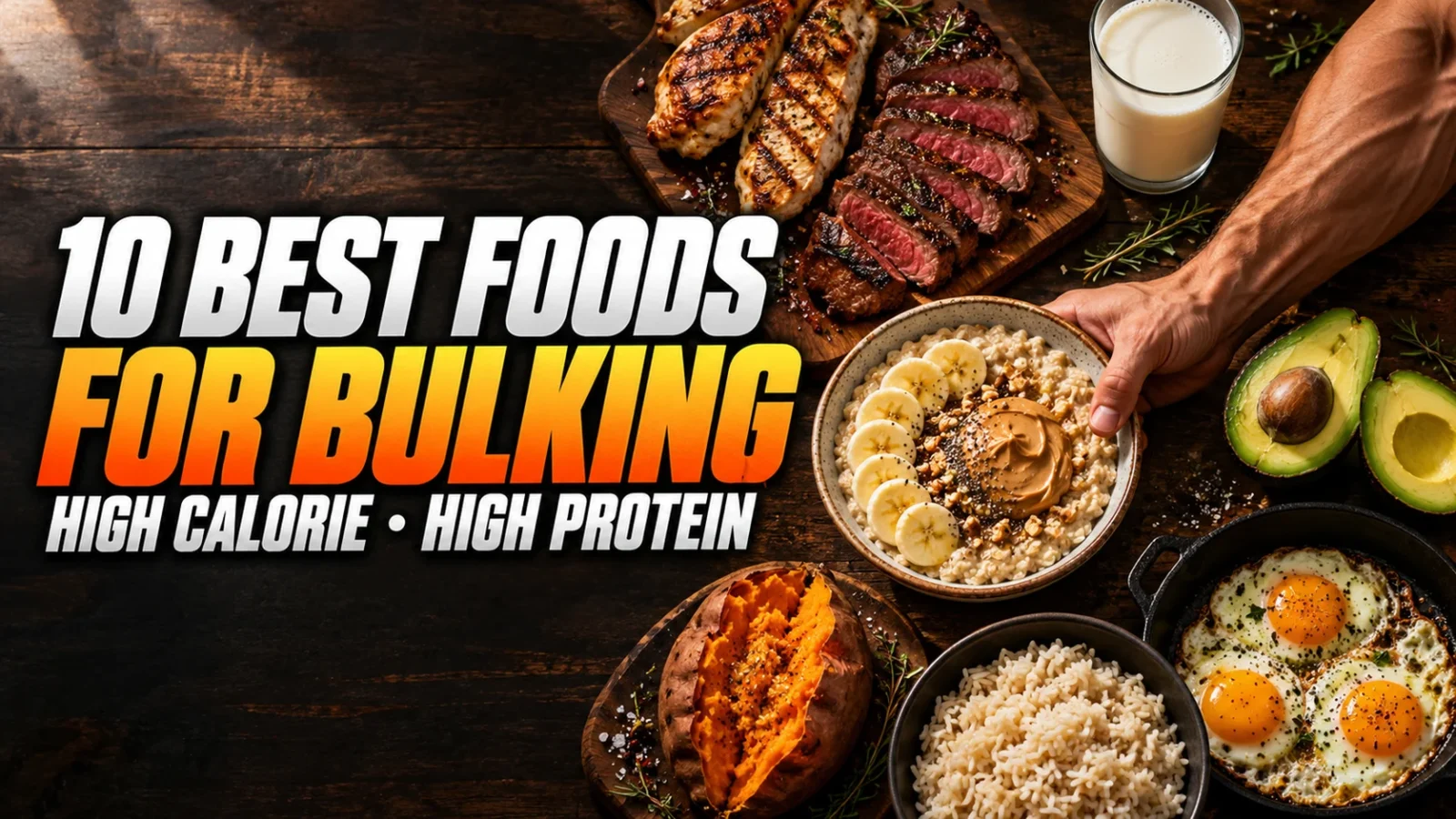
The easiest way to get there is to build meals around foods that pack a lot of calories, protein or both into a normal-sized portion. This guide covers the 10 best high calorie foods for bulking, with calories and protein per serving, plus breakfast, lunch, dinner and snack ideas that put them to work.
Expect some fat gain along with the muscle. A modest calorie surplus and good food choices keep it small.
Key Takeaways
- A surplus of roughly 250-500 calories a day above maintenance, with 1.4-2.0 g of protein per kg of body weight, covers the basics of a lean bulk.
- Eggs, nut butters, whole milk, Greek yogurt, avocados, oats, cottage cheese, rice, sweet potatoes, chicken and lean beef are cheap, easy staples for a bulk.
- Monounsaturated and polyunsaturated fats (olive oil, avocados, nuts, oily fish) are heart-friendly; it is a high saturated-fat intake that raises LDL cholesterol.
- Check whether a figure is cooked or dry: 100 g of brown rice is about 112 calories cooked but roughly 340-370 calories dry.
- Shakes, smoothies and calorie-dense add-ons like olive oil and nut butter are the simplest way to eat more without feeling stuffed.
Bulking Basics: Calories, Protein, Carbs and Fat
Bulking is about eating in a controlled calorie surplus and tracking your progress, so the extra energy goes mostly toward muscle rather than fat. Most guidelines suggest about 250-500 calories a day above maintenance. Newer lifters can usually use the top of that range; experienced lifters, who build muscle more slowly, tend to do better near the bottom. For a sense of how quickly muscle actually comes on, see our guide to realistic muscle gain per month.
Protein
Protein supplies the essential amino acids your body uses to repair and build muscle after training. The International Society of Sports Nutrition recommends 1.4-2.0 g of protein per kg of body weight per day for people who train, and a 2018 meta-analysis by Morton and colleagues found that the benefit for lean mass levelled off at around 1.6 g per kg on average.
Meats like chicken, beef and pork, plus eggs and dairy, make that number easy to reach. Spreading protein across three to five meals a day is a simple way to get there.
Fats
Fat has 9 calories per gram, more than twice the 4 calories per gram in protein and carbohydrate, which makes it the most calorie-dense part of any meal. Three tablespoons of olive oil (about 40 g) add roughly 360 calories without adding any real food volume.
The type of fat matters for long-term health. Butter, coconut oil and fatty processed meats are high in saturated fat, and a diet high in saturated fat raises LDL cholesterol. Monounsaturated fats (olive oil, avocados, most nuts) and polyunsaturated fats (oily fish, walnuts, seeds) do not have that effect, and replacing saturated fat with them is linked to lower LDL cholesterol and a lower risk of heart disease.
So there is no need to fear fat on a bulk. Lean on olive oil, avocados, nuts, nut butters, eggs and oily fish, and keep butter and fatty processed meats moderate.
Carbohydrates
Carbohydrates are your main fuel for hard training and refill muscle glycogen afterward. Whole-food carbs like oats, rice, potatoes and sweet potatoes add plenty of calories along with fiber, vitamins and minerals.
The catch is that high-fiber carbs are filling. If you struggle to eat enough, spread them across every meal, swap some brown rice for white rice, or get part of your carbs from milk and shakes. Balancing protein, carbs and fats this way gives you a bulking diet that supports both muscle gain and overall health.
The 10 Best High Calorie Foods for Bulking
These ten foods give you the most calories, protein or both per normal-sized serving, and they are cheap and easy to fit into any meal. The figures are rounded averages from standard food composition data. Brands, cuts and cooking methods vary, so check the label when you can.
| Food | Serving | Calories | Protein |
|---|---|---|---|
| 1. Whole eggs | 1 large (50 g) | ~78 | ~6 g |
| 2. Peanut butter | 1 tbsp (16 g) | ~95 | ~4 g |
| 3. Whole milk | 250 ml | ~150 | ~8 g |
| 3. Full-fat Greek yogurt | 285 g | ~280 | ~25 g |
| 4. Avocado | 1 large (200 g) | ~320 | ~4 g |
| 5. Rolled oats (dry) | 100 g | ~380 | ~13 g |
| 6. Cottage cheese (4% fat) | 1 cup (210 g) | ~205 | ~23 g |
| 7. Brown rice (cooked) | 100 g | ~112 | ~2.5 g |
| 8. Sweet potato (baked) | 1 large (180 g) | ~160 | ~3.6 g |
| 9. Chicken breast (cooked, skinless) | 100 g | ~165 | ~31 g |
| 10. Lean beef (cooked) | 100 g | ~180-250 | ~26-30 g |
1. Whole Eggs
One large boiled egg (about 50 g) has around 78 calories and 6 g of high-quality protein, with most of the fat and many of the vitamins in the yolk. Scramble or fry eggs in olive oil or butter to raise the calories, or add them to burritos, rice bowls and sandwiches.
2. Nut Butters
One tablespoon (16 g) of peanut, almond or cashew butter has around 90-100 calories, mostly from unsaturated fat. Two spoonfuls stirred into oats, spread on toast or blended into a shake add about 200 calories for almost no extra volume. Whole nuts work the same way: a 30 g handful has roughly 170-200 calories.
3. Whole Milk and Full-Fat Greek Yogurt
Full-fat dairy gives you calories, high-quality protein and calcium in a form that is easy to eat or drink. A 250 ml glass of whole milk has around 150 calories and 8 g of protein, and a 285 g serving of whole-milk Greek yogurt has around 280 calories and 25 g of protein.
Milk is one of the simplest calorie boosters there is: a glass with each of three meals adds around 450 calories a day.
4. Avocados
Avocados are rich in monounsaturated fat and fiber. One large avocado (about 200 g) has around 320 calories. Slice half into a rice bowl or onto eggs, or blend it into a smoothie for a creamier texture.
5. Oats
Rolled oats are cheap, quick to prepare and dense in calories before they soak up liquid: 100 g of dry oats has around 380 calories and 13 g of protein, plus soluble fiber. Cooked in whole milk with nut butter and fruit, a bowl of oats easily becomes a 1,000-calorie breakfast (see the recipe below).
6. Cottage Cheese
Cottage cheese is high in protein, most of it slow-digesting casein. A cup (210 g) of full-fat (4%) cottage cheese has about 205 calories, 23 g of protein, around 9 g of fat and 7-8 g of carbs. Eat it with fruit and nuts as a snack, or add it to wraps and sandwiches.
7. Brown Rice
Rice is a bulking staple because it is cheap, easy to digest and simple to eat in large portions. Brown rice keeps the bran, so it has more fiber and minerals such as magnesium than white rice, and that fiber slows how quickly its carbs reach your bloodstream.
Watch which number you are reading. 100 g of cooked brown rice has about 112 calories, 23 g of carbs, 2.5 g of protein and under 1 g of fat. The same 100 g weighed dry is roughly 340-370 calories, because rice about triples in weight as it cooks. If brown rice feels too filling, white rice gives you similar calories with less fiber, so it is easier to eat in bigger portions.
8. Sweet Potatoes
Sweet potatoes are not especially calorie-dense, but they are one of the most nutritious carb sources you can add to a bulk. A large baked sweet potato (about 180 g) has around 160 calories, 37 g of carbs, 3.6 g of protein and almost no fat. They are high in fiber, vitamin A (as beta-carotene) and vitamin C. Roast them in olive oil to add calories, and pair them with beef, chicken or eggs.
9. Chicken Breast
Chicken breast is one of the leanest and cheapest sources of high-quality protein. 100 g of cooked skinless breast has around 165 calories and 31 g of protein, along with B vitamins and phosphorus, a mineral involved in how your body uses and stores energy.
On its own it is fairly low in calories, so pair it with rice, potatoes, avocado or olive oil, or switch to chicken thighs, which carry more fat and calories.
10. Lean Beef
Lean beef is an excellent source of high-quality protein, B vitamins (especially B12), zinc and iron. 100 g of cooked lean beef has roughly 180-250 calories and 26-30 g of protein, depending on the cut and fat content, and roughly 40-50% of the fat in beef is monounsaturated, the same type found in olive oil.
Beef also contains small amounts of natural creatine, though far less than the 3-5 g a day used in supplement studies. If that is what you are after, see our guide to creatine monohydrate powders.
High-Calorie Breakfast Meals for Bulking
Breakfast is an easy place to load up on calories, especially if big meals are hard to finish later in the day. These three use the foods above.
Bananas didn’t make the top 10 because a medium one (about 120 g) has only around 105 calories, but they are cheap, convenient and easy to add to oats and shakes.
1. Breakfast Burrito
A breakfast burrito is easy to scale up. Fill a medium tortilla with 1 large scrambled egg, 50 g cooked rice, 100 g canned black beans, 100 g cooked 80% lean ground beef and a slice of cheese, plus any vegetables you like.
- Calories: about 700 kcal
- Protein: about 48 g
- Carbs: about 55 g
- Fat: about 30 g
2. Protein Oats
Cook 100 g rolled oats in 320 ml whole milk, then stir in 15 g unsweetened cocoa powder, 15 g peanut butter, 1 tablespoon maple syrup or honey and 1 scoop of whey protein. Top with a 120 g banana (or other fruit) and 30 g nuts.
- Calories: about 1,150 kcal
- Protein: about 60 g
- Carbs: about 140 g
- Fat: about 45 g
This bowl combines complex carbs, unsaturated fats and protein in one meal.
3. Smoothies and Protein Shakes
Eating enough every day is the hardest part of a bulk, and liquid calories are one of the simplest fixes, because drinks tend to be less filling than the same calories as solid food. For a chocolate protein shake, blend 1 large banana (140 g), 180 ml whole milk, 3 tbsp (21 g) unsweetened cocoa powder, 170 g full-fat yogurt, 1 tbsp honey, 1 tbsp (16 g) peanut butter and 1 scoop of whey protein.
- Calories: about 650-700 kcal
- Protein: about 45 g
- Carbs: about 80 g
- Fat: about 25 g
Need more? Our 1000-calorie shake guide shows how to scale a shake up further.
Lunch and Dinner Ideas for Bulking
Lunch and dinner are your best chances to fit in a big serving of protein, carbs and fat. After a day of work and training, a nutrient-dense meal supports recovery and keeps your daily calories on target. These three work for either meal.
1. Chicken and Rice Bowl with Avocado
A classic for a reason. Combine 200 g cooked skinless chicken breast with 200 g cooked brown rice, 60 g sliced avocado and a teaspoon of olive oil. Add broccoli or spinach for extra fiber, vitamins and minerals.
- Calories: about 700 kcal
- Protein: about 66 g
- Carbs: about 56 g
- Fat: about 22 g
2. Beef and Sweet Potato Burrito
Wrap 200 g cooked lean beef, 100 g roasted sweet potato, 40 g black beans and 30 g cottage cheese in a large whole-grain tortilla. Add salsa, guacamole or a little olive oil for extra flavor and calories.
- Calories: about 700 kcal
- Protein: about 68 g
- Carbs: about 56 g
- Fat: about 19 g
3. Steak and Cheese Sandwich
Load a whole-grain roll with 300 g thinly sliced cooked steak, 60 g cottage cheese and sautéed onions and peppers. Add a 100 g side of fries for even more calories.
- Calories: about 1,000-1,200 kcal
- Protein: about 100 g
- Carbs: about 90 g
- Fat: about 35-45 g, depending on the cut of steak and how the fries are cooked
These meals are filling, easy to batch-cook and high in protein, which makes a daily surplus much easier to reach.
400-Calorie Snack Ideas for Bulking
Snacks let you add calories between meals without feeling overly stuffed. Each of these comes to roughly 400 calories:
- 2 protein bars (check the label, since calories vary a lot by brand)
- A smoothie with 150 g whole-milk yogurt, a 120 g banana and 1 scoop of whey protein
- 2 slices of cheddar cheese with 50 g whole-grain crackers
- 70 g hummus drizzled with olive oil and 90 g pita bread
- 70 g dates stuffed with 35 g nut butter
- 75 g dark or milk chocolate
Clean Bulk vs Dirty Bulk
A clean bulk builds most meals around nutrient-dense whole foods, such as lean meats, dairy, eggs, whole grains, fruit and vegetables, in a modest surplus. It is slower, but it keeps fat gain in check and makes the cutting phase that follows shorter.
A dirty bulk means eating whatever gets the calories in, often fast food and sugary snacks, in a large surplus. You will still build muscle if you train hard and eat enough protein, but you gain more fat for the same amount of muscle and miss out on fiber and micronutrients.
Most lifters do best somewhere in between: mostly whole foods, with room for the occasional treat when it helps you hit your numbers.
Where Supplements Fit
Food should cover most of your calories and protein. A protein powder is simply a convenient way to top up protein when whole food falls short, and creatine monohydrate is one of the best-studied supplements for strength and muscle gain alongside training. If you are choosing a powder, our guide to the best protein powder for skinny guys compares options for people who struggle to gain weight.
Our partner Enhanced Labs makes training supplements for lifters; our Enhanced Labs review covers its range.

Pros
- Catalog is specifically organized around muscle building, fat loss, testosterone support, and workout performance.
- Range includes creatine, protein, EAAs, beta-alanine, and L-citrulline alongside more specialized formulas.
- Orders of $99+ qualify for free US shipping.
Cons
- Features several strong claims around muscle growth, testosterone, fat loss, and metabolic effects that should be distinguished from independently demonstrated clinical outcomes
- Heavily oriented toward bodybuilding and performance rather than broader nutritional supplementation.
The Bottom Line
The best high calorie foods for bulking are everyday staples (eggs, dairy, nut butters, avocados, oats, rice, sweet potatoes, chicken and beef) eaten consistently in a modest calorie surplus.
- Aim for roughly 250-500 calories above maintenance and 1.4-2.0 g of protein per kg of body weight a day, then adjust based on how your weight and waistline change.
- Use calorie-dense add-ons such as olive oil, nut butter, whole milk and shakes when big portions are hard to finish.
- Favor unsaturated fats over saturated ones, and check whether a calorie figure is for the dry or cooked weight.
Frequently Asked Questions
Disclaimer
Please read carefully
The information on this site is for educational and informational purposes only, and is not medical advice. Always consult a qualified healthcare professional before using any supplement or medication, or making changes to your health, fitness, or nutrition routine.
Not medical advice
Content here is not a substitute for professional medical advice.
Consult your doctor
Talk to your doctor before starting any supplement or new routine.
Use at your own risk
We are not responsible for adverse effects from acting on this.
Do your research
Make informed decisions about your own health.
No guarantees
Individual results vary. No claims about outcomes.
Important — Never disregard professional medical advice or delay seeking it because of something you read here. If you think you may have a medical emergency, call your doctor or your local emergency number right away.