Contents13 sections
Gyno (gynecomastia) is one of the side effects lifters worry about most, because once breast tissue has formed and settled, it rarely goes away without surgery. SARMs are often sold with the promise of “no estrogen, no gyno”: unlike testosterone, they are not converted to estrogen in the body.
That promise is only half true. RAD-140, LGD-4033 and other SARMs do not aromatize, but they do suppress natural testosterone, they are often stacked with compounds that do convert to estrogen, and products sold as SARMs often do not contain what the label says. Users do report sore nipples and gyno on SARM cycles. How often it happens is unknown, because no trial has tested these compounds at bodybuilding doses in healthy men.
This guide explains what gyno is, why SARMs can trigger it, what is known about RAD-140 and LGD-4033, the early warning signs, how the risk is reduced, and what actually treats it.
Key Takeaways
- SARMs such as RAD-140 and LGD-4033 are not converted to estrogen, but that does not make them gyno-proof.
- Gyno comes from the balance between estrogen and androgens in breast tissue. SARMs suppress natural testosterone, which can tip that balance during or after a cycle.
- Stacks with testosterone or prohormones, mislabeled products, leftover tissue from puberty and higher body fat all add to the risk.
- Taking an aromatase inhibitor “just in case” can crash estrogen, and in clinical trials aromatase inhibitors did poorly against gyno compared with tamoxifen.
- Recent, tender gyno can shrink once the cause is removed and a doctor treats it. Tissue that has been there for about a year or more usually needs surgery.
What Is Gyno?
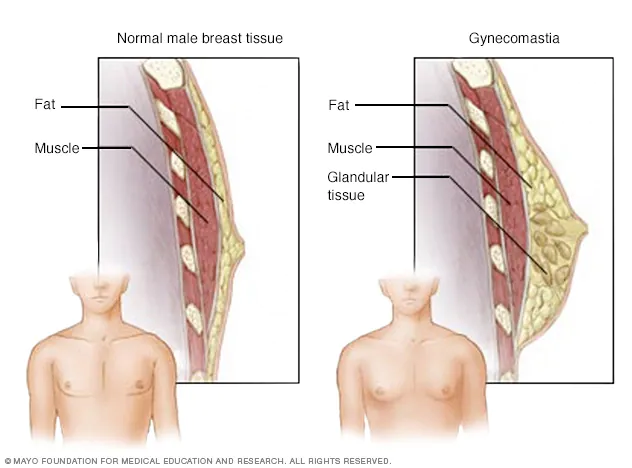
Gynecomastia is a benign growth of glandular breast tissue in men. Breast tissue responds to two opposing signals: estrogen makes it grow, and androgens such as testosterone hold it back. Gyno develops when the balance shifts toward estrogen. That can happen because estrogen rises, but also because androgen action falls while estrogen stays the same.
That second route is the one that matters for SARMs. It is also why drugs that block androgen action, such as the anti-androgens used to treat prostate cancer, commonly cause gyno.
True Gyno or Chest Fat?
Not every puffy chest is gyno. Fat over the chest (pseudogynecomastia) feels soft and evenly spread. True gyno is a firm, rubbery disc of tissue directly under the nipple and areola, and it is often tender when it is new. Many men have both. A doctor can usually tell the difference by examination, sometimes with an ultrasound.
Common Causes of Gyno
Gyno is common in men who have never touched a performance drug. The usual causes are:
- Puberty, when hormone levels swing. Tissue from this stage can stay into adulthood.
- Ageing, as testosterone falls and body fat tends to rise.
- Excess body fat, because the aromatase enzyme in fat tissue converts testosterone to estrogen.
- Medicines and drugs, including anabolic steroids, anti-androgens, spironolactone and a number of others.
- Medical conditions such as low testosterone (hypogonadism), liver disease, kidney disease and an overactive thyroid.
- Rarely, tumors of the testes or adrenal glands that produce hormones.
Two of these matter for SARM users. Leftover tissue from puberty can flare when hormones are disturbed, sometimes on one side only. Higher body fat raises the share of testosterone that is converted to estrogen.
Can SARMs Cause Gyno If They Don’t Convert to Estrogen?
Yes. Most SARMs, including RAD-140, LGD-4033 and ostarine, are non-steroidal molecules. The aromatase enzyme cannot turn them into estrogen, and that is the basis of the “no gyno” claim. But a compound does not have to become estrogen to change the balance between estrogen and androgens in breast tissue.
Suppression of Natural Testosterone
SARMs act on androgen receptors in the brain as well as in muscle. The hypothalamus and pituitary read that as “enough androgen” and cut the signals (LH and FSH) that tell the testes to make testosterone. It is the same feedback loop that shuts down natural production on steroids, and it is the reason SARM users are told to plan for recovery.
In the one published trial of LGD-4033 in healthy young men, just 1mg a day for three weeks lowered total testosterone, and the drop grew with the dose. That is a fraction of the doses users commonly report.
How strongly any given SARM acts on androgen receptors in male breast tissue has not been studied, so nobody knows whether it makes up there for the testosterone it suppresses.
The Gap After a Cycle
When a cycle ends, the SARM clears within days to about a week, while natural testosterone can take weeks or longer to recover. During that gap, androgen levels can be low. This is one proposed reason some users report nipple symptoms late in a cycle or after it. It has not been studied directly.
Stacks and Hidden Ingredients
Many “SARM cycles” are not SARM-only. Stacking SARMs with testosterone, prohormones or other aromatizing steroids brings back the direct estrogen problem, on top of the suppression.
Product quality is the other unknown. A 2017 analysis published in JAMA of products sold online as SARMs found that many did not contain what the label said: some contained other unapproved drugs, some a different amount than listed, and some no active ingredient at all. If you do not know what is in the bottle, you cannot know what it does to your hormones.
RAD-140 and Gyno
RAD-140 (testolone) is a non-steroidal SARM and does not convert to estrogen. It is suppressive: users’ blood work commonly shows testosterone, LH and FSH falling during a cycle. It has never been tested in a clinical trial in healthy men, so there is no controlled data on how often it causes gyno.
There is an interesting twist. RAD-140 has been studied as a breast cancer drug, because in some breast tumors that carry both androgen and estrogen receptors, activating the androgen receptor slows tumor growth. In principle, that suggests RAD-140 may oppose estrogen in breast tissue while it is active. That has not been shown in men, though, and it does nothing for the gap after a cycle, when the SARM is gone and natural testosterone is still low.

What users report fits that picture. Sore or puffy nipples come up in RAD-140 reports, sometimes late in a cycle and including men who already had some tissue. How often this turns into lasting gyno is unknown.
Online advice to treat it with repeated small doses of anastrozole, adjusted by how the nipples feel, is guesswork. Anastrozole is a prescription drug, nipple soreness says nothing about your estradiol level, and the clinical evidence for aromatase inhibitors against gyno is weak (see below). RAD-140 also carries risks beyond gyno, including liver injury described in published case reports.

 SARMs
Overview
- Form: Oral Capsules
- Researched Dosage: 5 mg to 30 mg daily
- Typical Cycle: 6-8 weeks
- Cost: $89.95
- Stacking Options: MK-677, LGD-4033, GW-501516
Pros
- Designed to stimulate androgen receptors and may support muscle growth and strength.
- Its anabolic activity may help maintain muscle during periods of calorie restriction.
- Unlike injectable anabolic steroids, RAD-140 is typically taken orally, making it more convenient for some users.
Cons
- RAD-140 can suppress the body’s natural testosterone production, potentially affecting hormones after use.
- Changes in liver enzymes, cholesterol, and other health markers have been reported or remain a concern.
- RAD-140 is not an approved human medication, so its long-term safety, effectiveness, and risks are not well established.
LGD-4033 and Gyno
LGD-4033 (ligandrol) is the only one of the popular SARMs with a published trial in healthy young men. In that study, 76 men took a placebo or 0.1, 0.3 or 1mg a day for 21 days. Lean mass rose with the dose. So did suppression: total testosterone, SHBG and HDL (“good”) cholesterol fell in a dose-dependent way, and free testosterone and FSH fell significantly at 1mg. Levels returned to baseline after the drug was stopped.
The trial was too short and too small to say anything about gyno. Commonly reported doses are 5-10mg a day for eight weeks or more, many times the highest dose tested and several times longer. LGD-4033 often comes up in user reports of water retention and nipple sensitivity, which fits a compound that suppresses testosterone this clearly, but no study has measured its gyno risk.
Which SARMs Are Least Likely to Cause Gyno?
No SARM has been shown to carry zero risk. What can be said is how each compound could affect the hormone balance:
| Compound | What It Is | Converts to Estrogen? | Suppresses Testosterone? | Gyno Notes |
|---|---|---|---|---|
| RAD-140 (testolone) | Non-steroidal SARM | No | Yes, in users’ blood work | Reported by users; no controlled data |
| LGD-4033 (ligandrol) | Non-steroidal SARM | No | Yes, dose-dependent in a human trial | Reported by users; no controlled data |
| Ostarine (MK-2866) | Non-steroidal SARM | No | Yes, more at higher doses | Generally considered the least suppressive of the three; not risk-free |
| MK-677 (ibutamoren) | Growth hormone secretagogue, not a SARM | No | Not known to | No androgen action, but raises GH and IGF-1 |
| Cardarine (GW501516) | PPAR-delta agonist, not a SARM | No | No | Not linked to gyno; serious cancer concerns from animal data |
MK-677 and Cardarine are often sold alongside SARMs and called SARMs, but they are not. Neither acts on the androgen receptor. Cardarine has no known route to gyno, but its development was abandoned after rodent studies found cancers in several organs. MK-677 raises growth hormone and IGF-1, which play a role in breast tissue growth, so it is not accurate to call it gyno-proof either.
Early Signs to Watch For
Gyno is far easier to deal with when it is caught early. The early signs are:
- Tender, sore or itchy nipples
- Puffiness of the nipple or areola
- A small, firm, rubbery lump directly under the nipple, on one or both sides
If any of these appear, stopping the compounds and seeing a doctor promptly gives the best chance of the tissue going away. A doctor will usually examine the chest and testes and order blood tests (testosterone, estradiol, LH, FSH, prolactin and liver function), sometimes with an ultrasound. Be honest about what you took; it changes what they look for.
Some signs need a quick check because they can point to something else, including rare male breast cancer: a hard lump that is not centered under the nipple, a lump fixed to the skin, skin dimpling, a nipple pulling inward, bloody discharge, or swollen glands in the armpit. A new lump in a testicle also needs urgent attention, as some testicular tumors cause gyno.
How the Risk Is Reduced
The only reliable way to avoid SARM-related gyno is not to use SARMs. For people who use them anyway, these are the factors that change the risk:
- Know your starting point. Check for existing tissue and get baseline blood work, including estradiol measured with a sensitive assay, so later results mean something.
- Avoid aromatizing stacks. Adding testosterone, prohormones or other aromatizing steroids reintroduces the direct estrogen problem.
- Less suppression, less risk. Suppression rises with dose, as the LGD-4033 trial showed, and longer cycles and stacked suppressive compounds deepen it.
- Body fat. Lower body fat means less aromatase activity.
- Plan recovery. Blood work 4 to 8 weeks after a cycle shows whether testosterone has come back. See our guide to PCT for SARMs.
Why an AI “Just in Case” Can Backfire
A common reflex is to keep an aromatase inhibitor (AI) such as anastrozole, exemestane or letrozole on hand and take it at the first twinge. On a SARM-only cycle, that logic is weak. SARMs lower testosterone, and with it the raw material for estrogen, so estradiol is often normal or already low. An AI on top can push it lower still.
Low estrogen in men is not harmless. In a controlled study that set men’s hormone levels experimentally, estrogen deficiency was mainly responsible for gains in body fat and contributed to lower sexual desire and erectile function. Estradiol also protects bone in men.
AIs also have a poor record against gyno itself. In a placebo-controlled trial in boys with pubertal gyno, anastrozole worked no better than placebo. In men taking the anti-androgen bicalutamide for prostate cancer, tamoxifen prevented gyno far more effectively than anastrozole.
How Gyno From SARMs Is Treated
Treatment depends on how long the tissue has been there.
Recent Gyno (Weeks to Months)
New, tender gyno is in an active growth phase. Removing the trigger is the first step: stop the SARM and anything stacked with it. Drug-related gyno often shrinks once the cause is gone, particularly when it is caught early.
If it does not settle, a doctor may prescribe tamoxifen off-label. Of the drug options, it has the best evidence for recent, painful gyno, and it blocks estrogen at the breast without lowering estrogen in the rest of the body. It has its own risks, including blood clots, which is why it belongs with a doctor rather than a forum protocol.
DIY “gyno reversal” with letrozole, a potent AI, brings all the low-estrogen problems above, with no good evidence that it removes established tissue.
Long-Standing Gyno (About a Year or More)
After about 12 months, the tissue usually turns fibrous and stops responding to medication. At that point, surgery is the definitive treatment. The surgeon removes the glandular tissue, usually through a small incision at the edge of the areola, often combined with liposuction for the surrounding fat.
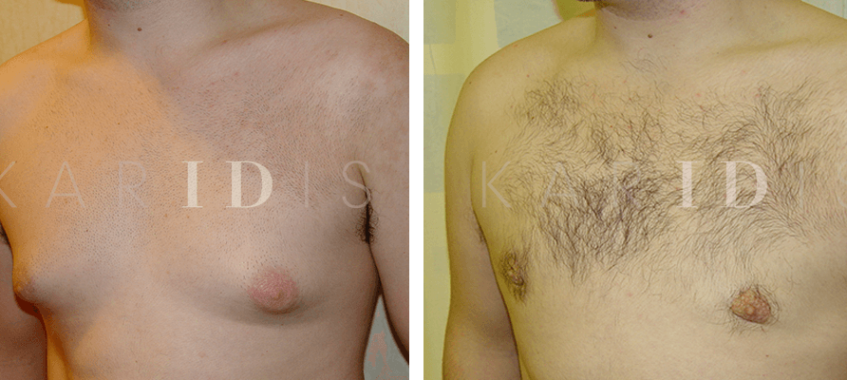
Surgery works well, but it is not a free pass. Recurrence is uncommon, but it can happen if some glandular tissue is left behind and the hormonal trigger returns. Surgery also does nothing about the suppression, liver and cholesterol effects that come with SARMs.
Gyno, Hair Loss and Acne: The Androgen Side Effects
Gyno is not the only androgen-related side effect. SARMs also act on androgen receptors in the skin and scalp, which is why hair loss and acne are reported too. All three tend to be more likely with stronger compounds, higher doses and longer cycles, and the word “selective” does not prevent any of them.
The Bottom Line
SARMs do not turn into estrogen, but they can still cause gyno by suppressing natural testosterone, through aromatizing stacks and through products that are not what the label says.
- RAD-140 and LGD-4033 both suppress natural testosterone. The resulting shift in the androgen-estrogen balance, during a cycle or in the gap after it, is the most likely route to gyno.
- Tender nipples or a lump under the nipple are a reason to stop and see a doctor. Recent gyno can regress; tissue present for about a year usually needs surgery.
- Taking an AI blind can crash estrogen. Blood work and avoiding aromatizing stacks matter more than anything kept on hand “just in case”.
Frequently Asked Questions
Disclaimer
Please read carefully
The information on this site is for educational and informational purposes only, and is not medical advice. Always consult a qualified healthcare professional before using any supplement or medication, or making changes to your health, fitness, or nutrition routine.
Not medical advice
Content here is not a substitute for professional medical advice.
Consult your doctor
Talk to your doctor before starting any supplement or new routine.
Use at your own risk
We are not responsible for adverse effects from acting on this.
Do your research
Make informed decisions about your own health.
No guarantees
Individual results vary. No claims about outcomes.
Important — Never disregard professional medical advice or delay seeking it because of something you read here. If you think you may have a medical emergency, call your doctor or your local emergency number right away.