Contents14 sections
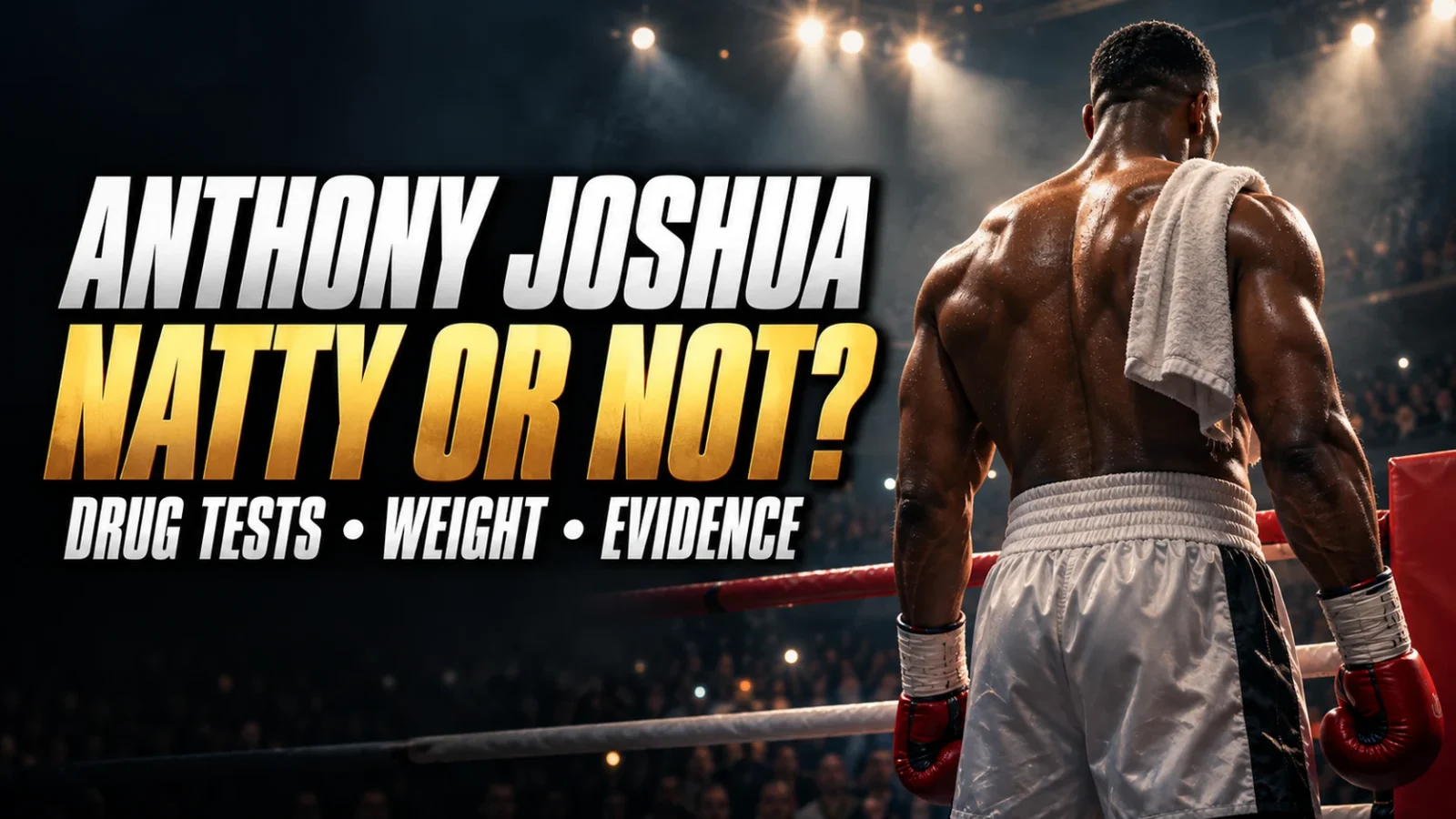
Anthony Joshua is one of the best-known heavyweights of his era. He took up boxing at 18, won Olympic super-heavyweight gold at London 2012 just five years later, and went on to become a two-time unified world heavyweight champion, holding the IBF, WBA (Super), WBO and IBO belts.
He also looks more like a physique athlete than most heavyweights. At 6’6″ and usually around 240-250 lbs on fight night, with broad shoulders, a thick chest and well-developed legs, Joshua has faced steroid accusations from fans and rivals for years.
Joshua has denied using steroids, and there is no public record of him failing a drug test. This article looks at what the record actually shows: the testing around his fights, the opponents who were caught, how his weight has changed since the Olympics, and what his physique can and cannot tell us. It is an analysis of public evidence, not an accusation.
Key Takeaways
- Anthony Joshua has publicly denied using steroids, and there is no public record of him failing a drug test or being sanctioned for doping.
- VADA testing before scheduled Joshua fights caught Jarrell Miller in 2019 and Dillian Whyte in 2023, but has never produced a public adverse finding against Joshua himself.
- He was already a big, muscular super-heavyweight at the 2012 Olympics, aged 22, and his pro career shows no sudden late jump in size.
- His drop of roughly 10 lbs for the Andy Ruiz Jr. rematch was a tactical choice to box on the move, not a sign of coming off a cycle.
- His estimated height-adjusted FFMI of about 23-25 sits at the top of the natural range. Clean tests lower the odds of use but cannot prove anyone is a lifetime natural.
Anthony Joshua Stats and Career Overview
| Detail | Information |
|---|---|
| Full name | Anthony Oluwafemi Olaseni Joshua |
| Born | 15 October 1989, Watford, England |
| Age | 37 (as of October 2026) |
| Height | 6’6″ (198 cm) |
| Reach | 82″ (208 cm) |
| Heritage | British, of Nigerian descent |
| Started boxing | 2007, aged 18, at Finchley Amateur Boxing Club |
| Amateur highlights | 2011 World Championships silver; 2012 Olympic super-heavyweight gold |
| Turned pro | 2013 |
| World titles | IBF, WBA (Super), WBO and IBO; two-time unified heavyweight champion |
| Fight weight | About 237-255 lbs (107.5-116 kg) for his biggest fights |
Why People Ask If Anthony Joshua Is on Steroids
Three things keep the question alive.
- His physique. Few heavyweights carry as much visible muscle as Joshua. Many of the division’s best fighters have won with softer builds, so a heavyweight who looks like a physique athlete stands out.
- His division’s record. Heavyweight boxing has seen several high-profile positive tests, including some by men Joshua fought or was due to fight (see the table below).
- Rivals’ trash talk. Opponents and fans have hinted at, or openly claimed, performance-enhancing drug use, usually in the build-up to fights. Trash talk sells fights, but it is not evidence.
None of these points shows whether Joshua has used steroids. They explain why the question exists; the rest of this article looks at the evidence that can be checked.
What Joshua Has Said About Steroids
Joshua has addressed the accusations head on. Asked by a reporter about rival fighters who claimed he took steroids, he answered:
“I take it as a compliment, because I don’t take steroids.”
Anthony Joshua
In the same interview he pointed to his father’s size as part of the explanation for his own build.
A denial on its own proves little. Athletes who were later caught have denied use just as firmly. An older version of this article tried to read honesty into how directly Joshua answered, but word-choice and body-language analysis is not a reliable way to detect lying, so we have left it out. What matters more is whether the denial fits the rest of the record.
Anthony Joshua’s Drug-Testing Record
VADA and UK Anti-Doping
The Voluntary Anti-Doping Association (VADA) is a US-based anti-doping organisation founded in 2011 by former ringside physician Dr Margaret Goodman. It runs unannounced urine and blood testing programmes for specific fights, with samples analysed at WADA-accredited laboratories. It can also use carbon isotope ratio (CIR) testing, which helps tell synthetic testosterone apart from the testosterone the body makes itself.
Many of Joshua’s biggest fights have been covered by VADA testing, and there is no public record of him returning an adverse finding. As a British professional licensed by the British Boxing Board of Control, he is also subject to testing by UK Anti-Doping (UKAD). Before turning pro, he competed in Olympic-style amateur boxing, where medallists at major championships are routinely tested.
Opponents Who Failed Tests
The testing around Joshua is not just for show. It has caught several heavyweights connected to him:
| Fighter | What Happened | Connection to Joshua |
|---|---|---|
| Dillian Whyte | Two-year UKAD ban after a positive test for the stimulant methylhexaneamine in 2012 | Fought Joshua in December 2015; Joshua won by stoppage in round 7 |
| Alexander Povetkin | Positive tests for meldonium and, later, ostarine in 2016, which derailed scheduled fights with Deontay Wilder and Bermane Stiverne | Fought Joshua in September 2018; Joshua won by stoppage in round 7 |
| Jarrell Miller | VADA adverse findings in 2019 for GW501516, then HGH and EPO; refused a licence in New York | Was due to fight Joshua in June 2019; Andy Ruiz Jr. replaced him |
| Dillian Whyte | VADA adverse finding in 2023, which he disputed | Their rematch set for August 2023 was cancelled; Joshua knocked out replacement Robert Helenius in round 7 |
Joshua’s fights sat inside the same testing net that caught these men. That makes it unlikely he was using detectable drugs in the build-up to those fights.
What a Clean Record Can and Cannot Show
Drug testing has real limits, and they apply to every athlete:
- Tests look for specific substances within detection windows. Short-acting drugs and small doses can clear the body quickly.
- Testing is most intensive in the weeks before a scheduled fight. Long gaps between fights are harder to cover.
- A negative test shows that no banned substance was found in that sample. It cannot prove someone has never used one.
The fair reading is this: Joshua’s record makes heavy, ongoing steroid use around his fights unlikely, but no testing record can certify any athlete as a lifetime natural.
Gains Timeline: From Olympic Gold to World Champion
A timeline is the most useful physique evidence, because natural muscle gain follows a predictable curve: fast in the first years of training, then slower. A sudden jump in size years into someone’s training raises questions.
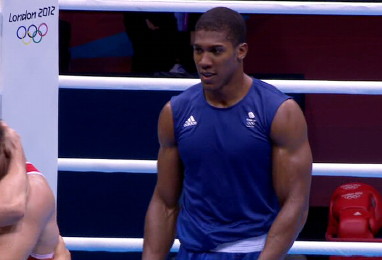
Joshua took up boxing in 2007, aged 18, at Finchley Amateur Boxing Club in north London. By the London 2012 Olympics, aged 22, he was already a big, muscular super-heavyweight. Photos from the Games show clearly the same athlete who later won world titles, only less filled out.
Between 22 and his late twenties, his upper body thickened and his fight weight settled in the 240s and low 250s (lbs). That kind of gradual change is normal for a 6’6″ man who keeps training hard through his twenties. It is not the sudden 20-30 lb jump over a few months that would point to drug use.
The timeline has limits too. It starts at 22, so it cannot say anything about the years before, although there is no evidence of earlier use either.
Weight Changes Across His Career
Heavyweight boxing has no upper weight limit, so a fighter’s weight is a choice made for each camp. Joshua’s reported weigh-ins show this clearly:
| Opponent | Year | Reported Weight (approx.) |
|---|---|---|
| Wladimir Klitschko | 2017 | 250 lbs (113 kg) |
| Carlos Takam | 2017 | 254 lbs (115 kg) |
| Andy Ruiz Jr. (first fight) | 2019 | 247 lbs (112 kg) |
| Andy Ruiz Jr. (rematch) | 2019 | 237 lbs (107.5 kg) |
| Oleksandr Usyk (first fight) | 2021 | 240 lbs (109 kg) |
| Jermaine Franklin | 2023 | 255 lbs (116 kg) |
Across these fights his weight moved within a range of almost 20 lbs, depending on the opponent and the style he planned to fight with.
The Ruiz Rematch Weight Drop
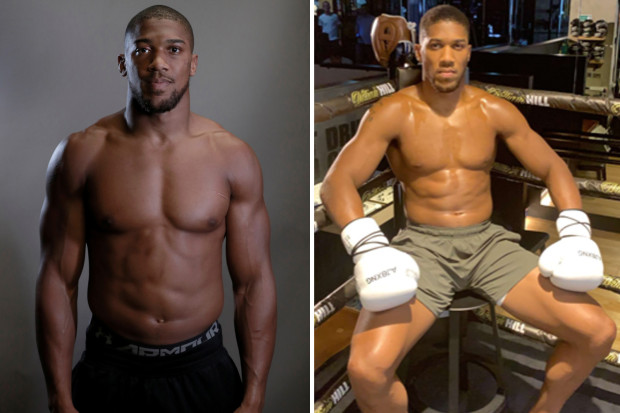
After losing his titles to Andy Ruiz Jr. by seventh-round stoppage at Madison Square Garden in June 2019, Joshua said he would come in lighter for the rematch so he could move better. In Diriyah, Saudi Arabia, that December, he weighed in about 10 lbs lighter, boxed on the outside behind his jab for 12 rounds and won a unanimous decision to regain the belts.
Some fans read the lighter look as proof that he had come off steroids. It isn’t. Dropping 10 lbs over a camp is well within reach through diet, more conditioning and less muscle-building work, and Joshua was heavier again in later fights. Weight change in either direction does not tell you whether someone is natural.
Physique: What Stands Out and What Doesn’t
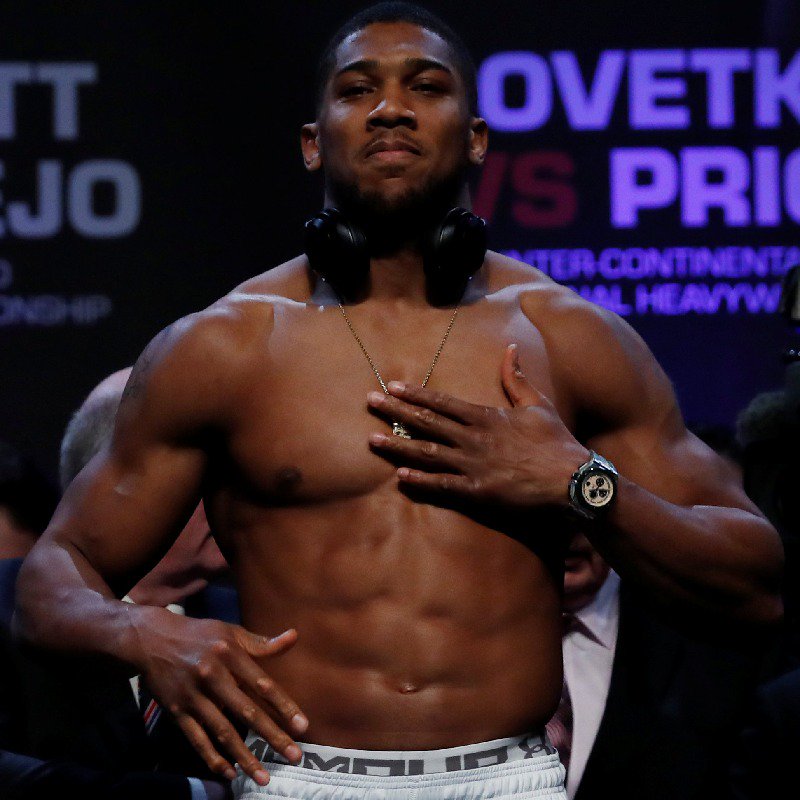
Joshua is very muscular for a boxer, with broad shoulders, a thick chest and big arms. At the same time, his physique does not show several of the markers people commonly link to heavy steroid use:
- Not extremely lean or dry. On fight night he usually carries a moderate amount of body fat rather than stage-ready conditioning.
- No disproportionate traps or shoulders. His upper body is big but in proportion with his 6’6″ frame.
- No obvious side effects in public photos, such as visible breast tissue (gynecomastia) or severe acne.
These markers are weak evidence on their own. Moderate steroid use does not always produce visible side effects, and plenty of natural lifters have acne or carry little fat. Our guide to spotting a fake natty explains why physique signs only ever add up to probabilities.
The Legs Argument
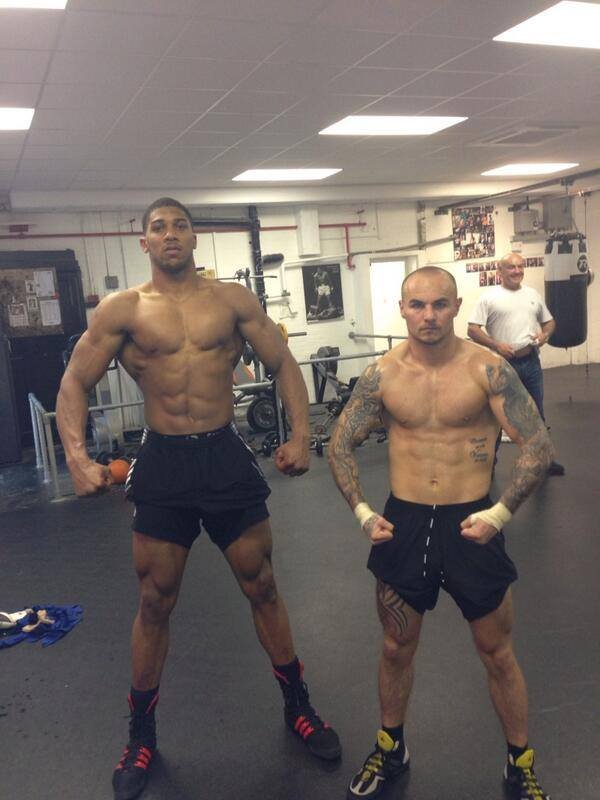
A popular argument says Joshua must be natural because his legs are as well developed as his upper body. The idea is that steroid users who skip leg training end up top-heavy, while natural lifters stay balanced.
The logic does not hold up. Elite boxers do train their legs, through strength work, roadwork and the demands of boxing itself, and enhanced athletes who train their whole body have balanced physiques too. Joshua’s proportions show that he trains hard and evenly. They are not proof either way.
FFMI Estimate
The fat-free mass index (FFMI) relates lean body mass to height. In a 1995 study of 157 male athletes, Kouri and colleagues found that men who did not use steroids topped out at a height-adjusted FFMI of about 25, while many users went above it. It is a rough guide rather than a hard limit, and it depends on body-fat estimates that are only educated guesses from photos.
| Weight | Estimated Body Fat | Raw FFMI | Height-Adjusted FFMI |
|---|---|---|---|
| 237 lbs (107.5 kg) | 11% | 24.4 | 23.3 |
| 247 lbs (112 kg) | 13% | 24.9 | 23.8 |
| 255 lbs (116 kg) | 15% | 25.1 | 24.0 |
| 255 lbs (116 kg) | 12% | 26.0 | 24.9 |
On these assumptions, Joshua’s height-adjusted FFMI sits at about 23-25: high, but within the range seen in drug-free athletes. Taller men tend to score higher on the raw number, which is why the height-adjusted figure is the fairer comparison for a 6’6″ heavyweight.
The “Genetics” Argument, Corrected
Older articles on this site, and plenty of comments online, explained Joshua’s size by his Nigerian heritage, citing a claim that Black men have about 21% more free testosterone than white men. That claim needs correcting.
It comes from a small 1986 study of 50 Black and 50 white college students in Los Angeles, which found about 19% higher total testosterone and 21% higher free testosterone on average in the Black group. Later, much larger population studies have not found a consistent difference in testosterone between Black and white men. And in healthy young men who lift, normal variation in natural hormone levels explains little of the difference in how much muscle people build.
Genetics do matter, but at the level of the individual, not of a group. Joshua’s height, frame, limb length, how his muscles respond to training and where he stores fat are personal traits, built on with years of hard training. For more on normal hormone levels, see our guide to the free testosterone range.
Evidence For and Against
| Points That Suggest He Is Natural | Points That Keep Doubts Alive |
|---|---|
| He has denied steroid use directly | Denials alone are not evidence |
| No public record of a failed test, despite VADA and UKAD testing | Testing has gaps and cannot prove lifetime natural status |
| Already big at the 2012 Olympics, with no late jump in size | The timeline starts at 22; earlier years cannot be checked |
| Estimated FFMI within the natural range | Near the top of that range, and body fat is estimated |
| No obvious side effects in public photos | Moderate use does not always show |
| Weight changes match his fight plans | Exceptionally muscular for a heavyweight boxer |
Our Assessment
On the available evidence, Anthony Joshua looks natural, and there is no evidence that he is not. He has denied steroid use, many of his fights have been covered by the kind of testing that caught several of his opponents, his size has changed only gradually since the 2012 Olympics, and his estimated FFMI is within the range seen in drug-free athletes.
What cannot be said is that he is proven natural. No athlete can be. A clean testing record lowers the odds of use around fights, but it does not rule out everything. The fair verdict is the one that applies to any athlete without a positive test: innocent unless the evidence says otherwise.
For another combat-sports physique in the natty-or-not debate, see our analysis of Brock Lesnar. For a Hollywood example of a big frame and a father with a similar build, read our look at Chris Hemsworth.
The Bottom Line
There is no evidence that Anthony Joshua has used steroids, and his testing record and gains timeline both point towards a natural physique, though no record can prove that with certainty.
- The testing around his fights caught several of his opponents but has never produced a public adverse finding against Joshua.
- He was already a big, muscular athlete at 22, and his size since has changed gradually and in line with his fight plans.
- The old race-based genetics claim and the weight-loss maths do not hold up; his height, individual genetics and years of hard training explain his build better.
Frequently Asked Questions
Disclaimer
Please read carefully
The information on this site is for educational and informational purposes only, and is not medical advice. Always consult a qualified healthcare professional before using any supplement or medication, or making changes to your health, fitness, or nutrition routine.
Not medical advice
Content here is not a substitute for professional medical advice.
Consult your doctor
Talk to your doctor before starting any supplement or new routine.
Use at your own risk
We are not responsible for adverse effects from acting on this.
Do your research
Make informed decisions about your own health.
No guarantees
Individual results vary. No claims about outcomes.
Important — Never disregard professional medical advice or delay seeking it because of something you read here. If you think you may have a medical emergency, call your doctor or your local emergency number right away.