Contents10 sections
You don’t need a commercial gym to build muscle. You need resistance you can keep increasing, a plan that trains every major muscle group, and the patience to add a little more weight or a few more reps over many weeks.
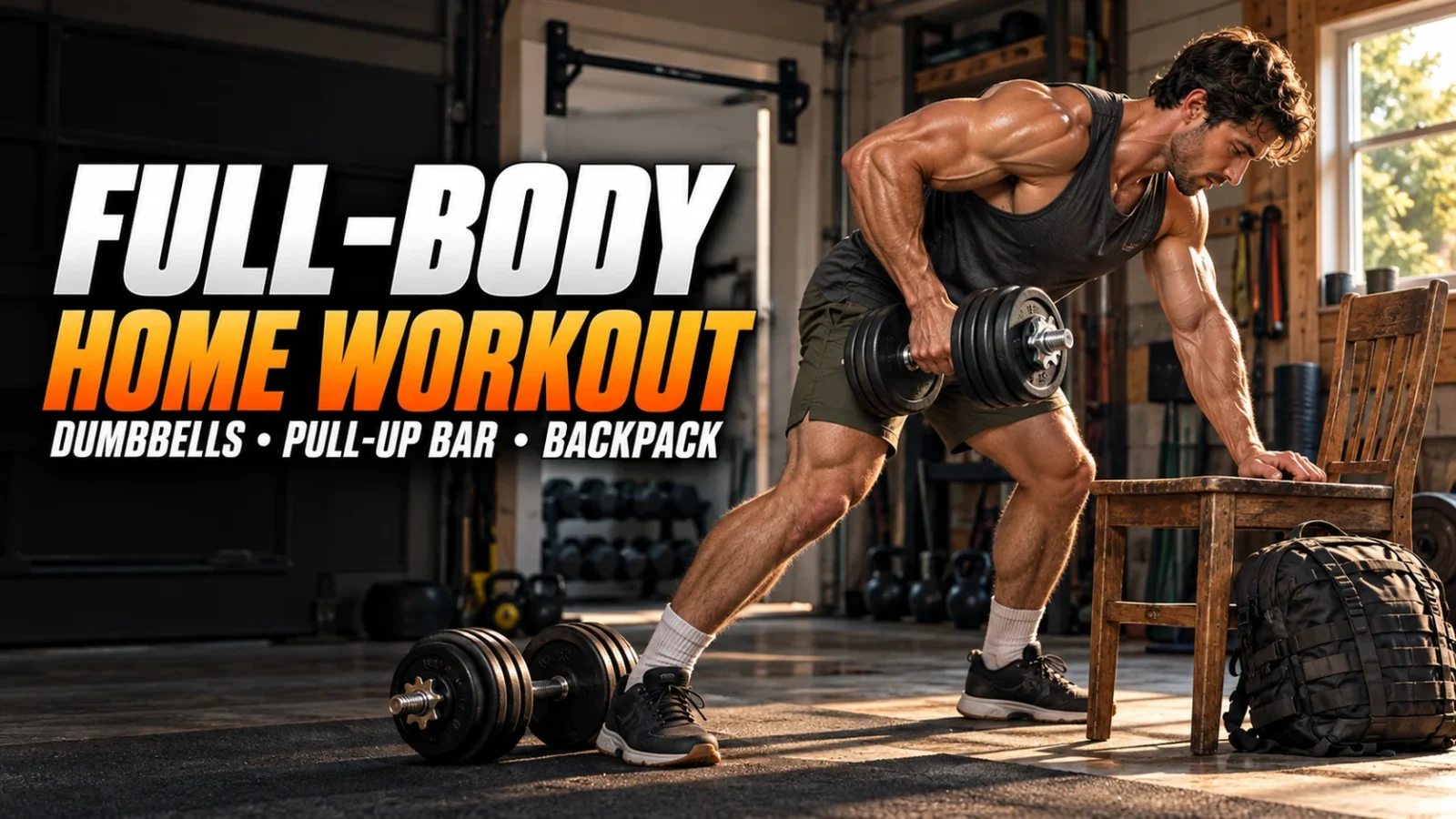
This guide gives you a three-day full-body home workout built around a small, affordable kit: adjustable dumbbells, a doorway pull-up bar, two sturdy chairs, a step, a backpack and a heavy bag of water softener salt. You get three workouts laid out as tables, notes on the less familiar exercises, and a simple week-to-week progression plan so the program keeps working after the first month.
The plan suits beginners and early intermediates. If you’re not sure where you stand, read how to tell if you are a beginner, intermediate or advanced lifter.
Key Takeaways
- Muscle grows from progressive overload: this plan only works if the weight, reps or difficulty keep rising over time.
- A minimal kit is enough to start: adjustable dumbbells, a pull-up bar, two sturdy chairs, a step, a backpack and a salt bag or sandbag.
- Train three non-consecutive days a week, rotating Workouts A, B and C, with 3 sets per exercise.
- Use double progression: add reps until every set reaches the top of the range, then add the smallest weight jump and start again near the bottom.
- Light home weights still build muscle when sets end close to failure; slow lowering, pauses and single-limb versions add difficulty once the dumbbells top out.
The Equipment You Need
The plan assumes you have the following. None of it is expensive, and most of it is easy to find second-hand.
- Adjustable dumbbells: a pair of spin-lock handles with plates, or a set of selectorized adjustable dumbbells. This is the most important purchase.
- Pull-up bar: a doorway bar that hooks over the frame or fits inside the door jamb. Check its weight rating and make sure the frame is solid before you hang from it.
- Two sturdy chairs or a flat bench: for dips, rows and pressing. The chairs should not fold or slide, so brace them against a wall.
- Stairs or a step: anything stable you can step onto, from a low step up to roughly knee height.
- A strong backpack: loaded with books, water bottles or bagged sand, it turns bodyweight exercises into weighted ones.
- A heavy bag: a 40-50 lb (18-23 kg) bag of water softener salt, or a sandbag. Heavy, awkward objects are excellent for pressing and carrying.
If you only buy one thing, buy the dumbbells. Spin-lock handles are cheap and let you keep adding plates over time, and extra plates often turn up used on local second-hand marketplaces. Salt bags are sold at most hardware stores. Wrap the bag in a heavy-duty plastic bag or an old duffel and tape it up so it doesn’t split.
What if you can’t get this equipment yet?
Start anyway. Bodyweight training builds muscle too, especially in beginners, as long as sets are taken close to failure and the exercises get harder over time. Studies in untrained men that compared push-ups with the bench press have found similar gains in strength and chest muscle size when the effort was matched.
The limit is the legs and back, which outgrow bodyweight squats and improvised rows quickly. Until you have dumbbells, use a loaded backpack, single-leg squats and lunges, backpack rows and resistance bands, then add dumbbells as soon as you can. Even one pair of handles with a few plates opens up most of the exercises below.
Why a Full-Body Plan Suits Home Training
Training the whole body three times a week means each muscle is worked about three times a week, with only three sets per exercise in each session. That spreads your weekly volume across short, manageable workouts and gives every muscle a day or two to recover before it is trained again.
Volume matters for growth. Research on weekly training volume suggests that around 10 or more hard sets per muscle group per week tends to produce more growth than fewer than five. Across Workouts A, B and C, the chest, back, shoulders and legs each get roughly 9-12 hard sets a week, before counting the overlap from compound lifts.
Load matters less than effort. Studies comparing light and heavy loads have found similar muscle growth when sets are taken close to failure, although heavier loads build more maximal strength. That is good news at home: if your dumbbells feel light, more reps and sets that finish near failure still do the job. For more on balancing the two goals, see our guide to hypertrophy and strength training.
The Weekly Schedule
Train three non-consecutive days a week. The standard setup is:
- Monday: Full-Body Workout A
- Wednesday: Full-Body Workout B
- Friday: Full-Body Workout C
- Other days: rest, walking or light activity
Any three days work as long as there is at least one rest day between sessions. Warm up for 5-10 minutes before each workout with brisk walking or jumping jacks, then one or two light sets of the first exercise. Rest about 2-3 minutes between sets of the big lifts and 60-90 seconds on the smaller exercises.
Workout A (Monday)
| Exercise | Sets | Reps | Rest |
|---|---|---|---|
| Dumbbell reverse lunge (backpack optional) | 3 | 8-12 per leg | 2 min |
| Dumbbell bench press (bench or floor) | 3 | 8-12 | 2-3 min |
| One-arm dumbbell row | 3 | 8-12 per arm | 90 sec |
| Seated dumbbell overhead press | 3 | 8-12 | 2 min |
| Chair dips (backpack optional) | 3 | 8-12 | 90 sec |
| Dumbbell curl | 3 | 8-12 | 60-90 sec |
| Dumbbell Romanian deadlift | 3 | 8-12 | 2 min |
| Dumbbell shrug or single-leg calf raise | 3 | 8-12 or 10-20 | 60 sec |
| Weighted sit-up | 3 | 10-20 | 60 sec |
Workout B (Wednesday)
| Exercise | Sets | Reps | Rest |
|---|---|---|---|
| Dumbbell step-up (backpack optional) | 3 | 10-15 per leg | 2 min |
| Chin-up (backpack optional) | 3 | 6-12 | 2 min |
| Dumbbell fly (bench or floor) | 3 | 10-15 | 90 sec |
| Dumbbell lateral raise | 3 | 12-15 | 60 sec |
| Feet-elevated diamond push-up | 3 | AMRAP, 1-2 short of failure | 90 sec |
| Sliding leg curl | 3 | 8-15 | 90 sec |
| Dumbbell rear-delt fly | 3 | 12-15 | 60 sec |
| Dumbbell shrug or single-leg calf raise | 3 | 8-12 or 10-20 | 60 sec |
| Dumbbell side bend | 3 | 10-15 per side | 60 sec |
Workout C (Friday)
| Exercise | Sets | Reps | Rest |
|---|---|---|---|
| Goblet squat (backpack optional) | 3 | 10-15 | 2 min |
| Push-up (backpack optional) | 3 | AMRAP, 1-2 short of failure | 90 sec |
| Pull-up (backpack optional) | 3 | 6-12 | 2 min |
| One-arm salt bag push press | 3 | 8-12 per arm | 90 sec |
| One-arm overhead dumbbell extension | 3 | 8-12 per arm | 60-90 sec |
| Hammer curl | 3 | 8-12 | 60-90 sec |
| Single-leg Romanian deadlift | 3 | 8-12 per leg | 90 sec |
| Dumbbell shrug or single-leg calf raise | 3 | 8-12 or 10-20 | 60 sec |
| Plank or ab wheel rollout | 3 | 30-60 sec or 8-15 | 60 sec |
AMRAP means as many reps as possible with good form. On the push-up variations, stop when you have one or two clean reps left rather than grinding until you collapse. With the rest periods above, each session takes about an hour. If you are short on time, pair an upper-body exercise with a lower-body or core exercise and alternate between them.
How to Progress Week to Week
Progressive overload is what turns this plan from exercise into muscle building. Each week, try to beat last week’s numbers on at least some exercises: one more rep, a slightly heavier dumbbell, or a harder version of a bodyweight move. Write every set down; a notebook or a phone app is enough.
Use double progression on the dumbbell lifts
Every dumbbell exercise has a rep range, such as 8-12. Pick a weight you can lift for the bottom of the range with good form and one or two reps left in the tank. Add reps from session to session. When you reach the top of the range on all 3 sets, move up by the smallest jump your dumbbells allow (usually 2.5-5 lb per dumbbell) and start again near the bottom of the range.
Here is how that looks on the dumbbell bench press in Workout A:
| Week | Weight per dumbbell | Set 1 | Set 2 | Set 3 | Next step |
|---|---|---|---|---|---|
| 1 | 40 lb | 10 | 9 | 8 | Same weight, add reps |
| 2 | 40 lb | 11 | 10 | 9 | Same weight, add reps |
| 3 | 40 lb | 12 | 11 | 10 | Same weight, add reps |
| 4 | 40 lb | 12 | 12 | 12 | All sets at 12: add weight |
| 5 | 45 lb | 9 | 8 | 8 | Build back toward 12 |
Progressing bodyweight and backpack exercises
For push-ups, dips, chin-ups, pull-ups and step-ups, add reps first. Once you can do more than about 20 clean push-ups, or reach the top of the range on chin-ups, pull-ups and dips, add load to the backpack in small steps of 2.5-5 lb (1-2 kg). If you can’t load it yet, make the movement harder instead: elevate your feet, slow the lowering phase or pause at the bottom.
When your dumbbells get too light
Home lifters eventually outgrow their heaviest dumbbells, usually on the leg and back exercises first. Before buying more plates, use these tools:
- Slow the lowering: take 3-4 seconds on the way down.
- Add pauses: hold for 1-2 seconds at the hardest point, such as the bottom of a squat or lunge or the top of a row.
- Go single-limb: single-leg Romanian deadlifts, split squats with the rear foot on a chair and one-arm presses put far more load on the working side.
- Use 1.5 reps: lower all the way, come halfway up, lower again, then stand or press all the way up. That counts as one rep.
- Raise the reps: move the range up to 15-30 and keep finishing sets close to failure.
- Add a fourth set for a muscle group that is lagging.
A sample 8-week block
| Week | Sets per exercise | How hard | Focus |
|---|---|---|---|
| 1 | 2 | Stop 3-4 reps before failure | Learn the movements, find starting weights |
| 2 | 3 | Stop about 3 reps before failure | Same weights, clean technique |
| 3-4 | 3 | Stop about 2 reps before failure | Add reps every session |
| 5-7 | 3 | Stop 1-2 reps before failure | Add weight when all sets reach the top of the range |
| 8 | 2 | Stop 3-4 reps before failure, about 10% lighter | Deload: recover, then start a new block |
After the deload, start the next block at the weights you reached in week 7. If a lift stalls for two or three sessions in a row despite good sleep and food, take a lighter week early or swap that exercise for a close variation. Treat this block as a practical template rather than a fixed rule, and adjust it to how you recover. For realistic expectations, see how much muscle you can gain per month.
Exercise Notes
Loading the backpack
Books, water bottles, bagged sand or spare plates all work. Pack the weight tightly and close to your back so it doesn’t shift during the rep. Only add the backpack once you can complete all sets at the top of the rep range with bodyweight, then increase in small steps of 2.5-5 lb (1-2 kg).
Chair dips
Place two sturdy chairs side by side, a little wider than your hips, with their backs against a wall or heavy furniture so they can’t slide. Put a hand on each seat, lower your body until your upper arms are about parallel to the floor, then press back up. Keep your feet on the floor to make the exercise easier, or rest them on a third chair to make it harder. Don’t go deeper than your shoulders tolerate.
Shrugs and calf raises
These two share a slot. Do shrugs in one workout and calf raises in the next, alternating through the week. For calf raises, hold a dumbbell in one hand, steady yourself on a wall or door frame with the other, and rise up on one foot. Standing on the edge of a stair or a solid board lets your heel drop lower for a fuller stretch.
Sit-ups and core work
For weighted sit-ups, hold a light plate or a dumbbell against your chest, and add load only once you can do 20 controlled reps. For planks, keep a straight line from head to heels. Once 60 seconds feels easy, ab wheel rollouts from the knees are the next step.
Push-ups and diamond push-ups
For diamond push-ups, bring your hands together under your chest so your thumbs and index fingers form a diamond; this shifts more of the work to the triceps. Resting your feet on a step or chair adds load. For regular push-ups, keep your body in a straight line and lower until your chest almost touches the floor. Once you pass about 20 reps a set, add the backpack.
Sliding leg curls
Lie on your back with your heels on a towel on a smooth floor (or wear socks), lift your hips into a bridge, then pull your heels toward your glutes and slide them back out while keeping your hips up. Start with both legs and move to one leg when 15 reps feels easy. A resistance band anchored low also works for leg curls.
The older version, lying face down with a dumbbell clamped between your feet, works too, but it is easy to lose control of the weight and drop it on your legs. If you use it, keep the weight light and the reps slow.
Chin-ups and pull-ups
Chin-ups use an underhand grip with your palms facing you, which brings in more biceps. Pull-ups use an overhand grip with your palms facing away. If you can’t do 6 reps yet, use negatives: jump or step up to the top position and lower yourself slowly over 3-5 seconds. A resistance band looped over the bar can also take some of your body weight.
One-arm salt bag push press
Lift the bag to your chest, then shift it so it rests on one shoulder with your hand under the middle of the bag. Dip slightly at the knees, drive up with your legs and press the bag overhead with one arm. The bag is harder to balance than a dumbbell, so start with lighter sets, learn the movement and keep your core braced. If the bag is too heavy for one arm, press it with both hands or use a one-arm dumbbell push press instead.
Romanian deadlifts
Hold the dumbbells in front of your thighs, soften your knees and push your hips back until you feel a strong stretch in your hamstrings, keeping your back flat. Drive your hips forward to stand back up. The single-leg version in Workout C makes a moderate dumbbell feel much heavier; hold a wall for balance at first.
Food and Recovery
Training is the signal; food and sleep let your body respond to it. A large meta-analysis of protein supplementation found that extra gains in lean mass levelled off at around 1.6 g of protein per kg of body weight per day (about 0.7 g per lb), which makes that a sensible daily target.
To add muscle at a steady rate, eat in a small calorie surplus and aim for at least 7 hours of sleep a night. If you struggle to eat enough, these high-calorie foods for bulking make it easier. Once this plan stops moving you forward, our 3 month muscle building workout is a good next step.
The Bottom Line
You can build real muscle at home with a pair of adjustable dumbbells, a pull-up bar and a few improvised weights, as long as the plan keeps getting harder.
- Train full body on three non-consecutive days a week, rotating Workouts A, B and C.
- Log every set and use double progression, adding load in small steps once all sets reach the top of the range.
- When the dumbbells top out, use slower lowering, pauses, single-limb work and higher reps before buying more plates.
- Back the training with enough protein, a small calorie surplus and good sleep.
Frequently Asked Questions
Disclaimer
Please read carefully
The information on this site is for educational and informational purposes only, and is not medical advice. Always consult a qualified healthcare professional before using any supplement or medication, or making changes to your health, fitness, or nutrition routine.
Not medical advice
Content here is not a substitute for professional medical advice.
Consult your doctor
Talk to your doctor before starting any supplement or new routine.
Use at your own risk
We are not responsible for adverse effects from acting on this.
Do your research
Make informed decisions about your own health.
No guarantees
Individual results vary. No claims about outcomes.
Important — Never disregard professional medical advice or delay seeking it because of something you read here. If you think you may have a medical emergency, call your doctor or your local emergency number right away.