Contents13 sections
Testosterone replacement therapy (TRT) has become far more common over the past two decades, and so have the questions about it. Does TRT cause infertility? Heart attacks? Prostate cancer? For men with a confirmed testosterone deficiency, TRT can bring real benefits. But it is a long-term medical treatment with trade-offs worth understanding before the first dose.
This guide sets out the pros and cons of TRT side by side: what testosterone does, how low testosterone is diagnosed, what the benefits look like in clinical trials, and which side effects need monitoring. It also covers what the large TRAVERSE trial found about heart safety, and how TRT differs from the broader term HRT.
Key Takeaways
- TRT is a treatment for diagnosed hypogonadism: symptoms of low testosterone plus consistently low morning testosterone, confirmed on a repeat blood test. Age alone is not a reason to start.
- In the TRAVERSE trial of 5,246 men with or at high risk of heart disease, testosterone gel did not increase heart attacks, strokes or cardiovascular deaths compared with placebo. Atrial fibrillation and blood clots in the lungs were more common.
- The best-supported benefits are better sex drive and sexual activity, more lean mass, higher bone density and correction of mild anemia. Gains in mood and energy are modest.
- TRT suppresses sperm production and can cause infertility. Men who want children soon are usually offered hCG or a SERM instead.
- Hematocrit, PSA and blood pressure need regular checks. Start only after a full workup with a doctor or a reputable TRT clinic.
Why Men Need Testosterone
Testosterone is the main male sex hormone. It drives the development and maintenance of typical male characteristics, such as muscle mass and strength and the growth of facial and body hair. [12] It also supports sex drive, sperm production, bone density and red blood cell production.
Testosterone levels are regulated by the hypothalamus and the pituitary gland, through the hypothalamic-pituitary-gonadal (HPG) axis. [12] The pituitary releases luteinizing hormone (LH) and follicle-stimulating hormone (FSH), which tell the testes to make testosterone and sperm.
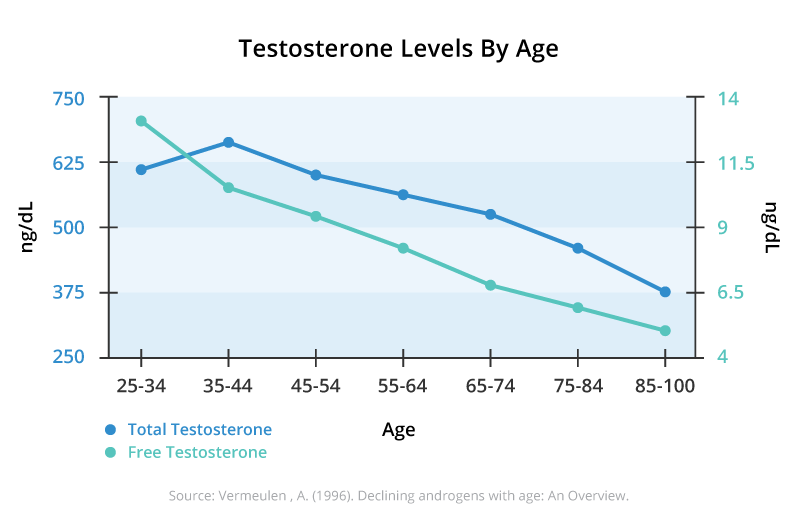
In young, healthy men (20 to 30 years old), serum testosterone usually ranges from about 300 to 800 ng/dL, although each lab sets its own reference range. [12] After the third decade of life, levels decline gradually, at roughly 1-2% per year. [12] For a breakdown by decade, see our guide to average testosterone levels by age.
What Classifies as Low Testosterone
Low testosterone (hypogonadism) is not diagnosed from a single number. The older 2010 Endocrine Society guidelines defined androgen deficiency as signs and symptoms of low testosterone together with unequivocally low morning testosterone, below 300 ng/dL, on two separate occasions. [13]
The current guidelines, from the Endocrine Society (2018) and the American Urological Association (AUA), keep the same principle: symptoms and signs of deficiency plus consistently low early-morning testosterone, confirmed on a repeat test. The AUA uses a total testosterone below 300 ng/dL as a reasonable cut-off. A good workup also measures LH and FSH, which show whether the problem starts in the testes (primary hypogonadism) or in the pituitary or hypothalamus (secondary hypogonadism). That changes which treatments make sense.
Symptoms and signs of low testosterone include [13]:
- Anemia
- Depressed mood
- Erectile dysfunction
- Impaired sexual function, decreased libido and sexual desire, fewer spontaneous erections
- Reduced muscle mass and strength
- Reduced bone mass and osteoporosis
- Insomnia and a reduced sense of general well-being
- Forgetfulness, difficulty concentrating and loss of memory
HRT vs TRT: What the Terms Mean
You will often see TRT and HRT (hormone replacement therapy) used for the same treatment, especially by men’s health clinics. The terms overlap, but they are not identical.
- HRT is the umbrella term for any treatment that replaces a hormone the body is not making enough of. In women it usually means estrogen, with or without a progestogen, for menopause symptoms. Thyroid hormone replacement is another example.
- TRT is one specific type of HRT: testosterone given to men with diagnosed testosterone deficiency.
- “Men’s HRT” at some clinics means testosterone plus other medicines, such as hCG to maintain testicular function or an aromatase inhibitor to control estradiol. Ask exactly what a program includes before you sign up.
The phrase “male menopause” (andropause) is also misleading. In menopause, the ovaries’ estrogen production falls steeply over a transition of a few years. In men, testosterone falls slowly over decades, and many older men keep levels in the normal range.
One more point on wording: TRT does not top up your own production. Outside testosterone switches off the HPG axis, so while you are on TRT the testes make little testosterone of their own. The treatment replaces natural production rather than adding to it, which is why it is usually long-term.
Testosterone Replacement Therapy (TRT)
The U.S. Food and Drug Administration (FDA) has approved prescription testosterone only for men with low testosterone caused by certain medical conditions, such as disorders of the testicles, pituitary gland or brain. It has cautioned that the benefits and safety of testosterone for low testosterone due to aging alone have not been established. [14]
TRT has been used by millions of men around the world to treat symptoms of low testosterone, such as diminished libido and erectile dysfunction, and to improve muscle strength and physical function. [13] In the United States, testosterone prescribing among men aged 40 or older rose from 0.81% in 2001 to 2.91% in 2011, driven by greater awareness among doctors, direct-to-consumer advertising and longer life expectancy. [13]
TRT raises serum testosterone to physiologic levels and improves deficiency-related symptoms. [13] Guidelines aim for the middle of the normal range, not the top of it.

Several formulations are available: injections into the muscle or under the skin, gels and patches, pellets implanted under the skin, and oral, buccal or nasal products. This lets doctors and patients personalize treatment according to each patient’s clinical and financial situation. [13] Our testosterone gel vs injection comparison covers the two most common options.
Pros of TRT
For men with confirmed hypogonadism who are treated and monitored by a doctor, TRT has several well-documented benefits. The size of each benefit varies, and some popular claims have not held up in trials.
Better Sex Drive and Sexual Function
Low testosterone is closely linked to low libido, fewer spontaneous erections and erectile dysfunction. In trials, TRT improves sexual desire and sexual activity in men with low testosterone. In a TRAVERSE substudy of men with low libido, testosterone improved sexual activity and desire but not erectile function, so erectile problems with other causes, such as vascular disease, usually need their own treatment.
More Muscle Mass and Less Fat
Testosterone is an anabolic hormone, and low levels are linked to lower muscle mass and strength. Less muscle means poorer physical function and, with age, a higher risk of falls and injury. TRT reliably increases lean mass and modestly reduces fat mass in men with low testosterone.
Low testosterone is also linked to fat gain, mostly around the abdomen, which raises the risk of type 2 diabetes and other metabolic diseases. [13]
Higher Bone Density
Testosterone helps maintain bone, and men with low levels are at higher risk of osteoporosis. TRT increases bone density and estimated bone strength in older men with low testosterone. However, a fracture analysis of TRAVERSE found that this did not translate into fewer fractures: clinical fractures were numerically more common with testosterone than with placebo. TRT is not a stand-alone treatment for osteoporosis.

Correction of Mild Anemia
Testosterone stimulates red blood cell production, which is why it was once used as a treatment for anemia. [2] Trials in older men with low testosterone have found that TRT corrects mild anemia more often than placebo.
Modest Gains in Mood and Energy
Men with low testosterone often report low mood, poor sleep and low energy, and some feel clearly better on treatment. In trials, though, the average improvements in mood and depressive symptoms are modest. TRT is not an antidepressant: in a TRAVERSE substudy of men with low-grade depressive symptoms, testosterone did not improve depression scores more than placebo.
TRT has also not been shown to improve memory. In the T Trials, older men with low testosterone and age-related memory complaints saw no cognitive benefit compared with placebo.
Heart Safety: Reassuring, Not Protective
Low testosterone is linked to several health conditions, such as heart disease, stroke and higher blood lipids. [13] Observational data from US veterans linked bringing testosterone back to normal with fewer heart attacks and strokes (evidence), but studies like this cannot prove cause and effect.
The best evidence now comes from the TRAVERSE trial, covered under the cons below. It found that TRT did not raise the risk of major cardiac events, but it did not lower it either. Heart protection is not a reason to start TRT.
Cons of TRT
Despite its benefits, TRT is a hormone treatment with real side effects. Most can be managed with monitoring, but some are serious, and patients need to know about them before starting.
Cardiovascular Risk: What TRAVERSE Showed
For years, data on the cardiovascular safety of TRT were conflicting and inconclusive. Some studies linked testosterone injections with a greater risk of heart attack and stroke than testosterone gel, though not with more venous blood clots; others found no increased cardiovascular risk with TRT. [1]
TRAVERSE was designed to settle the question. This large randomized trial, published in the New England Journal of Medicine in 2023, gave testosterone gel or placebo to 5,246 men aged 45 to 80 who had symptoms of hypogonadism, low testosterone, and existing heart disease or a high risk of it. Over an average follow-up of about 33 months:
- Major cardiac events (heart attack, stroke or cardiovascular death) occurred in 7.0% of men on testosterone and 7.3% of men on placebo, which met the trial’s test for no increased risk.
- Atrial fibrillation, acute kidney injury and pulmonary embolism (a blood clot in the lungs) were more common in the testosterone group.
Two limits matter. Many men stopped their study medication early, and the trial used gel at doses aimed at the normal range, so it says little about high-dose injections or steroid-style use. Following TRAVERSE, the FDA required testosterone labels to include the trial’s results and to carry a warning that testosterone can raise blood pressure.
Erythrocytosis (High Red Blood Cell Count)
Erythrocytosis is an increase in the number of red blood cells, seen on blood tests as a high hemoglobin or hematocrit. [2] It is one of the most common side effects of TRT.
Testosterone increases red blood cell production partly by lowering hepcidin, a hormone that locks iron away, which makes more iron available. [2] Estradiol seems to play a role too. Thicker blood may raise the risk of clots, so guidelines advise checking hematocrit before starting, at 3 to 6 months and then yearly, and pausing or lowering the dose if it rises above 54%. Short-acting injections tend to raise hematocrit more than gels.
Venous Thromboembolism (Blood Clots)
The known link between TRT and erythrocytosis, together with a report of more venous blood clots in men receiving TRT (especially those with an inherited clotting disorder, or thrombophilia), led the FDA to require a general warning about venous blood clots on testosterone products. [1] In TRAVERSE, pulmonary embolism was also more common with testosterone than with placebo.
Prostate Cancer Risk
Among the possible side effects of TRT, prostate safety is one of the major concerns, which is why urologists play an important role in diagnosing and treating testosterone deficiency. [1]
Older consensus guidelines on late-onset hypogonadism concluded that there was no conclusive evidence that testosterone therapy raises the risk of prostate cancer or benign prostatic hyperplasia (BPH), but that testosterone can stimulate growth and worsen symptoms in men with locally advanced and metastatic prostate cancer. [4]
Newer data point the same way. In the TRAVERSE prostate safety analysis, high-grade prostate cancer was rare and not significantly more common with testosterone than with placebo. The Endocrine Society still advises against TRT in men with prostate cancer, and guidelines call for a urology evaluation before starting in men with a prostate nodule or a raised PSA (above 4 ng/mL, or above 3 ng/mL in men at higher risk).
Infertility and Smaller Testicles
This is the con that surprises many younger men. Outside testosterone shuts down LH and FSH, and without them the testes make far less sperm. Sperm counts can fall to zero; testosterone has even been studied as a male contraceptive. The testicles usually shrink somewhat as well.
Sperm production often recovers after stopping, but this can take many months and is not guaranteed. Men who want children soon are usually offered other treatments instead. Our guide on how to increase sperm count while on TRT covers the options.
Other Cons of TRT
- Higher estradiol: some testosterone converts to estradiol, which can cause breast tenderness or breast enlargement (gynecomastia) in some men. See how to control estradiol on TRT.
- Acne and oily skin, especially at higher doses.
- Fluid retention and higher blood pressure in some men.
- Obstructive sleep apnea: TRT can worsen untreated severe sleep apnea.
- Lower urinary tract symptoms: guidelines advise caution in men with severe urinary symptoms from an enlarged prostate.
- Gels and patches: skin irritation, and gel can transfer to partners or children through skin contact.
- Long-term commitment: if you stop, symptoms return, often with a spell of very low testosterone while natural production restarts, which can take months.
TRT Pros and Cons at a Glance
| Pros | Cons |
|---|---|
| Better sex drive and sexual activity | Lower sperm production and possible infertility |
| More lean muscle, less fat | Higher hematocrit (thicker blood) |
| Higher bone density | Higher risk of blood clots, including in the lungs |
| Correction of mild anemia | More atrial fibrillation in TRAVERSE |
| Modest gains in mood and energy | Acne, breast tenderness and fluid retention |
| No increase in major cardiac events in TRAVERSE | Ongoing treatment, monitoring and cost |
Who Should Not Start TRT
The Endocrine Society’s 2018 guideline recommends against starting testosterone in men who:
- Plan to father a child in the near future
- Have breast or prostate cancer
- Have a prostate nodule, or a PSA above 4 ng/mL (above 3 ng/mL at higher risk), without a urology evaluation
- Have a raised hematocrit
- Have untreated severe obstructive sleep apnea or severe lower urinary tract symptoms
- Have uncontrolled heart failure, or had a heart attack or stroke in the past 6 months
- Have thrombophilia (an inherited tendency to form blood clots)
How to Start TRT
Start with a doctor (an endocrinologist, urologist or experienced primary care doctor) or a reputable online TRT clinic. Before treatment, a proper workup should include:
- Two early-morning testosterone tests on separate days
- LH and FSH to find the cause, plus other tests, such as prolactin, when the results point to a pituitary problem
- A baseline hematocrit, and a PSA test where prostate screening applies (usually men aged 55 to 69, or from 40 in men at higher risk)
- A physical exam, including the testicles, and a conversation about fertility plans
Once the diagnosis is confirmed, the prescriber chooses a formulation and dose, then rechecks your levels and adjusts as needed. Telehealth clinics follow the same steps, with blood drawn at a local lab and the medication shipped to your door.

Pros
- LegitScript-certified telehealth provider that uses licensed U.S. pharmacies.
- Licensed providers review every intake, and TRT plans include quarterly bloodwork.
- Direct-pay pricing with the consultation and shipping included and no membership fees.
- Fully remote, with no clinic visits and treatments shipped to your door.
Cons
- Serves U.S. patients only.
- Some treatments are compounded and have not been evaluated by the FDA for safety or effectiveness.
What Gets Monitored on TRT
| Check | When | Why |
|---|---|---|
| Testosterone | 3-6 months after starting, then yearly | Keep levels in the mid-normal range |
| Hematocrit | Before starting, at 3-6 months, then yearly | Pause or lower the dose if above 54% |
| PSA | Before starting, at 3-12 months, then per screening guidelines | Prostate safety in men where screening applies |
| Blood pressure | At follow-up visits | Testosterone can raise blood pressure |
| Bone density | After 1-2 years, in men with osteoporosis | Check the bone response |
| Estradiol | If symptoms such as breast tenderness appear | Not a routine guideline test |
Alternatives to TRT
Instead of outside testosterone, some men can use treatments that push the body to make more of its own: selective estrogen receptor modulators (SERMs) such as clomiphene and enclomiphene, human chorionic gonadotropin (hCG) and, in selected cases, aromatase inhibitors. [1]
These only work when the testes can still respond, which mostly means secondary hypogonadism. SERMs and aromatase inhibitors are not FDA-approved for treating low testosterone in men. Their big advantage is that they keep sperm production going. See enclomiphene vs TRT for a side-by-side comparison.
Causes matter too. In men with obesity, weight loss raises testosterone. Treating sleep apnea and reviewing medicines that lower testosterone, such as opioids, can also help before TRT is considered.
The Bottom Line
For men with confirmed low testosterone, the benefits of TRT usually outweigh the risks when it is properly prescribed and monitored. It is not a fix for normal aging or a shortcut to better health.
- The clearest pros are better sex drive and sexual activity, more lean mass, higher bone density and correction of mild anemia. Mood and energy gains are modest, and memory does not improve.
- In TRAVERSE, testosterone did not increase heart attacks, strokes or cardiovascular deaths, but atrial fibrillation and blood clots in the lungs were more common, so heart and clot risk still need attention.
- Infertility, high hematocrit and prostate checks are the main cons to plan for. Get two morning blood tests, a full workup and regular follow-up from a doctor or a reputable TRT clinic.
Frequently Asked Questions
Disclaimer
Please read carefully
The information on this site is for educational and informational purposes only, and is not medical advice. Always consult a qualified healthcare professional before using any supplement or medication, or making changes to your health, fitness, or nutrition routine.
Not medical advice
Content here is not a substitute for professional medical advice.
Consult your doctor
Talk to your doctor before starting any supplement or new routine.
Use at your own risk
We are not responsible for adverse effects from acting on this.
Do your research
Make informed decisions about your own health.
No guarantees
Individual results vary. No claims about outcomes.
Important — Never disregard professional medical advice or delay seeking it because of something you read here. If you think you may have a medical emergency, call your doctor or your local emergency number right away.