Contents15 sections
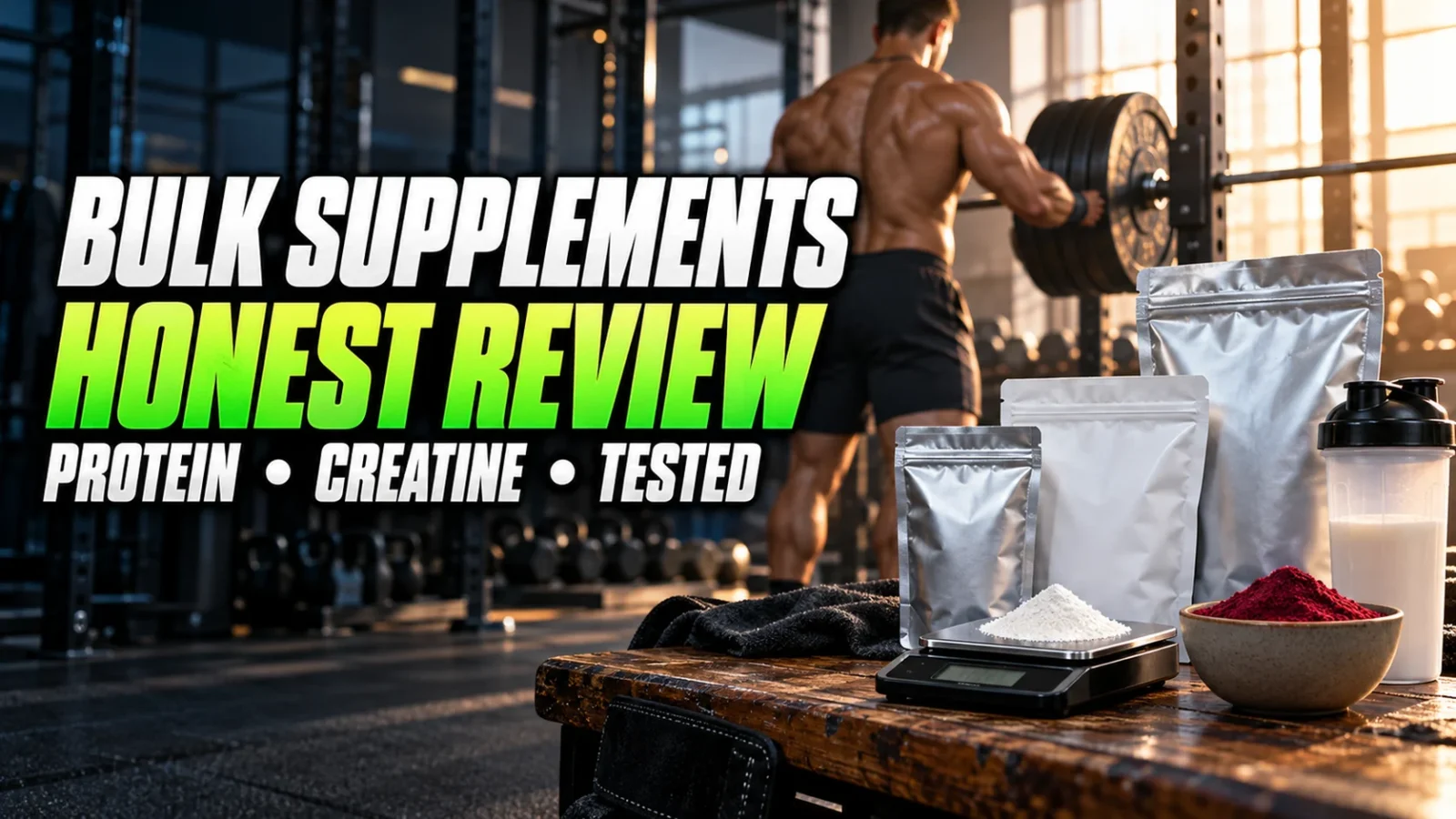
BulkSupplements.com (Bulk Supplements) is a Nevada-based supplier that sells single-ingredient supplements, mostly as plain powders, plus some capsules. It sells the same ingredients you find in branded pre-workouts, protein shakes and vitamins, but in simple resealable bags and without the marketing, which keeps the price per serving low.
In this Bulk Supplements review, we look at what the company sells, which products are worth knowing, what its quality control does and doesn’t prove, and how pricing, customer service and shipping work.
We also bought four of its products and used them ourselves. The Muscle & Brawn editorial team ran that test in late 2020. Prices, shipping terms and packaging have changed since then, so we no longer quote old prices. Check the current terms on their site before you order.
Key Takeaways
- Bulk Supplements sells hundreds of single-ingredient powders and capsules in plain packaging, which keeps the cost per serving low.
- An FDA-registered facility that follows Good Manufacturing Practice (GMP) is the legal baseline, not FDA approval. The company says it tests its products and offers certificates of analysis (COAs).
- Our team tested pea protein, beet root powder, stevia extract and acerola extract in late 2020. All four were pure, mixed easily and were good value.
- The main drawback: our powders came without a scoop, so you need a scale or measuring spoons, especially for potent products like stevia extract.
- It suits people who want to build their own stack. If you would rather have ready-dosed products, Enhanced Labs and Transparent Labs are worth comparing.
Bulk Supplements at a Glance
| Feature | Details |
|---|---|
| Best for | Single-ingredient supplements in pure powder or simple capsules |
| Product types | Sports nutrition, protein, amino acids, vitamins and minerals, herbal extracts |
| Pricing | Low per serving; the price per gram drops as the bag size goes up |
| Quality control | GMP manufacturing; the company says it tests products and offers COAs |
| Packaging | Plain resealable pouches; the powders we bought had no scoop |
| Where to buy | Its own website and Amazon |
| What we tested | Pea protein, beet root powder, stevia extract and acerola extract (late 2020) |
Who Is Bulk Supplements?
BulkSupplements.com was started in 2011 and is based in Nevada. It sells direct through its own website and through Amazon. Sizes run from small pouches for one person up to bulk quantities, and businesses can set up a wholesale account.

The business model is simple. Many supplement companies spend heavily on branding, flashy tubs and flavor systems. Bulk Supplements puts most of its products in plain bags with a printed label, and that is a big part of why it can charge less.
The trade-off is convenience. You get the raw ingredient, usually unflavored, and you measure and mix it yourself.
What Products Do They Sell?
Bulk Supplements sells several hundred individual products, so we can’t list them all. The range breaks down into sports and fitness supplements, vitamins and minerals, and herbal extracts, plus a few food-type products.
Sports and Fitness Supplements
Lifters make up a large share of Bulk Supplements’ customers, and the protein range reflects that. You can choose whey concentrate or whey isolate, including a grass-fed option, and plant proteins such as pea and soy for vegans. The protein powders are sold unflavored and without added sweeteners.
The site also sells the common building blocks of pre- and post-workout formulas, including:
- Creatine monohydrate
- Beta-alanine
- L-citrulline and citrulline malate
- L-arginine
- BCAAs
- L-glutamine
Buying this way lets you build your own pre- or post-workout blend. Many branded products hide their doses inside a “proprietary blend”, which lists the ingredients but not how much of each you get. When you mix your own, you know exactly what is in every serving.
Keep in mind that these powders are unflavored. If you want something that tastes like a typical pre-workout, mix them into a flavored drink or add a water flavoring.
Vitamins and Minerals
A multivitamin gives you a fixed amount of each nutrient. If you only need one or two, you can buy them on their own instead. The range includes B vitamins, vitamin C, vitamin D, zinc and magnesium.
One real advantage is that you can choose the exact form of a mineral. Magnesium, for example, comes in several forms, and some are absorbed better or are gentler on the stomach than others.
Take care with doses. Some single nutrients have a safe upper limit that a careless scoop can pass, for example 40mg of zinc and 4,000 IU (100mcg) of vitamin D a day for most adults. Count what you already get from food and other products.
Herbal Supplements
The herbal range covers popular extracts from Ayurveda, traditional Chinese medicine and other traditions. Ashwagandha, tongkat ali and tribulus terrestris, which are common in expensive testosterone boosters, can be bought here on their own for much less.

The evidence behind these herbs varies. Ashwagandha has the most human research of the three, mainly for stress, with some small studies in lifters. Tongkat ali has limited human data. Tribulus has not raised testosterone in most human studies, so a cheaper bag of it is still not a reason to buy it.
Some products in this section work as food too, such as organic matcha green tea and stevia extract, a zero-calorie sweetener that does not raise blood sugar.
Popular Bulk Supplements Products
Bulk Supplements sells almost every supplement you can think of, but its most popular products are mostly gym staples. Here are the ones worth knowing, with what the research says about each ingredient.
1. Creatine Monohydrate (Micronized)
Creatine is one of the most studied supplements in sports nutrition. It raises the phosphocreatine stored in your muscles, which your body uses to quickly recycle ATP, the molecule that powers short, hard efforts. In practice, that means a few more reps or a bit more power in each set.
Over weeks of training, that extra work adds up. Many studies show greater gains in strength and lean mass when creatine is combined with resistance training. The dose used in most studies is 3-5g a day. Micronized creatine is simply ground finer so it mixes more easily; it is not more effective.
Research on creatine and the brain is still early. It has shown some benefit for memory and mental fatigue in certain groups, such as people who are sleep-deprived. Animal studies looked promising for several neurological diseases, but larger human trials in conditions such as ALS and Parkinson’s disease did not show a benefit. For more options, see our guide to the best creatine monohydrate powders.
2. Whey Protein Isolate (90%)
If you want protein in its plainest form, this is it: whey isolate and nothing else, with no added sugar, carbs or flavoring. You can add your own flavor or mix it with other supplements.
Whey is rich in leucine and digests quickly, and in short-term studies it stimulates muscle protein synthesis more than soy or casein. Over months, though, your total daily protein intake matters more than the type of powder. Because it is an isolate, it also contains less lactose than a standard whey concentrate.
3. Beta-Alanine
Beta-alanine is a non-essential amino acid that your muscles use to make carnosine. Carnosine buffers the acid that builds up during hard exercise, so beta-alanine helps most in intense efforts lasting about one to four minutes, such as high-rep sets, rowing or sprint intervals.
It works by building up over time, not as a one-off dose. Studies typically use about 3-6g a day, split into smaller doses, for at least two to four weeks. The tingling some people feel after a dose (paresthesia) is harmless. Despite what some product pages claim, beta-alanine is not a vasodilator and does not improve blood flow.
4. L-Citrulline DL-Malate 2:1
This is two ingredients in one: two parts L-citrulline to one part malate. Your body converts citrulline into arginine, which it uses to make nitric oxide, a molecule that widens blood vessels. Malate is involved in cellular energy production, although there is little evidence that it adds much on its own.
Studies commonly use 6-8g of citrulline malate about an hour before training. Some found more reps and less soreness; others found no effect, so results are mixed. Our guide to citrulline malate covers the research in more detail.
5. Ascorbic Acid (Vitamin C)
Most people get enough vitamin C from food or a multivitamin. Pure ascorbic acid powder is a cheap way to take more if you want to, but more is not always better. Regular supplementation slightly shortens colds in research, but it does not prevent them for most people.
The upper limit for adults is 2,000mg a day, and large doses often cause stomach upset or diarrhea. If you think you have a real deficiency, see a doctor rather than treating it yourself.
6. NAC (N-Acetyl L-Cysteine)

Bulk Supplements sells NAC as pure N-acetyl L-cysteine with no other ingredients. You can choose standard gelatin capsules, vegetarian capsules or powder. We did not test NAC for this review.
The label directions we saw listed 600mg servings, taken one to three times a day. NAC is also used as a prescription drug (acetylcysteine), so check with a doctor first if you take medication or have a medical condition.
How Are Products Controlled for Quality?
In the US, dietary supplements are regulated as a category of food, not as drugs. Nobody checks a supplement before it goes on sale to confirm that it works or that it contains an effective dose. The manufacturer is responsible for the safety and labeling of its own products.
Bulk Supplements says its facility is FDA-registered and follows current Good Manufacturing Practice (cGMP). It is worth knowing what that means. FDA registration is a listing that every food and supplement facility must have; it is not an approval or endorsement. GMP compliance is a legal requirement for every US supplement maker, and the FDA inspects facilities but does not certify them. The GMP rules require a manufacturer to:
- Develop and maintain a quality control system
- Investigate any problems with product quality
- Check the identity and quality of its raw materials
- Test that finished products meet their specifications
Bulk Supplements also says it tests products for purity and that you can get the certificate of analysis (COA) for a product on request. A COA is a lab report showing what a batch contains, which is useful for checking that a single-ingredient powder has no fillers. Like most supplement COAs, it is a test the company arranges itself. It is not the same as an independent certification such as NSF Certified for Sport or Informed Sport, which athletes in tested sports should look for.
How Does Their Pricing Compare?
Bulk Supplements is usually much cheaper per serving than branded supplements made from the same ingredient. A single bag of a basic powder such as creatine can last months. Prices vary by product, so compare the cost per gram of the active ingredient, not the price of the bag.
The bigger the bag, the lower the price per gram. That only saves money if you finish it before it goes stale, so buy the size you will actually use. When we bought our four test products in late 2020, each one cost less per serving than the comparable products we checked from other brands.
Customer Service and Shipping
You can reach the support team through the contact form on their website, which lets you describe your problem and attach files. When we reviewed the company, it also offered phone support during business hours, Pacific time. Customer reviews we saw generally describe the team as helpful.
Bulk Supplements ships across the US and internationally, with faster shipping options for US orders. International orders take longer, partly because of customs. Shipping rates and the free-shipping threshold change, so check the current terms at checkout. Our own orders arrived within a few business days.
Our Hands-On Test
In late 2020, the Muscle & Brawn editorial team bought four popular Bulk Supplements products from different categories (protein, pre-workout, sweeteners and antioxidants) and used them in our own training. Here is what we found.

The short version: the products were pure, affordable and did what they are meant to do. Each one had plenty of servings and a neutral or slightly sweet taste.
The only real drawback was measuring. None of the bags came with a scoop, and most products needed a scale for accurate servings.
We tested these four products:
- Pea Protein Isolate
- Beet Root Powder
- Stevia Extract
- Acerola Extract
Pea Protein Isolate
We picked Pea Protein Isolate from the protein range. It is a good alternative to animal protein for vegans, vegetarians and anyone who wants to try a plant protein. The label we tested listed 24g of protein per serving, with very little fat or carbohydrate.

In terms of quality and purity, it was one of the better pea proteins we have tried. It was somewhat chalky and quite bland, though, so if you want a flavored shake you will need to add something.
Our favorite way to use it was one serving mixed with 8oz of unsweetened almond milk and a serving of stevia after training. It came in a 250g resealable pouch that kept it fresh, and it cost a little less per serving than the other pea proteins we compared.
Beet Root Powder

We chose Beet Root Powder from the pre-workout range. Beetroot is popular with endurance athletes because it is rich in dietary nitrate, which the body converts into nitric oxide. That can improve blood flow and the oxygen cost of exercise. Beetroot also contains betalains, the red pigments that act as antioxidants.
Be realistic about the dose. Most studies used concentrated beetroot juice with a measured amount of nitrate, taken two to three hours before exercise, and the benefits tend to be smaller in well-trained athletes. Plain beet root powder rarely lists its nitrate content, and a scoop may provide much less than the amounts studied.
We liked this product a lot. It had a slightly sweet taste and mixed easily with water, which made it easy to add to an intra-workout drink. It came in a 100g resealable pouch and was the best value of the beetroot products we compared. One warning: the powder stains, so mix it carefully.
Stevia Extract

From the sweeteners range we tried Stevia Extract, one of the most popular zero-calorie sweeteners. Purified stevia extract is roughly 200-300 times sweeter than sugar, which makes it a simple way to cut back on added sugar.
That strength is also the problem. The recommended serving was just 1/32 of a teaspoon, and a 100g pouch held more than 2,500 servings, so measuring it was by far the hardest part of our test. A normal kitchen scale is not precise enough at that size; use a milligram scale or a set of mini measuring spoons.
Because each serving is so small, the cost per serving is tiny. We have not seen another stevia product come close on value.
Acerola Extract

The last product we tested was Acerola Extract from the antioxidants range. It comes from the acerola (Barbados) cherry, one of the richest natural sources of vitamin C. The fruit also contains carotenoids and flavonoids.
It had a light, pleasantly sweet taste and was easy to mix, so we could take it at any point in the day. Our favorite use was a post-training recovery drink: one serving of acerola, one tablespoon of beet root powder and one serving of stevia.
It came in a 100g resealable pouch, was well priced per serving, and again needed a scale for accurate servings. It is a good option if you want a whole-fruit source of vitamin C with a gentler, lower dose than pure ascorbic acid. The vitamin C content of acerola extracts varies between products, so check the label.
Our Favorite Product

Beet Root Powder was our favorite of the four. Our tester felt it helped endurance during longer sessions and made recovery drinks easy to put together. That is one person’s impression, not a controlled trial, but it fits the research on nitrate for endurance work. If you train for endurance or long, high-volume sessions, it is a cheap thing to try.
Our Test at a Glance
| Product | What we liked | Drawbacks |
|---|---|---|
| Pea Protein Isolate | 24g protein per serving, low carb and low fat, many bag sizes | Unflavored, somewhat chalky, needs a scale |
| Beet Root Powder | Pure beetroot, no added sugar, mixes easily | Nitrate content not listed, stains surfaces, needs a scale |
| Stevia Extract | Zero calories, thousands of servings per bag | Very hard to measure, too sweet for some |
| Acerola Extract | Pleasant taste, easy to mix, gentle vitamin C source | No scoop, some people may prefer capsules |
Tips for Using Bulk Powders Safely
Single-ingredient powders give you full control, which also means mistakes are yours. A few simple habits help:
- Weigh, don’t guess. A digital kitchen scale works for protein and creatine. For tiny servings like stevia, use a milligram scale or mini measuring spoons.
- Check the serving on the label. Compare it with the doses used in studies, and count what you already get from food and other products.
- Be extra careful with potent powders. The FDA has warned against pure and highly concentrated caffeine powders because a dangerous dose can fit in a teaspoon.
- Label and store your mixes. Keep bags sealed, dry and out of reach of children, and write the date and contents on any blend you make.
Pros and Cons
Pros
- Low price per serving, especially in larger bags
- A huge range of single ingredients, with a choice of forms
- No proprietary blends, so you know exactly what you take
- GMP manufacturing and COAs available on request
Cons
- The powders we bought came without a scoop, so you need a scale
- Mostly unflavored
- Company-arranged lab tests are not the same as NSF or Informed Sport certification
- You have to work out your own doses and blends
Alternatives to Bulk Supplements
Bulk Supplements vs Enhanced Labs
Enhanced Labs, one of our partners, sells several of the same basics as finished products, including creatine monohydrate, beta-alanine and L-citrulline. Its creatine comes with a 5g scoop, so there is no need for a scale. If you want the staples without measuring powders yourself, it is worth comparing. Our Enhanced Labs review covers which of its products are worth buying.

Pros
- Catalog is specifically organized around muscle building, fat loss, testosterone support, and workout performance.
- Range includes creatine, protein, EAAs, beta-alanine, and L-citrulline alongside more specialized formulas.
- Orders of $99+ qualify for free US shipping.
Cons
- Features several strong claims around muscle growth, testosterone, fat loss, and metabolic effects that should be distinguished from independently demonstrated clinical outcomes
- Heavily oriented toward bodybuilding and performance rather than broader nutritional supplementation.
Bulk Supplements vs Transparent Labs
Both brands avoid proprietary blends, but they suit different buyers. Bulk Supplements is the cheaper choice if you want single ingredients to build your own stack. Transparent Labs is the better pick if you want ready-made, flavored formulas with every dose already worked out, at a premium price.
The Bottom Line
Bulk Supplements is a legitimate, low-cost source of single-ingredient supplements, best for people who are happy to measure and mix their own.
- Plain packaging and pure ingredients keep the price per serving low, and you always know what is in each serving.
- The four products our team tested in late 2020 were pure, mixed well and were good value; beet root powder was our favorite.
- FDA registration and GMP are the legal minimum, not FDA approval. Ask for the COA if purity matters to you.
- Budget for a scale, and check current prices and shipping terms before you order.
Frequently Asked Questions
Disclaimer
Please read carefully
The information on this site is for educational and informational purposes only, and is not medical advice. Always consult a qualified healthcare professional before using any supplement or medication, or making changes to your health, fitness, or nutrition routine.
Not medical advice
Content here is not a substitute for professional medical advice.
Consult your doctor
Talk to your doctor before starting any supplement or new routine.
Use at your own risk
We are not responsible for adverse effects from acting on this.
Do your research
Make informed decisions about your own health.
No guarantees
Individual results vary. No claims about outcomes.
Important — Never disregard professional medical advice or delay seeking it because of something you read here. If you think you may have a medical emergency, call your doctor or your local emergency number right away.