Contents11 sections
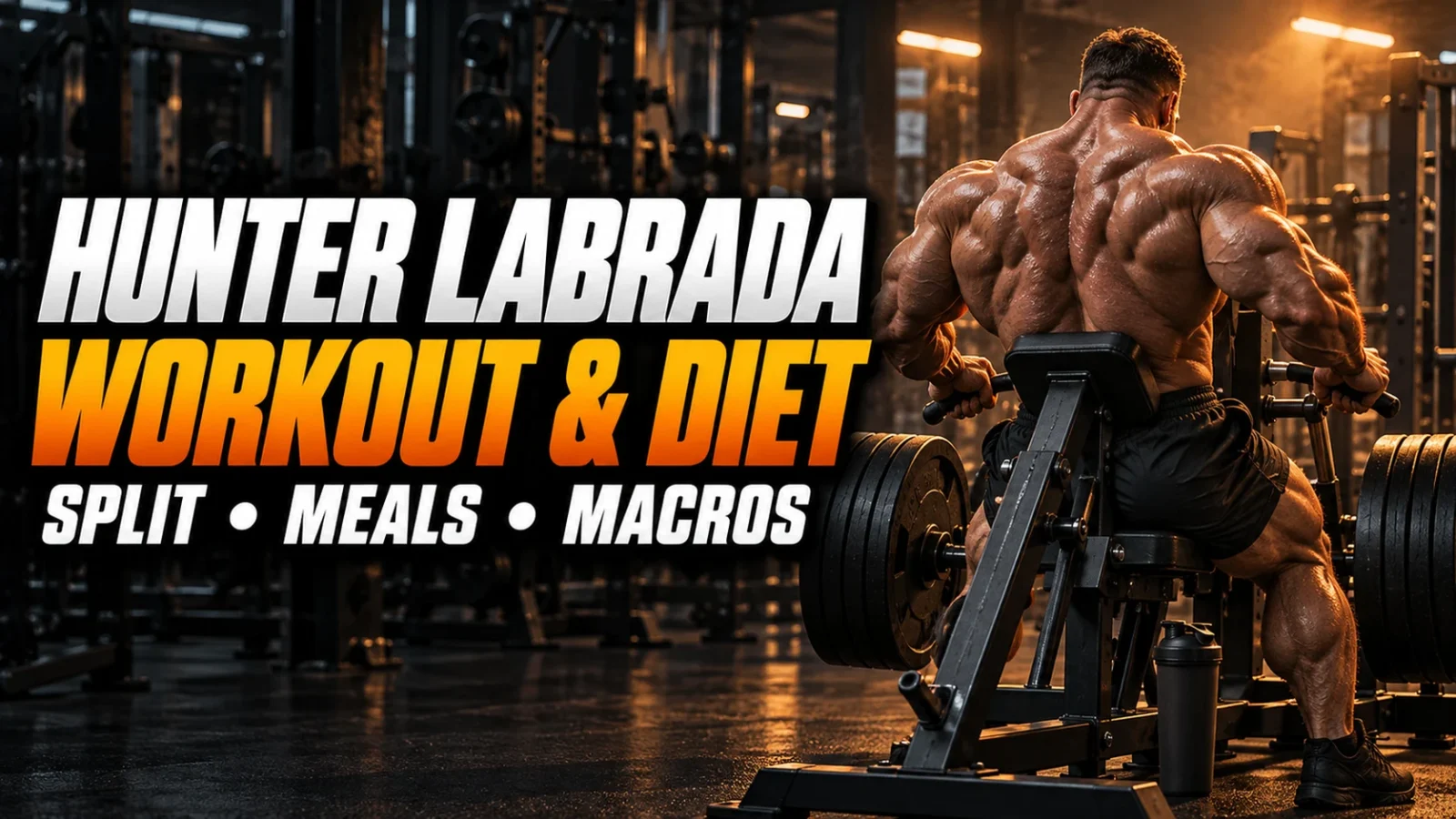
Hunter Labrada is an IFBB Pro bodybuilder in the Men’s Open division and the son of IFBB Hall of Famer Lee Labrada, one of the top Mr. Olympia contenders of the late 1980s and early 1990s. Hunter turned pro by winning the 2018 NPC National Championships overall and finished fourth at the 2021 Mr. Olympia.
He is known for carrying a lot of size with good conditioning. His training is built on a short list of mostly machine exercises that he repeats and pushes harder over time. His diet stands out too: much of it is drunk rather than eaten, with whey isolate shakes and liquid egg whites doing a lot of the work.
Below you will find his stats, the split he showed during his 2022 Olympia prep, a sample off-season day of eating with the macros checked, and his contest record.
Key Takeaways
- Hunter Labrada is an IFBB Pro Men’s Open bodybuilder, born March 17, 1992, and the son of IFBB Hall of Famer Lee Labrada.
- He won the 2018 NPC Nationals overall to earn his pro card, then placed 8th, 4th and 7th at the 2020, 2021 and 2022 Mr. Olympia.
- His prep split rotates pull, push, arms and legs sessions, with only one to three hard sets per exercise on mostly machines and cables.
- He keeps the same exercises and tries to beat his loads or reps, instead of changing movements to “confuse” the muscle.
- A sample off-season day comes to about 4,070 kcal (387 g protein, 489 g carbs, 63 g fat), much of it from whey isolate and egg whites.
Who Is Hunter Labrada?
Hunter Labrada is a professional bodybuilder who earned his IFBB Pro status by winning the 2018 NPC National Championships overall. He competes in Men’s Open, the heaviest and most mass-focused division in the sport.

Bodybuilding runs in the family. His father, Lee Labrada, was one of the best-known physiques of the Lee Haney era and is a member of the IFBB Hall of Fame. Lee never won the Sandow trophy; Haney held the title through 1991, as our list of Mr. Olympia winners shows. Hunter has followed him onto the Olympia stage in the Open division.
Hunter also has a YouTube channel where he has documented his training, meals and daily life as a professional bodybuilder, which is where much of what is known about his routine comes from.
Hunter Labrada Stats
| Attribute | Detail |
|---|---|
| Full name | Hunter Labrada |
| Date of birth | March 17, 1992 |
| Age | 34 |
| Father | Lee Labrada, IFBB Hall of Famer |
| Division | Men’s Open Bodybuilding (IFBB Pro League) |
| Pro status | IFBB Pro since 2018 (2018 NPC Nationals overall winner) |
| Height | About 5’9″ (175 cm), as commonly listed |
| Weight | About 230-255 lbs (104-116 kg), as reported; varies with the season |
| Mr. Olympia results | 8th (2020), 4th (2021), 7th (2022) |
Hunter Labrada’s Training Philosophy
Hunter trains on progressive overload: he runs the same workouts with the same exercises week after week and tries to add load or reps over time. He does not chase variety or “muscle confusion”. Keeping the exercises fixed makes progress easy to measure, because a better set on the same machine is a real improvement, not a new movement that only feels harder.
Progressive overload itself is far older than modern bodybuilding; it is the basic principle behind nearly every strength and muscle-building program. What sets Hunter’s training apart is the low-volume, high-effort style: few sets per exercise, each one taken very hard. That approach is often compared to the training Dorian Yates made famous on his way to six Mr. Olympia titles in the 1990s.
Most of his exercises are machines, cables and chest-supported variations, many done one side at a time. Stable, supported movements let a lifter push a set close to failure without balance, grip or lower-back fatigue becoming the limit. Unilateral work also lets each side be trained on its own, which helps when one side lags.
Several exercise names below carry the name of the machine maker (Nautilus, Arsenal, Prime, Rogers, Strive). Any similar plate-loaded or cable machine trains the same muscles.
Hunter Labrada Workout Plan
The sessions below are the ones Hunter showed during his prep for the 2022 Mr. Olympia, in the order he ran them. Volume was reduced in the lead-up to the show, so treat the set counts as a prep-phase snapshot rather than his year-round plan.
| Order | Session | Main focus |
|---|---|---|
| 1 | Pull A | Lats, upper back, rear delts |
| 2 | Push A | Chest, shoulders |
| 3 | Arms A | Biceps, triceps, abs |
| 4 | Legs | Calves, hamstrings, quads, adductors |
| 5 | Off day | Rest, posing, recovery |
| 6 | Pull B | Lats, upper back, rear delts |
| 7 | Push B | Chest, shoulders |
| 8 | Arms B | Biceps, triceps, abs |
Pull A
| Exercise | Sets | Target |
|---|---|---|
| Supported straight-arm pushdown | 2 | Lats |
| Unilateral Nautilus pulldown | 2 | Lats, one arm at a time |
| Arsenal T-bar row | 2 | Mid-back thickness |
| Prime row | 2 | Upper and mid back |
| Rear delt flye | 2 | Rear delts |
Push A
| Exercise | Sets | Target |
|---|---|---|
| Cable flye | 2 | Chest |
| Prime incline press | 3 | Upper chest, front delts |
| Prime shoulder press | 3 | Front and side delts |
| Supported Y-raise | 2 | Delts, lower traps |
Arms A
| Exercise | Sets | Target |
|---|---|---|
| Dumbbell preacher curl | 2 | Biceps |
| Cuff triceps extension | 2 | Triceps |
| Supported step-forward cable curl | 2 | Biceps |
| Seated overhead extension | 2 | Triceps, long head |
| Abmat crunch | 3 | Abs |
| Hanging leg raise | 3 | Abs, hip flexors |
Legs
| Exercise | Sets | Target |
|---|---|---|
| Standing calf raise | 2 (the second is a drop set) | Calves |
| Seated calf raise | 1 | Calves (soleus) |
| Seated hamstring curl | 2 | Hamstrings |
| Banded hack squat | 1 | Quads |
| Unilateral hip press | 1 | Quads, glutes |
| Leg extension | 1 | Quads |
| Adductor machine | 1 | Adductors |
Leg day has the fewest sets of the rotation: most movements get a single set. A plan this lean relies on each set being taken very close to failure.
Off Day
One full rest day sits in the middle of the rotation. Hunter uses it for posing practice and recovery rather than extra training.

Pull B
| Exercise | Sets | Target |
|---|---|---|
| Unilateral supported straight-arm row | 2 | Lats |
| Unilateral cable pulldown (lat focus) | 2 | Lats |
| Unilateral Rogers 3-way row | 2 | Upper and mid back |
| Arsenal T-bar row | 2 | Mid-back thickness |
| Prime row | 2 | Upper and mid back |
| Rear delt flye | 2 | Rear delts |
Push B
| Exercise | Sets | Target |
|---|---|---|
| Pec deck flye | 2 | Chest |
| Reverse-band Smith machine incline press | 3 | Upper chest, front delts |
| Supported Y-raise | 2 | Delts, lower traps |
| Prime shoulder press | 3 | Front and side delts |
Arms B
| Exercise | Sets | Target |
|---|---|---|
| Strive biceps curl | 2 | Biceps |
| Cuff triceps extension | 2 | Triceps |
| Seated cable curl | 2 | Biceps |
| Unilateral overhead cuff extension | 2 | Triceps, long head |
| Abmat crunch | 3 | Abs |
| Hanging leg raise | 3 | Abs, hip flexors |
Hunter trains in a well-equipped gym with a wide choice of machines, so he can pick the exact tool for each muscle. He placed seventh at the 2022 Olympia with this plan, after fourth the year before; a prep split is no guarantee of a placing, which also depends on the field and the judging on the day.
How to Use Hunter Labrada’s Approach
Copy the principles, not the exact set counts. A prep-phase plan for an elite Open bodybuilder is not built for a lifter with a normal job, normal recovery and a normal gym. For most people, more weekly volume will work better: a 2017 meta-analysis by Schoenfeld and colleagues found a dose-response link between weekly sets and muscle growth, with 10 or more sets per muscle per week producing more growth than fewer than five.
- Keep your exercises fixed for several weeks. Log every set and aim to add a rep or a little load each time.
- Use stable machines and supported rows for hard sets, so the target muscle fails before your balance or lower back does.
- Add sets before you add exercises. Two or three hard sets per movement, across two sessions per muscle in each rotation, gets most lifters into a productive weekly range.
- Train hard, not recklessly. Low-volume, near-failure sets demand good technique and full warm-ups, especially on heavy pressing and leg machines.
Hunter Labrada Diet Plan
Hunter’s diet stands out for how much of it is liquid. On the off-season day below, two meals are built around whey isolate shakes, two include large servings of liquid egg whites, and only one is a classic meat-and-rice meal. Shakes and egg whites are quick to prepare and easy to get down, a practical way to hit very high protein and carbohydrate targets without having to eat huge amounts of solid food.
A note on sources: this sample day is based on an off-season plan Hunter has shared publicly. The per-meal macros are approximate, meal 5 is a free meal with estimated macros, and it reflects one off-season, not a fixed plan. His food changes between the off-season and contest prep.
| Meal | Foods | Protein | Carbs | Fat |
|---|---|---|---|---|
| Meal 1 | 500 ml liquid egg whites, 160 g oats, 1 tbsp fish oil | 77 g | 107 g | 20 g |
| Meal 2 | 75 g whey isolate (about 2.5 scoops), 300 g cooked rice | 70 g | 87 g | 2 g |
| Meal 3 | 75 g whey isolate, 100 g Karbolyn (a carbohydrate powder) | 63 g | 100 g | 1 g |
| Meal 4 | 8 oz (about 225 g) fish or chicken, 300 g cooked rice | 62 g | 85 g | 5 g |
| Meal 5 | Free meal with at least 50 g protein and 100 g carbs (estimate) | ~55 g | ~110 g | ~35 g |
| Meal 6 | 500 ml liquid egg whites | 60 g | 0 g | 0 g |
| Total | About 4,070 kcal | 387 g | 489 g | 63 g |
The totals add up: 387 g of protein and 489 g of carbs at 4 kcal per gram, plus 63 g of fat at 9 kcal per gram, gives about 4,070 kcal. That splits into roughly 38% of calories from protein, 48% from carbs and 14% from fat.
The protein figure is very high. For a man of about 245 lbs (111 kg), 387 g is roughly 3.5 g per kg of body weight. A 2018 meta-analysis by Morton and colleagues found that the benefit of extra protein for lean mass gains levelled off at around 1.6 g per kg per day, with an upper estimate of about 2.2 g/kg. Most lifters can build muscle on far less than Hunter eats.
Most of his protein on this day comes from whey and egg whites rather than meat, and fat is kept low, which leaves room for a lot of carbohydrate around training. If you struggle to eat enough to gain weight, liquid calories can work for regular lifters too; our 1000 calorie shake guide shows one way to do it.
Beyond whey isolate and a carb powder, his published plan says little about supplements. For most lifters, the supplements with the strongest evidence are the basics: protein powder to help reach a daily protein target and creatine monohydrate, one of the most studied sports supplements for strength and lean mass.

Pros
- Catalog is specifically organized around muscle building, fat loss, testosterone support, and workout performance.
- Range includes creatine, protein, EAAs, beta-alanine, and L-citrulline alongside more specialized formulas.
- Orders of $99+ qualify for free US shipping.
Cons
- Features several strong claims around muscle growth, testosterone, fat loss, and metabolic effects that should be distinguished from independently demonstrated clinical outcomes
- Heavily oriented toward bodybuilding and performance rather than broader nutritional supplementation.
Hunter Labrada Bodybuilding Career
Hunter won his class at every amateur contest in the record below before turning pro at the 2018 NPC Nationals. As a pro, he won the Tampa Pro and the Chicago Pro and reached fourth place at the 2021 Mr. Olympia, part of the same new wave of Open competitors as Nick Walker.
| Year | Contest | Result |
|---|---|---|
| 2016 | NPC Branch Warren Classic (Heavyweight) | 1st and overall winner |
| 2016 | NPC San Antonio Extravaganza (Superheavyweight) | 1st |
| 2017 | NPC Europa Dallas (Superheavyweight) | 1st |
| 2018 | NPC Junior USA Championships (Superheavyweight) | 1st and overall winner |
| 2018 | NPC National Championships (Superheavyweight) | 1st and overall winner; earned IFBB Pro card |
| 2020 | IFBB Tampa Pro | 1st |
| 2020 | Mr. Olympia | 8th |
| 2021 | IFBB Chicago Pro | 1st |
| 2021 | Mr. Olympia | 4th |
| 2022 | Mr. Olympia | 7th |
The table covers his amateur career and his pro results through the 2022 Mr. Olympia. For later placings, the IFBB Pro League’s official contest results are the reference.
The Bottom Line
Hunter Labrada’s approach is simple: a fixed set of mostly machine exercises, a few very hard sets on each, steady progress in load or reps, and a high-protein, shake-heavy diet to fuel it.
- His prep split rotates pull, push, arms and legs sessions with one to three hard sets per exercise, mostly on stable, supported machines.
- His sample off-season day of about 4,070 kcal shows how far shakes and egg whites can carry a big intake, though his roughly 3.5 g of protein per kg is far more than most lifters need.
- Copy the principles (fixed exercises, logged progress, hard sets), but most lifters will grow better with more weekly sets than his prep-phase plan.
Frequently Asked Questions
Disclaimer
Please read carefully
The information on this site is for educational and informational purposes only, and is not medical advice. Always consult a qualified healthcare professional before using any supplement or medication, or making changes to your health, fitness, or nutrition routine.
Not medical advice
Content here is not a substitute for professional medical advice.
Consult your doctor
Talk to your doctor before starting any supplement or new routine.
Use at your own risk
We are not responsible for adverse effects from acting on this.
Do your research
Make informed decisions about your own health.
No guarantees
Individual results vary. No claims about outcomes.
Important — Never disregard professional medical advice or delay seeking it because of something you read here. If you think you may have a medical emergency, call your doctor or your local emergency number right away.