Contents12 sections
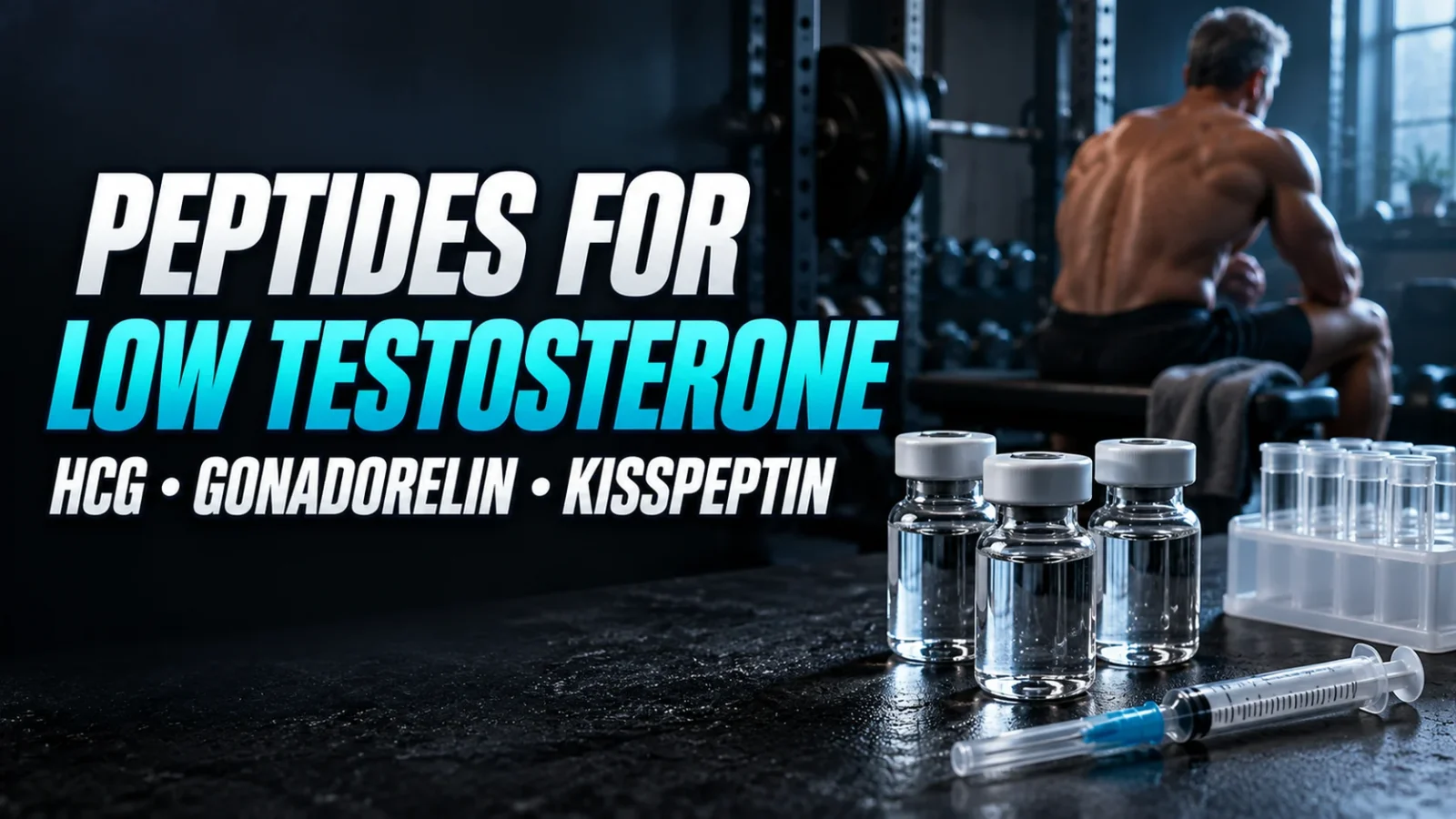
Search for peptides for low testosterone and most lists push growth hormone peptides such as ipamorelin and CJC-1295, or even the tanning peptide Melanotan II. None of them has been shown to raise testosterone in men. The peptides that do raise it work on the hormone chain that tells the testes to make testosterone: hCG, gonadorelin and kisspeptin.
These three are not interchangeable. hCG is an approved prescription drug with decades of medical use. Gonadorelin raises testosterone only when it is given in pulses, and the same signal given continuously lowers it. Kisspeptin raises testosterone in short human studies but is still an experimental research compound. All three only work if the testes can still respond.
This guide explains how each one works, what the human studies show, the doses used in studies, the side effects, and which popular “testosterone peptides” don’t do what they promise. It also explains why the cause of your low testosterone decides whether any peptide can help.
Key Takeaways
- Only peptides that act on the testosterone hormone chain raise testosterone: hCG, gonadorelin and kisspeptin. Growth hormone peptides, Melanotan II and BPC-157 do not.
- hCG has the strongest evidence. It mimics LH at the testes and is FDA-approved for men whose low testosterone comes from a pituitary or hypothalamic problem.
- Gonadorelin works when it is given in pulses, as with a pump every couple of hours. Continuous exposure to GnRH-type drugs shuts testosterone down instead.
- Kisspeptin raises LH and testosterone in short human studies, but there are no long-term trials and no established dose. It remains a research compound.
- No peptide helps much if the testes themselves are failing. Confirm low testosterone with repeat morning blood tests and check LH and FSH first.
How Your Body Makes Testosterone
Testosterone production runs through a three-step chain called the hypothalamic-pituitary-gonadal (HPG) axis:
- The hypothalamus releases gonadotropin-releasing hormone (GnRH) in short pulses, roughly every one to two hours. Kisspeptin is one of the main signals that triggers these pulses.
- Each GnRH pulse tells the pituitary gland to release luteinizing hormone (LH) and follicle-stimulating hormone (FSH).
- LH tells the Leydig cells in the testes to make testosterone. FSH, together with the high testosterone level inside the testes, drives sperm production.
Testosterone and estradiol then feed back to the brain and pituitary to slow the chain down. This feedback is why testosterone injections, anabolic steroids and most SARMs suppress your own LH, FSH, testosterone and sperm production.
Why the Cause of Low Testosterone Matters
Doctors split low testosterone into two types. In primary hypogonadism the testes are the problem: LH and FSH run high because the brain keeps signalling testes that can’t respond. In secondary (hypogonadotropic) hypogonadism the signal is the problem: LH and FSH are low or inappropriately normal, and the testes are often still able to work.
Every peptide in this guide acts upstream of the testes. hCG replaces the LH signal, gonadorelin replaces the GnRH signal, and kisspeptin triggers your own GnRH. If the testes are damaged, none of them can raise testosterone much. If the problem sits in the brain or pituitary, they may. Gonadorelin also needs a working pituitary, and kisspeptin needs working GnRH neurons as well.
Secondary low testosterone is common after steroid or TRT use, in men with obesity or type 2 diabetes, and with long-term opioid use. That is the group in which these peptides are most often discussed.
Which Peptides Actually Raise Testosterone?
Here is how the peptides most often recommended for low testosterone compare on human evidence.
| Peptide | How It Works | Raises Testosterone in Men? | Status |
|---|---|---|---|
| hCG | Acts like LH directly on the testes | Yes, reliably, if the testes work | FDA-approved prescription drug |
| Gonadorelin | Synthetic GnRH; triggers LH and FSH release | Yes when given in pulses; continuous exposure suppresses it | Prescription where available; not FDA-approved to treat low testosterone |
| Kisspeptin (-10, -54) | Triggers the brain’s own GnRH pulses | Short-term rises in small studies | Research compound only |
| Ipamorelin, CJC-1295, sermorelin | Raise growth hormone and IGF-1 | No good evidence | Research compounds or compounded prescriptions |
| Melanotan II, PT-141 | Act on melanocortin receptors in the brain | No; may affect arousal and erections | Melanotan II unapproved; PT-141 approved only for women with low desire |
| BPC-157, TB-500 | Tissue repair, mostly animal data | No | Research compounds only |
hCG: The Strongest Evidence
Human chorionic gonadotropin (hCG) is a hormone made in large amounts during pregnancy. Strictly speaking it is a large glycoprotein hormone rather than a short peptide, but it is the compound most people mean when they ask which peptide raises testosterone.
hCG binds the same receptor as LH on the Leydig cells, so it switches on testosterone production even when the pituitary sends little or no LH. It also stays in the blood far longer than natural LH, so it can be injected a few times a week instead of in pulses. It is FDA-approved for men with hypogonadotropic hypogonadism, and it has been used for decades, alone or together with FSH, to restore testosterone and sperm production in these men.
It is also widely used next to TRT. Testosterone therapy suppresses LH, and with it the high testosterone level inside the testes that sperm production depends on. In studies of men given testosterone, low doses of hCG kept testosterone inside the testes close to normal, and in a small retrospective study of men on TRT, hCG every other day was associated with preserved sperm production. Bodybuilders use it during and after steroid cycles for the same reason; see our guide to hCG for bodybuilding.
hCG Doses Used in Studies
The US prescribing information lists several regimens for hypogonadotropic hypogonadism in men, ranging from 500-1,000 units three times a week up to 4,000 units three times a week for six to nine months, adjusted to the response. Studies of hCG alongside testosterone therapy used much lower amounts, roughly 125-500 units every other day.
In clinical practice the dose is set by blood tests: testosterone, estradiol and, when fertility matters, a semen analysis. None of these figures is a recommendation for self-treatment.
hCG Side Effects
- Higher estradiol, because hCG increases aromatase activity in the testes. This can cause breast tenderness or gynecomastia.
- Acne, fluid retention, headache, irritability and fatigue.
- Pain or reactions at the injection site.
- Reduced response at very high doses, which can temporarily desensitize the Leydig cells.
- The usual risks of higher testosterone, such as a rise in red blood cell count (hematocrit).
hCG can bring testosterone into the normal range in men with secondary low testosterone. It does not fix primary testicular failure, where LH is already high and the testes can’t respond to more of the same signal.
Gonadorelin: It Only Works When Pulsed
Gonadorelin is a synthetic copy of GnRH, the 10-amino-acid peptide the hypothalamus releases to trigger LH and FSH. It lasts only a few minutes in the blood, and that short life is the key to understanding it.
The pituitary responds properly to GnRH only when it arrives in pulses. Given as a small subcutaneous dose every couple of hours through a portable pump, gonadorelin can bring on puberty, normal testosterone and sperm production in men whose hypothalamus does not make GnRH, such as men with Kallmann syndrome. This is a specialist treatment, used mainly in endocrine and fertility clinics.
Given continuously, or as a long-acting drug, the same signal does the opposite. The pituitary desensitizes, LH falls, and testosterone drops to castration levels. That is exactly how GnRH agonists such as leuprolide are used to treat prostate cancer.
Gonadorelin With TRT
After the FDA reclassified hCG as a biologic, US compounding pharmacies could no longer make it, and many TRT clinics switched to compounded gonadorelin as a substitute. Commonly reported doses are around 100 mcg per injection, given anywhere from a few times a week to twice a day.
Those schedules are far from the pulsed pattern used in the clinical studies, and there is little published evidence that they maintain testicular size or sperm production on TRT. The trade-offs between the two are covered in gonadorelin vs hCG.
Reported side effects include headache, nausea, flushing, abdominal discomfort and injection-site reactions. Allergic reactions, including rare anaphylaxis, have been reported with repeated use.
Kisspeptin: Promising but Experimental
Kisspeptin is a family of peptides made from the KISS1 gene. Kisspeptin-54 is the full-length form and kisspeptin-10 is the shortest active fragment. Both act on the kisspeptin receptor on GnRH neurons, one of the main switches for the whole reproductive axis. People born with a non-working kisspeptin receptor do not go through puberty normally, which is how its role was discovered.
In human studies, IV infusions of kisspeptin-54 raised LH, FSH and testosterone in healthy men, and kisspeptin-10 raised LH and testosterone in healthy men and in men with type 2 diabetes and low testosterone. Because kisspeptin works through your own GnRH pulses, it keeps more of the natural rhythm than hCG does. Small brain-imaging studies also suggest it affects how the brain processes sexual and emotional cues.
The limits are large:
- Most studies lasted hours to days and gave kisspeptin as IV infusions or injections in a research clinic, with doses calculated per kilogram of body weight.
- Kisspeptin-10 clears from the blood within minutes, so a single injection gives only a brief signal.
- There are no long-term trials in men with low testosterone and no established dose for self-injection.
- Continuous exposure can desensitize the system. Long-acting kisspeptin analogues given continuously have been studied to lower testosterone, not raise it, in prostate cancer research.
Our full guide to kisspeptin-10 covers the research in more detail.

Overview
- Form: Peptide vial for injection (5 mg)
- Researched Dosage: About 1 mcg/kg in human studies; 100 mcg to 200 mcg, 1-2 times daily reported
- Typical Cycle: 2-4 weeks
- Cost: $25.49
- Stacking Options: HCG, Gonadorelin, Enclomiphene
Pros
- It acts at the top of the hormone chain, triggering GnRH release, which then raises LH, FSH and testosterone.
- Human studies in healthy men found single doses quickly raised LH and testosterone levels.
- It has been studied for fertility, including triggering egg maturation in IVF, so it has real clinical research behind it.
Cons
- Kisspeptin-10 has a half-life of only a few minutes, so its effect on hormones is brief.
- Constant or high dosing can desensitize the system and suppress hormones instead of raising them.
- It is not an approved human medication, and the FDA lists it as a bulk substance with potential safety risks (Category 2).
Popular “Testosterone Peptides” That Don’t Raise Testosterone
Many lists of the best peptides for low testosterone are built around compounds that have never been shown to raise it. Claims that peptides can raise testosterone by 150% in a few weeks have no basis in published research.
Growth Hormone Peptides: Ipamorelin, CJC-1295, Sermorelin, Tesamorelin
These peptides make the pituitary release more growth hormone, which raises IGF-1. Ipamorelin was described as the first selective growth hormone secretagogue: in animal studies it released growth hormone without the rise in cortisol seen with older compounds. Nothing in that research shows a rise in testosterone. Growth hormone and LH are separate pituitary outputs, and there are no good human studies showing that GH peptides raise testosterone in adult men.
Tesamorelin is FDA-approved, but only to reduce excess abdominal fat in people with HIV. Sermorelin was once approved for growth hormone deficiency in children and is now mainly compounded. Common side effects of this group include water retention, joint aches, tingling or numb hands and higher blood sugar. Whatever their other uses, they are not a treatment for low testosterone.
Melanotan II and PT-141
Melanotan II was developed as a tanning agent. It acts on melanocortin receptors in the brain, including MC4R, which is involved in sexual arousal and erections. That explains why users report spontaneous erections and higher libido, but it does not raise testosterone. Melanotan II is unapproved, and reported problems include nausea, flushing, darkening or new moles, painful prolonged erections and, in case reports, kidney injury.
Its relative PT-141 (bremelanotide) is FDA-approved only for premenopausal women with low sexual desire. Neither compound is a testosterone treatment.
BPC-157 and TB-500
These are healing peptides, studied mostly in animals for tendon, muscle and gut repair. There is no evidence that either one changes testosterone, LH or FSH.
Non-Peptide Options With Stronger Evidence
For most men with confirmed low testosterone, the best-studied treatments are not peptides at all.
- Testosterone therapy (TRT) is the standard treatment for confirmed hypogonadism. It works whatever the cause, but it suppresses sperm production, which is why hCG is often added for men who want to keep their fertility.
- Clomiphene and enclomiphene are oral drugs that block estrogen feedback at the brain, so the pituitary releases more LH and FSH. In men with secondary low testosterone they raise testosterone while preserving sperm production. Clomiphene is used off-label in men, and enclomiphene is not FDA-approved. See our enclomiphene guide for men.
- Fixing the cause can raise testosterone on its own: weight loss in men with obesity, enough sleep, and reviewing medications that suppress the axis, such as opioids.
 SERMs & AIs
Overview
- Form: Oral capsules (25 mg each, 60 capsules)
- Researched Dosage: 25 mg to 50 mg daily for PCT
- Typical Cycle: 4-6 weeks
- Cost: $69.95
- Stacking Options: Tamoxifen, HCG, Enclomiphene
Pros
- A SERM that blocks estrogen at the hypothalamus, prompting the body to make more LH, FSH and its own testosterone.
- Studies in men with low testosterone found it raised testosterone while preserving sperm production, unlike TRT.
- It is oral, inexpensive and has been in medical use since 1967, so its effects are well documented.
Cons
- About a third of each dose is zuclomiphene, a long-lasting isomer linked to mood swings, irritability and low mood.
- Blurred vision, floaters and light sensitivity have been reported; visual symptoms are a reason to stop.
- It is FDA-approved only for female infertility, so use in men is off-label, and this product is sold for research use only.
Get Tested Before Trying Any Peptide
Low energy and low libido have many causes. Endocrine guidelines recommend diagnosing low testosterone only when symptoms come with low total testosterone on at least two early-morning, fasting blood tests. Cut-offs differ: the American Urological Association uses 300 ng/dL, and the Endocrine Society uses about 264 ng/dL. See average testosterone levels by age for typical ranges.
If testosterone is low, LH and FSH show whether the problem is in the testes or in the brain and pituitary. Depending on the result, doctors may also check prolactin, estradiol, iron levels and thyroid function, and sometimes order a pituitary MRI.
Raising testosterone by any route carries the same basic risks as testosterone itself. Men with prostate or breast cancer, or an already high red blood cell count, need specialist advice before using anything that raises testosterone.
The Bottom Line
Only a few peptides raise testosterone, and only when the testes can still respond.
- hCG has the best evidence and is an approved prescription drug. It is also the standard way to protect testicular function and fertility on TRT.
- Gonadorelin works when pulsed by a pump. The occasional injections used by TRT clinics are poorly studied, and continuous exposure suppresses testosterone.
- Kisspeptin is the most interesting research peptide here, but it has only short-term human data. Growth hormone peptides, Melanotan II, BPC-157 and TB-500 do not raise testosterone.
Frequently Asked Questions
Disclaimer
Please read carefully
The information on this site is for educational and informational purposes only, and is not medical advice. Always consult a qualified healthcare professional before using any supplement or medication, or making changes to your health, fitness, or nutrition routine.
Not medical advice
Content here is not a substitute for professional medical advice.
Consult your doctor
Talk to your doctor before starting any supplement or new routine.
Use at your own risk
We are not responsible for adverse effects from acting on this.
Do your research
Make informed decisions about your own health.
No guarantees
Individual results vary. No claims about outcomes.
Important — Never disregard professional medical advice or delay seeking it because of something you read here. If you think you may have a medical emergency, call your doctor or your local emergency number right away.