Contents11 sections
HGH Fragment 176-191 is a short piece of the growth hormone molecule, sold as a research peptide for one purpose: fat loss. It doesn’t build muscle, and unlike full HGH it doesn’t appear to raise IGF-1 or disrupt blood sugar. The idea is targeted lipolysis, which is the release of stored fatty acids from fat cells so the body can burn them as fuel.
That narrow profile is what makes it popular. Most compounds that produce meaningful fat loss come with trade-offs such as insulin resistance, hormonal suppression or organ stress, and Fragment appears to avoid most of them. The catch is that the strong fat-loss results come from animal studies, while human trials of its close relative AOD-9604 found no meaningful weight loss compared with placebo.
This article covers what the research shows, what users report in their before and after results, and how to set honest expectations. No peptide will do the job of a calorie deficit and a training program.
Key Takeaways
- HGH Fragment 176-191 is the fat-burning end of the growth hormone molecule. It is thought to increase the breakdown of stored fat without the muscle-building or IGF-1 effects of full HGH.
- In obese mice, a modified version of the fragment increased fat burning and caused weight loss. Claims that it is “12 times stronger than HGH” have never been shown in people.
- Human trials of AOD-9604, a close relative, found it was well tolerated and did not raise IGF-1, but it produced no meaningful fat loss compared with placebo.
- Users commonly report 5 to 10 lbs of scale weight lost over a 3 to 4 week cycle, but that comes with a diet and includes water and glycogen. How much of it the peptide caused is unknown.
- It is not FDA-approved for any use and is banned in tested sport. Most of what is sold comes from research vendors, and quality varies.
What Is HGH Fragment 176-191?
Human growth hormone is a 191-amino acid protein. Fragment 176-191 is the last 16 amino acids of that chain, the C-terminal region linked to HGH’s fat-burning (lipolytic) activity. Our HGH Frag 176-191 guide covers the compound itself in more depth.
The idea behind isolating it was simple. If HGH’s fat-burning effect sits mainly in this tail end of the molecule, giving just that piece should deliver the lipolysis without activating the growth hormone receptor in the liver. That receptor drives IGF-1 production and, at high doses, insulin resistance.
That separation is what made researchers interested. In a study in obese mice, chronic treatment with either full HGH or a modified C-terminal fragment increased fat oxidation and caused weight loss. The modified fragment, later developed as AOD-9604, did not appear to share full HGH’s negative effect on blood sugar control.
You will often read that Fragment burns fat 12 times better than HGH. That claim rests on animal data at best and has never been shown in humans, so treat it with caution.
What Human Trials Found
AOD-9604 is a modified version of the hGH 176-191 fragment that went through human clinical trials as an obesity drug. It is the closest thing to human data for HGH Fragment 176-191.
Two findings matter. First, AOD-9604 was well tolerated, with side effects similar to placebo, and it did not raise IGF-1. Second, it did not produce meaningful weight loss compared with placebo in the larger trials, and its development as a weight-loss drug was stopped.
That is a big gap between the rodent results and the human results. It doesn’t prove that Fragment does nothing at the doses users inject, but it does mean the strong fat-loss claims you see online are not backed by controlled human evidence.
| Evidence | What it showed | Limits |
|---|---|---|
| Obese mouse studies | Full HGH and a modified fragment both increased fat burning and caused weight loss | Animal data; results don’t transfer directly to people |
| Human AOD-9604 trials | Well tolerated, no rise in IGF-1, no meaningful weight loss versus placebo | Tested a pharmaceutical version, not grey-market vials |
| User reports | 5 to 10 lbs of scale weight lost over 3 to 4 weeks | No control group; includes the diet, water, glycogen and often other compounds |
How It Is Thought to Burn Fat
Fragment is thought to act at the first step of fat loss. It stimulates lipolysis, the breakdown of triglycerides stored in fat cells into free fatty acids. Those fatty acids travel in the blood to tissues with mitochondria, mainly skeletal muscle, where they are burned for energy. Releasing fat is only half the job: without a calorie deficit, released fatty acids can simply be stored again.
The key difference from full HGH is blood sugar. Full HGH at the doses common in bodybuilding can reduce insulin sensitivity, which works against fat loss and needs careful management. Fragment doesn’t appear to activate the GH receptor in a way that raises IGF-1, so it isn’t expected to cause the same problem.
In theory, that means fat mobilization without the anabolic and metabolic complexity of full HGH. In practice, the human trial results above suggest the effect is small at best.
Before and After HGH Fragment 176-191
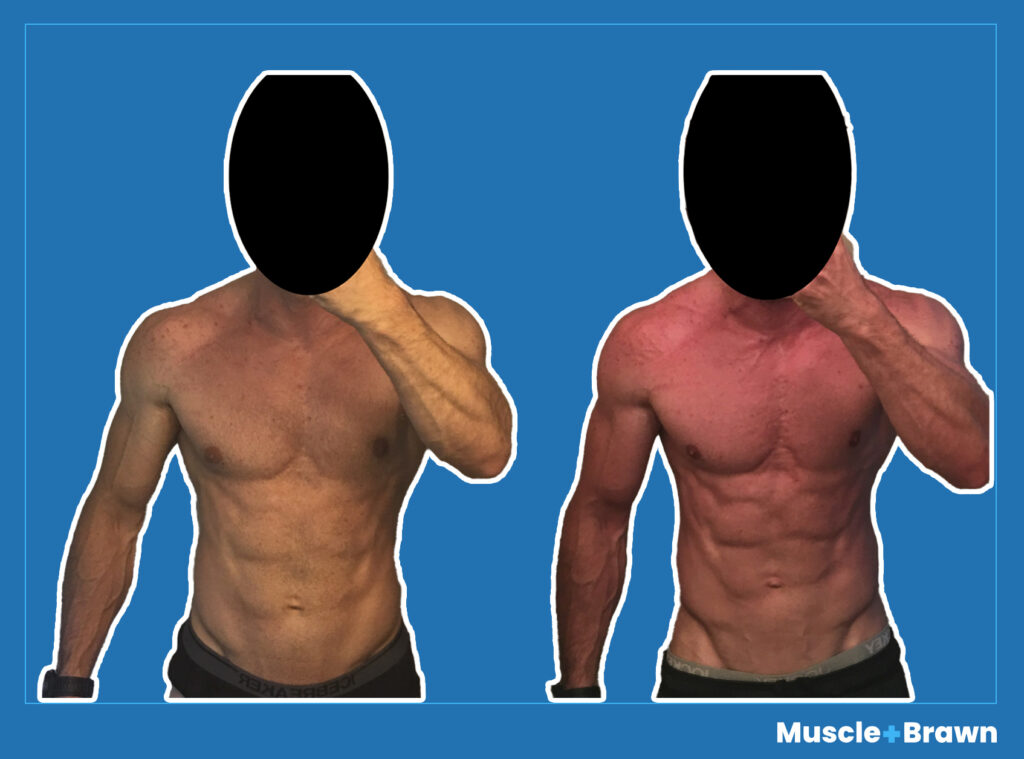
Before and after photos for Fragment are rarely dramatic, and that matches what users write. The pattern that comes up again and again in forum reviews is the same: no noticeable feeling from the compound, and steady weight loss when a diet and training plan are already in place.
Most reports describe a 3 to 4 week cycle at 250 to 500 mcg per day, split into a morning and a pre-bed injection on an empty stomach. Reported scale weight losses over that period usually fall between 5 and 10 lbs. Those numbers come with heavy caveats: the users were also dieting, many were running or coming off other compounds, and early weight loss on any diet includes water and glycogen. None of these reports had a control group.
A Representative User Report
One detailed forum review describes a 3.5-week run with a rising dose: lower in week one, then higher through weeks two and three. The user injected morning and evening, fasting before and after each dose, and noticed no side effects and no sense of the compound “working.”
What they did notice was that their bodyweight kept dropping, even though they relaxed their diet and raised calories during the cycle. Total loss was roughly 7 lbs. The user pointed out that part of that was likely glycogen and water lost after coming off a heavier cycle of other compounds, so not all of it can be credited to Fragment.
Their own view was that Fragment works better on top of an anabolic base, which protects muscle during an aggressive diet. That is one person’s opinion, and it shows the problem with user reports: when several compounds and a diet change at once, the peptide’s own contribution can’t be separated out.
What You Should Realistically Expect
Honest expectations for a Fragment cycle, with diet and training in place:
- The 5 to 10 lbs of scale weight users report over 3 to 4 weeks is mostly the result of the diet, water and glycogen. How much extra fat Fragment burns on top of that is unknown
- Based on the human AOD-9604 trials, any added fat loss from the peptide is likely to be small, and it may be none
- Users often say midsection fat responds first, but no human study has shown that Fragment targets belly fat
- Higher doses don’t appear to help: users rarely report better results above 500 mcg per day
- You won’t feel it working the way you feel stimulants or thermogenics. If it does anything, it shows up slowly on the scale and in the mirror
The biggest driver of a good before and after is still a modest calorie deficit, often 300 to 500 calories below maintenance, with resistance training and enough protein to hold on to muscle. Some users stack Fragment with GH secretagogues such as CJC-1295 and Ipamorelin. That adds the effects and side effects of raised GH and IGF-1, which is exactly what Fragment on its own is meant to avoid.
Commonly Reported Dosing
There is no approved dose for HGH Fragment 176-191, and no human study has tested the injected research peptide at the doses users run. The figures below are commonly reported doses, not recommendations.
The most commonly reported range is 250 to 500 mcg per day, split into two subcutaneous injections: one in the morning and one before bed, both on an empty stomach. Users typically avoid food for about 30 minutes before and after each injection, on the reasoning that eating, and the insulin response it causes, blunts fat release.
Some users take one larger morning dose instead. Split dosing is more common in reports, as the peptide is thought to be cleared from the body quickly.
Reconstitution
As a worked example, adding 2 mL of bacteriostatic water to a 2 mg vial gives 1,000 mcg per mL, so 250 mcg is 0.25 mL, or 25 units on a U-100 insulin syringe. The peptide reconstitution calculator does the math for other vial sizes.
Cycle Length
Cycles of 3 to 4 weeks are common in user reports, and some people run it longer. There is no human data showing which length works best, or that longer cycles add anything.
Injection Site
Subcutaneous, usually in the abdomen or thigh. Rotating sites reduces local irritation.
Side Effects and Safety
The most commonly reported side effects are mild and mostly injection-related:
- Redness, swelling or mild pain at the injection site, mostly in the first week
- Headaches in the first few days
- Mild, short-lived tiredness or dizziness
- Occasional flushing
Because Fragment doesn’t meaningfully raise IGF-1, the classic side effects of full HGH, such as joint pain, carpal tunnel symptoms, fluid retention and blood sugar problems, are not expected. The human AOD-9604 trials support this part of the story: IGF-1 didn’t rise, and side effects were similar to placebo.
The caveats are real, though. Those trials used a pharmaceutical-grade product under medical supervision. Grey-market vials can be underdosed, contaminated or mislabeled, and there is no long-term safety data for injected Fragment at bodybuilding doses.
Legal Status and Sourcing
HGH Fragment 176-191 is not FDA-approved for any medical use. The FDA has also restricted US compounding pharmacies from preparing AOD-9604 and several other popular peptides, so a legitimate prescription is not a realistic route for most people. Growth hormone fragments, including AOD-9604 and hGH 176-191, are on the WADA prohibited list, so tested athletes should avoid them entirely.
In most places, Fragment is sold as a research chemical under a “not for human use” label, which puts it in the same grey area as other research peptides. Rules vary by country and change over time, so check the current status where you live.
If you research vendors, look for third-party certificates of analysis from accredited labs, HPLC and mass spectrometry data, lot-number traceability and a long track record. A certificate of analysis shows what was in a tested batch; it does not make a product safe to inject.

Pros
- Exceptional purity & testing (≥98%)
- Pharmaceutical-style packaging for stability
- Broad catalog across peptides & nootropics
- Strong reputation & consistency across years
Cons
- Some items frequently out of stock due to high demand
- Limited long-term data for some compounds
The Bottom Line
HGH Fragment 176-191 is one of the cleaner research peptides sold for fat loss, but the human evidence that it causes meaningful fat loss is weak.
- Rodent studies showed more fat burning and weight loss, but human trials of its close relative AOD-9604 found no meaningful fat loss compared with placebo.
- User before and after reports of 5 to 10 lbs of scale weight over 3 to 4 weeks come with a diet, water and glycogen loss, and often other compounds. The peptide’s own share is unknown.
- It was well tolerated in trials and doesn’t raise IGF-1, but it isn’t FDA-approved, it is banned by WADA, and grey-market quality varies. A calorie deficit and a solid training plan still drive the result.
Frequently Asked Questions
Disclaimer
Please read carefully
The information on this site is for educational and informational purposes only, and is not medical advice. Always consult a qualified healthcare professional before using any supplement or medication, or making changes to your health, fitness, or nutrition routine.
Not medical advice
Content here is not a substitute for professional medical advice.
Consult your doctor
Talk to your doctor before starting any supplement or new routine.
Use at your own risk
We are not responsible for adverse effects from acting on this.
Do your research
Make informed decisions about your own health.
No guarantees
Individual results vary. No claims about outcomes.
Important — Never disregard professional medical advice or delay seeking it because of something you read here. If you think you may have a medical emergency, call your doctor or your local emergency number right away.