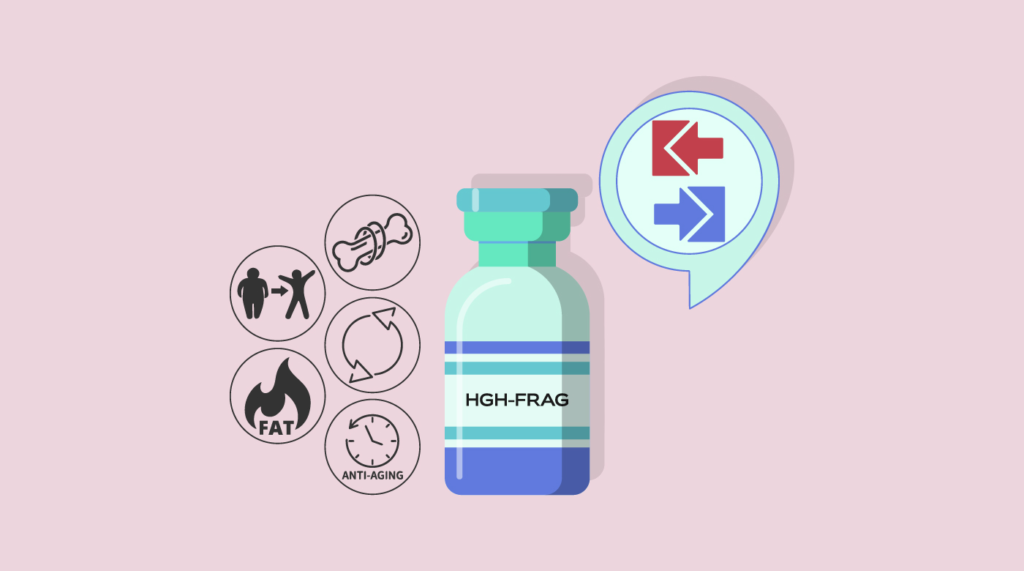
HGH Fragment 176-191 has one job, and it does that job very well. Strip fat. That’s it. No muscle-building properties, no growth hormone receptor binding, no insulin-like growth factor surge. Just targeted lipolysis, which is the process of pulling fatty acids out of fat cells and dumping them into the bloodstream where your body can burn them as fuel.
That narrowness of purpose is actually what makes it interesting. Most compounds that produce meaningful fat loss come with a trade-off: insulin resistance, suppression, organ stress, or a laundry list of systemic effects you didn’t sign up for. Fragment mostly sidesteps all of that.
But it still takes work. People who expect a peptide to do what a calorie deficit and a training programme should be doing are going to be disappointed. What Fragment can do is meaningfully accelerate fat loss when the fundamentals are already in place, particularly stubborn adipose tissue around the midsection.
Here’s what the research shows, what real users actually experience, and how to set accurate expectations going in.
Key Takeaways
- HGH Fragment 176-191 accelerates fat loss by stimulating lipase activity, which releases free fatty acids from fat cells into the bloodstream for use as fuel. 🔥
- It appears to have a particular affinity for visceral and abdominal fat, making it useful for targeting stubborn midsection fat. 💪
- Unlike full HGH, Fragment does not significantly raise IGF-1 or cause insulin resistance — giving it a cleaner risk profile for fat loss purposes. ⚖️
- Real-world user results typically show 5 to 10 lbs of fat loss over a 3 to 4 week cycle when combined with diet and training. ⚡
- Some evidence suggests potential secondary cardiovascular benefits, including modest improvements in blood pressure and lipid markers. ❤️

What is HGH Fragment 176 191?
Human Growth Hormone is a 191-amino acid peptide. Fragment 176-191 is, as the name describes, the last 16 amino acids of that chain. Specifically, the C-terminal region responsible for HGH’s lipolytic activity.
The research idea behind isolating this fragment was straightforward: HGH’s fat-burning effects come primarily from this tail end of the molecule. If you can administer just that fragment, you get the lipolysis without triggering the growth hormone receptor in the liver — which is what drives IGF-1 production and, in turn, insulin resistance.
That separation of effects is what makes Fragment clinically interesting. Studies in obese rodents showed it produced fat loss at rates 12 times greater than equivalent doses of full HGH, with none of the glucose metabolism disruption. Human data is more limited, but the mechanism is well-characterized and the anecdotal record from the research community is consistent with the animal data.
In practical terms, it works like this: Fragment stimulates lipase, the enzyme responsible for breaking down triglycerides stored in fat cells. This releases free fatty acids into circulation, where they can then be oxidized for energy through the standard beta-oxidation pathway. The abdominal and visceral fat depots appear to respond particularly well, which aligns with what users consistently report.
How It Actually Burns Fat
Fat loss at the cellular level involves a sequence of steps that Fragment helps accelerate at the earliest stage. When lipase activity increases, stored triglycerides in adipocytes are broken down into free fatty acids. Those fatty acids enter the bloodstream and make their way to tissues with mitochondria — primarily skeletal muscle — where they’re converted into acetyl-CoA and fed into the citric acid cycle to generate ATP.
The key distinction between Fragment and full HGH at this stage is the insulin sensitivity question. Full HGH, used at dosages common in bodybuilding, can promote glucose being stored as fat rather than burned. It’s a somewhat counterproductive effect that requires careful management. Fragment appears to sidestep this issue entirely. It doesn’t bind to the GH receptor in a way that stimulates IGF-1, so the insulin sensitization pathway isn’t disrupted in the same way.
What you get is essentially targeted fat mobilization without the anabolic and metabolic complexity of full HGH. For someone whose only goal is body recomposition with fat as the primary target, that’s a meaningful advantage.
Before and After HGH Fragment 176 191
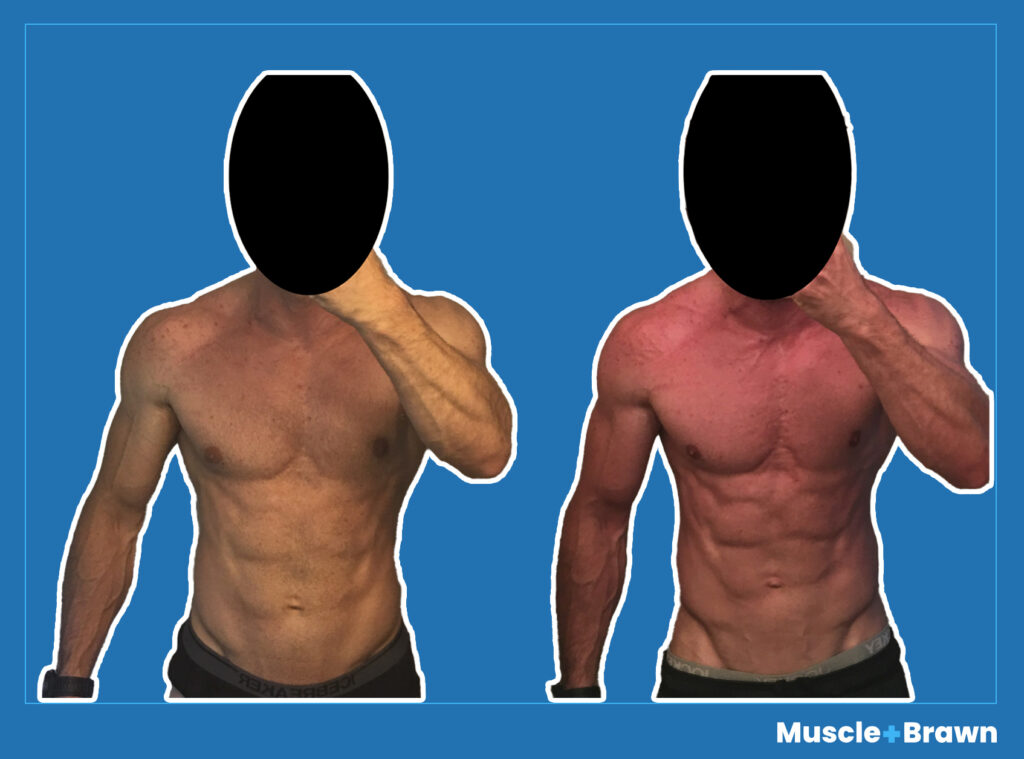
HGH Fragment 176-191 Before and After: What Users Actually Experience
The research community reports for Fragment are more consistent than you’d expect from a grey-market compound. The pattern that comes up repeatedly is: no dramatic subjective experience, but the scale moves and it moves in the right direction.
The most commonly cited user experience goes something like this: a 3 to 4 week cycle at doses ranging from 200 to 500 mcg per day, split across morning and pre-bed injections on an empty stomach, produces somewhere between 5 and 10 lbs of scale weight reduction. How much of that is pure fat versus water, glycogen, and other variables depends heavily on what else the person is doing — diet quality, training volume, and whether they’re running other compounds.
A Representative User Report
One well-documented community report ran Fragment for 3.5 weeks with a progressive dosing protocol, They would start lower in week one and increase through weeks two and three. Morning and evening injections, with fasting periods before and after each dose. The user noted no meaningful side effects and no subjective sense of the compound “working.”
What they did notice was that their bodyweight kept dropping despite loosening up on their diet and increasing calories during the cycle. Total loss over the period: roughly 7 lbs. The user appropriately noted that some portion of that weight was likely attributable to glycogen and nitrogen depletion from coming off a heavier compound cycle. Not all 7 lbs can be attributed to Fragment alone.
Their conclusion, which matches what most experienced users arrive at: Fragment works best when run on top of an anabolic base. Keeping muscle hardness and size from AAS or other anabolics allows for a more aggressive dietary approach during the Fragment cycle without the risk of catabolism eating into your gains. Run Fragment alone on a moderate deficit and you’ll still lose fat, but the results are less visually dramatic because you’re losing everything more slowly.
What You Should Realistically Expect
Honest expectations for a standalone Fragment cycle at standard doses, with diet and training in place:
- 3 to 5 lbs of net fat loss over a 3 to 4 week cycle is a realistic outcome for most users
- Abdominal and lower body fat tends to respond faster than other depots
- Scale weight may drop faster than fat loss alone would explain because some water follows glycogen as insulin dynamics shift
- Results are dose-dependent but there’s a ceiling: going above 500 mcg per day doesn’t appear to produce proportionally greater fat loss
- The compound is subtle. You won’t feel it working the way stimulants or aggressive thermogenics feel. The results show up in the mirror and on the scale, not in your subjective experience
Pair Fragment with a resistance training programme and a modest calorie deficit of 300 to 500 calories below maintenance, and results tend to land in the better half of that range. Stack it with a GHRP and CJC-1295 to amplify GH pulsatility and you can push further while still keeping the protocol relatively clean.
Dosing Protocol
The standard research-backed dosing range for HGH Fragment 176-191 is 250 to 500 mcg per day, typically split into two injections: one in the morning on an empty stomach and one before bed. Fasting for at least 30 minutes before and after each injection appears to improve uptake.
Some users run a single larger morning dose instead of splitting it. The split dosing approach is more commonly reported as producing consistent results, likely because Fragment’s half-life is relatively short and maintaining higher circulating levels throughout the day supports more sustained lipase activity.
Reconstitution
Add 2 mL of bacteriostatic water to a 2 mg vial to produce a concentration of 1,000 mcg per mL. A 250 mcg dose is then 25 units on a U-100 insulin syringe.
Cycle length
3 to 4 weeks is the standard recommendation. There’s limited evidence on whether running it longer produces additional benefit, and shorter cycles make sense given how most users structure their overall protocols.
Injection site
Subcutaneous, typically in the abdominal area or thigh. Rotating sites reduces localised irritation.
Side Effects and Safety Profile
Fragment’s safety profile is one of its genuine selling points compared to full HGH. The most commonly reported side effects are mild and injection-related:
- Injection site redness, swelling, or mild pain — particularly common in the first week
- Headaches, most often in the first few days as the body adjusts
- Mild fatigue or dizziness, usually transient
- Occasional flushing, more common when doses are taken too quickly
The lack of meaningful IGF-1 stimulation means the classic HGH side effect profile (joint pain, carpal tunnel syndrome, gynecomastia risk, glucose dysregulation) is largely absent. There are isolated reports of transient insulin sensitivity changes with Fragment, but these are far less consistent or clinically significant than what’s observed with full HGH.
The main caveat is the standard one for any research compound: long-term human safety data is limited. Fragment has not been approved by the FDA for any human application. It’s sold and used under research-only framing, which means you’re working with a compound that has a reasonable mechanistic and animal safety record but no large-scale human trials behind it.
Sourcing and Legal Status
HGH Fragment 176-191 can be obtained through two main channels. The first is a prescription from a physician. Some weight loss clinics and anti-aging practices do prescribe Fragment as part of supervised protocols alongside other compounds. If you can access that route, it’s the preferred option for quality assurance and medical oversight.
The second is purchasing it as a research chemical from an online vendor. If going this route, the same sourcing criteria apply as with any research peptide: third-party COAs from accredited labs, HPLC and mass spectrometry data, lot-number traceability, and a vendor with a demonstrated track record. Reconstitution and injection technique also matter.
Legally, Fragment occupies the same grey area as other research peptides. It’s not scheduled, FDA-approved, and is only sold under a research-use disclaimer. Rules vary by country and change with the regulatory environment, so checking current status in your jurisdiction before purchasing is always worth doing.
Conclusion: Is HGH Frag Worth it?
For someone whose primary goal is fat loss, particularly stubborn midsection fat, and who already has diet and training locked in, Fragment is worth the consideration. It’s one of the cleaner fat-burning research peptides available, it does what it’s supposed to do without creating a cascade of secondary problems, and the before and after evidence from the research community is more consistent than you’d expect.
It won’t build muscle. It won’t replace a calorie deficit. It won’t do anything dramatic if the fundamentals aren’t already in place. But if you’re already doing the work and want something that genuinely accelerates fat mobilisation, the HGH Fragment earns its place in the stack. Especially during a cut where protecting muscle is also a priority.
Frequently Asked Questions
How does HGH Fragment 176-191 cause fat loss?
Fragment stimulates lipase activity in adipose tissue, which breaks down stored triglycerides and releases free fatty acids into the bloodstream. Those fatty acids are then available to be oxidised as energy through beta-oxidation in mitochondria-containing cells, particularly skeletal muscle.
How much fat can you realistically lose on HGH Fragment 176-191?
With diet and training in place, most users report losing between 5 and 10 lbs over a 3 to 4 week cycle. Some of that will be water weight following glycogen shifts, especially if you’re transitioning from a heavier compound cycle. Net fat loss in that range is a realistic expectation — dramatic results without lifestyle changes are not.
What is the correct dosage for HGH Fragment 176-191?
The standard dosing range is 250 to 500 mcg per day, split across two injections — one in the morning and one before bed, both on an empty stomach. Reconstitute a 2 mg vial with 2 mL of bacteriostatic water to get a working concentration of 1,000 mcg per mL.
What are the side effects of HGH Fragment 176-191?
The most common side effects are mild and injection-related: localised pain or redness at the injection site, headaches in the first few days, and occasional mild fatigue or dizziness. The IGF-1-driven side effects associated with full HGH — joint pain, fluid retention, glucose dysregulation — are largely not observed with Fragment.
How long should you run HGH Fragment 176-191?
Three to four weeks is the standard cycle length. There’s no strong evidence that running it longer produces proportionally greater fat loss, and keeping cycles short is consistent with how most experienced users manage research peptide protocols.