Contents16 sections
The glow peptide protocol combines three research peptides, BPC-157, TB-500 and GHK-Cu, in one plan aimed at skin quality and tissue repair. GHK-Cu is the skin-focused ingredient, linked to collagen and elastin production. BPC-157 and TB-500 are better known as healing peptides, studied for tendon, muscle and wound repair.
The appeal is one plan that covers collagen, blood supply and inflammation at the same time. The catch is the evidence: most of what is known about these peptides comes from lab and animal studies, and the combination has never been tested in a human trial.
This guide explains what each peptide does, which benefits have some support and which are guesswork, the doses commonly reported for the protocol, the side effects and who should avoid it.
Key Takeaways
- The glow peptide protocol pairs GHK-Cu, a skin-focused copper peptide, with BPC-157 and TB-500, two peptides studied for tissue repair.
- Human data are scarce: BPC-157 has only a few small, uncontrolled human reports, TB-500 has no published human trials, and the three-peptide combination has never been studied.
- GHK-Cu’s collagen and elastin effects come from lab studies, and its human skin evidence comes mostly from topical creams, not injections.
- Commonly reported doses are 250-500 mcg of BPC-157 a day, 2-2.5 mg of TB-500 twice a week and 1-2 mg of GHK-Cu a day. None has been tested in a controlled trial.
- Expect subtle skin changes at best. Long-term safety is unknown, and people who are pregnant, have a cancer history or compete in tested sport should avoid it.
What Is the GLOW Peptide Blend?
Glow Stack is a vendor name, not a medical product. Formulas can differ between sellers, but the version most vendors sell as GLOW combines three peptides in a fixed ratio of about 5:1:1:
| Component | Typical amount per vial | What it is |
|---|---|---|
| GHK-Cu | 50 mg | A copper-binding tripeptide (glycine-histidine-lysine) found naturally in human plasma; levels fall with age |
| BPC-157 | 10 mg | A synthetic 15-amino-acid peptide based on a protein found in human gastric juice |
| TB-500 | 10 mg | A synthetic peptide based on thymosin beta-4, a protein involved in cell migration and tissue repair |
Some articles describe “glow” stacks that contain CJC-1295 or injectable glutathione. Those are different products: CJC-1295 is a growth hormone releasing peptide, and glutathione is an antioxidant usually given by IV drip. Neither is part of the GLOW blend. Some vendors also sell a four-peptide version, often called KLOW, which adds the anti-inflammatory peptide KPV.
The idea behind the stack is simple. GHK-Cu is the skin-focused ingredient, while BPC-157 and TB-500 are better known as healing peptides. Together they are meant to cover collagen, blood supply and tissue repair in one injection. Whether the three work better together than alone has never been tested.
How the Glow Peptide Protocol Signals Repair
Peptides are short chains of amino acids that act as signals in the body. The glow peptide protocol uses three of them to push skin and connective tissue toward repair: one aimed at the skin’s collagen matrix, and two aimed at healing and blood supply.
Each peptide works through a different pathway. Together they are meant to cover collagen and elastin production, wound healing and inflammation in one plan. Whether they work better together than alone has never been tested.
The Trio Behind the Glow Blend
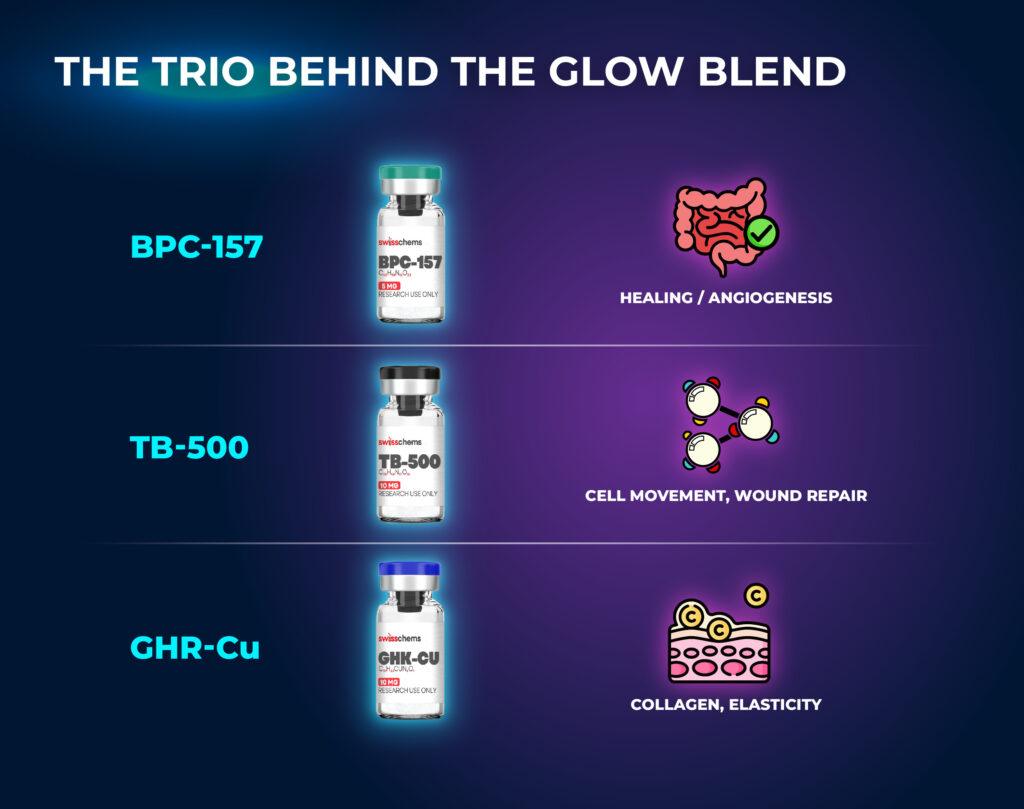
BPC-157 is a synthetic 15-amino-acid peptide based on a protein found in human gastric juice. In rat studies it sped up the healing of tendon, ligament, muscle and gut injuries, partly by promoting the growth of new blood vessels, which carry oxygen and nutrients to damaged tissue.
TB-500 is a synthetic peptide based on thymosin beta-4, a protein found in almost every human cell. Thymosin beta-4 binds actin, a protein cells use to move, and helps repair cells migrate into injured areas. Most TB-500 research is lab and animal work; the human trials that exist used full-length thymosin beta-4, not TB-500.
GHK-Cu is a copper-binding tripeptide (glycine-histidine-lysine) found naturally in human plasma and saliva, and its levels fall with age. In fibroblast cultures it increases the production of collagen, elastin and glycosaminoglycans, and it shows antioxidant and anti-inflammatory effects in lab studies. It is the ingredient with the most direct link to skin.
What Are the Benefits of the Glow Peptide Protocol?
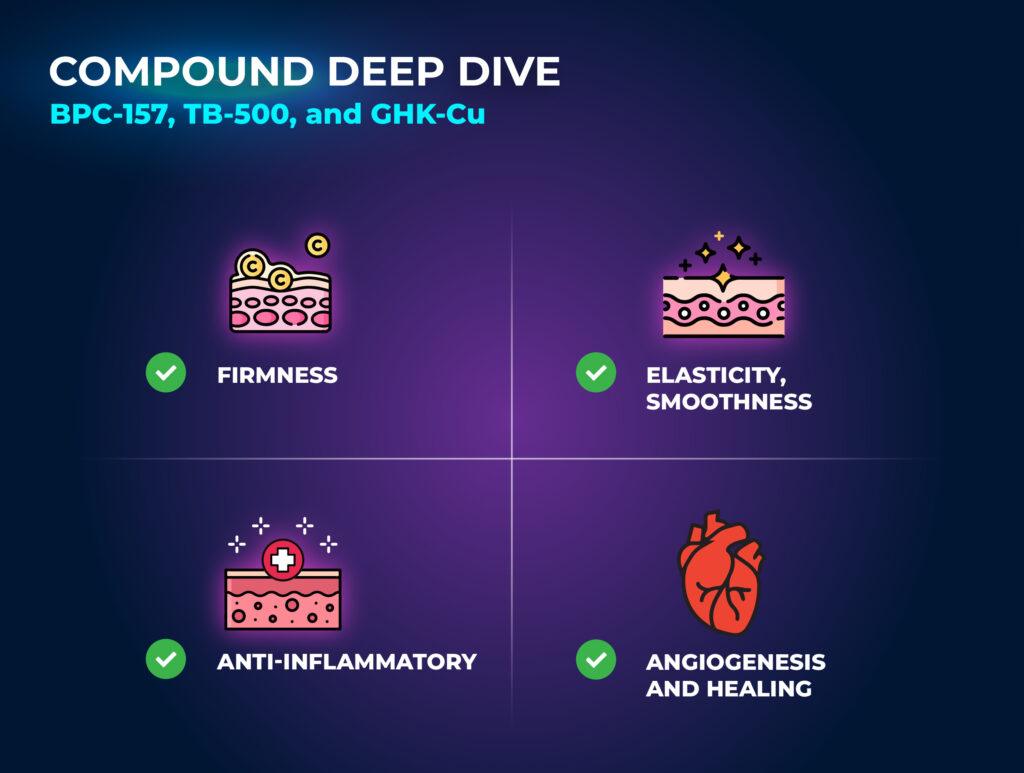
The protocol is marketed for firmer skin, fewer fine lines, a calmer tone and faster recovery. The mechanisms below come mostly from cell and animal studies, so read them as reasons the idea is plausible, not as proof of visible results.
Collagen Synthesis: Firmness and Skin Elasticity
Collagen is the scaffold that keeps skin firm, and elastin lets it spring back. Both decline with age, sun exposure and chronic inflammation. In fibroblast cultures, GHK-Cu increases collagen and elastin production and helps balance the enzymes that break down and rebuild the skin’s matrix (metalloproteinases and their inhibitors).
Copper is also a cofactor for lysyl oxidase, the enzyme that cross-links collagen and elastin fibres. Small studies of copper peptide creams on facial skin reported modest improvements in firmness, skin density and fine lines over several weeks to a few months. BPC-157 and TB-500 add little here directly; their role in the protocol is repair and blood supply.
Anti-Inflammatory Effects: Calming Redness
Inflammation is part of early healing, but when it stays high it slows repair and breaks down collagen. All three peptides have lowered markers of inflammation in lab or animal models. On the skin, that could mean less redness and swelling, but no study has measured this for the injected protocol.
Angiogenesis: New Blood Vessels for Repair
New blood vessels bring oxygen, amino acids and growth factors to healing tissue. BPC-157 has been linked with angiogenesis in injured tissue in rat studies, and thymosin beta-4 also supports blood vessel formation during repair. This is the main reason the pair is used for recovery from injuries, and also the main reason for caution in anyone with a cancer history (see the safety section).
What Results Look Like Over Time
Expect subtle cosmetic changes, not a transformation. The topical copper peptide studies measured changes in fine lines and firmness over a few months, not days. There is no comparable data for the injected blend, so user reports of results within 4-12 weeks are anecdotal.
Why BPC-157 and TB-500 Are Paired
BPC-157 and TB-500 are one of the most common peptide pairs for injury recovery. The idea is that they cover different steps: BPC-157 supports blood vessel growth and tissue healing (and, in rat studies, the gut lining), while TB-500 helps repair cells move into the damaged area.
People use the pair for tendon and joint strain and for recovery from hard training, and some use it around cosmetic procedures. In the glow protocol, the two are added to GHK-Cu on the theory that better repair and blood supply also help the skin. The theory is reasonable but untested: no study has compared the combination with either peptide alone.
Other Uses: Scalp, Gut and Anti-Aging
Scalp Health
Copper peptides are also used on the scalp. In lab and animal studies they supported hair follicles and may lengthen the anagen (growth) phase of the hair cycle, and more time in the growth phase can mean thicker hair over time. Human evidence for regrowth is weak, and results depend on the cause of hair loss. For the wider picture, see our guide to peptides for hair growth.
Some routines pair gentle scalp microneedling with a copper peptide solution applied afterwards. Freshly needled skin absorbs more, but it also irritates and gets infected more easily, so timing and frequency are best set with a dermatologist. No study has tested whether injected BPC-157 or TB-500 helps the scalp recover after microneedling.
Gut Health
Gut and skin health are thought to be linked through the immune system: a weaker gut barrier lets more irritants through, which can raise systemic inflammation that shows up in the skin. BPC-157 is best known in research for protecting and repairing the gut lining in rat studies. Whether that leads to clearer skin in people has not been studied.
The basics have better evidence: fibre-rich foods, enough quality protein, good hydration and limited alcohol all help protect the gut lining.
Anti-Aging Glow
Aging lowers collagen, elastin and skin hydration. The glow protocol targets all three from more than one angle, and users often report a brighter, smoother look over a few months, but these reports are anecdotal.
The habits with the best evidence matter more than any peptide. Wear sunscreen daily, use a gentle cleanser and a moisturiser that suits your skin type, and add a retinoid at night if your skin tolerates it. Sleep seven to nine hours, don’t smoke, and keep up regular resistance training for overall health.
What the Evidence Actually Shows
This is the most important point about the glow peptide protocol: human data on BPC-157 and TB-500 are scarce, and the three-peptide combination has never been studied in people. Each ingredient has a different level of evidence.
| Peptide | Main evidence | Human data |
|---|---|---|
| GHK-Cu | Cell studies, animal wound models, topical skin studies | Small studies of copper peptide creams on facial skin; no controlled trials of injections |
| BPC-157 | Rat studies on tendon, ligament, muscle and gut healing | A few small, uncontrolled reports; no controlled trials |
| TB-500 | Lab and animal studies on wound, heart and eye tissue | None for TB-500 itself; human trials used full-length thymosin beta-4 as eye drops or skin gel |
| Glow protocol (all three) | None published | None |
Results in animals often fail to carry over to people, and rat studies dose by body weight, so their doses do not translate directly into human doses. For how the premixed version of the three peptides is put together and dosed, see our guide to the Glow Stack peptide blend.
Glow Peptide Protocol Dosage: Commonly Reported Doses
There is no approved or studied dose for the glow peptide protocol. The figures below are doses commonly reported by users and vendors. They are listed so you know what is being discussed, not as advice, and none has been tested in a controlled human trial.
| Peptide | Commonly reported dose | Frequency | Typical course |
|---|---|---|---|
| BPC-157 | 250-500 mcg | Once a day (sometimes split into two), subcutaneous | 4-8 weeks |
| TB-500 | 2-2.5 mg | Twice a week for the first 4-6 weeks, then about 2 mg once a week | 6-12 weeks |
| GHK-Cu (injectable) | 1-2 mg | Once a day, subcutaneous | Several weeks, then a break |
| Premixed blend (50/10/10 mg vial) | 1-2 mg of GHK-Cu, delivering 200-400 mcg each of BPC-157 and TB-500 | Once a day, subcutaneous | Several weeks, then a break |
Watch the units: BPC-157 is dosed in micrograms (mcg), TB-500 and GHK-Cu in milligrams (mg), and mixing them up is a common dosing error. Because its ratio is fixed, the premixed blend also delivers much less TB-500 per week than a standalone TB-500 protocol.
Cycle Structure
A commonly reported structure has three phases:
- Weeks 1-6: loading phase, with TB-500 at the higher, twice-weekly frequency. Track skin response each week.
- Weeks 7-12: maintenance phase at a lower frequency.
- Week 12: reassess, then take a break of several weeks or adjust. There is no data on how long continuous use is safe.
Injection and Administration
These peptides are usually given by subcutaneous injection: the needle goes into the soft fat under the skin, most often on the abdomen or thigh. Rotate sites to reduce irritation, clean the skin first and use a new sterile needle every time.
- Do not mix products in the same syringe unless a clinician directs it.
- Keep reconstituted vials in the fridge and follow the supplier’s storage instructions.
- If you also use topical copper peptides, keep vitamin C (ascorbic acid) and strong acids for a different time of day.
Some people inject near scars, fine lines or slow-healing areas, or time injections around microneedling or laser sessions. There is no evidence that injecting near the treated area works better than a standard site, and injecting into the face carries extra risk. The facial skin data for GHK-Cu come from topical use.
Tracking Your Results
Track simple markers: skin texture, hydration, redness and recovery time after training or treatments. Take photos in the same light each week, and keep a short log of sleep, stress and protein intake. If nothing has changed by week 12, the protocol is unlikely to be worth continuing.
Choosing a Supplier
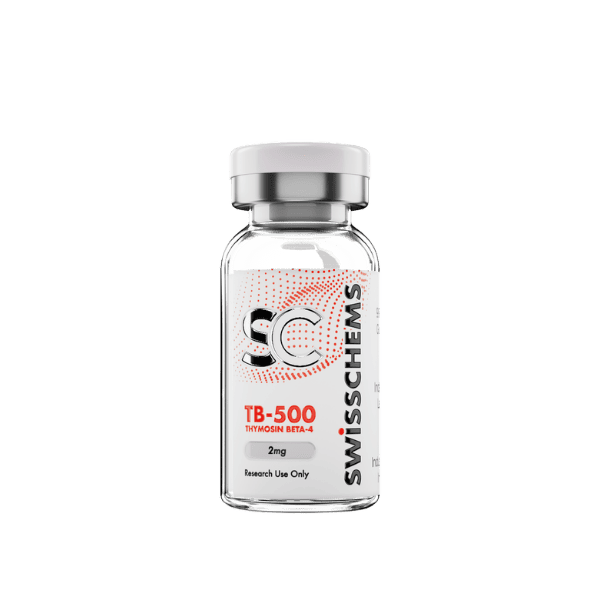
Research peptides are not regulated like medicines, so purity and dose vary between vendors. Choose a supplier that publishes recent third-party test results (certificates of analysis) for each batch and states the exact amount of each peptide on the label. A certificate of analysis shows what is in the vial; it does not make the product safe to inject. SwissChems sells TB-500 as a single peptide for anyone who prefers to dose the ingredients separately.

Pros
- Exceptional purity & testing (≥98%)
- Pharmaceutical-style packaging for stability
- Broad catalog across peptides & nootropics
- Strong reputation & consistency across years
Cons
- Some items frequently out of stock due to high demand
- Limited long-term data for some compounds
Overview
- Form: Lyophilized powder
- Researched Dosage: 2 mg to 5 mg per week, often split into two doses, during a 4-6 week loading phase; then 2 mg to 2.5 mg every 1-2 weeks for maintenance
- Typical Cycle: 4-8 weeks
- Cost: $23.96-$25.16
- Stacking Options: BPC-157, GHK-Cu, CJC-1295/Ipamorelin
Pros
- Thought to help regulate actin, a protein involved in cell movement and structure, which may help with tissue repair and recovery.
- Animal studies suggest it may speed up healing in muscle, tendon, ligament and skin, and may reduce inflammation.
- Commonly paired with BPC-157 because the two peptides are believed to support recovery in different ways.
Cons
- May encourage new blood vessel growth and cell migration, which raises a theoretical concern about speeding up existing tumors. Long-term human safety data is very limited.
- Not an approved human medication. The FDA lists it as a bulk substance with potential safety risks (Category 2), and WADA bans it for tested athletes.
Compared to Other Peptides
| Peptide / Stack | Main use | Evidence | Best fit |
|---|---|---|---|
| Glow Stack (GHK-Cu + BPC-157 + TB-500) | Skin quality, with tissue repair as a secondary aim | No trials of the blend | Skin-focused users who accept injections |
| GHK-Cu alone | Skin and collagen | Topical human studies; injection data lacking | Skin goals; topical use is an option |
| BPC-157 | Tendon, ligament and gut repair | Mostly rat studies | Injury recovery |
| TB-500 | Tissue repair and cell migration | Mostly animal studies | Injury recovery, often stacked with BPC-157 |
| CJC-1295 + Ipamorelin | Raises growth hormone release | Small human studies of each peptide | Body composition and recovery goals, not skin |
Who the GLOW Protocol Is For
Adults Focused on Skin Quality and Early Signs of Aging
The blend is aimed at people who notice dull or dry skin, fine lines or reduced firmness and want to support collagen and hydration. It is a cosmetic experiment with an unproven upside, so it makes most sense for people who already have the basics in place: sun protection, sleep and a consistent skincare routine.
Lifters and Athletes
Interest from lifters usually comes from the BPC-157 and TB-500 content. The Glow Stack is not a muscle-building peptide: it does not raise growth hormone or testosterone. Tested athletes should avoid it, because BPC-157 and TB-500 are on the WADA prohibited list.
People Who Prefer a Non-Injected Option
The Glow Stack is injected, so it is not a non-invasive treatment. If you want to avoid injections, topical GHK-Cu serums and creams are where most of the human skin data come from.
Safety, Side Effects and Who Should Avoid It
Short-term reports describe these peptides as generally well tolerated, but no study has tracked their long-term safety in people. The most commonly reported side effects are at the injection site: stinging (GHK-Cu injections often sting), redness, swelling, itching and small bruises. Some users report headache, nausea, tiredness or a brief light-headed feeling, effects more often linked to TB-500.
Stop and speak with a doctor if you get severe redness or swelling, a fever, or a spreading rash or hives. These can point to an infection, an allergic reaction (including to copper) or a contaminated product.
Avoid the protocol if you:
- are pregnant or breastfeeding
- have a current or past cancer: BPC-157 and TB-500 promote blood vessel growth in lab and animal studies, and thymosin beta-4 has been linked to tumour growth in some lab research
- have Wilson’s disease or another copper metabolism disorder, or a copper allergy
- have a weakened immune system or a serious chronic illness, unless a specialist oversees it
- compete in tested sport: BPC-157 and TB-500 are on the WADA prohibited list
Because these products are unregulated, the bigger risks may be contamination, wrong peptide content and dosing errors. Buy from a tested source and store the vials as directed.
The Bottom Line
The glow peptide protocol pairs a skin peptide with two healing peptides, but the evidence behind it is mostly lab and animal data.
- GHK-Cu is the skin ingredient, and its best human data come from topical creams. Human data on BPC-157 and TB-500 are scarce, and the combination has never been tested.
- Commonly reported doses are 250-500 mcg of BPC-157 a day, 2-2.5 mg of TB-500 twice a week and 1-2 mg of GHK-Cu a day, usually over 8-12 weeks. They are not studied or approved doses.
- Expect subtle changes at best. Keep up sunscreen and a basic skincare routine, buy only third-party-tested products, and skip it if you are pregnant, have a cancer history or compete in tested sport.
Frequently Asked Questions
Disclaimer
Please read carefully
The information on this site is for educational and informational purposes only, and is not medical advice. Always consult a qualified healthcare professional before using any supplement or medication, or making changes to your health, fitness, or nutrition routine.
Not medical advice
Content here is not a substitute for professional medical advice.
Consult your doctor
Talk to your doctor before starting any supplement or new routine.
Use at your own risk
We are not responsible for adverse effects from acting on this.
Do your research
Make informed decisions about your own health.
No guarantees
Individual results vary. No claims about outcomes.
Important — Never disregard professional medical advice or delay seeking it because of something you read here. If you think you may have a medical emergency, call your doctor or your local emergency number right away.