Contents11 sections
Eating what feels like a lot and still not gaining weight is a common problem for naturally lean lifters. “Just eat more” is correct advice, but it is hard to follow when you have a small appetite, a busy schedule or a high daily energy burn.
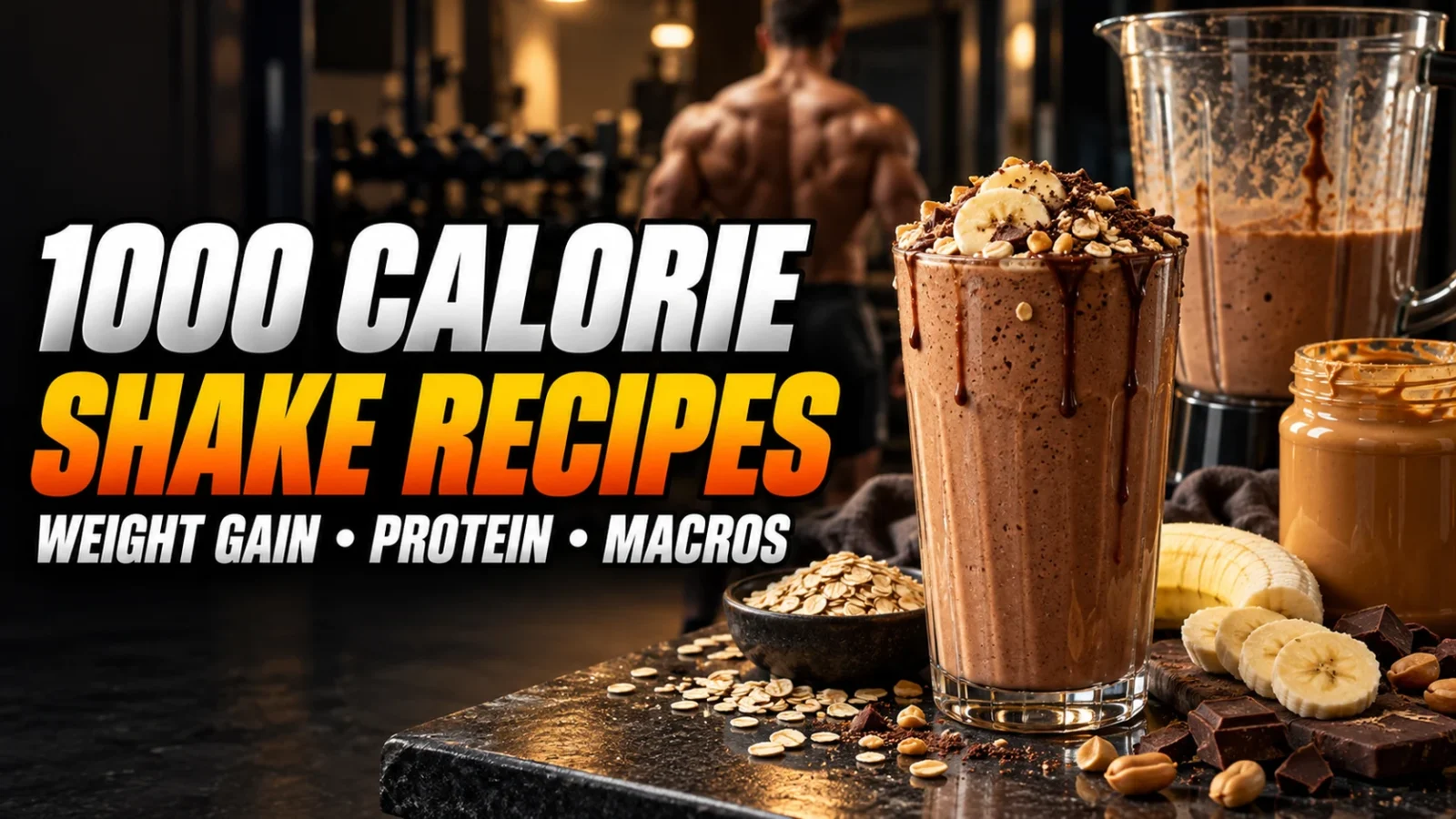
A 1000 calorie shake makes it easier. It is a homemade blend of protein powder, oats, milk, fruit and nut butter that delivers a full meal’s worth of calories in a glass you can finish in a few minutes.
Whether you are a bodybuilder in an off-season, a naturally skinny “hard-gainer” or someone rebuilding muscle after time off, this guide gives you three recipes with checked calorie and macro counts, the most useful calorie-dense ingredients, and the best times to drink the shake.
Key Takeaways
- A 1000 calorie shake helps you reach a calorie surplus, which weight gain requires. It only works if your total daily intake ends up above what you burn.
- The three recipes below come to roughly 1,015-1,055 calories and 67-82g of protein each, based on standard food values. Your brands and portions will change the numbers.
- Oats, whole milk, Greek yogurt, nut butter and bananas add calories efficiently. Honey and maple syrup add flavor, but they are sugar.
- Drink it with breakfast, after training or between meals. A full shake is heavy, so leave 2-3 hours before a workout or split it in two.
- Aim for slow, steady gain (a common guideline is about 0.25-0.5% of body weight per week) and make the shake smaller if the scale moves faster.
What Is a 1000 Calorie Shake?
Gaining weight requires a calorie surplus: you have to take in more calories than you burn. It sounds simple, but it is harder than it looks for some people.
Some people burn more energy than they realize, and others fill up quickly and struggle to finish large meals. Liquid calories tend to be less filling than the same calories from solid food, so a shake is often easier to get down than another plate of food. That is where a 1000 calorie shake helps:
- It is calorie-dense and quick to drink.
- It provides protein, carbs and fats in one serving.
- It is easy to adjust to your taste, your diet and your calorie target.
Many commercial mass gainers get most of their calories from maltodextrin and sugar. A homemade shake lets you build the same calories from whole foods and see exactly what is in it. Keep in mind that extra calories build muscle only alongside resistance training and enough protein. Without training, most of the surplus is stored as fat.
The 1000 Calorie Shake Recipes
Here are three 1000 calorie shake recipes to help you reach your bulking calories without stuffing yourself. For more ways to raise your intake, see our list of high-calorie foods for bulking.
The figures are approximate and based on standard values for common products. Protein powders vary the most: a scoop can contain anywhere from about 20g to 30g of protein, so check your label and adjust the totals.
1. Chocolate Peanut Butter Powerhouse
The highest-protein recipe of the three, with the classic chocolate and peanut butter combination. Blend everything with a handful of ice cubes until smooth.
| Ingredient | Calories | Protein | Carbs | Fat |
|---|---|---|---|---|
| 2 scoops chocolate whey protein | 250 | 50g | 6g | 3g |
| 2 tbsp peanut butter | 190 | 7g | 8g | 16g |
| 1 medium banana | 105 | 1g | 27g | 0g |
| 1/2 cup rolled oats | 150 | 5g | 27g | 3g |
| 1 tbsp honey | 65 | 0g | 17g | 0g |
| 1 cup whole milk | 150 | 8g | 12g | 8g |
| 1/2 cup plain whole-milk Greek yogurt | 110 | 10g | 5g | 6g |
| 1 tbsp ground flaxseed | 35 | 1g | 2g | 3g |
| Total | about 1,055 | 82g | 104g | 39g |
Want more? A full cup of Greek yogurt adds about 110 calories and 10g of protein.
2. Banana and Nut Mass Builder
A naturally sweet shake built on two bananas and almonds. Almonds and almond butter are not interchangeable cup for cup: a quarter cup of whole almonds has about the same calories as 2 tablespoons of almond butter, not a quarter cup of it.
| Ingredient | Calories | Protein | Carbs | Fat |
|---|---|---|---|---|
| 2 scoops vanilla protein | 250 | 50g | 6g | 3g |
| 2 medium bananas | 210 | 3g | 54g | 1g |
| 1/4 cup almonds (or 2 tbsp almond butter) | 205 | 7g | 7g | 18g |
| 1/2 cup rolled oats | 150 | 5g | 27g | 3g |
| 1 cup unsweetened almond milk | 35 | 1g | 2g | 3g |
| 1/2 cup full-fat Greek yogurt | 110 | 10g | 5g | 6g |
| 1 tbsp chia seeds | 60 | 2g | 5g | 4g |
| Total | about 1,020 | 78g | 106g | 38g |
Optional: drizzle 1 tablespoon of maple syrup on top. It adds about 50 calories and 12-13g of sugar, which is not included in the total above.
3. Mocha Morning Muscle Shake
A breakfast shake with a coffee kick. Regular ice cream is used here; premium brands can add considerably more calories per half cup.
| Ingredient | Calories | Protein | Carbs | Fat |
|---|---|---|---|---|
| 2 scoops chocolate or mocha protein | 250 | 50g | 6g | 3g |
| 1 tsp unsweetened cocoa powder | 5 | 0g | 1g | 0g |
| 1/2 cup rolled oats | 150 | 5g | 27g | 3g |
| 1 tbsp coconut oil | 120 | 0g | 0g | 14g |
| 1 medium banana | 105 | 1g | 27g | 0g |
| 1 shot espresso or 1 tsp instant coffee (optional) | 0 | 0g | 0g | 0g |
| 1 cup whole milk | 150 | 8g | 12g | 8g |
| 1/2 cup regular vanilla ice cream | 135 | 2g | 16g | 7g |
| A few drops of vanilla extract or a pinch of cinnamon | 0 | 0g | 0g | 0g |
| 2 tbsp heavy cream, whipped, as a topping | 100 | 1g | 1g | 11g |
| Total | about 1,015 | 67g | 90g | 46g |
Tips for a Smooth 1000-Calorie Shake
- Blend on high for 45-60 seconds: this gives a smooth, lump-free shake, even with thick ingredients like oats, frozen bananas or nuts.
- Layer it: start with the liquid (milk or a plant milk), then the protein powder, then soft ingredients like yogurt and banana, and frozen items last. Your blender will process everything more evenly.
- Adjust the texture: too thick? Add a splash of milk. Too thin? Add oats or frozen fruit such as mango or blueberries. For a creamier shake, use a frozen banana or a spoonful of Greek yogurt.
- Add flavor without much sugar: cinnamon, unsweetened cocoa, vanilla extract and espresso add flavor with almost no sugar. Honey and maple syrup add flavor too, but they are sugar (roughly 12-17g per tablespoon), so count them in your totals.
- Use ground flaxseed: whole flaxseeds can pass through the gut undigested, so buy them ground or grind them first.
- Take your time: if a full shake leaves you bloated, sip it over 20-30 minutes or split it into two servings a few hours apart.
Best Ingredients for High-Calorie Smoothies

Mix and match these to build your own shake. Calories are approximate per typical portion.
| Ingredient | Portion | Calories | What it adds |
|---|---|---|---|
| Rolled oats | 1/2 cup | 150 | Slow-digesting carbs, fiber and B vitamins; thickens the shake |
| Whole milk | 1 cup | 150 | Protein (whey and casein), calcium and fat |
| Greek yogurt (plain, whole milk) | 1/2 cup | 110 | Protein, calcium and live cultures; a rich, creamy texture |
| Canned full-fat coconut milk | 1/4 cup | about 110 | Very calorie-dense, mostly saturated fat; the carton drink has far fewer calories |
| Unsweetened almond milk | 1 cup | 30-40 | A dairy-free base with few calories; use it for a lighter shake, not a bigger one |
| Peanut butter | 2 tbsp | 190 | Fat, some protein and vitamin E; creaminess |
| Almonds, walnuts or cashews | 1/4 cup | 190-210 | Fats, protein, magnesium and zinc |
| Ground flaxseed or chia seeds | 1 tbsp | 35-60 | Plant omega-3 (ALA) and fiber; thickens the shake |
| Banana (frozen works best) | 1 medium | 105 | Carbs and potassium; a thick, ice-cream-like texture without ice |
| Frozen berries or mango | 1 cup | 50-100 | Vitamin C, folate and antioxidants; natural sweetness (still sugar, but no added sugar) |
| Medjool dates | 2 dates | about 135 | Natural sweetness with fiber and potassium |
| Protein powder | 1 scoop | 100-130 | About 20-25g of protein in most whey products; pick one with little or no added sugar |
| Avocado | 1/2 fruit | 115-160 | Creamy texture and mostly unsaturated fat |
| Spinach | 1 cup raw | about 7 | Vitamins A and K, folate and magnesium; nutrients rather than calories, and you will barely taste it |
Benefits of a 1000 Calorie Shake
Supports Muscle Growth When You Train
Each recipe delivers roughly 65-85g of protein along with carbs and fats. A large meta-analysis of resistance-training studies found that gains in muscle mass leveled off at around 1.6g of protein per kg of body weight per day (about 0.7g per lb), so one shake covers a big share of most lifters’ daily target.
- Whey protein digests quickly and is rich in leucine, the amino acid most closely linked to switching on muscle protein synthesis.
- Milk and Greek yogurt add casein, which digests more slowly.
- Peanut butter and nuts add calorie-dense fat, so you reach 1,000 calories without a huge glass.
Convenient for Busy Schedules
Few people want to cook six meals a day. Throw the ingredients into a blender, blend on high, and in about five minutes you have the calories of a large meal that would otherwise take half an hour or more to cook and eat. To save more time, portion the dry ingredients (protein powder, oats, seeds) into jars for the week.
Easier to Finish Than a Big Meal
Large solid meals can leave you feeling stuffed. A shake goes down faster and, for most people, feels less filling than the same calories from food. That is the advantage for people who struggle to eat enough, and also why shakes can cause unplanned fat gain if you are not tracking your weight.
- Oats add slow-digesting carbs and fiber. If half a cup leaves you bloated, start with a quarter cup.
- Bananas are easy on most stomachs and add potassium.
- Fat slows digestion. If the shake sits heavy, halve the nut butter or oil and make up the calories with oats or banana.
Customizable for Any Diet
Lactose intolerant, vegan or allergic to nuts? The shake is easy to adapt:
- Dairy-free: use a plant protein (pea and rice blends are common) with soy, oat or coconut milk. Soy milk has the most protein of the common plant milks, about 7g per cup.
- Watch the swap: replacing a cup of whole milk with unsweetened almond milk removes about 115 calories and 7g of protein, so add oats or nut butter to make up the difference.
- Nut-free: swap nut butter for sunflower seed butter or tahini, which have similar calories per tablespoon.
- More calories from fat: add half an avocado or a tablespoon of coconut oil (about 120 calories).
Fuel for Training and Recovery
The carbs in the shake help refill muscle glycogen, the protein supplies amino acids for repair, and the fats add long-lasting energy. That makes it a practical option on hard training days, when your calorie needs are highest.
Choosing a Protein Powder for Your Shake
The protein powder provides most of the protein in these recipes, so it is worth choosing carefully:
- Whey concentrate: the cheapest option, mixes well and contains some lactose.
- Whey isolate: filtered further, with very little lactose or fat; often the better choice for sensitive stomachs.
- Casein: digests slowly and gives a thicker texture, which suits an evening shake.
- Plant blends: dairy-free; mixing sources such as pea and rice gives a more complete amino acid profile than either alone.
On the label, check the protein per scoop, the added sugar, and whether the product is third-party tested (for example NSF Certified for Sport or Informed Sport), which means an independent lab has screened it for banned substances. For specific picks, see our guide to the best protein powder for skinny guys, or our protein powders for sensitive stomachs if dairy gives you trouble.
Enhanced Labs, one of our partners, sells protein powders alongside its other supplements. Our Enhanced Labs review covers its range.

Pros
- Catalog is specifically organized around muscle building, fat loss, testosterone support, and workout performance.
- Range includes creatine, protein, EAAs, beta-alanine, and L-citrulline alongside more specialized formulas.
- Orders of $99+ qualify for free US shipping.
Cons
- Features several strong claims around muscle growth, testosterone, fat loss, and metabolic effects that should be distinguished from independently demonstrated clinical outcomes
- Heavily oriented toward bodybuilding and performance rather than broader nutritional supplementation.
The Best Time to Drink a 1000 Calorie Shake
Your total calories and protein across the day matter far more than timing. Timing simply makes the shake easier to fit in and more comfortable to drink.
Morning
Start the day with a big chunk of your calories already in. This works especially well if you wake up with no appetite or don’t have time for a large breakfast.
Before a Workout
A 1,000-calorie shake with around 40g of fat digests slowly, and training on a full stomach can cause nausea. Most people do best drinking it 2-3 hours before training. If you train sooner, drink half beforehand and the rest afterwards.
After a Workout
After a hard session, the carbs help refill glycogen stores and the protein supports muscle repair. There is no need to rush: the window after training is wider than once believed, and drinking the shake within a couple of hours is fine.
As a Meal Replacement
No time for a full meal? The shake is a solid stand-in when you are rushing between work, class or the gym, with no cooking needed.
Still aim to eat proper meals most of the day. Think of the shake as a meal-saver, not a permanent replacement for vegetables and other whole foods.
How Often Should You Drink It?
Once a day is enough for most people. Keep in mind that 1,000 extra calories a day on top of a diet that already meets your needs is a large surplus, and most of the extra weight gained that fast will be fat. The shake works best when it replaces a smaller snack or makes up for meals you don’t finish.
Weigh yourself a few times a week and watch the weekly average. A common guideline for lean gain is about 0.25-0.5% of body weight per week, roughly 0.5-1 lb for a 180 lb lifter. If you gain faster, make the shake smaller or drink it only on training days. If the scale hasn’t moved after two weeks, add another 250-300 calories elsewhere in your day.
The Bottom Line
A 1000 calorie shake is a simple, effective tool for people who struggle to eat enough, as long as it puts you in a modest calorie surplus and you train hard.
- The three recipes come to roughly 1,015-1,055 calories and 67-82g of protein each; check your own protein powder and portions.
- Honey, maple syrup and ice cream add flavor and calories but also sugar; cinnamon, cocoa, vanilla and espresso add flavor with almost none.
- Track your weekly average weight and adjust the size of the shake so you gain slowly and add muscle, not just fat.
Frequently Asked Questions
Disclaimer
Please read carefully
The information on this site is for educational and informational purposes only, and is not medical advice. Always consult a qualified healthcare professional before using any supplement or medication, or making changes to your health, fitness, or nutrition routine.
Not medical advice
Content here is not a substitute for professional medical advice.
Consult your doctor
Talk to your doctor before starting any supplement or new routine.
Use at your own risk
We are not responsible for adverse effects from acting on this.
Do your research
Make informed decisions about your own health.
No guarantees
Individual results vary. No claims about outcomes.
Important — Never disregard professional medical advice or delay seeking it because of something you read here. If you think you may have a medical emergency, call your doctor or your local emergency number right away.