
Contents14 sections
Tirzepatide is a once-weekly injection sold as Mounjaro for type 2 diabetes and as Zepbound for chronic weight management. It activates two gut-hormone receptors, GIP and GLP-1, while semaglutide (Ozempic, Wegovy) activates GLP-1 alone.
In the only head-to-head obesity trial so far, tirzepatide produced more average weight loss than semaglutide. Both drugs share most of the same side effects, the same thyroid warning and the same problem: weight tends to come back when treatment stops.
Below: how tirzepatide works, the label dosing schedule, the trial results and side effects, compared with semaglutide at each step.
Key Takeaways
- Tirzepatide is a dual GIP and GLP-1 receptor agonist, FDA-approved as Mounjaro for type 2 diabetes (2022) and as Zepbound for chronic weight management (2023).
- The label starting dose is 2.5 mg once a week for 4 weeks. It rises in 2.5 mg steps, at least 4 weeks apart, to a maintenance dose of 5-15 mg; 2.5 mg is a start-up dose only.
- In SURMOUNT-1, adults without diabetes lost an average of 15-21% of body weight over 72 weeks, depending on dose, compared with about 3% on placebo.
- In the head-to-head SURMOUNT-5 trial, tirzepatide produced about 20% average weight loss at 72 weeks, against about 14% for semaglutide.
- Side effects are mostly gastrointestinal and peak during dose increases. Both drugs carry the same boxed thyroid warning, and most people regain weight after stopping.
What Is Tirzepatide?
Tirzepatide is a synthetic peptide made by Eli Lilly. It is a 39-amino-acid chain built on the sequence of the natural hormone GIP, with a fatty-acid side chain that binds albumin in the blood and gives it a half-life of about five days, so it is injected once a week [1].
It is given as a subcutaneous injection in the abdomen, thigh or upper arm. Mounjaro and Zepbound contain the same molecule in the same strengths; they differ only in the conditions they are approved for.
- Mounjaro (May 2022): approved alongside diet and exercise to improve blood sugar control in adults with type 2 diabetes [2].
- Zepbound (November 2023): approved for chronic weight management in adults with obesity (BMI of 30 or more), or with overweight (BMI of 27 or more) plus at least one weight-related condition such as high blood pressure, type 2 diabetes or high cholesterol.
- Zepbound (December 2024): also approved for moderate to severe obstructive sleep apnea in adults with obesity.
So tirzepatide is approved for weight loss; older claims that it is not predate Zepbound.
How Tirzepatide Works, and How It Differs From Semaglutide
GLP-1 and GIP are incretins: gut hormones released after a meal that tell the pancreas to release insulin. Tirzepatide activates the receptors for both; semaglutide only the GLP-1 receptor.
GLP-1 receptor activation does most of the heavy lifting for both drugs:
- It increases insulin release when blood sugar is high and lowers glucagon, which reduces glucose output from the liver.
- It slows stomach emptying, so meals feel more filling for longer.
- It acts on appetite centers in the brain, lowering hunger. Most of the weight loss comes from eating less.
Tirzepatide adds GIP receptor activation, and acts more strongly at the GIP receptor than at the GLP-1 receptor. GIP also increases insulin release after meals, and animal research suggests it may reduce food intake and nausea through the brain. Exactly how much GIP adds to weight loss in humans is still debated: Amgen’s experimental drug MariTide blocks the GIP receptor instead of activating it and also produces weight loss.
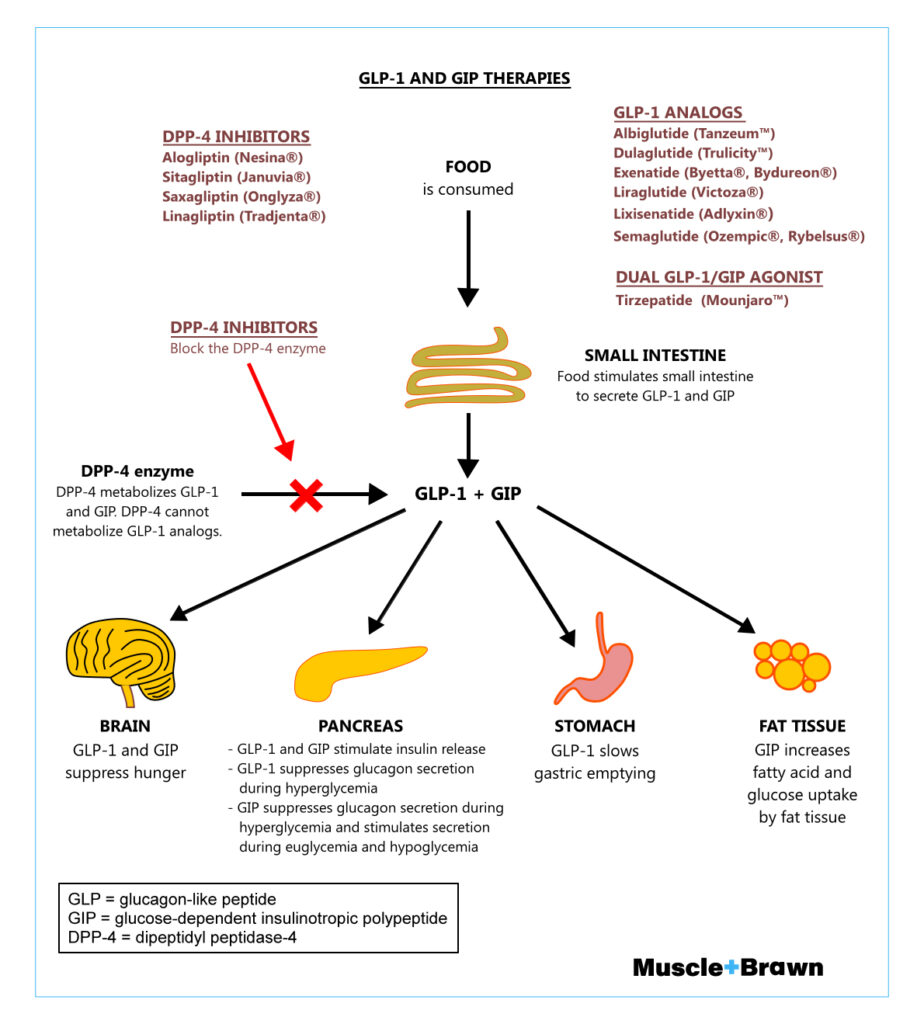
Tirzepatide is a dual GLP-1 / GIP receptor agonist that mimics the actions of both hormones
Semaglutide is a modified human GLP-1, about 94% identical to the natural hormone, with a half-life of about one week. It comes as a weekly injection (Ozempic, Wegovy) and as a daily tablet for type 2 diabetes (Rybelsus).
Tirzepatide vs Semaglutide at a Glance
| Tirzepatide | Semaglutide | |
|---|---|---|
| Receptors | GIP and GLP-1 | GLP-1 only |
| US brand names | Mounjaro, Zepbound | Ozempic, Wegovy, Rybelsus (oral) |
| Starting dose (injection) | 2.5 mg once weekly | 0.25 mg once weekly |
| Maximum weekly dose | 15 mg | 2 mg (Ozempic), 2.4 mg (Wegovy) |
| Half-life | About 5 days | About 7 days |
| Missed dose (label) | Take within 4 days, otherwise skip | Ozempic: within 5 days; Wegovy: take it if the next dose is more than 2 days away |
| Weight loss, head-to-head (SURMOUNT-5, 72 weeks) | -20.2% | -13.7% |
| Heart outcome data | Less long-term data so far | SELECT trial: 20% lower risk of heart attack, stroke or cardiovascular death in people with heart disease and overweight or obesity |
| Boxed warning | Thyroid C-cell tumors in rodents | Thyroid C-cell tumors in rodents |
Tirzepatide Dosage: The Label Schedule
The FDA label for both Mounjaro and Zepbound starts everyone at 2.5 mg once a week for 4 weeks. This dose is for getting the body used to the drug; it is not meant as a treatment dose. After that the dose goes to 5 mg, and it can then be raised in 2.5 mg steps, with at least 4 weeks at each step, up to a maximum of 15 mg a week.
| Weeks (earliest) | Weekly dose | Notes |
|---|---|---|
| 1-4 | 2.5 mg | Start-up dose only |
| 5-8 | 5 mg | Lowest maintenance dose |
| 9-12 | 7.5 mg | Optional step if more effect is needed |
| 13-16 | 10 mg | Maintenance option |
| 17-20 | 12.5 mg | Optional step |
| 21 onward | 15 mg | Maximum dose |
Not everyone climbs to 15 mg. The Zepbound label lists 5, 10 or 15 mg as maintenance doses for weight management, and 10 or 15 mg for sleep apnea. Prescribers often stop at the lowest dose that works.
Other practical rules from the label:
- Inject on the same day each week, at any time of day, with or without food. The day can be changed as long as there are at least 3 days (72 hours) between doses.
- A missed dose can be taken within 4 days (96 hours). After that, skip it and take the next dose on the usual day.
- Rotate injection sites, and do not combine tirzepatide with another GLP-1 drug.
- Tirzepatide can make birth control pills less reliable. The label advises switching to a non-oral method, or adding a barrier method, for 4 weeks after starting and for 4 weeks after each dose increase.
- With insulin or a sulfonylurea, lower doses of those drugs may be needed to avoid low blood sugar.
Semaglutide Dosage for Comparison
Wegovy starts at 0.25 mg a week and steps up every 4 weeks through 0.5 mg, 1 mg and 1.7 mg to a maintenance dose of 2.4 mg from week 17 (1.7 mg if 2.4 mg is not tolerated). Ozempic starts at 0.25 mg for 4 weeks, moves to 0.5 mg, and can be raised to 1 mg and then 2 mg, with at least 4 weeks at each dose.
Switching Between the Two
There is no official conversion chart between semaglutide and tirzepatide doses. People who switch usually start tirzepatide low and climb again; the prescriber sets the dose and timing.
Weight Loss Results: What the Trials Show
Tirzepatide on Its Own: SURMOUNT-1
SURMOUNT-1 enrolled 2,539 adults with obesity, or overweight plus a weight-related condition, who did not have diabetes. After 72 weeks, average weight loss was 15.0% on 5 mg, 19.5% on 10 mg and 20.9% on 15 mg, compared with 3.1% on placebo. For someone starting at 100 kg (220 lb), that is roughly 15-21 kg (33-46 lb).
Semaglutide on Its Own: STEP 1
STEP 1 tested semaglutide 2.4 mg in 1,961 adults with obesity or overweight without diabetes. After 68 weeks, average weight loss was 14.9%, against 2.4% on placebo. In STEP 8, semaglutide 2.4 mg also clearly beat the older daily injection liraglutide 3.0 mg (Saxenda): 15.8% versus 6.4% at 68 weeks.
Comparing SURMOUNT-1 with STEP 1 directly is unreliable because the trials differed in length and design; the head-to-head trials are better evidence.
Head to Head in Type 2 Diabetes: SURPASS-2
SURPASS-2 randomized 1,879 adults with type 2 diabetes already on metformin to tirzepatide 5, 10 or 15 mg or semaglutide 1 mg for 40 weeks [3]. HbA1c fell by 2.01 to 2.30 percentage points on tirzepatide and by 1.86 points on semaglutide. Weight fell by 7.6 to 11.2 kg on tirzepatide and by 5.7 kg on semaglutide.
One caveat: semaglutide is now used at up to 2 mg for diabetes and 2.4 mg for weight loss, so SURPASS-2 did not test its highest doses.
Head to Head in Obesity: SURMOUNT-5
SURMOUNT-5 addressed that. It compared each drug at its highest tolerated weight-loss dose (tirzepatide 10 or 15 mg, semaglutide 1.7 or 2.4 mg) in 751 adults with obesity but without diabetes. After 72 weeks, average weight loss was 20.2% with tirzepatide and 13.7% with semaglutide, and waist size fell by 18.4 cm versus 13.0 cm. The trial was open-label and funded by Lilly, the maker of tirzepatide.
| Trial | Who | Length | Tirzepatide | Comparator |
|---|---|---|---|---|
| SURMOUNT-1 | Obesity, no diabetes | 72 weeks | -15.0% to -20.9% body weight | Placebo: -3.1% |
| STEP 1 (semaglutide trial) | Obesity, no diabetes | 68 weeks | Not tested | Semaglutide 2.4 mg: -14.9%; placebo: -2.4% |
| SURPASS-2 | Type 2 diabetes on metformin | 40 weeks | -7.6 to -11.2 kg | Semaglutide 1 mg: -5.7 kg |
| SURMOUNT-5 | Obesity, no diabetes | 72 weeks | -20.2% body weight | Semaglutide 1.7-2.4 mg: -13.7% |
These are averages: some people lose far more and some very little, and people with type 2 diabetes generally lose less on either drug.
Not All of It Is Fat
Body-composition scans in the main trials showed that roughly a quarter to a third or more of the weight lost was lean mass rather than fat. That is typical of large weight loss, and a reason to keep lifting and eat enough protein while appetite is low.
What Happens When You Stop
These drugs control appetite only while they are taken. In SURMOUNT-4, participants took tirzepatide for 36 weeks (average loss 20.9%) and were then split. Over the next 52 weeks, those switched to placebo regained 14% of their body weight, while those who stayed on tirzepatide lost a further 5.5%.
Semaglutide behaves the same way: in the STEP 1 extension, people who stopped regained about two-thirds of their lost weight within a year. Both work as long-term treatment, not a short course.
Side Effects: Tirzepatide vs Semaglutide
The side effects of the two drugs are very similar. The most common are gastrointestinal, mostly mild to moderate, and most frequent in the weeks after starting or raising the dose [4]:
- Nausea, vomiting and diarrhea
- Constipation
- Abdominal pain, indigestion and burping
- Reduced appetite (the intended effect, but it can go too far)
- Fatigue
- Injection-site reactions such as redness or itching
- Hair shedding, reported in weight-loss trials and usually linked to rapid weight loss
In the head-to-head trials, rates of nausea, diarrhea and vomiting were broadly similar between the two drugs. A slow climb through the doses is the main way to keep them manageable.
Less Common but Serious Risks
| Risk | What to know |
|---|---|
| Thyroid C-cell tumors | Boxed warning on both drugs, based on tumors in rats and mice. Whether this applies to humans is unknown. Both are contraindicated with a personal or family history of medullary thyroid cancer or MEN 2. |
| Pancreatitis | Rare. Severe, persistent stomach pain needs urgent care. |
| Gallbladder problems | Gallstones and gallbladder inflammation were more common on both drugs. |
| Low blood sugar | Uncommon on its own; the risk rises when combined with insulin or a sulfonylurea. |
| Kidney injury | Dehydration from vomiting or diarrhea can cause acute kidney injury. |
| Diabetic eye disease | Existing diabetic retinopathy can temporarily worsen with rapid blood sugar improvement; it should be monitored. |
| Anesthesia | Slower stomach emptying raises the risk of inhaling stomach contents under sedation; tell the surgical team. |
| Pregnancy | Not used in pregnancy. The Zepbound and Wegovy labels advise stopping when pregnancy is recognized, and the Wegovy label also advises stopping at least 2 months before a planned pregnancy. |
One difference: the birth control pill warning applies to tirzepatide, not semaglutide.
Who Each Drug Is For
For adults, Zepbound and Wegovy share the same weight-management criteria: a BMI of 30 or more, or 27 or more with at least one weight-related condition. Mounjaro and Ozempic are approved for type 2 diabetes; they are also prescribed off-label for weight loss, but insurance coverage for that varies.
When both are options, the trade-offs look like this:
- Tirzepatide produces more weight loss on average, based on SURMOUNT-5.
- Semaglutide has the longer safety record and proven heart benefit in people with heart disease and overweight. It also comes as an oral tablet for diabetes.
- Tolerance, coverage and supply often decide in practice; someone who cannot tolerate one may do better on the other.
Compounded and “Research” Versions
During the drug shortages, US pharmacies were allowed to compound copies of both drugs. That broad allowance ended when the FDA declared the shortages over (tirzepatide in late 2024, semaglutide in early 2025). The FDA has also warned about dosing errors with compounded semaglutide and about counterfeit pens.
Powders sold online as “research peptides” are not approved medicines; no regulator checks their purity, strength or sterility, and the dosing above applies to the approved products only.
What Comes Next: Retatrutide
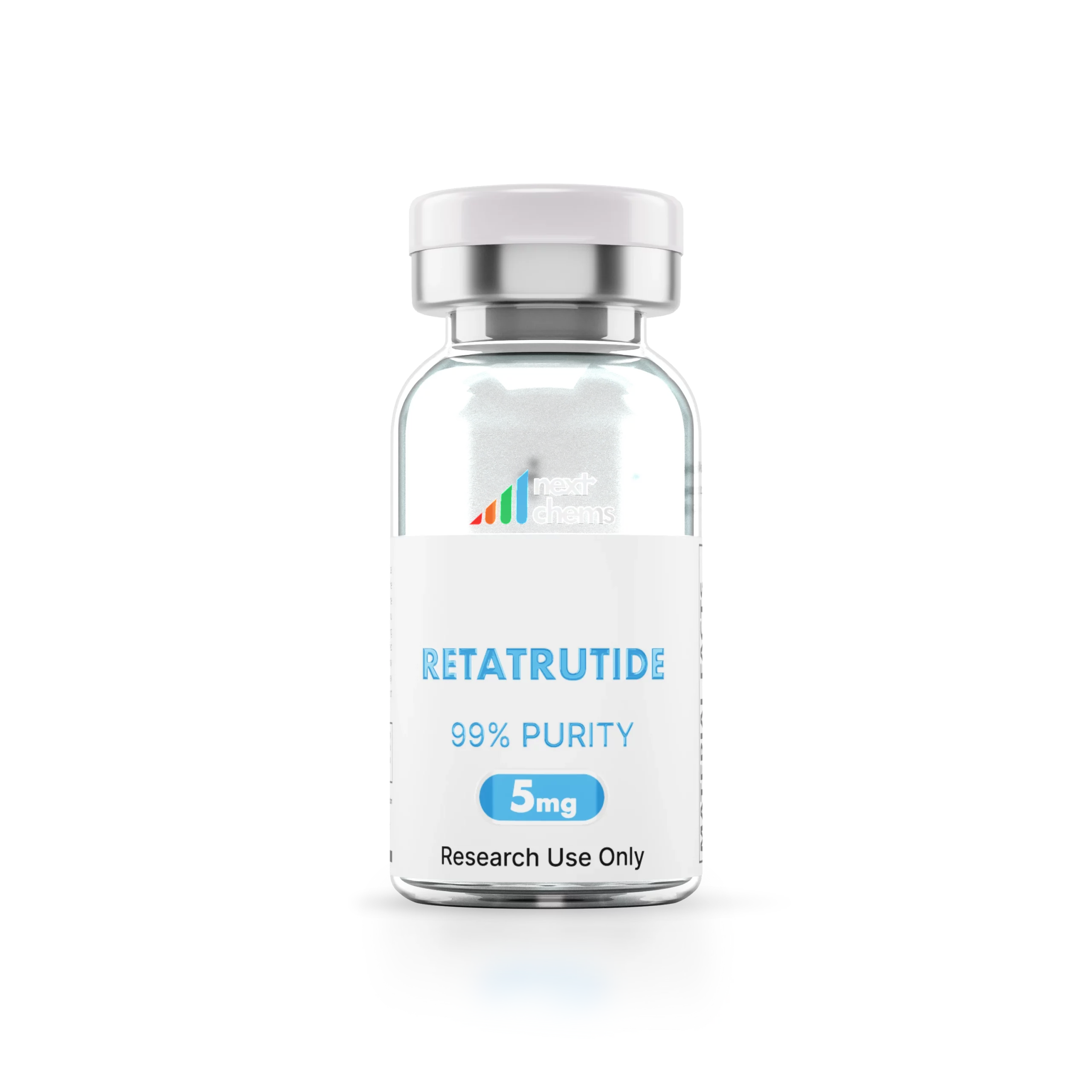
Lilly is now testing retatrutide, which adds a third target, the glucagon receptor, to GIP and GLP-1. In its phase 2 trial, published in 2023, adults with obesity lost an average of 24.2% of body weight after 48 weeks on the top 12 mg dose. It has moved into larger phase 3 trials (the TRIUMPH program) but remains investigational and is not approved for human use. See our retatrutide guide and our roundup of peptides for weight loss.

Overview
- Studied For: Triple-receptor activity, appetite and metabolic signalling support, substantial weight-loss potential, improved glucose regulation
- Mechanism: Triple receptor agonist targeting GLP-1, GIP, and glucagon receptors
- Available Strengths: 5mg, 20mg, and 30mg vials
- Form: Lyophilised powder
- Research Status: Appetite regulation, metabolic signalling, glucose regulation, energy expenditure
Pros
- Targets GLP-1, GIP, and glucagon receptors within a single compound
- Phase 2 research reported substantial body-weight reductions over 48 weeks
- Being studied for potential improvements in glucose regulation, energy expenditure, and liver-fat levels
Cons
- Remains investigational and is not currently approved by regulatory authorities
- Commonly reported effects include nausea, diarrhea, vomiting, constipation, and abdominal discomfort
- Long-term safety and effectiveness are still being evaluated in clinical trials
The Bottom Line
Tirzepatide is an FDA-approved weight-loss and diabetes drug that, in head-to-head trials, outperforms semaglutide on weight loss with a very similar side-effect profile.
- The label schedule starts at 2.5 mg weekly for 4 weeks and climbs in 2.5 mg steps, at least 4 weeks apart, to a maintenance dose of 5-15 mg.
- In SURMOUNT-5, average weight loss was 20.2% on tirzepatide and 13.7% on semaglutide after 72 weeks; semaglutide still has the longer track record and proven heart benefit.
- Both drugs cause mostly gastrointestinal side effects, share the same thyroid warning, and work only while they are taken: most lost weight returns after stopping.
Frequently Asked Questions
Disclaimer
Please read carefully
The information on this site is for educational and informational purposes only, and is not medical advice. Always consult a qualified healthcare professional before using any supplement or medication, or making changes to your health, fitness, or nutrition routine.
Not medical advice
Content here is not a substitute for professional medical advice.
Consult your doctor
Talk to your doctor before starting any supplement or new routine.
Use at your own risk
We are not responsible for adverse effects from acting on this.
Do your research
Make informed decisions about your own health.
No guarantees
Individual results vary. No claims about outcomes.
Important — Never disregard professional medical advice or delay seeking it because of something you read here. If you think you may have a medical emergency, call your doctor or your local emergency number right away.