Contents10 sections
Semax and Selank are two synthetic peptides developed in Moscow, largely at the Institute of Molecular Genetics of the Russian Academy of Sciences, and registered in Russia as nasal medicines. They are often mentioned together because they share a design: a short fragment of a natural peptide with a Pro-Gly-Pro tail added to slow its breakdown.
Their jobs are different. Semax is built from a fragment of the hormone ACTH and is studied mainly for stroke recovery, attention and memory. Selank is built from the immune peptide tuftsin and is studied mainly for anxiety. Outside Russia, neither is approved, and both are sold online as research peptides.
This guide compares the two side by side: structure, how each is thought to work, what human and animal studies show, the doses used in Russian medicine and commonly reported online, onset and duration, side effects, legal status, and who tends to pick which.
Key Takeaways
- Semax and Selank are both seven-amino-acid peptides developed in Russia and registered there as nasal medicines. Neither is approved by the FDA.
- Semax (about 813 Da) is an ACTH fragment analogue studied mainly in stroke and cognitive disorders. Users describe it as stimulating and focusing.
- Selank (about 751 Da) is a tuftsin analogue studied mainly in anxiety. In small Russian trials it eased anxiety about as well as a benzodiazepine, with less sedation.
- Most mechanism data (BDNF, GABA, serotonin, immune effects) comes from rats, mice and cells. Neither peptide is a proven antidepressant or a proven brain booster for healthy people.
- The Russian products are 0.1% Semax and 0.15% Selank nasal solutions. The doses reported online, a few hundred micrograms per nasal dose, come from users, not trials.
Semax vs Selank at a Glance
| Semax | Selank | |
|---|---|---|
| Structure | 7 amino acids: Met-Glu-His-Phe-Pro-Gly-Pro | 7 amino acids: Thr-Lys-Pro-Arg-Pro-Gly-Pro |
| Molecular weight | About 813 Da | About 751 Da |
| Built from | ACTH(4-7) fragment plus a Pro-Gly-Pro tail; no hormonal activity | Tuftsin, an immune peptide, plus a Pro-Gly-Pro tail |
| Main studied use | Ischemic stroke recovery, cognitive disorders | Generalized anxiety, neurasthenia |
| Proposed mechanism | Raises BDNF and its receptor TrkB in rat brain; affects dopamine and serotonin systems in animals | Modulates GABA-A receptors; slows enkephalin breakdown; immune effects (mostly animal and cell data) |
| Typical feel (user reports) | Alert and focused, sometimes overstimulated | Calm and less reactive, usually not sedated |
| Russian product | 0.1% nasal drops (1 mg per mL); 1% strength for stroke care | 0.15% nasal solution (1.5 mg per mL) |
| Reported side effects | Nasal irritation, headache; restlessness or poor sleep in some users | Nasal irritation, headache, occasional tiredness |
| US status | Not FDA approved; sold as a research chemical | Not FDA approved; sold as a research chemical |
What Semax Is and How It Works

Semax is a synthetic analogue of a fragment of adrenocorticotropic hormone (ACTH), the pituitary hormone that drives cortisol release. Its first four amino acids (Met-Glu-His-Phe) are ACTH(4-7), and the Pro-Gly-Pro tail was added to slow its breakdown, giving a chain of seven amino acids [3]. Unlike ACTH, Semax does not stimulate the adrenal glands; its effects are on the brain.
In Russia, Semax is a registered nasal-drop medicine: a 0.1% strength for cognitive and nervous-system conditions and a 1% strength used in stroke care.
BDNF and Learning
Semax’s best-known effect is on brain-derived neurotrophic factor (BDNF), a protein that supports the growth and survival of neurons and the formation of new connections between them. In rats, a nasal dose raised BDNF and its receptor TrkB in the hippocampus, a brain region central to memory, and Semax improved learning in some tasks. These are animal results; they show a plausible mechanism, not a proven effect on human memory.
Immune and Blood-Vessel Genes After Stroke
In rats with focal brain ischemia, a model of stroke, Semax changed the activity of genes linked to the immune system, including genes for chemokines and immunoglobulins and genes that control the number and movement of immune cells. It also changed genes involved in the development and function of blood vessels [5]. The researchers suggest this immune and vascular effect may explain part of the protection seen in stroke models.
Older Russian animal work also points to antioxidant effects in damaged brain tissue [8], and Russian research has looked at recovery after brain injury, including stroke [9]. Use after any brain injury belongs under medical care, not self-experimentation.
Dopamine, Serotonin and Mood
Rodent studies suggest Semax activates dopamine and serotonin systems in the brain, which is one reason it is discussed for motivation and mood. Some animal studies also report less depression-like and anxiety-like behavior. There are no controlled human trials of Semax for depression or anxiety, so it should not be treated as a mood medicine.
What the Human Evidence Covers
Human data are mostly small Russian clinical studies in ischemic stroke and cognitive disorders, often with limited blinding and published mainly in Russian journals. There are no good controlled trials in healthy people. Claims about ADHD, Alzheimer’s disease or Parkinson’s disease rest on animal models and small reports. Users commonly describe sharper focus and less mental fatigue, but that is self-reported and open to placebo effects.
What Selank Is and How It Works
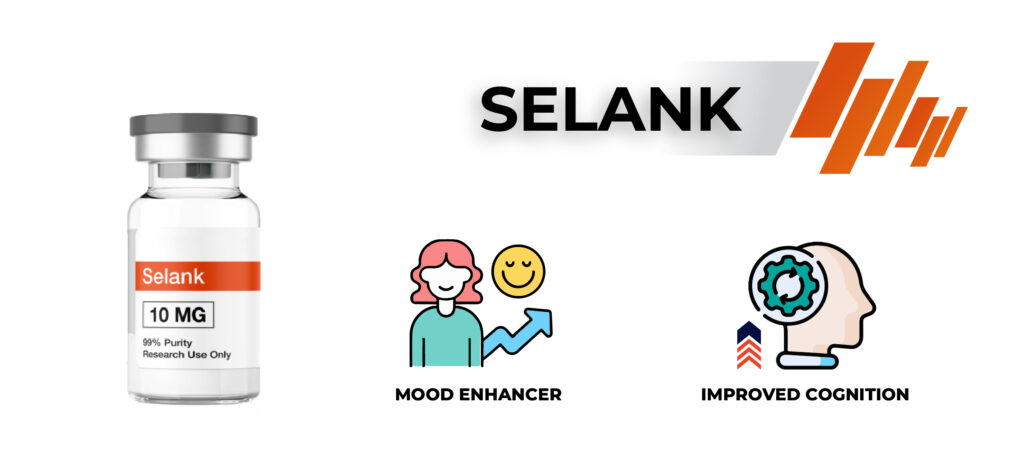
Selank is a synthetic analogue of tuftsin, a four-amino-acid immune peptide (Thr-Lys-Pro-Arg) that comes from the immunoglobulin G antibody. Adding the same Pro-Gly-Pro tail used in Semax gives a seven-amino-acid peptide that lasts longer in the body [4]. It was developed in Moscow as an anti-anxiety agent with nootropic effects and is registered in Russia as a nasal medicine. Our full Selank guide covers it in more depth.
GABA and Enkephalins
GABA is the brain’s main calming signal. Laboratory binding studies suggest Selank acts as an allosteric modulator of GABA-A receptors, the receptor family benzodiazepines also act on, and rat and cell studies found that it changes the expression of genes involved in GABA signaling [10]. Selank also appears to slow the breakdown of enkephalins, the body’s own opioid-like calming peptides.
Serotonin: What Is and Is Not Known
Selank is often marketed as a peptide that “raises serotonin”. The evidence for that is thin. Mouse studies report changes in serotonin metabolism in the brain, but no human study has shown that Selank raises serotonin, and it has not been tested as a treatment for depression. It is not an alternative to antidepressant medication.
Memory and BDNF
Rat studies report higher BDNF in the hippocampus after nasal Selank and better learning in some tasks [11]. No controlled study has shown that Selank improves memory in healthy people.
Immune Effects
Because it is built on tuftsin, Selank also acts on the immune system. Russian studies report that it shifts the balance of cytokines, the immune system’s signaling molecules, and influenza experiments suggest antiviral activity [6]. Human data here are very limited, and Selank should not be relied on to prevent or treat infections.
What the Human Evidence Covers
Anxiety is Selank’s best-supported use. In small Russian clinical studies of patients with generalized anxiety disorder and neurasthenia, Selank reduced anxiety about as much as the benzodiazepine medazepam, with less sedation and an anti-fatigue effect. These studies have not been repeated by independent groups. Claims that Selank treats PTSD, Alzheimer’s disease or multiple sclerosis have no clinical trial support.
Practical Comparison: Doses, Onset and Who Picks Which
Neither peptide has an established dose outside Russian medical use. The figures below describe the registered Russian products and what users commonly report. They are not dosing advice. Research-grade powder also has to be mixed and measured by the user, which adds error.
Doses Used in Medicine and Commonly Reported
| Semax | Selank | |
|---|---|---|
| Usual route | Nasal drops or spray | Nasal drops or spray |
| Registered Russian product | 0.1% drops (1 mg per mL) for cognitive and nervous-system use; 1% drops (10 mg per mL) in hospital stroke care | 0.15% solution (1.5 mg per mL), split into several doses a day over short courses |
| Commonly reported doses | A few hundred micrograms to about 1 mg a day, split into 2-3 nasal doses | About 250-500 mcg per dose, 1-3 times a day |
| Typical course (reported) | One to a few weeks, then a break | One to a few weeks, then a break |
| Onset (user reports) | Often within 10-30 minutes | Often within 15-30 minutes |
| Duration (user reports) | Several hours | A few hours |
| Time of day | Morning or early afternoon, as it can disturb sleep | Any time; often used before stressful situations |
The 1% Semax strength is used in hospital stroke care at much higher daily doses than anything users report. Onset and duration figures come from user communities: both peptides are broken down quickly in the body, and there is little published human data on how long their effects last.
Vendors also sell N-Acetyl Semax Amidate and N-Acetyl Selank Amidate, modified versions said to be stronger and longer-lasting. There are no published human studies of these forms. For handling powder and homemade nasal solutions, see our guide on how to store peptides.
Who Tends to Pick Which
- Semax is chosen for focus, attention and mental fatigue during long work or study days. People prone to anxiety, irritability or poor sleep often find it too stimulating.
- Selank is chosen when stress or anxiety is what gets in the way of thinking clearly. In the studies so far it calmed without the heavy sedation of benzodiazepines.
- Both: some users take Semax in the morning and Selank as needed, hoping for focus without jitters. The combination has never been studied, and stacking makes it harder to tell which peptide causes a side effect.
- Neither without a doctor: anyone with a diagnosed anxiety, mood, attention or neurological condition, anyone taking medication that acts on the brain, pregnant or breastfeeding women, and athletes in tested sport.
Side Effects and Safety
In the Russian clinical studies both peptides were well tolerated, but those studies were small and short, and there is no long-term safety data. Most of what is known about side effects outside Russia comes from user reports.
Semax
- Nasal irritation or dryness
- Headache
- Restlessness, irritability or anxiety, reported mostly at higher doses
- Trouble sleeping when taken late in the day
Selank
- Nasal or throat irritation
- Occasional headache
- Occasional tiredness or dizziness
- A flat or emotionally blunted feeling, reported mostly at higher doses
Interactions
Do not combine either peptide with prescription drugs that act on the brain, such as benzodiazepines, antidepressants, MAO inhibitors or ADHD medication, unless your doctor knows and agrees. Do not stop a prescribed anxiety or mood medication to switch to Selank or Semax: stopping some of these drugs suddenly, especially benzodiazepines, can be dangerous.
Legal Status and Product Quality
Semax and Selank are registered medicines in Russia. Neither is approved by the FDA, and in the US they cannot legally be sold as drugs or dietary supplements for human use, so they are sold as research chemicals “not for human consumption”. Rules differ by country; our guide on whether peptides are legal explains the main points.
Because no regulator checks research products, purity, the real dose and sterility all depend on the seller. Before buying any research peptide, look for:
- Third-party testing (HPLC purity and mass spectrometry identity) for the batch you receive
- Clear labeling with batch number, amount per vial and expiry date
- Transparent contact details and no claims that the product treats or cures anything
- Packaging and shipping that protect the peptide from heat
A certificate of analysis shows what is in a vial; it does not make a product safe for human use. SwissChems, one of the site’s partners, sells research peptides. The same checks apply to any seller.

Pros
- Exceptional purity & testing (≥98%)
- Pharmaceutical-style packaging for stability
- Broad catalog across peptides & nootropics
- Strong reputation & consistency across years
Cons
- Some items frequently out of stock due to high demand
- Limited long-term data for some compounds
The Bottom Line
Semax and Selank are related Russian nasal peptides with different strengths: Semax leans toward focus and stroke recovery, Selank toward calm and anxiety relief.
- Semax (about 813 Da) is an ACTH fragment analogue. Its human data come from small Russian trials in stroke and cognitive disorders, and its BDNF and mood effects are mostly animal findings.
- Selank (about 751 Da) is a tuftsin analogue. Small Russian trials found it eased anxiety about as well as a benzodiazepine with less sedation, but it is not a proven antidepressant.
- Doses reported online are a few hundred micrograms per nasal dose, but they come from users, not trials. Neither peptide is FDA approved, research products vary in quality, and anyone on brain-acting medication should speak to a doctor first.
Frequently Asked Questions
Disclaimer
Please read carefully
The information on this site is for educational and informational purposes only, and is not medical advice. Always consult a qualified healthcare professional before using any supplement or medication, or making changes to your health, fitness, or nutrition routine.
Not medical advice
Content here is not a substitute for professional medical advice.
Consult your doctor
Talk to your doctor before starting any supplement or new routine.
Use at your own risk
We are not responsible for adverse effects from acting on this.
Do your research
Make informed decisions about your own health.
No guarantees
Individual results vary. No claims about outcomes.
Important — Never disregard professional medical advice or delay seeking it because of something you read here. If you think you may have a medical emergency, call your doctor or your local emergency number right away.