Contents10 sections
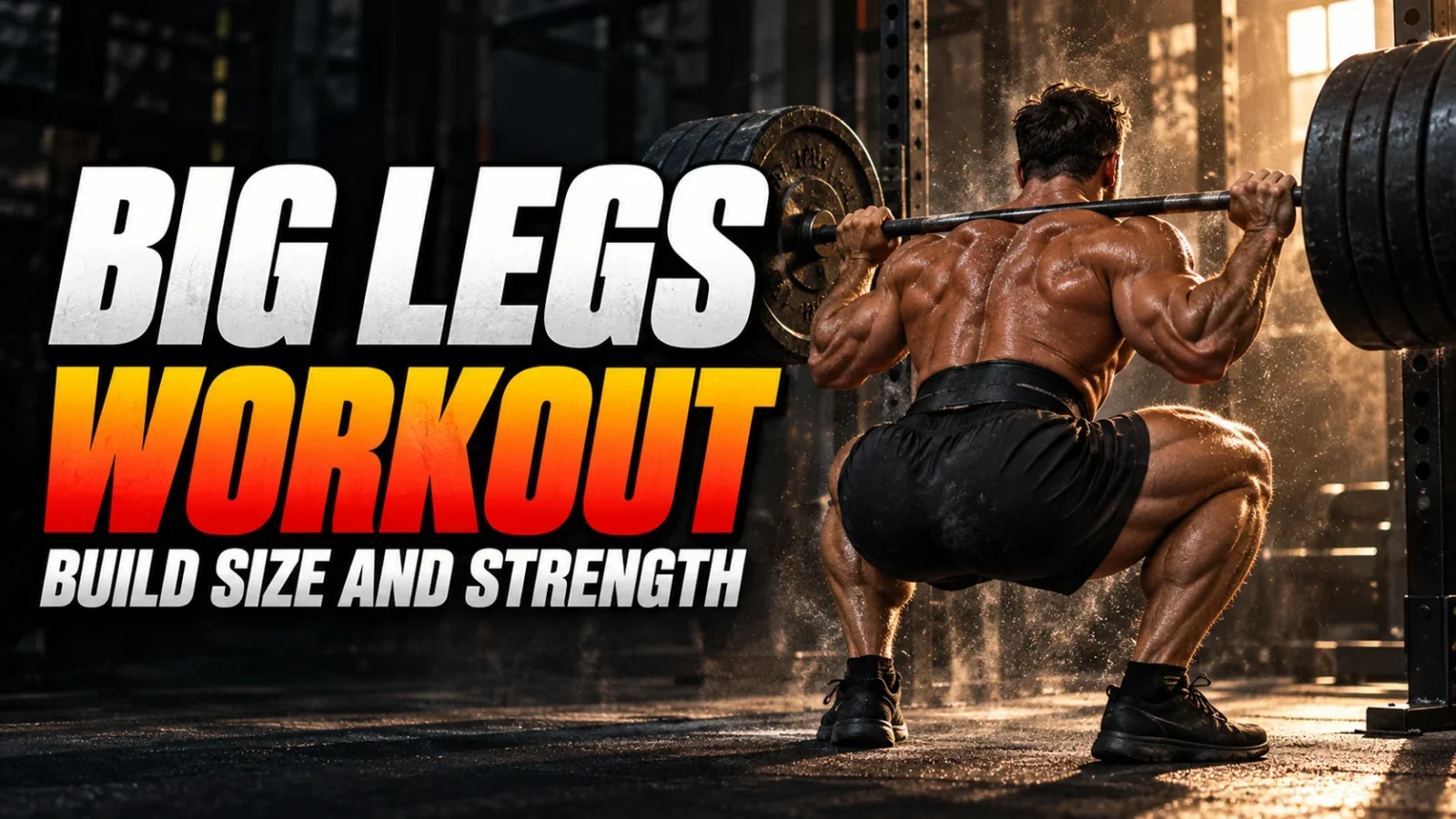
If your goal is bigger legs, you can’t skip leg day and expect results. A few sets of leg extensions won’t do it, and machines alone won’t build your quads if the sets are easy. Legs grow when you train them hard, with a plan, every week.
This guide is for lifters who want legs that look as strong as they feel: quads, hamstrings, glutes and calves that match a well-built upper body.
Below is a focused big legs workout that combines heavy compound lifts with targeted isolation work, with sets, reps and form cues for each exercise. It works whether you train for size, strength or both. You’ll also find the supplements with real evidence behind them, Jay Cutler’s leg routine and the most common mistakes to avoid.
Key Takeaways
- Strong legs are the base of a powerful, athletic body. They improve performance and complete your physique.
- A good leg workout mixes heavy compound lifts (squats, Romanian deadlifts, lunges, leg press) with isolation work, so every major leg muscle gets trained.
- Focus on the big muscles (quads, hamstrings and glutes), but don’t neglect the calves: compound lifts barely train them.
- Train legs about twice a week, at least 72 hours apart. Total weekly hard sets and progressive overload matter more than any single exercise.
- Consistency, enough calories and protein, and good sleep decide how fast you grow. Creatine monohydrate (3-5 g a day, every day) is the best-supported supplement.
Why You Need to Train Your Legs
Big legs aren’t just about looks. Your legs are the engine room of your body: squatting, sprinting, jumping, climbing stairs and lifting anything off the floor all start there.
Powerful legs don’t just make you look athletic, they make you perform like it. They improve balance and total-body strength. Neglect them and you’re building a house on a shaky foundation: however strong your upper body is, weak legs hold you back.
You may have heard that leg day is worth it for the “hormonal boost”. Heavy leg training does cause a short rise in testosterone and growth hormone, but research suggests these brief post-workout spikes have little to do with how much muscle you build. Legs grow for the same reasons any muscle grows: hard sets, enough volume, progressive overload and recovery.
So if you’re chasing a complete physique or real strength, train your legs like you mean it. Not occasionally, but consistently, every week.
The Big Legs Workout
Building bigger legs comes down to two principles: progressive overload and training every muscle. You need a plan that pushes your muscles a little harder week after week, not a few random sets.
That means starting with heavy compound lifts that hit the big muscles: your quads, hamstrings and glutes. These build mass and overall strength. Isolation work then targets each muscle directly, including the calves, which compound lifts barely train. The workout is built on three rules:
- Lift heavy enough to build muscle and strength. Don’t be afraid of the barbell; respect it and move it with intent.
- Train smart enough to avoid burnout or injury. Volume and intensity matter, but so does knowing when to back off or adjust.
- Recover well so your muscles can actually grow. Sleep, nutrition and hydration are as important as the training itself.
Do this workout twice a week, with at least 72 hours between sessions. Warm up for 5-10 minutes with light cardio and dynamic stretches, then do a few lighter sets of the first exercise before going heavy. The full session is a lot of volume, so if you’re newer to training, start with 2-3 sets per exercise and build up.
| Exercise | Sets x Reps | Main muscles |
|---|---|---|
| Barbell back squat | 4 x 6-8 | Quads, glutes, adductors |
| Romanian deadlift | 4 x 8-10 | Hamstrings, glutes |
| Walking lunges | 3 x 10-12 steps per leg | Quads, glutes |
| Leg press | 3 x 10-12 | Quads, glutes |
| Leg curl (seated or lying) | 3 x 12-15 | Hamstrings |
| Leg extension | 3 x 12-15 | Quads |
| Standing calf raise | 4 x 15-20 | Calves |
| Stair climber | 10-15 minutes, moderate pace | Glutes, quads, calves, conditioning |
1. Barbell Back Squat

4 Sets of 6-8 Reps
Your leg day should start here. The barbell back squat trains the quads, glutes and adductors hard, while the hamstrings, calves and core work to keep you stable. Going heavy with good depth builds strength and size at the same time.
Squat as deep as you can with a neutral spine, ideally to or below parallel. Drive through your whole foot and keep your torso braced. If you cut depth to move more weight, you’re training your ego, not your legs.
2. Romanian Deadlift

4 Sets of 8-10 Reps
The Romanian deadlift is one of the best exercises for your hamstrings and glutes. It’s all about controlled movement: hinge at the hips with a slight bend in the knees and lower the bar slowly along your legs, keeping your back flat.
Go down until you feel a strong stretch in your hamstrings (for most people, around mid-shin), then drive your hips forward and squeeze your glutes at the top.
3. Walking Lunges

3 Sets of 10-12 Steps Each Leg
Walking lunges aren’t glamorous, but they work your quads, glutes and core hard. Because each leg works on its own, they also build balance and help even out differences between your left and right side.
Hold a pair of dumbbells, take long steps and keep your chest up. Longer steps put more of the work on your glutes; shorter steps shift it toward your quads.
4. Leg Press

3 Sets of 10-12 Reps
The leg press lets you load your quads heavily without a bar on your back. Think of it as your volume machine: controlled, hard reps in the 10-12 range.
Place your feet about shoulder-width apart, lower as deep as you can without your lower back peeling off the pad, and don’t snap your knees into lockout at the top. Control beats speed here. Single-leg presses are a good option if one leg is clearly weaker than the other.
5. Leg Curl (Seated or Lying)

3 Sets of 12-15 Reps
Hamstrings often get less attention than quads, but they matter for balance, a complete-looking leg and knee health. Leg curls train them at the knee, which the Romanian deadlift doesn’t.
Seated and lying curls both work. Seated curls train the hamstrings in a more stretched position, and in a training study they grew the hamstrings more than lying curls. Whichever you choose, move slowly through the full range, keep your hips down and squeeze at the top of each rep.
6. Leg Extension

3 Sets of 12-15 Reps
Leg extensions isolate the front of your thighs, including the rectus femoris, the quad muscle that squats train least. Squeeze hard at the top of each rep and control the lowering phase instead of letting the weight drop. Use a moderate weight: this isn’t a power move, it’s about tension and hypertrophy.
7. Standing Calf Raise

4 Sets of 15-20 Reps
Calves are stubborn, but they grow if you train them consistently and through a full range of motion. The standing calf raise targets the gastrocnemius, the two-headed muscle that gives the calf its visible shape. Bent-knee (seated) raises shift more of the work to the soleus underneath.
Use a calf raise machine or a step. Lower slowly, pause in the deep stretch at the bottom, rise powerfully and hold the contraction at the top for a second. Don’t bounce. Train your calves like any other muscle you want to grow.
8. Stair Climber

10-15 Minutes at Moderate Intensity
Finish with the stair climber at a steady, moderate pace. It adds extra work for your glutes, quads and calves, plus some conditioning, without the pounding of running.
Take controlled steps and don’t lean on the handrails. Don’t expect it to “carve definition” on its own: how defined your legs look depends on muscle size and body fat, not on one machine.
Together, these exercises cover your whole lower body: heavy compound work for strength and mass, then isolation work for each muscle. Follow the plan, add weight or reps over time, and your legs will grow.
Supplements That Can Support Leg Growth
Supplements can’t replace training, food and sleep, but a few have good evidence behind them. These are the ones worth knowing about, with the doses used in studies:
| Supplement | Doses used in studies | What it does |
|---|---|---|
| Creatine monohydrate | 3-5 g a day, every day (optional loading: about 20 g a day in 4 doses for 5-7 days) | More strength and training volume; more muscle gained over time |
| Whey protein | A 20-40 g serving to help reach your daily protein target | Supports muscle growth and recovery |
| Beta-alanine | About 3.2-6.4 g a day in split doses, for at least 2-4 weeks | Delays fatigue in hard efforts lasting about 1-4 minutes |
| Caffeine | 3-6 mg per kg of body weight, about 60 minutes before training | Better focus, strength and endurance |
Creatine works by filling up your muscles’ creatine stores over time, so take it every day and don’t cycle it on and off; consistency matters far more than timing. One scoop is usually 5 g. It can add a little water weight in the first weeks, and large single doses can upset the stomach, but research hasn’t linked it to dehydration or cramps. Our creatine monohydrate powder guide covers it in more depth.
Whey is simply a convenient protein food: it supports muscle growth when it helps you reach your daily total (about 1.6 g of protein per kg of body weight a day is a good target for building muscle). Beta-alanine raises muscle carnosine and delays muscle fatigue; the harmless tingling it causes is milder with smaller, split doses.
Enhanced Labs, one of our partners, makes creatine monohydrate, beta-alanine, a clear whey protein and the Rage pre-workout.

Pros
- Catalog is specifically organized around muscle building, fat loss, testosterone support, and workout performance.
- Range includes creatine, protein, EAAs, beta-alanine, and L-citrulline alongside more specialized formulas.
- Orders of $99+ qualify for free US shipping.
Cons
- Features several strong claims around muscle growth, testosterone, fat loss, and metabolic effects that should be distinguished from independently demonstrated clinical outcomes
- Heavily oriented toward bodybuilding and performance rather than broader nutritional supplementation.
Tips for Your Big Legs Workout

- Focus on progressive overload: If your weights never go up, your legs won’t either. Add a little weight or a rep or two over time; small jumps add up.
- Train close to failure, safely: Most working sets should end with only 1-3 good reps left in the tank. Keep your form, and squat in a rack with the safeties set or with a spotter.
- Prioritize recovery: Hard leg sessions need real recovery. Sleep, hydration and protein are non-negotiable.
- Eat well for growth: If your goal is size, you need a slight calorie surplus. Don’t be afraid of carbs; they fuel hard leg sessions.
- Stretch and mobilize: Tight hips, stiff hamstrings and poor ankle mobility limit your squat depth and your gains. Ten minutes of mobility work on rest days helps.
Jay Cutler’s Leg Workout Routine
Four-time Mr. Olympia Jay Cutler was known for his leg development. In a leg routine he shared with FLEX magazine, now published on Muscle & Fitness, he explained his approach:
“To achieve maximum results from my leg workouts, I always made sure to hit them from different angles and positions from week to week. And while I know some guys prefer to do legs twice a week, I always train once every five days.”
Jay Cutler, FLEX (Muscle & Fitness)
Cutler’s Leg Workout
Here is the leg session from that feature. It is high volume, with 12 reps on every set and plenty of machine work:
| Exercise | Sets | Reps |
|---|---|---|
| Leg extension (warm-up) | 2 | 12 |
| Leg press | 3 | 12 |
| Hack squat | 3 | 12 |
| Back or front squat | 3 | 12 |
| Lunge (barbell or dumbbells) | 3 | 12 |
| Single-leg leg press | 3 | 12 |
This is an elite bodybuilder’s routine, built for years of training and recovery, so treat it as an example rather than a starting point. It also shows that frequency is flexible: Cutler trained legs once every five days with a lot of volume per session, while the workout above splits the work across two sessions a week. For more of his training, see our guide to Jay Cutler’s training routines, or try the Tom Platz leg workout for another classic high-volume approach.
Common Mistakes to Avoid
- Half-repping squats: Deeper squats train your glutes and adductors through a longer range. A training study that compared full and half squats found bigger gains in glute and adductor size with full squats. Depth matters.
- Skipping hamstrings: Many lifters go heavy on quads and neglect the back of their legs. That leaves the hamstrings underdeveloped and weak compared with the quads. Give them as much attention: hip hinges and leg curls both.
- Too little weekly volume: Legs are a large muscle group and need plenty of hard sets to grow. Splitting them over two sessions a week makes that volume easier to recover from. Once a week can work too, as long as the session has enough sets.
- Training too easy: Free weights and machines can both build big legs, but only if the sets are hard and the loads go up over time. Light “pump” work alone won’t build much size or strength.
- Neglecting calves: Genetics play a big part in calf size, but you can’t judge yours until you’ve trained them properly. High reps, a full range of motion and consistency will get them growing.
The Bottom Line
Bigger legs come from a simple formula done consistently for months: heavy compound lifts, targeted isolation work, progressive overload, and enough food and recovery.
- Run the workout above about twice a week, at least 72 hours apart; cut sets or drop an isolation exercise if you can’t keep every set hard.
- Train quads, hamstrings, glutes and calves through a full range of motion, and add weight or reps over time.
- Eat in a slight calorie surplus with enough protein and sleep well; creatine monohydrate at 3-5 g a day is the supplement with the strongest evidence.
Frequently Asked Questions
Disclaimer
Please read carefully
The information on this site is for educational and informational purposes only, and is not medical advice. Always consult a qualified healthcare professional before using any supplement or medication, or making changes to your health, fitness, or nutrition routine.
Not medical advice
Content here is not a substitute for professional medical advice.
Consult your doctor
Talk to your doctor before starting any supplement or new routine.
Use at your own risk
We are not responsible for adverse effects from acting on this.
Do your research
Make informed decisions about your own health.
No guarantees
Individual results vary. No claims about outcomes.
Important — Never disregard professional medical advice or delay seeking it because of something you read here. If you think you may have a medical emergency, call your doctor or your local emergency number right away.