Contents9 sections
Walk into any gym and you will see lifters yanking heavy rows and pulldowns with their whole body. The weight moves, but the back does far less of the work than it should, and months later their backs still look the same.
Building a bigger back comes down to hard, controlled sets that keep the load on the lats, traps and rhomboids. Cable machines make that easier. The cable keeps resistance on the muscle through more of the range than many free-weight exercises, it is hard to cheat with momentum, and you can change the angle, grip and attachment in seconds.
This guide covers nine of the best cable back exercises, each with setup, form cues and sets and reps, plus sample beginner and advanced workouts and what the research says about volume, load and tempo.
Key Takeaways
- Cables keep resistance on the back muscles through more of the range of motion and make it hard to cheat with momentum.
- Lat pulldowns and seated or single-arm cable rows are the core lifts; straight-arm pulldowns, face pulls and reverse flyes fill the gaps.
- Muscle growth depends far more on effort, weekly sets and progressive overload than on whether you use cables, machines or free weights.
- A good target for most lifters is 10 or more hard back sets per week, split over two sessions.
- Pull with the shoulder blades and elbows, control the lowering phase and add reps or weight over time.
Why Cables Work for Back Training
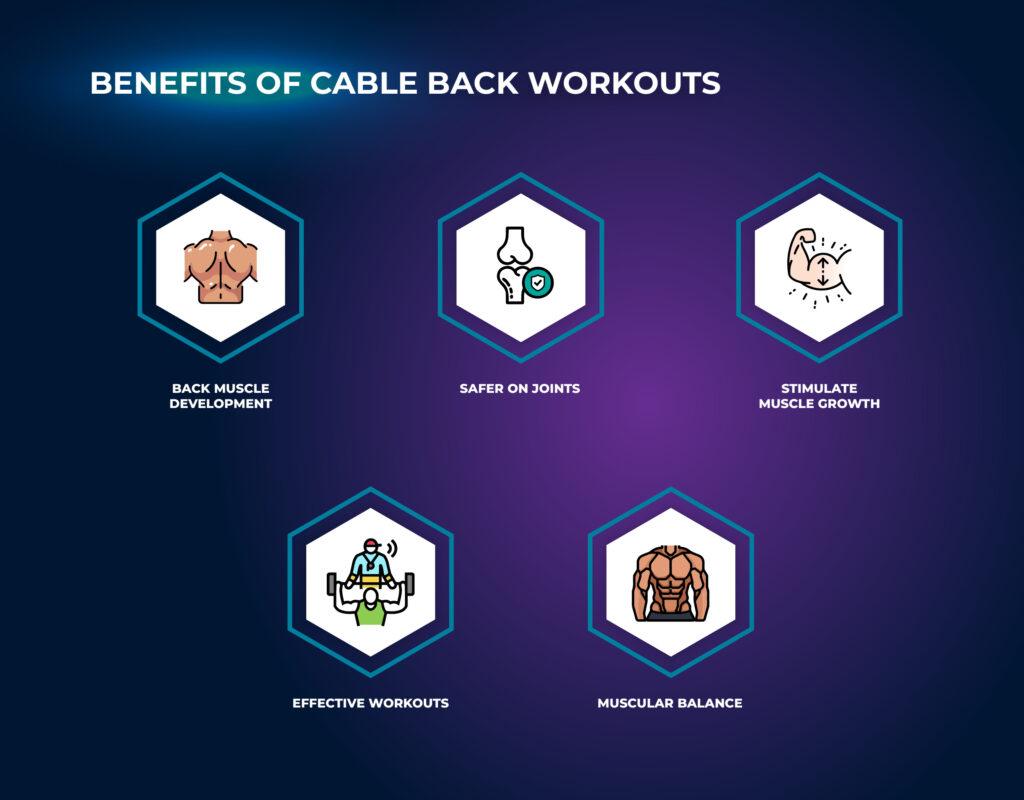
Cables are not magic, and they do not replace every free-weight lift. They do have a few real advantages for back training.
Resistance Through More of the Range
With a dumbbell, gravity always pulls straight down, so a row is easy at the bottom and hard at the top. A cable pulls along its own line, so on rows, pulldowns and face pulls the muscle stays loaded from the stretched position to the squeeze. The tension is not perfectly constant (it changes with the angle between the cable and your arm), but it is more even than in most free-weight versions.
Easy to Change Angles, Grips and Attachments
Moving the pulley or swapping a straight bar for a rope or V-handle changes the line of pull in seconds. That lets you work the lats, mid-back, rear delts and traps from different angles in one session, and pick the grip that feels best on your shoulders and elbows.
One Side at a Time
Single-arm rows and pulldowns let each side work on its own, so the stronger side cannot take over. They are a simple way to spot and work on side-to-side differences.
Joint-Friendly and Easy to Learn
Supported lifts such as the lat pulldown and seated row let you train the back hard without the lower-back fatigue of heavy bent-over rows, and the guided path makes them easy for beginners to learn. Changing the weight is a pin move, which also makes drop sets quick.
Where Cables Fall Short
Equipment matters less than effort. Studies comparing machine and free-weight programs, such as a 2020 trial by Schwanbeck and colleagues in the Journal of Strength and Conditioning Research, have found similar gains in muscle size. Barbell rows, deadlifts and pull-ups still build strength that cables cannot fully replace, and strong lifters can run out of weight on the stack. Most people do best with a mix of both.
The 9 Best Cable Back Exercises
The table gives a quick overview. Each exercise below has setup, form cues and a starting point for sets and reps. Use a weight that leaves 1-3 reps in reserve on most sets.
| Exercise | Main Muscles | Sets x Reps |
|---|---|---|
| Seated cable row | Lats, rhomboids, middle traps, rear delts | 3-4 x 8-12 |
| Single-arm cable row | Lats, mid-back | 3 x 10-12 per side |
| Lat pulldown | Lats, teres major, biceps | 3-4 x 8-12 |
| Single-arm kneeling pulldown | Lats, teres major | 2-3 x 10-15 per side |
| Straight-arm pulldown | Lats, teres major, long head of the triceps | 2-3 x 12-15 |
| Face pull | Rear delts, middle and lower traps, rotator cuff | 3 x 12-20 |
| Reverse cable fly | Rear delts, middle traps, rhomboids | 3 x 12-20 |
| Cable shrug | Upper traps | 3 x 10-15 |
| Cable deadlift | Glutes, hamstrings, spinal erectors | 3 x 10-15 |
1. Seated Cable Row
The seated row is the main horizontal pull on a cable station. It trains the lats, rhomboids, middle traps and rear delts, with the biceps assisting and the lower back working to hold your torso still. A close neutral-grip V-handle with the elbows tucked puts more of the work on the lats; a wide overhand bar with the elbows flared shifts it toward the upper back and rear delts.
- Setup: Sit with your feet on the platform and knees slightly bent. Grab the handle and sit tall with your chest up and arms straight.
- Form cues: Start the pull by drawing your shoulder blades back, then drive your elbows past your torso until the handle touches your upper stomach. Pause for a second, then let the weight pull your arms and shoulder blades forward into a full stretch without rounding your lower back.
- Avoid: Rocking your torso back and forth to move the weight.
- Sets and reps: 3-4 sets of 8-12.
2. Single-Arm Cable Row
The single-arm row lets each side work on its own and allows a longer stretch than the two-handed version.
- Setup: Set a pulley between waist and chest height with a D-handle. Stand in a split stance with the opposite foot forward, or sit at the row station.
- Form cues: Reach forward and let the shoulder blade move with the arm, then pull your elbow back toward your hip. Keep your hips and chest square to the stack.
- Avoid: Twisting your torso to finish the rep.
- Sets and reps: 3 sets of 10-12 per side. Start with your weaker side and match those reps on the other side.
3. Lat Pulldown (Wide, Neutral and Underhand Grip)
The lat pulldown is the cable version of the pull-up. It trains the lats and teres major, with help from the biceps, lower traps and rhomboids.
Grip matters, but less than many lifters think. Signorile and colleagues (Journal of Strength and Conditioning Research, 2002) found that a wide overhand grip pulled to the front of the chest produced more lat activity than pulling behind the neck or using a close or underhand grip. Lusk and colleagues (same journal, 2010) found more lat activity with an overhand grip than an underhand grip, while grip width made little difference. Other grip-width research on the lat pulldown has also found only modest differences between grips. Pick the grip that lets you pull hard and pain-free, and pull to the front.
- Setup: Adjust the thigh pad so your legs are locked in. Take an overhand grip slightly wider than shoulder width, use a neutral-grip handle, or take an underhand grip at shoulder width.
- Form cues: Lean back slightly, keep your chest up and pull the bar to your upper chest by driving your elbows down toward your hips. Control the bar back up until your arms are straight and you feel a stretch in your lats.
- Avoid: Pulling behind the neck, swinging your torso, or stopping short of a full stretch.
- Sets and reps: 3-4 sets of 8-12, or 6-10 for heavier work.
4. Single-Arm Kneeling Pulldown
Working one arm at a time lets you pull the elbow lower and closer to the hip than a bar allows, and stops the stronger side from doing the work.
- Setup: Attach a D-handle to a high pulley and kneel (on both knees or half-kneeling) slightly to the side of the stack, so the working arm is fully stretched overhead.
- Form cues: Pull the elbow down and in toward your hip while keeping your torso tall. Let the arm rise all the way back to a full stretch on each rep.
- Avoid: Twisting or leaning far over to move more weight.
- Sets and reps: 2-3 sets of 10-15 per side.
5. Straight-Arm Pulldown
With the elbows held almost straight, the biceps barely help, so the lats and teres major do most of the work, assisted by the long head of the triceps and the rear delts. It works well as a finisher, or as a warm-up to feel the lats before heavier pulls.
- Setup: Attach a straight bar or rope to a high pulley. Step back one or two steps, hinge slightly at the hips and hold the bar at about head height with your arms extended and elbows slightly bent.
- Form cues: Keep the elbow angle fixed and sweep the bar down in an arc to your thighs. Squeeze for a second, then let your arms rise until you feel a stretch in the lats.
- Avoid: Bending the elbows and turning it into a triceps pushdown.
- Sets and reps: 2-3 sets of 12-15.
6. Face Pull
Face pulls train the rear delts, the middle and lower traps and the rotator cuff muscles that rotate the shoulder outward. Many lifters use them to balance out a lot of pressing.
- Setup: Attach a rope to a pulley set between upper-chest and forehead height. Grip the ends with your palms facing each other, step back and stand in a staggered stance.
- Form cues: Pull the rope toward your forehead with your elbows high, spreading the ends apart. Finish with your hands beside your ears and your upper arms rotated back, then return slowly.
- Avoid: Leaning back or turning the pull into a row to your chest.
- Sets and reps: 3 sets of 12-20.
7. Reverse Cable Fly
The reverse cable fly isolates the rear delts and mid-back. The cables load the muscles right from the start of the movement, the part where a dumbbell reverse fly is easiest.
- Setup: Set two pulleys at shoulder height. Cross the cables: hold the left cable in your right hand and the right cable in your left hand. Stand in the middle with your feet shoulder-width apart and knees soft.
- Form cues: Keep a slight, fixed bend in your elbows and sweep your arms out and back until they are in line with your body. Lead with the backs of your hands and keep your shoulders down.
- Avoid: Shrugging, or bending the elbows and turning it into a row.
- Sets and reps: 3 sets of 12-20.
8. Cable Shrug
Cable shrugs train the upper traps and are an easy way to add trap work at the end of a back session.
- Setup: Attach a straight bar to a low pulley and stand close to the stack, or use D-handles on two low pulleys and stand between them.
- Form cues: With your arms straight, lift your shoulders straight up toward your ears, pause for a second, then lower all the way down.
- Avoid: Rolling the shoulders or bending the elbows.
- Sets and reps: 3 sets of 10-15.
9. Cable Deadlift
The cable deadlift trains the hip hinge: the glutes, hamstrings and the spinal erectors that hold your back straight. The loads are much lighter than on a barbell deadlift, so it works best as higher-rep posterior-chain work, as a way to practise the hinge, or on days you want less load on your spine. It does not replace heavy deadlifts for strength. The cable pull-through (facing away from the stack with a rope between your legs) trains the same pattern.
- Setup: Attach a straight bar or rope to a low pulley. Stand facing the stack, a step back, with your feet about hip-width apart.
- Form cues: Push your hips back with a soft knee bend and a neutral spine until you feel a stretch in your hamstrings, then drive your hips forward to stand tall. The cable pulls you toward the stack, so brace hard and keep the bar close to your legs.
- Avoid: Rounding your lower back or turning the hinge into a squat.
- Sets and reps: 3 sets of 10-15.
Tip: Small changes in grip and elbow path change which part of the back works hardest. Keep your elbows close to your body to put more work on the lats; flare them out to bias the upper back and rear delts.
How to Build a Cable Back Workout
Cable work fits any training split, whether you run push-pull-legs, upper-lower or full-body sessions. The same rules apply as for any muscle: enough hard sets, enough effort and steady progression. For a deeper look at rep ranges and loading, see our guide to hypertrophy and strength training.
Volume, Effort and Frequency
- Weekly sets: A meta-analysis by Schoenfeld, Ogborn and Krieger (Journal of Sports Sciences, 2017) found a dose-response relationship between weekly sets and muscle growth, with 10 or more sets per muscle per week producing more growth than fewer than five. For most lifters, 10-20 hard back sets per week is a sensible range.
- Load and effort: A 2017 meta-analysis by Schoenfeld and colleagues in the Journal of Strength and Conditioning Research found that light and heavy loads build similar muscle when sets are taken close to failure, while heavier loads build more maximal strength. Moderate reps (6-15) are a practical middle ground on cables.
- Frequency: A 2016 meta-analysis in Sports Medicine by the same group found that training a muscle at least twice a week led to more growth than training it once. Splitting your weekly back sets over two sessions keeps each workout productive.
Tempo and Time Under Tension
Load, tempo and rest periods all shape how a muscle adapts, but very slow reps are not required for growth. A meta-analysis by Schoenfeld, Ogborn and Krieger (Sports Medicine, 2015) found similar muscle growth with repetition durations from about half a second to eight seconds per rep.
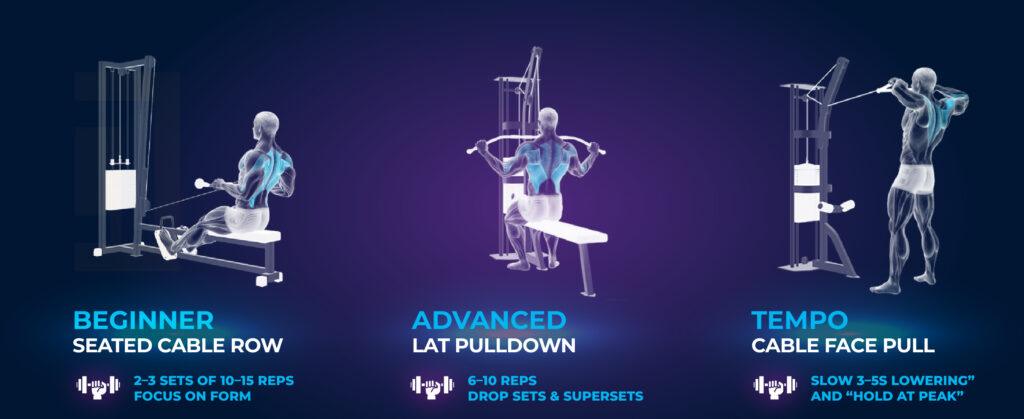
On cables, a practical target is a steady pull, a one-second squeeze and a lowering phase of 2-3 seconds. That keeps the load on your back and makes cheating harder without turning every set into a slow grind.
Sample Beginner Cable Back Workout
Run this once or twice a week. Start light, learn each movement and add reps before adding weight. Not sure where you stand? Here is how to tell if you are a beginner, intermediate or advanced lifter.
| Exercise | Sets x Reps | Notes |
|---|---|---|
| Lat pulldown (overhand grip) | 3 x 10-12 | Pull to the upper chest |
| Seated cable row (V-handle) | 3 x 10-12 | Pause with the handle at your stomach |
| Straight-arm pulldown | 2 x 12-15 | Keep the elbows fixed |
| Face pull | 2 x 15-20 | Elbows high |
Rest 1-2 minutes between sets. Once you can do the top of every rep range with clean form, add a little weight.
Sample Advanced Cable Back Workout
Run this once or twice a week alongside your free-weight work. Take most sets to within 1-2 reps of failure.
| Exercise | Sets x Reps | Notes |
|---|---|---|
| Lat pulldown (wide overhand grip) | 4 x 6-10 | Heaviest pull of the day |
| Seated cable row | 3 x 8-10 | Full stretch on every rep |
| Single-arm kneeling pulldown | 3 x 10-12 per side | Weaker side first |
| Straight-arm pulldown | 2 x 12-15 | Drop set on the last set |
| Reverse cable fly | 3 x 15-20 | Superset with cable shrugs |
| Cable shrug | 3 x 10-15 | One-second pause at the top |
- Intensity techniques: Advanced training techniques such as drop sets, supersets and controlled negatives are easy to run on a cable stack because changing the weight is a pin move. Use them on the last set of an exercise rather than on every set. Our guide to burn sets shows another way to extend a set.
- Progression: Keep your main lifts the same for 4-8 weeks so you can track progress, adding reps first and then weight. Swap accessory exercises when they stop progressing.
Supplements
No supplement replaces training and diet, but if you want one, creatine monohydrate has the strongest evidence for strength and muscle gain; Enhanced Labs offers creatine, magnesium and pre-workout formulas.

Pros
- Catalog is specifically organized around muscle building, fat loss, testosterone support, and workout performance.
- Range includes creatine, protein, EAAs, beta-alanine, and L-citrulline alongside more specialized formulas.
- Orders of $99+ qualify for free US shipping.
Cons
- Features several strong claims around muscle growth, testosterone, fat loss, and metabolic effects that should be distinguished from independently demonstrated clinical outcomes
- Heavily oriented toward bodybuilding and performance rather than broader nutritional supplementation.
Common Mistakes With Cable Back Exercises
Cables only work well when you use them well. Watch for these five mistakes.
1. Using Momentum Instead of Muscle
Swinging your torso or jerking the cable takes the load off your back and puts it on your joints and other muscles.
- Fix: Keep your torso still and control every rep, especially the lowering phase.
2. Ignoring the Shoulder Blades
Pulling with the arms alone, without moving the shoulder blades, limits how much the lats and mid-back work.
- Fix: Start rows by drawing the shoulder blades back and pulldowns by pulling them down. Think “shoulder blades first, arms second.”
3. Letting the Biceps Take Over
On rows and pulldowns, gripping hard and curling the weight shifts the work to the arms.
- Fix: Think of your hands as hooks and drive with the elbows. Straight-arm pulldowns help you learn to feel the lats working.
4. Poor Setup and Body Position
Standing or sitting too close to or too far from the pulley changes the line of pull and can put your joints in awkward positions.
- Fix: Set the pulley height and your position so the cable lines up with the movement, keep a neutral spine and set your feet about shoulder-width apart.
5. Going Too Heavy
Too much weight breaks down form, especially on seated rows and straight-arm pulldowns.
- Fix: Choose a weight you can control through the full range of motion, and add weight only when you reach the top of your rep range with good form.
The Bottom Line
Cable back workouts are one of the simplest ways to build a bigger, stronger back: the cable keeps the load on your muscles, the angles are easy to adjust and the movements are easy to learn.
- Build each session around a lat pulldown and a seated or single-arm row, then add straight-arm pulldowns, face pulls or reverse flyes.
- Aim for 10 or more hard back sets a week over two sessions, and add reps or weight over time.
- Use cables alongside free weights such as barbell rows and deadlifts, not instead of them.
Frequently Asked Questions
Disclaimer
Please read carefully
The information on this site is for educational and informational purposes only, and is not medical advice. Always consult a qualified healthcare professional before using any supplement or medication, or making changes to your health, fitness, or nutrition routine.
Not medical advice
Content here is not a substitute for professional medical advice.
Consult your doctor
Talk to your doctor before starting any supplement or new routine.
Use at your own risk
We are not responsible for adverse effects from acting on this.
Do your research
Make informed decisions about your own health.
No guarantees
Individual results vary. No claims about outcomes.
Important — Never disregard professional medical advice or delay seeking it because of something you read here. If you think you may have a medical emergency, call your doctor or your local emergency number right away.