
Contents7 sections
Gynecomastia is the enlargement of glandular breast tissue in boys and men. It is the most common condition of the male breast, and most of it is harmless and temporary. It shows up in newborns and in teenage boys, and it comes back in middle and older age as the balance between estrogen and testosterone shifts.
The numbers quoted online often clash, with figures of 35%, 50%, 65% and 70% appearing side by side. That is mostly because studies look at different age groups and use different definitions. Below are 15 gynecomastia statistics on how common it is, what causes it and how often it leads to surgery, with an explanation of where each number comes from.
Key Takeaways
- Gynecomastia is very common at three stages of life: 60-90% of newborn boys, 50-60% of boys in puberty and up to 70% of men aged 50 to 69 have breast tissue a doctor can feel.
- The published figures disagree because studies measure different groups (teens, older men, hospital patients) and count different things (tissue found on examination versus visible enlargement).
- Among men who see a doctor about it, about a quarter have pubertal tissue that never went away, 10-25% have a medication cause and about a quarter have no identifiable cause.
- Most pubertal gynecomastia goes away on its own within six months to two years. Medication works best on recent tissue; long-standing tissue usually needs surgery.
- Male breast cancer is rare: under 1% of all breast cancers and about 2,800 cases a year in the US. A hard, fixed or one-sided lump should still be checked.
Chapter 1: How Common Is Gynecomastia?
Gynecomastia means extra glandular breast tissue, not just chest fat. A doctor feels it as a firm or rubbery disc under and around the nipple, sometimes tender, on one side or both. Chest fat without glandular tissue is called pseudogynecomastia and is common with weight gain.
Gynecomastia is not dangerous in itself, but it can affect how men and boys feel about their bodies. Teenagers in particular may avoid sport or changing in front of others, so it is worth taking seriously even when it is medically harmless.
1. 60-90% of newborn boys have temporary breast tissue
Estrogen from the mother crosses the placenta during pregnancy, so most newborn boys are born with small breast buds. Studies put this at 60% to 90% of male infants. It is not a disease, and it usually disappears within a few weeks as the mother’s hormones clear from the baby’s body.
2. 50-60% of adolescent boys develop gynecomastia during puberty
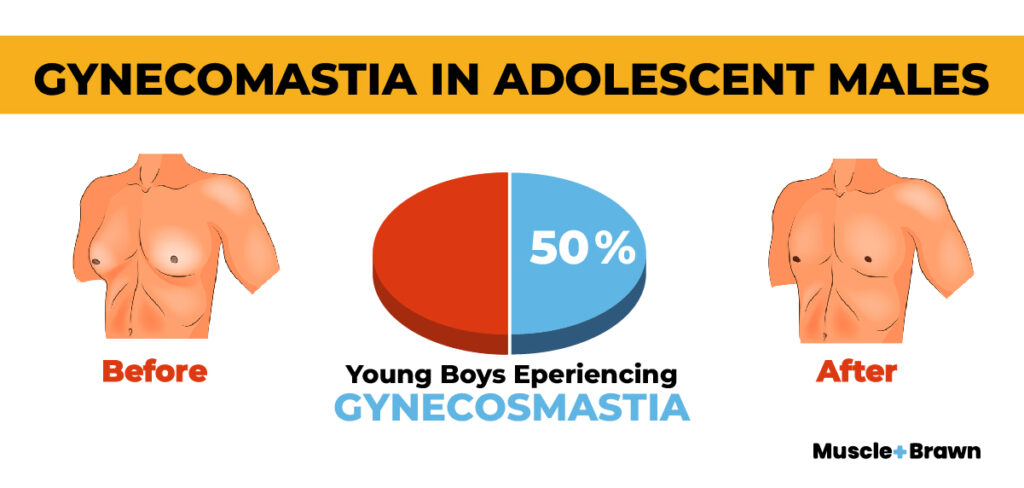
During puberty, estrogen levels can rise before testosterone reaches adult levels, so for a while the balance tips toward estrogen. The result is breast tissue in roughly 50% to 60% of boys. It usually starts between the ages of 10 and 12 and is most common around 13 to 14.
Published figures for this age group range from as low as 4% to as high as 69%. Studies examine boys of different ages and count different amounts of tissue as gynecomastia, which is where the higher “65% of teenage boys” figures come from.
3. Most pubertal gynecomastia goes away within six months to two years
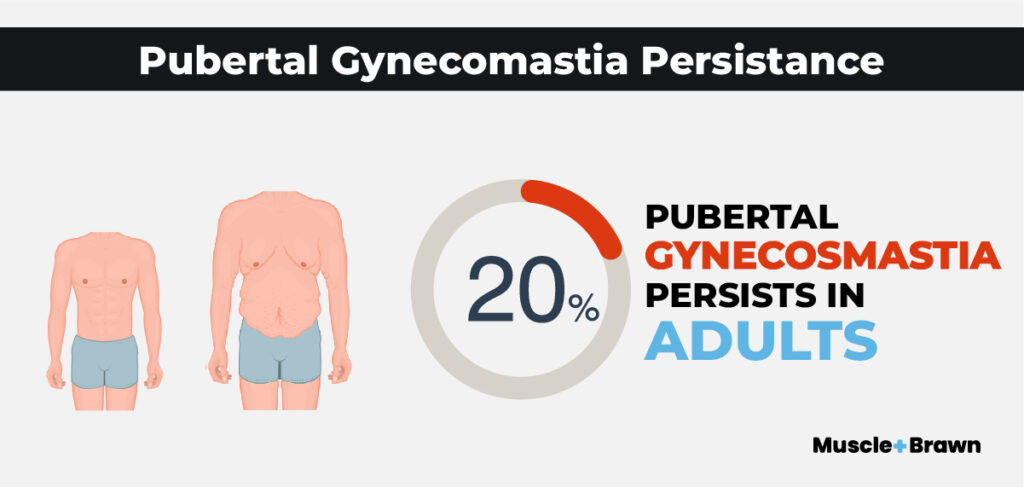
Pubertal gynecomastia usually shrinks on its own as testosterone rises, most often within six months to two years. That is why doctors generally watch and wait in teenagers. A minority of cases last past the late teens, more often when the tissue is large.
You will see claims that 20% or 25% of pubertal gynecomastia never resolves. The 25% figure actually describes something different: among adult men who see a doctor about gynecomastia, about a quarter have pubertal tissue that never went away (see statistic 6). Good long-term data on what share of all teenage cases persist into adulthood is limited.
4. Up to 70% of men aged 50 to 69 have gynecomastia
Gynecomastia becomes common again in middle and older age. Studies have found breast tissue on examination in up to 70% of men aged 50 to 69. Testosterone levels fall gradually with age, while body fat tends to rise. Fat tissue contains aromatase, the enzyme that converts testosterone into estradiol, so more fat means more estrogen relative to testosterone. Older men also take more medications that can cause it.
5. 65% of hospitalized men aged 27 to 92 had gynecomastia in one study
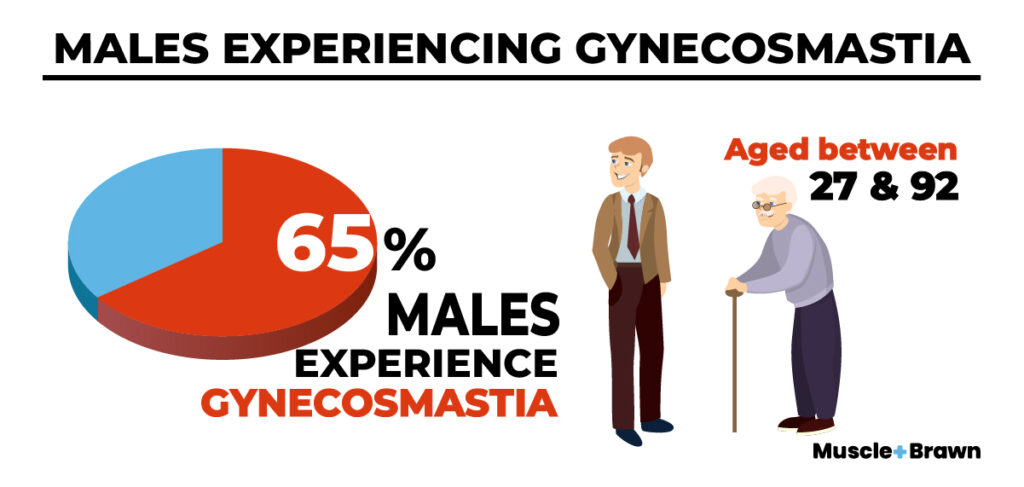
The often-quoted figure that 65% of men aged 27 to 92 have gynecomastia comes from examinations of men in hospital. Hospital patients are older and sicker and take more medications than the general population, and liver disease, kidney disease and many drugs are known causes. The figure shows how common breast tissue is in that group. It is not the lifetime odds for a healthy man.
Why Gynecomastia Statistics Disagree
Three things explain most of the conflicting numbers you will find:
- Age group: a figure for 14-year-olds or 60-year-olds will be far higher than one for men in their 20s and 30s.
- Definition: some studies count a small disc of tissue a doctor can feel; others count only enlargement big enough to see. Visible, bothersome gynecomastia is much less common than tissue found on examination.
- Population: hospital patients and men seeking treatment are not representative of healthy men.
Cleveland Clinic describes gynecomastia as common, estimating that 50% to 65% of boys and men worldwide are affected (4). The American Society of Plastic Surgeons also describes how often it occurs at different ages (1). The table below puts the main figures side by side.
| Group | Reported Share With Gynecomastia | What the Figure Describes |
|---|---|---|
| Newborn boys | 60-90% | Temporary breast buds from the mother’s estrogen |
| Boys in puberty | 50-60% (4-69% across studies) | Tissue found on examination, usually temporary |
| Hospitalized men aged 27-92 | 65% (one study) | Tissue found on examination in an older, sicker group |
| Men aged 50-69 | Up to 70% | Tissue found on examination |
| Boys and men worldwide | 50-65% | Cleveland Clinic estimate of how many are affected |
Chapter 2: What Causes Gynecomastia?
Men and women both make testosterone and estrogen. Men make far more androgens and only small amounts of estrogen. Gynecomastia develops when that balance shifts toward estrogen: estrogen rises, androgen levels or androgen action fall, or both.
The best-known breakdown of causes comes from men who sought a medical evaluation for gynecomastia, summarized in a widely cited review in The New England Journal of Medicine. Because these are men who went to a doctor, the shares describe noticeable or persistent gynecomastia, not the temporary tissue of puberty or older age.
| Cause | Approximate Share of Cases |
|---|---|
| Persistent pubertal gynecomastia | About 25% |
| Medications | 10-25% |
| No identifiable cause (idiopathic) | About 25% |
| Liver cirrhosis or malnutrition | About 8% |
| Primary hypogonadism (testicular failure, including Klinefelter syndrome) | About 8% |
| Testicular tumors | About 3% |
| Secondary hypogonadism (pituitary or hypothalamic causes) | About 2% |
| Hyperthyroidism | About 1.5% |
| Chronic kidney disease | About 1% |
6. About 25% of cases in adult men are pubertal gynecomastia that never went away
Among men evaluated for gynecomastia, around a quarter have tissue that first appeared in puberty and never fully regressed. After a year or so, the glandular tissue tends to become fibrous. That is why long-standing gynecomastia rarely shrinks on its own or with medication.
7. Medications cause 10-25% of gynecomastia
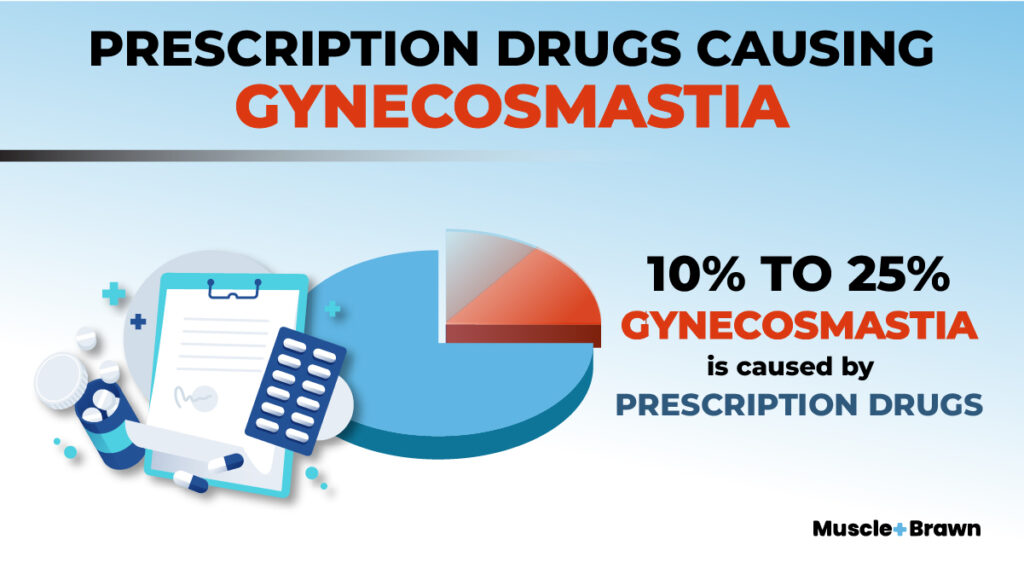
Many drugs can cause gynecomastia by raising estrogen, lowering testosterone, blocking androgen receptors or raising prolactin. Well-documented examples include:
- Spironolactone: a diuretic used for heart failure, high blood pressure and fluid retention. It blocks androgen receptors.
- Ketoconazole: an antifungal that interferes with testosterone production.
- Antiandrogens and 5-alpha reductase inhibitors: drugs such as bicalutamide for prostate cancer, and finasteride or dutasteride for an enlarged prostate or hair loss.
- Hormones: estrogens, hCG and anabolic steroids that convert to estradiol, such as testosterone. See our guide to steroids and gyno.
- Other medicines: cimetidine, some antipsychotics, some HIV medicines and digoxin.
If a medicine is the likely cause, a doctor may stop it or switch to an alternative. Tissue that appeared recently often shrinks after the drug is stopped; tissue that has been there for a long time may not. Do not stop a prescribed medication without talking to the prescriber first.
8. In a major heart failure trial, 10% of men on spironolactone developed breast symptoms
Spironolactone shows how strong a drug effect can be. In the RALES trial of spironolactone for severe heart failure, gynecomastia or breast pain was reported by 10% of men taking the drug, compared with 1% of men on placebo. Eplerenone, a related drug that acts more selectively on its target, causes these effects far less often and is a common alternative.
9. Up to 75% of men on antiandrogen therapy develop gynecomastia
Gynecomastia is especially common in men having hormone therapy for prostate cancer. With antiandrogen monotherapy, such as high-dose bicalutamide, gynecomastia and breast pain are reported in more than half of men, and in up to about three in four in some reports. Androgen deprivation therapy, which lowers testosterone itself, also causes it, though less often.
Men who need these treatments usually cannot simply stop them, but the risk can be reduced. Low-dose radiotherapy to the breast area before treatment and the drug tamoxifen both lower the chance of gynecomastia. In head-to-head trials, tamoxifen worked better.
10. About 25% of gynecomastia has no identifiable cause
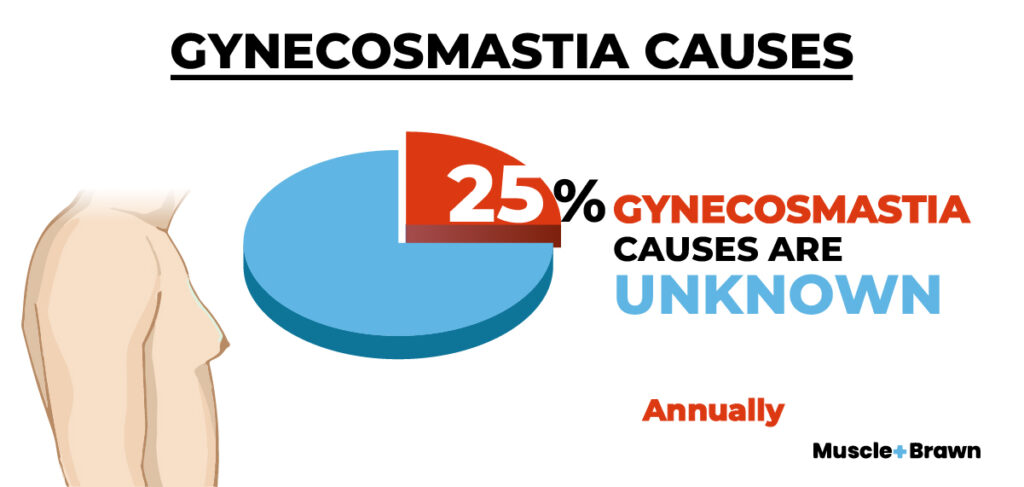
In about a quarter of men evaluated for gynecomastia, no cause is found. Doctors call this idiopathic gynecomastia. Many of these cases probably reflect the normal changes of aging and weight gain described above: lower testosterone, more body fat and more conversion of testosterone to estradiol.
Heavy drinking can contribute, mainly through liver damage. Marijuana is often listed as a cause, but the evidence for it is weak.
11. Klinefelter syndrome affects about 1 in 500 to 1,000 males
Klinefelter syndrome is a genetic condition in which a male is born with an extra X chromosome (XXY instead of XY). It affects roughly 1 in 500 to 1 in 1,000 males, and many are never diagnosed. The testes produce little testosterone, so breast enlargement is a common sign, along with small testes, infertility, lower bone density and, in some boys, learning or language difficulties (6).
Reported rates of gynecomastia in men with Klinefelter syndrome vary widely between studies. These men also have a higher risk of male breast cancer than other men, so new or changing breast tissue should be checked.
12. About half of men with persistent pubertal gynecomastia have a family history of it
Gynecomastia can run in families. Researchers have reported a family history of the condition in about half of patients whose pubertal gynecomastia persists (7) (8). Rare inherited disorders such as aromatase excess syndrome, in which the body makes too much of the enzyme that converts androgens to estrogen, can cause it in several members of the same family.
Chapter 3: Treatment, Surgery and Breast Cancer
Treatment depends on age, cause and how long the tissue has been there (3):
- Teenagers: usually watchful waiting, with check-ups to follow the size of the tissue, because most cases resolve.
- Adults: doctors look for and treat a cause first, such as a medication, low testosterone, or liver, kidney or thyroid disease.
- Medication: no drug is FDA-approved specifically for gynecomastia. Tamoxifen and raloxifene are approved for other uses and are sometimes prescribed off-label for recent, painful tissue. They work best within the first year, before the tissue turns fibrous.
- Surgery: for tissue that is large or has been present for a year or more, because fibrous tissue does not respond to drugs.
13. More than 20,000 US men have gynecomastia surgery each year
Gynecomastia surgery, also called male breast reduction, is one of the most common cosmetic operations in men. The American Society of Plastic Surgeons’ annual statistics have counted more than 20,000 of these procedures a year in the US in recent reports. Surgeons usually remove glandular tissue through a small incision at the edge of the areola, often combined with liposuction to remove surrounding fat.
For teenagers, surgeons usually advise waiting until puberty has finished and the tissue has had time to resolve on its own, unless it is severe or causing real distress.
14. Male breast reduction usually costs between $3,000 and $8,000
The cost of gynecomastia surgery depends on the surgeon, the location and the extent of the procedure. Totals of roughly $3,000 to $8,000 are typical in the US. The surgeon’s fee is only part of the bill: anesthesia, the operating facility, medications and compression garments are often charged separately. Insurance rarely pays when the surgery is considered cosmetic, although some plans cover cases that meet strict medical criteria.
15. About 2,800 US men are diagnosed with breast cancer each year
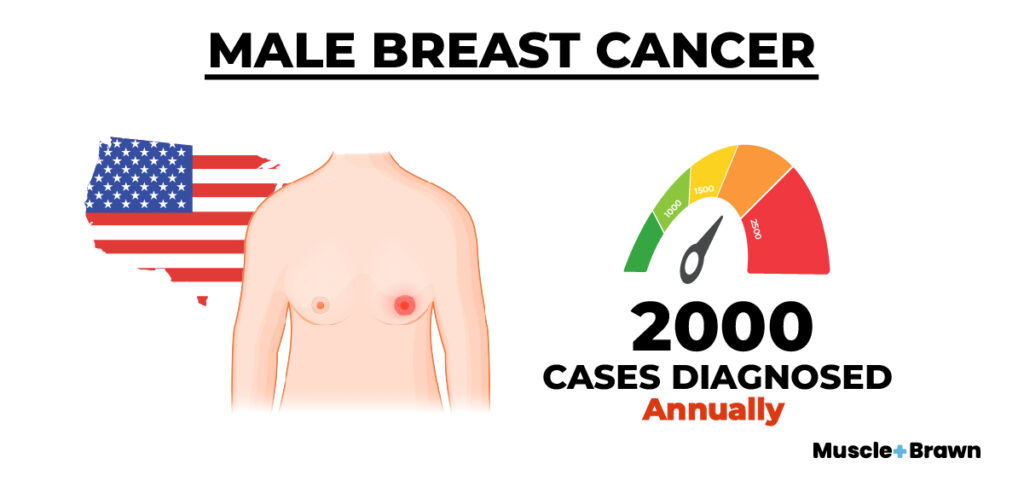
Breast cancer in men is rare. The American Cancer Society estimates about 2,800 new cases of invasive breast cancer in US men each year and around 500 deaths. Men account for less than 1% of all breast cancer cases, and a man’s lifetime risk is about 1 in 726.
Gynecomastia itself is benign and is not considered a strong risk factor. Mayo Clinic doctors note that it may raise the risk slightly because of the shift in the balance of estrogen to testosterone (5). Stronger risk factors include older age, a family history of breast cancer, inherited BRCA2 mutations (more common in people of Ashkenazi Jewish ancestry), Klinefelter syndrome, liver disease, obesity and past radiation to the chest.
Gynecomastia is usually soft or rubbery, centered under the nipple and often on both sides. See a doctor promptly for a hard or fixed lump, a lump off to one side of the nipple, nipple discharge or bleeding, skin dimpling, or swollen lymph nodes in the armpit.
For more numbers on hormones and performance drugs, see our anabolic steroid statistics.
The Bottom Line
Gynecomastia is one of the most common conditions in boys and men, and most of the alarming-sounding numbers describe harmless, temporary breast tissue.
- The headline figures of 50-70% count any breast tissue found on examination in specific age groups. Visible, bothersome gynecomastia is much less common.
- In teenagers it usually goes away on its own. In adults it is worth finding the cause, such as a medication, anabolic steroids, weight gain, low testosterone or liver disease, and treating it early, before the tissue turns fibrous.
- Breast cancer in men is rare, but a hard, fixed or one-sided lump, nipple discharge or skin changes need a doctor’s check.
Frequently Asked Questions
Disclaimer
Please read carefully
The information on this site is for educational and informational purposes only, and is not medical advice. Always consult a qualified healthcare professional before using any supplement or medication, or making changes to your health, fitness, or nutrition routine.
Not medical advice
Content here is not a substitute for professional medical advice.
Consult your doctor
Talk to your doctor before starting any supplement or new routine.
Use at your own risk
We are not responsible for adverse effects from acting on this.
Do your research
Make informed decisions about your own health.
No guarantees
Individual results vary. No claims about outcomes.
Important — Never disregard professional medical advice or delay seeking it because of something you read here. If you think you may have a medical emergency, call your doctor or your local emergency number right away.