Contents9 sections
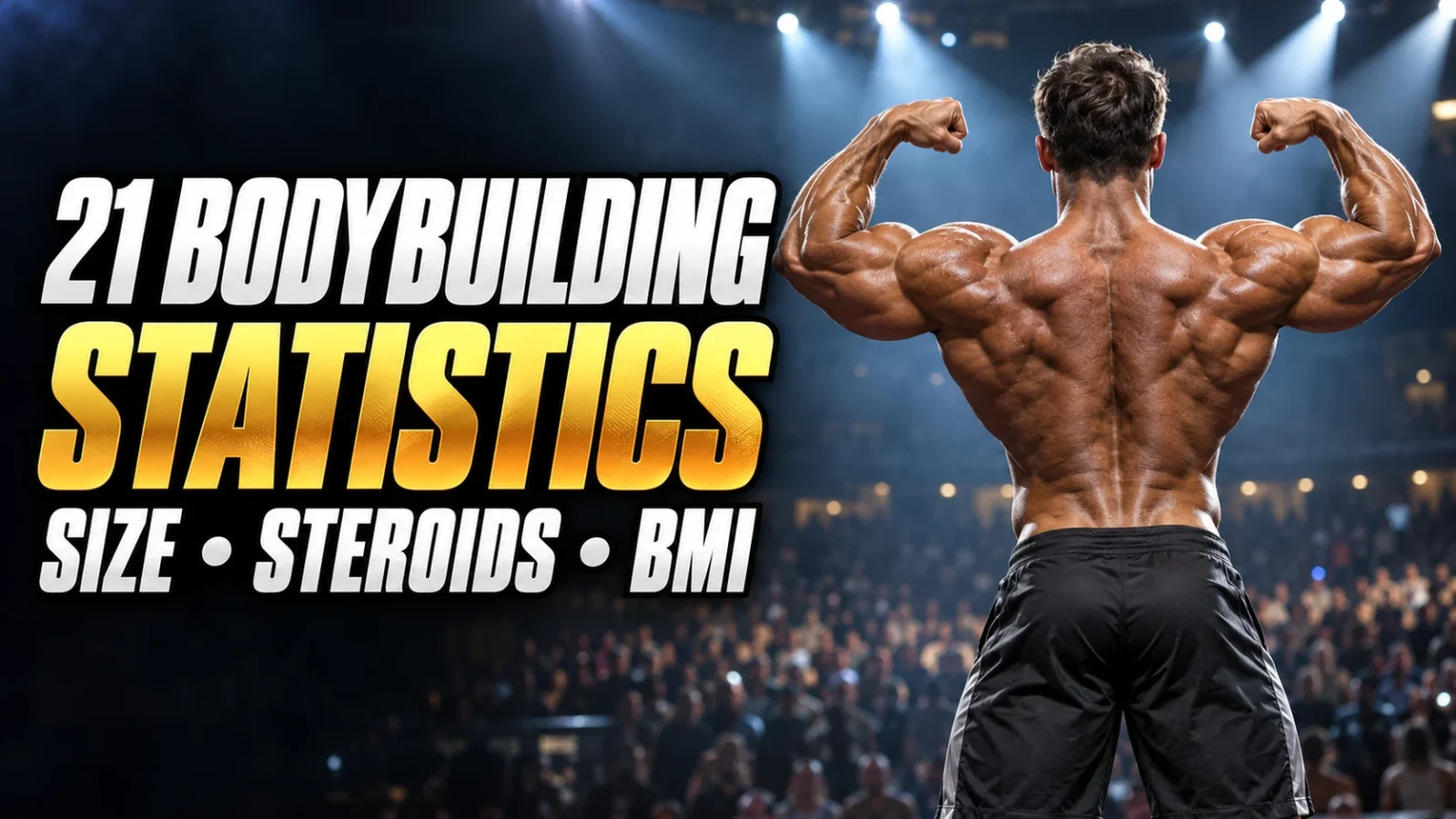
Bodybuilding statistics show what elite physiques actually look like, how they are built and what they cost. The numbers below come from studies that measured professional and amateur bodybuilders, surveys of how competitors train and which drugs they use, market data on supplements and recent research on how and when bodybuilders die.
Some of these figures come from small or self-reported samples, so each one is explained with where it comes from and what it can and cannot tell you. Here are 21 bodybuilding statistics on size, BMI and body fat, steroids, training, diet and supplements, and mortality.
Key Takeaways
- In a Polish study, professional bodybuilders had a slightly higher BMI than amateurs but about 5.7% body fat versus 18%. BMI cannot tell muscle from fat.
- About three in four competitive bodybuilders in one survey used anabolic steroids during the season. Worldwide, an estimated 3.3% of people have ever used them.
- Most competitive bodybuilders train 5-6 days a week on a split, using 3-5 exercises per muscle group. Research supports 10 or more weekly sets per muscle for growth.
- The global supplement market was worth about $152 billion in 2021 and close to $200 billion by 2024. More than half of US adults take at least one supplement.
- A 2025 European Heart Journal study of 20,286 male bodybuilders found sudden cardiac death behind 38% of deaths, with professionals at about five times the risk of amateurs.
Chapter 1: Pro vs Amateur Bodybuilders: Size, BMI and Body Fat
Bodybuilders carry more muscle and less fat than most people. A Polish study published in 2019 went a step further and compared 29 professional bodybuilders with 26 amateur bodybuilders of similar age. Three findings stand out.
1. Pro bodybuilders’ arms were 5.4 cm bigger and their thighs 5.1 cm bigger

On average, the professionals’ arm circumference was 5.4 cm larger than the amateurs’, and their thigh (quadriceps) circumference was 5.12 cm larger.
2. Pro bodybuilders’ waists were 5.7 cm slimmer
Despite carrying far more muscle, the professionals had waists 5.7 cm smaller than the amateurs. More muscle on the arms and legs with a smaller waist is what creates the V-taper judges reward, and it reflects how much leaner the professionals were.
3. Pros had a higher BMI but about 5.7% body fat, versus 18% in amateurs
The professionals’ body mass index (BMI) was slightly higher than the amateurs’. Yet when body fat was estimated from skinfold measurements, the pros averaged about 5.7% body fat, compared with about 18% in the amateur group.
| Measurement | Professionals vs Amateurs |
|---|---|
| Arm circumference | 5.4 cm larger |
| Thigh circumference | 5.12 cm larger |
| Waist circumference | 5.7 cm smaller |
| BMI | Slightly higher |
| Body fat (skinfolds) | About 5.7% vs about 18% |
Why BMI Misleads for Bodybuilders
BMI is body weight divided by height squared. It was designed to screen large populations for weight-related health risk, and it cannot tell muscle from fat. A lean, heavily muscled bodybuilder can fall in the “overweight” or even “obese” BMI range while carrying very little fat. That is exactly what the pros in this study show: the higher BMI belonged to the far leaner group.
Skinfold calipers are a cheap, practical way to estimate body fat, and they were enough here to show the gap between the groups. They are still an estimate that depends on the tester and the formula used. Lab methods such as DEXA scans and underwater weighing are generally more accurate.
Chapter 2: Anabolic Steroid Statistics in Bodybuilding
Anabolic steroid use is common in competitive bodybuilding, and many users take doses far above anything used in medicine. That is where most of the sport’s serious health risks come from, including high blood pressure, heart disease and, as Chapter 5 shows, early death. For broader figures on use, health effects and the law, see our anabolic steroid statistics.
4. Muscle gain from testosterone rises with the dose
In a controlled trial published in 2001, healthy young men were given weekly testosterone doses ranging from 25 mg to 600 mg for 20 weeks. Fat-free mass, muscle size and leg strength rose in step with the dose, even though the men were not put on a training program. HDL (“good”) cholesterol fell as the dose went up.
That dose-response is why more drugs usually means more muscle, and also why side effects climb along with it. These were doses studied under medical supervision, not advice.
5. About 3 in 4 competitive bodybuilders in one survey used steroids during the season
In a survey of competitive bodybuilders, about three out of four reported using anabolic steroids during the competitive season. Self-reported surveys like this depend on who chooses to answer, so the share varies between studies and countries. Use among competitors is still consistently far higher than in the general population.
6. Before contests, stanozolol (52%), boldenone (31%) and oxandrolone (18%) were the most common add-ons
In the run-up to a show, many of the same bodybuilders added further drugs to what they were already using. Stanozolol was the most common at 52%, followed by boldenone at 31% and oxandrolone at 18%. Stanozolol and oxandrolone are oral steroids mostly used while dieting, which is why they show up more before contests.
7. In the off-season, nandrolone (48%), Sustanon (46%), boldenone (42%) and testosterone (36%) were the most used

Off-season use centered on injectable steroids taken to gain size. Sustanon is itself a blend of four testosterone esters, so the share using some form of testosterone was likely higher than the 36% figure alone suggests.

The survey also recorded drugs that are not steroids. Clenbuterol is a beta-2 agonist approved for asthma in some countries and only for horses in the US. Liothyronine (T3) is a thyroid hormone medicine that some bodybuilders take to speed up fat loss. Clomiphene is a fertility drug used after a cycle to restart natural testosterone production (see Clomid for bodybuilding).
8. 3.3% of people worldwide have used anabolic steroids
A 2014 meta-analysis of studies from around the world estimated lifetime anabolic steroid use at 3.3% overall: 6.4% of men and 1.6% of women. Use was highest among recreational sportspeople such as gym-goers, at 18.4%.
Why Data on Professional Bodybuilders Is Thin
Hard data on drug use by top professionals is close to non-existent. Open professional bodybuilding does not drug test the way Olympic sports do, and pros rarely discuss their protocols in detail. Most figures come from anonymous surveys of amateur and national-level competitors. Tested natural federations do exist, and how to tell genuine naturals from enhanced lifters is covered in steroids vs natural bodybuilders.
Chapter 3: Bodybuilding & Weight Training Statistics
Bodybuilding has moved from a niche sport into the mainstream, helped by social media and the attention around contests such as the Mr. Olympia. There is no single training program behind a pro physique, but surveys show clear patterns in how competitive bodybuilders train.
9. Most competitive bodybuilders train 5-6 days a week on a split routine

In a survey of competitive male bodybuilders published in the Journal of Strength and Conditioning Research, most trained 5-6 days a week and worked each major muscle group, such as chest or legs, once or twice a week. About 70% used a five-way split, giving each main muscle group its own day, and about 30% used a three-way split.
10. About 95% use 3-5 exercises per muscle group
Almost all of the bodybuilders surveyed did 3-5 different exercises for each muscle group in a session, with most working sets in the 7-12 rep range. The exact loads and rep ranges shifted with the phase of the season.
11. 85% focus on lifting heavier in the off-season

In the off-season, about 85% of bodybuilders prioritized heavier loads to build as much muscle as possible. Top professionals typically trained each major muscle group no more than twice a week, in sessions that rarely ran past 70 minutes, according to a 2020 review of bodybuilding training programs.
12. Before a contest, about 1 in 5 switch to sets of more than 15 reps

In the weeks before a show, aerobic training goes up. About 20% of bodybuilders cut the number of sets they perform. Most stay with 7-12 reps, but about 20% move to sets of more than 15 reps. The aim at this stage is to keep muscle while dieting and doing more cardio, not to build new size.
13. 10 or more weekly sets per muscle build more muscle than fewer than 5
Research backs the high-volume habits bodybuilders arrived at by trial and error. A 2017 meta-analysis found that 10 or more sets per muscle group each week produced more muscle growth than fewer than 5, and each extra weekly set was linked to a little more growth. A 2016 meta-analysis found that training each muscle at least twice a week produced more growth than training it once.
Chapter 4: Bodybuilding Diet & Supplement Statistics
Diet is where competitive bodybuilders differ most from regular gym-goers, especially in the months before a show, when the goal is to get as lean as possible without losing muscle. There is no single bodybuilding diet, but most are built around high protein intakes from foods such as eggs, meat, fish, dairy and whey protein.
14. Contest-prep protein targets run as high as 2.3-3.1 g per kg of lean body mass
The International Society of Sports Nutrition recommends 1.4-2.0 g of protein per kg of body weight a day for most people who train. During contest prep, when calories are low, a widely cited 2014 review of evidence for natural bodybuilders suggested 2.3-3.1 g per kg of lean body mass to help hold on to muscle.
15. Recommended contest-prep weight loss is 0.5-1% of body weight per week
The same review recommended losing about 0.5-1% of body weight per week during prep. Losing weight faster raises the risk of losing muscle along with fat, which is why contest diets usually last several months.
16. The global supplement market is worth close to $200 billion

Market research firm Grand View Research valued the global dietary supplements market at about $152 billion in 2021 and close to $200 billion by 2024, and expects growth of roughly 9% a year. Sports nutrition products such as protein powder and creatine are only one part of this. Vitamins, minerals and other everyday supplements account for a large share.
17. US supplement manufacturing is worth about $40 billion a year
IBISWorld estimates the US vitamin and supplement manufacturing industry at around $40 billion a year, with growth of only about 1% a year between 2018 and 2023. The gap between this and the 9% global growth figure is not a contradiction. One measures the revenue of US manufacturers, the other worldwide sales across every type of supplement.
18. 57.6% of US adults take a dietary supplement

In the CDC’s national health and nutrition survey for 2017-2018, 57.6% of US adults had used at least one dietary supplement in the past 30 days. Use was higher in women than in men and rose with age, which makes older adults some of the industry’s biggest customers. Multivitamins, vitamin D and omega-3s were among the most common products.
Demand for immune-support products such as vitamin C, vitamin D and zinc also jumped during the COVID-19 pandemic. For lifters, the supplements with the strongest evidence remain the basics: protein to help reach a daily target and creatine monohydrate.

Pros
- Catalog is specifically organized around muscle building, fat loss, testosterone support, and workout performance.
- Range includes creatine, protein, EAAs, beta-alanine, and L-citrulline alongside more specialized formulas.
- Orders of $99+ qualify for free US shipping.
Cons
- Features several strong claims around muscle growth, testosterone, fat loss, and metabolic effects that should be distinguished from independently demonstrated clinical outcomes
- Heavily oriented toward bodybuilding and performance rather than broader nutritional supplementation.
Chapter 5: Bodybuilding Deaths: Myths vs Facts
Many people believe professional bodybuilders die young. Figures that circulated online claimed both that bodybuilders outlive the average man and that they die at higher rates than NFL or MLB players. The best recent evidence settles much of the debate: competitive bodybuilders, and professionals in particular, face a real excess risk of sudden cardiac death.

19. 38% of deaths among male competitive bodybuilders were sudden cardiac deaths
A study published in the European Heart Journal in 2025 looked at 20,286 male bodybuilders who had competed in at least one IFBB competition between 2005 and 2020. It identified 121 deaths, at an average age of 45. Sudden cardiac death accounted for 38% of them.
Deaths were identified from publicly available sources, so some may have been missed and the true numbers could be higher. The athletes were also relatively young when the study period began, so an average age at death of 45 does not mean bodybuilders typically die at 45. The striking finding is how many of these deaths were sudden and heart-related.
20. Professional bodybuilders had about five times the sudden cardiac death risk of amateurs
The risk was concentrated at the top of the sport. In the same study, professional bodybuilders had roughly five times the risk of sudden cardiac death of amateurs. Likely contributors include very intense training, rapid weight changes and dehydration before shows, and heavy use of performance-enhancing drugs, all of which tend to be more extreme at the professional level.
This fits other research on long-term steroid users. A 2017 study in the journal Circulation found that experienced weightlifters who had used steroids for years had weaker heart pumping function and more coronary artery plaque than weightlifters who had not. Bodybuilders with long-term steroid use have also developed a serious kidney disease, focal segmental glomerulosclerosis, in published case series. Diuretics used to look dry on stage and insulin used for size add their own risks, including dangerous shifts in blood salts and very low blood sugar.
21. 12.9% of elite powerlifters suspected of steroid use died within 12 years, versus 3.1% of controls
Earlier evidence from a related strength sport points the same way. A Finnish study followed 62 elite powerlifters, suspected of steroid use, who had placed in national championships in the late 1970s and early 1980s. Over 12 years, 12.9% of them died, compared with 3.1% of a control group from the general population. Causes included suicide, heart attack, liver failure and lymphoma.
Do Bodybuilders Outlive the Average Man?
The claim that professional bodybuilders aged 44 to 69 outlive the average American man rested on a general population life table, not on a study that followed a defined group of bodybuilders over time and counted who died and when. Studies that do follow competitors, like the two above, find more early deaths, not fewer.
The comparison with other athletes has a similar problem. The figures quoted online, that bodybuilders die at 1.75 times the rate of NFL players and 2.5 times the rate of MLB players, were cited to a 2019 JAMA Network Open study that compared NFL players with MLB players and did not include bodybuilders. They should not be treated as research findings.
| Claim | What the Evidence Shows |
|---|---|
| Bodybuilders outlive the average man | Based on a general life table, not a study of bodybuilders. Studies that follow competitors find more early deaths. |
| Bodybuilders die at 1.75 times the rate of NFL players and 2.5 times that of MLB players | Not from a study of bodybuilders. The JAMA study cited for it compared NFL and MLB players only. |
| Bodybuilder deaths are just media hype | Sudden cardiac death caused 38% of the 121 deaths in the 2025 European Heart Journal study, and professionals had about five times the risk of amateurs. |
| Lifting weights shortens your life | No. Muscle-strengthening activity is linked to a 10-17% lower risk of death from all causes. |
None of this means lifting weights is bad for you. A 2022 meta-analysis of cohort studies found that people who did muscle-strengthening activities had a 10-17% lower risk of death from all causes, heart disease and cancer. The danger in bodybuilding comes from the extremes of competition, above all high-dose drug use, not from the training itself.

The Bottom Line
Competitive bodybuilders are far leaner and more muscular than amateurs, train with high volume and eat high-protein diets, but drug use is widespread and the newest research ties the sport’s extremes to a real risk of early cardiac death.
- BMI badly misjudges muscular people: in the Polish study, pros had a higher BMI than amateurs but about 5.7% body fat versus 18%.
- Steroid use is common among competitors, and its effects, both muscle gain and side effects, rise with the dose.
- Sudden cardiac death caused 38% of deaths among male bodybuilders in the 2025 European Heart Journal study, with professionals at about five times the risk of amateurs. The claim that bodybuilders outlive the average man does not hold up.
Frequently Asked Questions
Disclaimer
Please read carefully
The information on this site is for educational and informational purposes only, and is not medical advice. Always consult a qualified healthcare professional before using any supplement or medication, or making changes to your health, fitness, or nutrition routine.
Not medical advice
Content here is not a substitute for professional medical advice.
Consult your doctor
Talk to your doctor before starting any supplement or new routine.
Use at your own risk
We are not responsible for adverse effects from acting on this.
Do your research
Make informed decisions about your own health.
No guarantees
Individual results vary. No claims about outcomes.
Important — Never disregard professional medical advice or delay seeking it because of something you read here. If you think you may have a medical emergency, call your doctor or your local emergency number right away.