
Contents12 sections
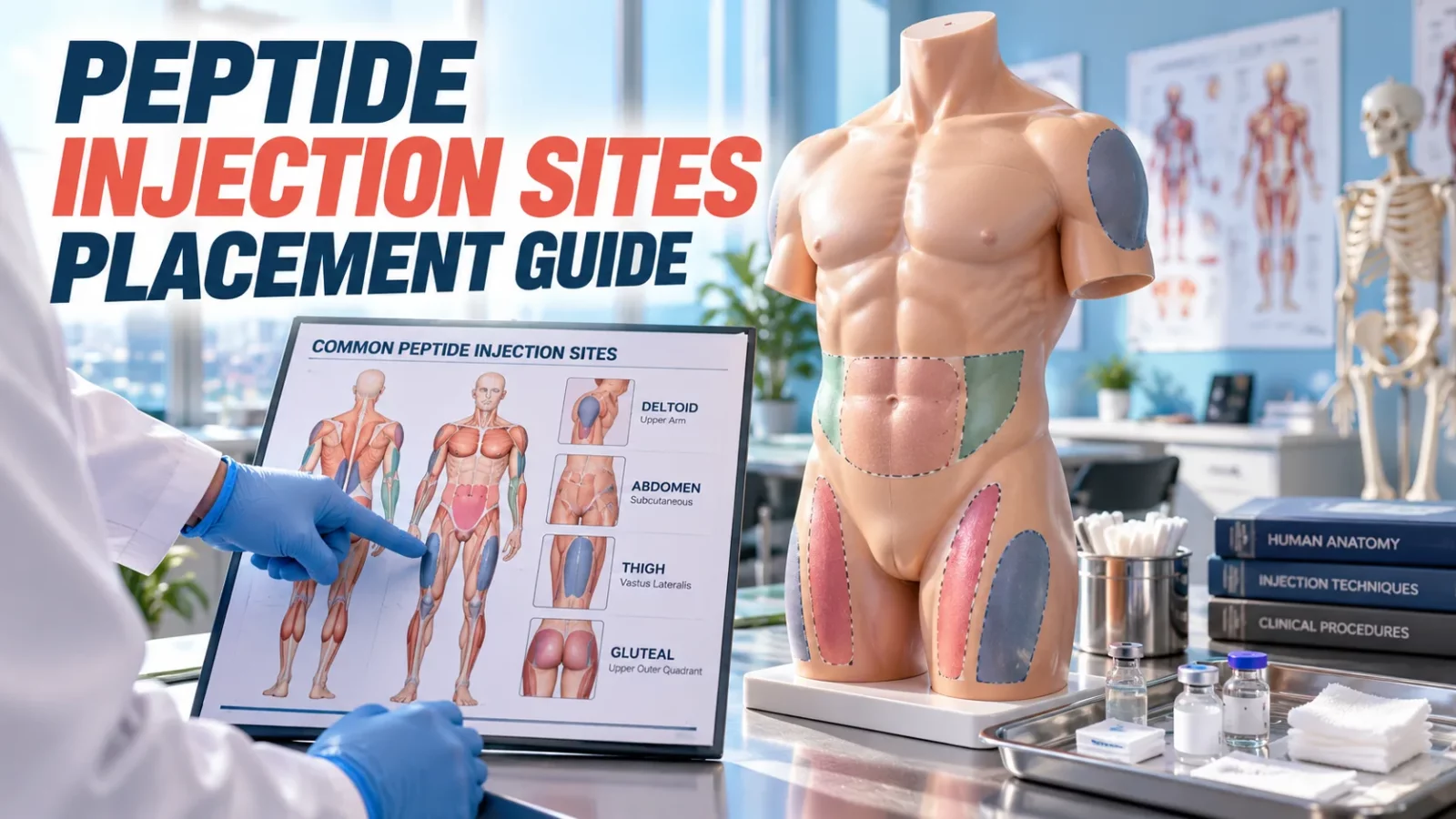
The best peptide injection sites for subcutaneous administration are the abdomen (at least 5cm from the navel) and the upper thigh. These areas have the most subcutaneous fat, fewer nerve endings, and consistent absorption rates. For intramuscular peptide injections, the deltoid (upper arm) and gluteus (buttocks) are the standard sites.
I have administered and supervised hundreds of peptide injections over the past decade, working with clients using everything from BPC-157 and TB-500 for recovery to CJC-1295 and Ipamorelin for growth hormone protocols. The injection itself is the part most people overthink. With the right site selection, needle size, and technique, subcutaneous peptide injections are straightforward and nearly painless.
This guide covers where to inject peptides, including every viable injection site, step-by-step technique for both subcutaneous and intramuscular injections, needle selection, site rotation protocols, and troubleshooting for common issues like lumps, stinging, and bruising.
Key Takeaways
- The abdomen and upper thigh are the best peptide injection sites for subcutaneous injections due to high subcutaneous fat content and consistent absorption.
- Most peptides (BPC-157, CJC-1295, Ipamorelin, MK 677 injectable, Thymosin Beta-4) are administered subcutaneously, not intramuscularly.
- Use a 29-31 gauge insulin syringe with a 1/2-inch needle for subcutaneous peptide injections. Inject at a 45-90 degree angle depending on how much skin you can pinch.
- Rotate injection sites systematically to prevent tissue damage, scar tissue buildup, and absorption inconsistencies.
- Always inject on an empty stomach for GH-releasing peptides. Insulin blunts growth hormone release.
Best Peptide Injection Sites (Subcutaneous)
Subcutaneous (subQ) injection is the standard route for most peptides, and choosing the right subcutaneous injection sites is the most important decision you will make for consistent results. The needle goes into the fatty tissue between the skin and muscle, where the peptide absorbs gradually into the bloodstream. This route provides more sustained release than intramuscular injection and is easier to self-administer.
1. Abdomen (Best Overall Site)
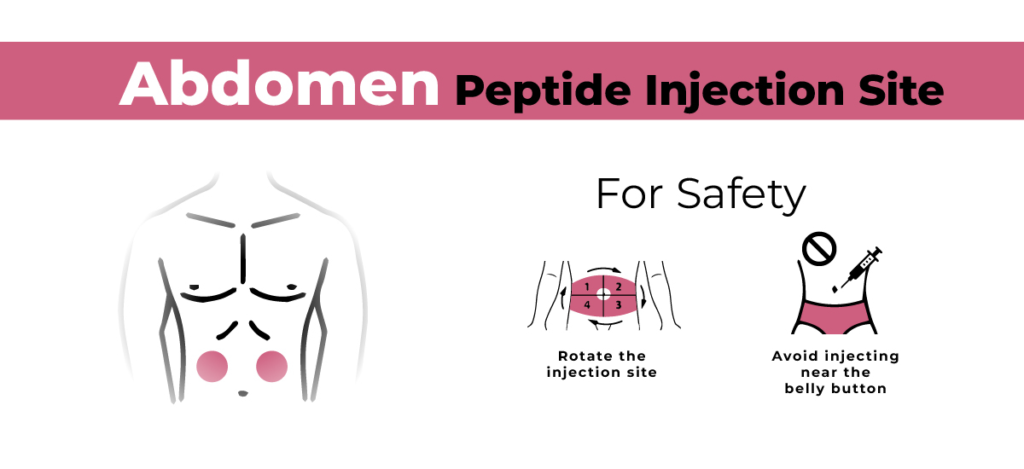
The abdomen is the most popular peptide injection site and the one I recommend for most users. The stomach area is the most searched peptide injection site for good reason: it has the largest area of accessible subcutaneous fat, making it easy to pinch skin and inject consistently.
Where exactly: Anywhere on the belly at least 5cm (2 inches) from the navel. Avoid the immediate area around the belly button, as it is more sensitive and has less consistent fat depth. The best zones are the left and right flanks, roughly between the hip bone and the bottom of the rib cage.
Why it works:
- Thick subcutaneous fat layer for reliable absorption
- Fewer nerve endings than other sites, meaning less pain
- Large area allows extensive site rotation
- Easy to access for self-injection
2. Upper Thigh

The front and outer upper thigh is the second most common subcutaneous injection site. It offers a good amount of subcutaneous tissue and is easy to reach.
Where exactly: The front or outer aspect of the thigh, roughly midway between the knee and hip. Avoid the inner thigh (more nerve endings and blood vessels) and the area directly over the kneecap.
Why it works:
- Good subcutaneous fat depth in most individuals
- Easy to self-administer while seated
- Large area for rotation
- Less visible than the abdomen for those concerned about injection marks
3. Upper Arm (Back of the Arm)
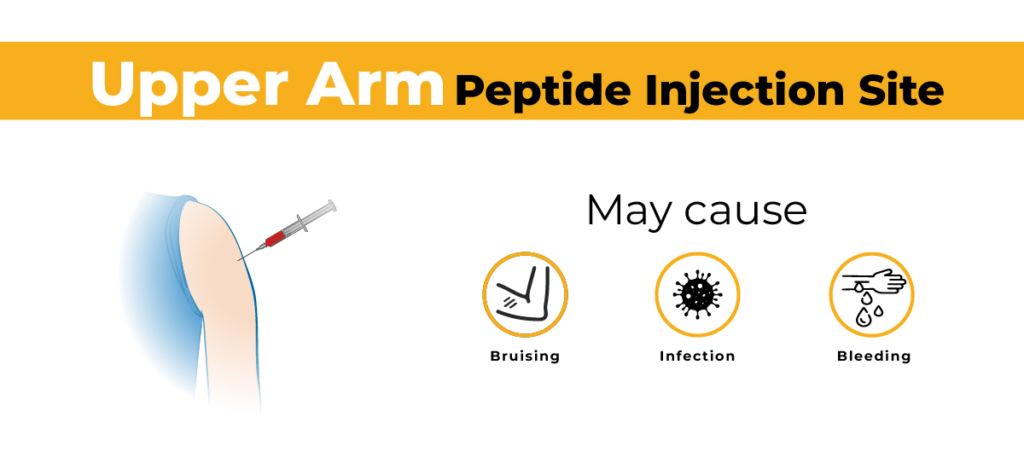
The back of the upper arm, specifically the triceps area, is a viable subcutaneous injection site, though it is harder to self-administer without assistance.
Where exactly: The fatty tissue on the back of the upper arm, between the shoulder and elbow. Pinch the skin to lift the subcutaneous layer away from the muscle.
Considerations:
- Harder to reach for self-injection (may need a partner)
- Less subcutaneous fat than the abdomen or thigh in lean individuals
- Good rotation option to supplement primary sites
4. Lower Back / Love Handle Area
The flanks and lower back have substantial subcutaneous fat in most people, making them viable injection sites.
Where exactly: The area above the hip bone on either side of the lower back. This is essentially the “love handle” region.
Considerations:
- Good fat depth for absorption
- Harder to access for self-injection without practice
- Useful as a rotation site, not a primary site
- Avoid injecting near the spine
5. Gluteal (Upper Buttock)
The upper outer quadrant of the buttock can be used for subcutaneous injections, though it is more commonly used for intramuscular injections.
Where exactly: The upper outer area of the buttock, away from the sciatic nerve (which runs through the lower inner quadrant).
Considerations:
- Good fat depth
- Difficult to self-inject
- Better suited as an intramuscular injection site for peptides that require IM administration
Intramuscular Peptide Injection Sites
Most peptides are administered subcutaneously, but some may be prescribed or studied via intramuscular (IM) injection. IM injection delivers the peptide directly into muscle tissue, where it absorbs faster than subcutaneous injection.
Deltoid (Upper Arm)
Where: The fleshy part of the outer upper arm, approximately 2-3 finger widths below the acromion (the bony point of the shoulder).
Best for: Small-volume IM injections (1mL or less). The deltoid is easy to access and commonly used for vaccines and small peptide doses.
Gluteus (Buttock)
Where: The upper outer quadrant of the buttock. Draw an imaginary cross over the buttock and inject in the upper outer section. This avoids the sciatic nerve in the lower inner quadrant.
Best for: Larger-volume IM injections. The gluteus is the largest muscle and can accommodate higher volumes comfortably.
Vastus Lateralis (Outer Thigh)
Where: The outer middle third of the thigh. This is a large, accessible muscle that is easy to self-inject.
Best for: Self-administered IM injections. The outer thigh is the easiest IM site to reach on your own.
How to Inject Peptides Subcutaneously: Step-by-Step
This is the standard peptide injection technique for subcutaneous administration. For complete peptide preparation including reconstitution and dosing calculations, see our full guide on how to inject peptides. Below is the step-by-step process for how to inject peptides subcutaneously at any of the sites listed above.
Equipment Needed
- Insulin syringe (29-31 gauge, 1/2-inch needle)
- Alcohol swabs
- Reconstituted peptide vial
- Sharps container for needle disposal
Step-by-Step Procedure
- Wash your hands thoroughly with soap and water.
- Clean the injection site with an alcohol swab in a circular motion. Let it dry completely (injecting through wet alcohol stings).
- Draw up your dose from the peptide vial using sterile technique. Pull back the plunger, inject air into the vial equal to your dose volume, then invert the vial and draw the peptide solution.
- Remove air bubbles by tapping the syringe barrel and pushing the plunger until a small drop appears at the needle tip.
- Pinch the skin at your chosen injection site with your non-dominant hand. Lift the subcutaneous fat away from the underlying muscle.
- Insert the needle at a 45-90 degree angle. If you can pinch a full inch of skin, inject at 90 degrees. If the skin fold is thinner, use 45 degrees.
- Inject slowly. Push the plunger steadily and completely. There is no need to aspirate (pull back) for subcutaneous injections.
- Withdraw the needle at the same angle you inserted it. Apply gentle pressure with a clean gauze pad if there is any bleeding. Do not rub.
- Dispose of the needle immediately in a sharps container. Never recap or reuse needles.
Needle Selection for Peptide Injections
| Injection Type | Needle Gauge | Needle Length | Syringe Volume |
|---|---|---|---|
| Subcutaneous | 29-31 gauge | 1/2 inch (12.7mm) | 0.3-1mL insulin syringe |
| Intramuscular | 23-25 gauge | 1-1.5 inches (25-38mm) | 1-3mL syringe |
For subcutaneous peptide injections: Use an insulin syringe. The 29-31 gauge needle is thin enough that most people barely feel the injection. The 1/2-inch length is standard for reaching subcutaneous tissue without penetrating into muscle.
For intramuscular injections: Use a larger gauge (23-25) and longer needle (1-1.5 inches) to reach muscle tissue. The specific length depends on the injection site and the individual’s body composition.
Injection Site Rotation
Rotating your peptide injection sites is not optional. Injecting in the same spot repeatedly causes:
- Lipohypertrophy: Hardened, fatty lumps under the skin that impair absorption
- Scar tissue buildup: Makes future injections more painful and less effective
- Bruising and irritation: Tissue does not heal fully between injections
- Inconsistent absorption: Damaged tissue absorbs peptides unpredictably
Rotation Protocol
Use a systematic rotation rather than random selection. The simplest approach:
For daily injections: Divide the abdomen into 4 quadrants (upper left, upper right, lower left, lower right). Inject in a different quadrant each day, cycling through all 4 before returning to the first. Space injections within each quadrant at least 1 inch (2.5cm) apart.
For less frequent injections (1-2x per week): Alternate between the abdomen and thigh, or rotate through abdomen, left thigh, right thigh, and back to abdomen.
Keep a simple log or use a consistent pattern you can remember. Some users mark injection sites with a skin-safe marker for the first few weeks until the rotation becomes automatic.
Timing Considerations
Growth hormone-releasing peptides (CJC-1295, Ipamorelin, Sermorelin, GHRP-6): Inject on an empty stomach, either before bed or at least 30-60 minutes before eating. Insulin inhibits GH release, so timing around meals matters significantly for these peptides.
Recovery and healing peptides (BPC-157, TB-500): Timing is less critical. Can be injected with or without food. For localized injuries, some protocols recommend injecting as close to the injury site as possible for BPC-157.
Tanning peptides (Melanotan II): Typically injected subcutaneously in the abdomen. Timing relative to meals is not a significant factor.
Troubleshooting Common Injection Issues
Lumps at the Injection Site
Small lumps at peptide injection sites are common and usually harmless after subcutaneous administration. They occur when the peptide solution pools in the subcutaneous tissue before absorbing. They typically resolve within 24-48 hours. If lumps persist or grow, you may be injecting too quickly, injecting too much volume in one site, or not rotating sites adequately.
Stinging or Burning During Injection
Stinging usually means the alcohol swab was not fully dry before injection, or the peptide solution is at a different temperature than body tissue. Let the alcohol dry completely, and allow refrigerated peptide vials to warm to room temperature for 5-10 minutes before injecting.
Bruising
Minor bruising is normal and means you nicked a small blood vessel. It is cosmetic and does not affect peptide absorption. To minimize bruising: do not inject in areas with visible veins, apply gentle pressure (not rubbing) after withdrawal, and use a thinner gauge needle (30-31 gauge).
Bleeding After Injection
A small drop of blood is normal. Apply gentle pressure with a gauze pad for 30 seconds. If bleeding is more than a few drops, you likely hit a small vein. This is not dangerous but means the needle went slightly deeper than intended or hit a superficial vessel. Adjust your angle on the next injection.
Where to Buy Peptides
Quality sourcing matters for both safety and effectiveness. Only buy from vendors that provide third-party Certificates of Analysis (COAs), proper cold-chain shipping for temperature-sensitive peptides, and transparent labeling.
For our current tested and ranked vendor list, see our guide to the best peptide vendors.
The Bottom Line
The abdomen and upper thigh are the best peptide injection sites for subcutaneous administration.
- These two locations offer the most subcutaneous fat, the least pain, and the most consistent absorption.
- Use a 29-31 gauge insulin syringe, rotate sites systematically, inject on an empty stomach for GH-releasing peptides, and dispose of needles properly.
- Choose your site, clean it, pinch the skin, and inject. With proper technique and consistent rotation, subcutaneous peptide injections become routine within a few sessions.
Frequently Asked Questions
Disclaimer
Please read carefully
The information on this site is for educational and informational purposes only, and is not medical advice. Always consult a qualified healthcare professional before using any supplement or medication, or making changes to your health, fitness, or nutrition routine.
Not medical advice
Content here is not a substitute for professional medical advice.
Consult your doctor
Talk to your doctor before starting any supplement or new routine.
Use at your own risk
We are not responsible for adverse effects from acting on this.
Do your research
Make informed decisions about your own health.
No guarantees
Individual results vary. No claims about outcomes.
Important — Never disregard professional medical advice or delay seeking it because of something you read here. If you think you may have a medical emergency, call your doctor or your local emergency number right away.




how can i stop it hitting and injection site hurts and stings with a lump for 24 hours and i am supposed to inject everyday