
Contents13 sections
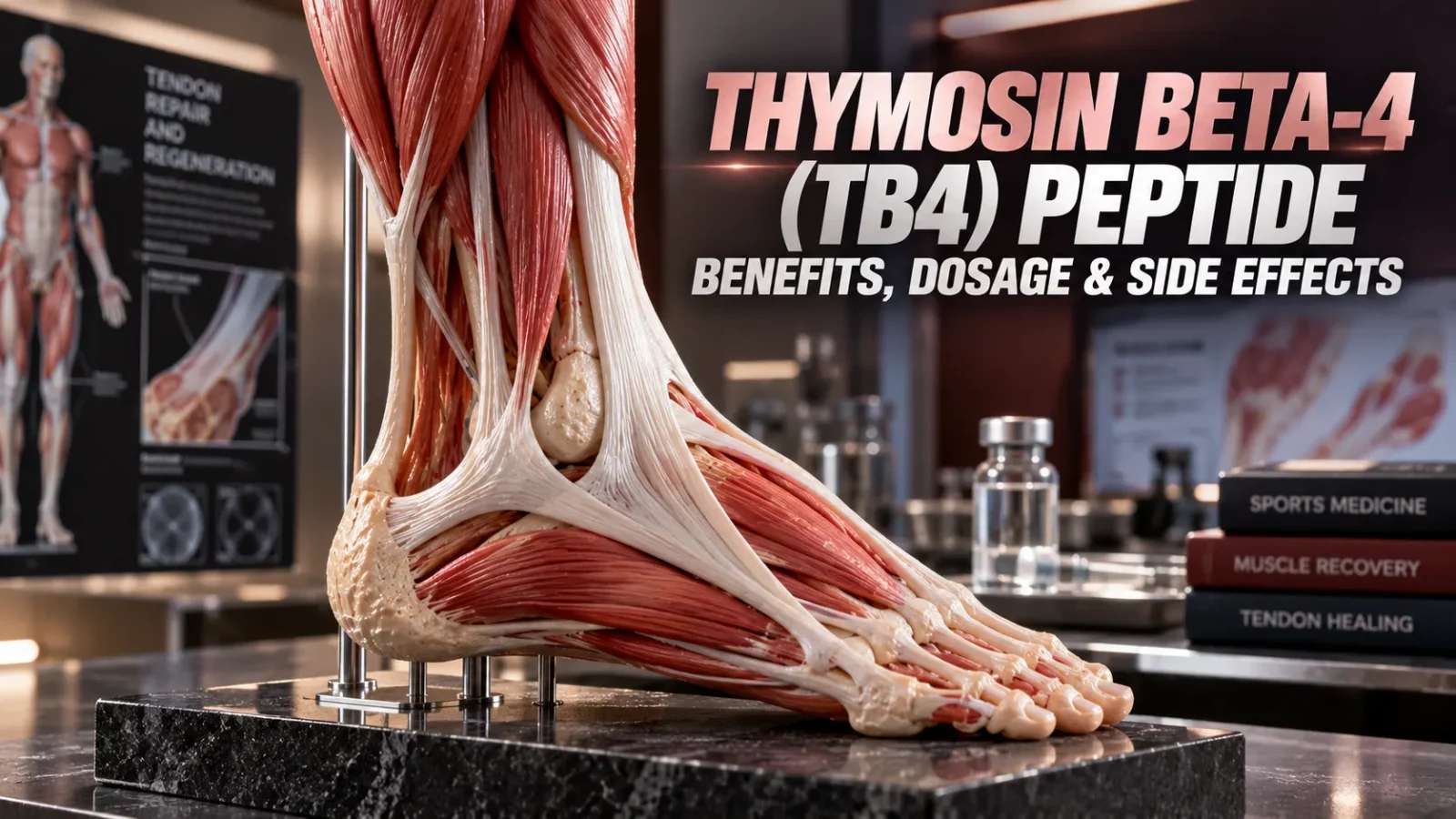
Thymosin Beta-4 is a naturally occurring peptide that plays a central role in wound healing, tissue repair, and inflammation control. Comprising 43 amino acids, this TB4 peptide is produced by the thymus gland and is found throughout the body in platelets, macrophages, and other cell types that respond to injury.
For athletes and bodybuilders, Thymosin Beta-4 benefits center on faster recovery from muscle injuries, reduced inflammation after intense training, and improved flexibility. The peptide has also demonstrated therapeutic potential for cardiovascular repair, corneal healing, liver protection, and neuroprotection in clinical research.
Key Takeaways
- Thymosin Beta-4 is a 43-amino-acid peptide naturally produced by the thymus gland. It is the most abundant member of the beta-thymosin family.
- Primary Thymosin Beta-4 benefits include accelerated wound healing, reduced inflammation, cardiovascular protection, corneal repair, and hair growth stimulation.
- The typical Thymosin Beta-4 dosage is 2-12 mg via subcutaneous or intramuscular injection, with cycle lengths of 20 days to 6 months depending on the application.
- Common Thymosin Beta-4 side effects are mild: injection site redness, joint discomfort, fatigue, and headache.
- Thymosin Beta-4 and TB-500 are not the same compound. TB-500 is a synthetic 7-amino-acid fragment derived from TB4’s active region.
What Is Thymosin Beta-4?
Thymosin Beta-4 (TB4) is a small, naturally occurring peptide first isolated from the thymus gland. It belongs to the thymosin family of lymphocyte growth factors originally extracted from calf thymuses, with TB4 being the most abundant of the beta-thymosins.
While it is primarily produced in the thymus, the peptide is also present in the spleen and peritoneal macrophages. After injury, it is released by platelets, macrophages, and other cell types to protect damaged tissue and initiate repair.
Quick Facts
| Property | Detail |
|---|---|
| Full name | Thymosin Beta-4 |
| Also known as | TB4, Timbetasin |
| Amino acids | 43 |
| Source | Thymus gland (endogenous) |
| Primary function | Wound healing, tissue repair, anti-inflammatory |
| Administration | Subcutaneous or intramuscular injection, eye drops |
| Research status | Clinical trials for wound repair, dry eye, cardiac recovery |
How Thymosin Beta-4 Works
Thymosin Beta-4 is a multifunctional peptide that mediates multiple stages of wound healing at the cellular level. Here is how it operates:
Angiogenesis Promotion
TB4 promotes the formation of new blood vessels by upregulating vascular endothelial growth factor (VEGF) expression. This helps restore blood supply to damaged tissue, which is critical for recovery from ischemia and necrosis.
Anti-Apoptotic Activity
The peptide prevents programmed cell death by inhibiting transforming growth factor pathways. This allows cells in the heart, eyes, nerves, and other organs to survive longer after sustaining damage.
Anti-Inflammatory Action
The TB4 peptide controls inflammation at wound sites by inhibiting the release of pro-inflammatory cytokines like tumor necrosis factor-alpha (TNF-alpha). Reducing early inflammation prevents secondary tissue damage and speeds healing.
Antimicrobial Protection
TB4 has antimicrobial properties that protect wound sites from infection while promoting cell survival during the repair process.
Tissue Regeneration
The peptide promotes stem cell mobilization, migration, and differentiation by sequestering actin monomers to maintain high concentrations of unpolymerized actin. This actin regulation plays a key role in cell movement and tissue rebuilding.
Liver Protection

Research shows that TB4 inhibits the migration and proliferation of hepatic stellate cells (HSCs), protecting the liver from fibrotic damage after injury, disease, or medication-related toxicity.
Thymosin Beta-4 Benefits
Accelerated Wound Healing
The primary Thymosin Beta-4 benefit is its ability to speed up wound healing through anti-apoptotic and anti-inflammatory mechanisms. Athletes and bodybuilders use TB4 to expedite recovery after muscle injuries, reduce complications from intense training, and minimize scar tissue formation.
Cardiovascular Protection
In cases of myocardial infarction (heart attack), the TB4 peptide protects heart tissue by reducing apoptosis and inflammation. This helps preserve cardiac function during and after a heart attack. Research in animal models has shown significant improvements in cardiac recovery with TB4 treatment.
Corneal Healing and Eye Health
TB4 demonstrates therapeutic effects in treating corneal injuries caused by chemical exposure or trauma. By reducing inflammation, inhibiting apoptosis, and regulating cellular matrices, the peptide supports corneal tissue regeneration. Eye drops containing 0.1% Thymosin Beta-4 have also shown efficacy in relieving dry eye symptoms by reducing inflammatory cytokine levels.
Neuroprotective Effects
Research suggests that TB4 protects and repairs neurons, with potential benefits for brain health and recovery from neurological damage. The peptide’s anti-inflammatory and anti-apoptotic properties extend to neural tissue.
Hair Growth Stimulation
Research indicates that TB4 promotes hair growth by enhancing fibronectin expression in dermal papilla cells. This positions the peptide as a potential treatment for hair loss conditions, though human data remains limited.
Liver Protection
In cases of liver injury from trauma, disease, or medications, the peptide acts as an antioxidant in liver tissues. It prevents fibrotic scar formation, preserving liver function and promoting tissue repair.
Anti-Inflammatory Support
Beyond wound healing, Thymosin Beta-4 benefits include broad anti-inflammatory effects that have shown promise in research on ulcerative colitis and other inflammatory conditions.
Thymosin Beta-4 Dosage
Recommended Dosage
| Parameter | Detail |
|---|---|
| General dose range | 2-12 mg |
| Injection dose | 0.25 mL subcutaneously, daily |
| Wound repair cycle | 0.25 mL daily for 20 days |
| Extended cycle | 3-6 months, alternating intake every other week |
| Eye drops | 0.1% TB4 solution with glycine, for 7-14 days |
Administration Methods
| Method | Notes |
|---|---|
| Subcutaneous injection | Most common. Standard peptide injection technique applies. |
| Intramuscular injection | Alternative delivery. Some users inject closer to the injury site for targeted results. |
| Eye drops | 0.1% concentration with glycine for dry eye treatment. Non-invasive. |
Cycle Considerations
- Acute injury recovery: The standard Thymosin Beta-4 dosage for acute wound repair calls for daily injections over a 20-day cycle
- Long-term protective use: 3-6 month cycles with alternating weeks (one week on, one week off) for sustained anti-inflammatory and regenerative effects
- Eye drops: 7-14 day courses based on clinical study protocols
Thymosin Beta-4 Side Effects
TB4 has a favorable safety profile based on available research. The most commonly reported Thymosin Beta-4 side effects are mild and temporary.
Common Side Effects
| Side Effect | Frequency | Severity |
|---|---|---|
| Injection site redness | Common | Mild |
| Joint discomfort | Occasional | Mild |
| Fatigue and lethargy | Occasional | Mild |
| Headache | Occasional | Mild |
Safety Considerations
- Tumor concern: One notable concern is TB4’s anti-apoptotic activity, which could theoretically promote tumor cell survival and metastasis. While this has not been demonstrated in clinical human studies, individuals with active cancer or a history of cancer should exercise caution and consult an oncologist before use.
- Limited long-term data: Long-term Thymosin Beta-4 side effects remain understudied, as with most research peptides. Clinical trials are ongoing.
- Injection hygiene: Proper reconstitution and sterile injection technique are essential to avoid infection. The peptide comes as a powder that must be reconstituted before injection.
Peptide Stacking: TB4 Combinations
TB4 + BPC-157
The most common TB4 stack pairs it with BPC-157, another healing peptide. Both promote wound repair and have anti-inflammatory properties, but they work through different mechanisms and target different tissues:
| Feature | Thymosin Beta-4 | BPC-157 |
|---|---|---|
| Primary target | Muscle and dermal injuries | Gut epithelium and tendons |
| Mechanism | Actin regulation, stem cell mobilization | Nitric oxide modulation, growth factor upregulation |
| Strength | Systemic healing, cardiovascular repair | Localized healing, gut protection |
| Combined benefit | Broader healing coverage across multiple tissue types |
Stacking TB4 with BPC-157 is popular among athletes recovering from musculoskeletal injuries because the two peptides complement each other’s healing pathways. Some athletes also pair TB4 with HGH therapy to support broader systemic recovery and muscle repair.
Thymosin Beta-4 vs. TB-500: Key Differences
This is one of the most common points of confusion in the peptide space. TB4 and TB-500 are not the same compound.
| Feature | Thymosin Beta-4 | TB-500 |
|---|---|---|
| Structure | Full 43-amino-acid peptide | Synthetic 7-amino-acid fragment |
| Origin | Naturally occurring (endogenous) | Synthesized in a laboratory |
| Active region | Contains the active sequence (17)LKKTETQ plus 36 additional amino acids | Contains only the (17)LKKTETQ active sequence |
| Potency | Full biological activity of the complete peptide | Activity limited to the functions of the active fragment |
| Cost | Generally more expensive | More affordable |
| Availability | Less widely available | Widely available from peptide vendors |
What This Means in Practice
TB-500 contains only the seven-amino-acid active region of Thymosin Beta-4. While this fragment retains key healing properties, it lacks the full biological activity of the complete 43-amino-acid parent peptide. Many vendors sell TB-500 labeled as “Thymosin Beta-4,” which adds to the confusion. Always verify what you are purchasing by checking the amino acid count and certificate of analysis.
For most wound-healing and recovery applications, TB-500 provides similar core benefits at a lower cost. However, for cardiovascular protection, neuroprotection, and other systemic applications, the full Thymosin Beta-4 peptide may offer advantages that the fragment does not.
TB4 vs. BPC-157 Comparison
| Feature | Thymosin Beta-4 | BPC-157 |
|---|---|---|
| Origin | Thymus gland (endogenous) | Gastric juice (body-protective compound) |
| Primary strength | Muscle, dermal, and cardiovascular healing | Gut, tendon, and ligament healing |
| Mechanism | Actin regulation, VEGF upregulation, anti-apoptotic | Nitric oxide system, growth factor modulation |
| Anti-inflammatory | Yes (TNF-alpha inhibition) | Yes (multiple pathways) |
| Best for | Systemic injuries, cardiac events, corneal damage | Gut issues, localized tendon/ligament injuries |
| Administration | Injectable, eye drops | Injectable, oral (stable in gastric acid) |
Both peptides are commonly used for injury recovery, but they excel in different areas. TB4 is the better choice for systemic healing and cardiovascular protection, while BPC-157 is preferred for gut health, tendon repair, and localized injuries.
Where to Buy TB4
TB4 is available as a research peptide from several vendors. When purchasing, verify the product’s amino acid count (43 for true TB4 vs. 7 for TB-500) and request a certificate of analysis (COA) for purity verification.
For vetted vendor recommendations, see our best peptide vendors guide. For information on peptide regulations in your country, check our peptide legality guide.
The Bottom Line
Frequently Asked Questions
Disclaimer
Please read carefully
The information on this site is for educational and informational purposes only, and is not medical advice. Always consult a qualified healthcare professional before using any supplement or medication, or making changes to your health, fitness, or nutrition routine.
Not medical advice
Content here is not a substitute for professional medical advice.
Consult your doctor
Talk to your doctor before starting any supplement or new routine.
Use at your own risk
We are not responsible for adverse effects from acting on this.
Do your research
Make informed decisions about your own health.
No guarantees
Individual results vary. No claims about outcomes.
Important — Never disregard professional medical advice or delay seeking it because of something you read here. If you think you may have a medical emergency, call your doctor or your local emergency number right away.




Are you guys aware of any peptides that may help to improve nerve damage/ inflammation restoring functionality and repairing the myelin sheath? Any information you can provide would be greatly appreciated.
Keep up the good work guys and girls your knowledge is much needed out here.
Many Thanks
Jess
Hi Jess, Prodrome makes product called Glia. They are pills filled with Plasmogens that repair myelin sheathing. My sister with Parkinson’s saw improvement in her first week taking it. Trials have shown to work for MS, Parkinson’s Dementia and anything else where myelin is inflamed or compromised in other ways.
Can it help repair COPD?
No, thymosin beta-4 and TB-500 are nowhere near the same, and it is irresponsible of you to suggest otherwise. TB-500 is a derivative of thymosin beta-4. Thymosin beta-4 has 43 amino acids, while TB-500 is much smaller, with seven amino acids. The parent compound is six times larger than its derivative, and six times more powerful. Thymosin beta-4 is like TB-500 on steroids. It can heal a much broader range of conditions, and heal them more quickly, than any imaginable dose of TB-500.
Timothy, thank you for the info re: TB500 and Thym-beta-4. I have been confused relating these two. You cleared it up.