
Contents8 sections
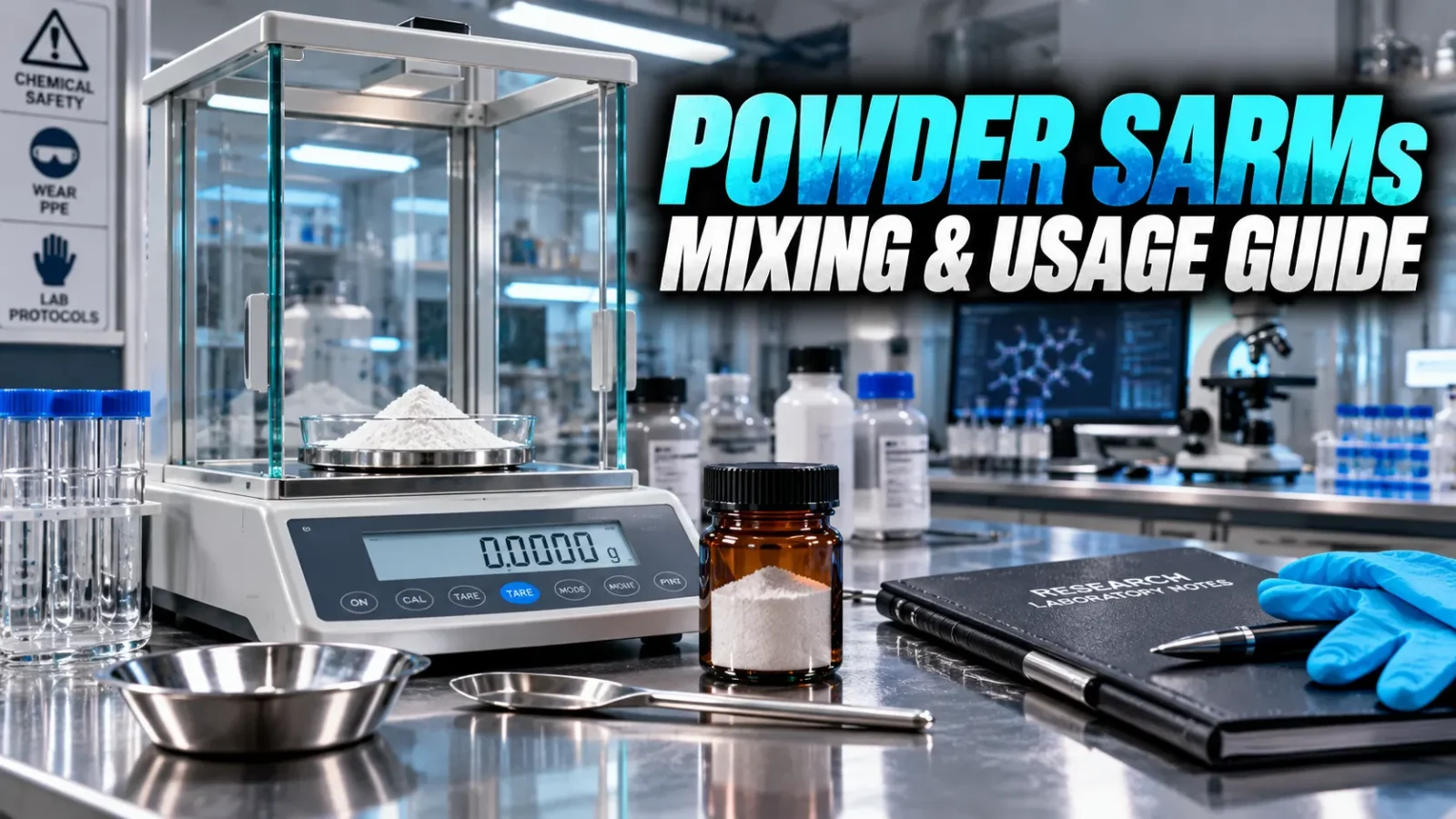
Powder SARMs are the most economical form available, typically costing 30-50% less than pre-made capsules or liquid solutions. The trade-off is that SARM powder requires preparation before use — converting the raw powder into a properly dosed liquid solution that allows accurate measurement of each individual dose.
The conversion process from powder to liquid is straightforward but requires attention to detail. Inaccurate mixing SARMs produces inconsistent dosing, which undermines the purpose of using these compounds in the first place. This guide covers the complete process from selecting a solvent to preparing, storing, and administering the finished solution.
Key Takeaways
- Powder SARMs are the cheapest form but require conversion to liquid for accurate dosing
- PEG-300, DMSO, and Everclear are the most commonly used solvents for dissolution.
- Preparing multi-day batches reduces measurement error compared to daily powder dosing.
- A milligram scale (0.001g precision) is essential for accurate powder measurement.
- Sublingual administration provides the highest bioavailability for liquid SARMs.
- All SARMs are unapproved research chemicals with significant health risks.
Why Convert Powder SARMs to Liquid?
Raw powder presents a practical dosing challenge. A typical daily dose ranges from 5-25 mg depending on the compound, and measuring quantities that small with consistent accuracy requires a precision milligram scale. Even with proper equipment, daily powder measurement introduces cumulative dosing variance.
Converting powder SARMs to liquid eliminates this problem. Once dissolved at a known concentration (e.g., 10 mg/mL), each milliliter contains a precisely measured dose that can be dispensed with a standard oral syringe or calibrated dropper.
| Form | Cost | Dosing Accuracy | Convenience |
|---|---|---|---|
| Powder (raw) | Lowest | Requires precision scale; error-prone | Requires daily measurement |
| Powder (converted to liquid) | Low | High (volumetric measurement) | Prepared in batches |
| Pre-made liquid | Moderate | High (pre-measured concentration) | Ready to use |
| Capsules | Highest | Fixed dose; no adjustment | Most convenient |
The liquid form also resolves the taste issue. Raw compound powder has a notably unpleasant bitter flavor that makes direct oral consumption difficult. Dissolving the powder in a solvent and administering it sublingually or chased with juice minimizes the taste problem.
Equipment and Materials Needed
Before beginning the conversion process, gather the following:
| Item | Purpose | Notes |
|---|---|---|
| Milligram scale (0.001g) | Measuring raw powder accurately | Essential; kitchen scales lack the required precision |
| Glass beaker or vial | Mixing container | Glass preferred; some solvents interact with plastic |
| Solvent (PEG-300, DMSO, or Everclear) | Dissolving the powder | Choice depends on the specific SARM compound |
| Oral syringe (1 mL) | Measuring and dispensing doses | More accurate than eyedroppers |
| Sealed glass vial | Storing the finished solution | Amber glass protects light-sensitive compounds |
| Stirring rod or magnetic stirrer | Ensuring complete dissolution | Thorough mixing prevents concentration inconsistency |
A warm water bath (not direct heat) helps dissolve compounds that resist dissolution at room temperature. Some SARM compounds dissolve readily, while others require sustained gentle warming.
Choosing a Solvent
The solvent choice depends on the specific SARM compound and personal preference. The three most commonly used options each have distinct characteristics.
PEG-300 (Polyethylene Glycol 300)
PEG-300 is the most widely used solvent for powder SARMs preparation. It dissolves most SARM compounds effectively and produces a solution with reasonable shelf stability.
| Property | Details |
|---|---|
| Dissolution rate | Good for most SARMs |
| Taste | Mildly sweet; masks some bitterness |
| Viscosity | Moderately thick |
| Shelf stability | Good at room temperature |
| Availability | Widely available from chemical suppliers |
Avoid higher-molecular-weight PEG variants (PEG-400, PEG-600) as they produce increasingly viscous solutions that are difficult to measure and dispense accurately.
DMSO (Dimethyl Sulfoxide)
DMSO is a powerful solvent that dissolves compounds resistant to PEG-300. It has high skin permeability, which means it can enhance absorption but also carries anything dissolved in it through the skin.
| Property | Details |
|---|---|
| Dissolution rate | Excellent; dissolves most compounds |
| Taste | Strong, garlic-like aftertaste |
| Skin permeability | Very high; handle with care |
| Shelf stability | Good |
| Safety note | Can carry dissolved compounds through skin on contact |
The skin permeability of DMSO requires careful handling. Spills should be cleaned immediately, and gloves are advisable during preparation.
Everclear (High-Proof Ethanol)
Everclear (190-proof grain alcohol) provides an alternative for individuals who prefer an ethanol-based solution. It evaporates cleanly and has a familiar taste profile.
| Property | Details |
|---|---|
| Dissolution rate | Moderate; some compounds dissolve slowly |
| Taste | Strong alcohol flavor |
| Shelf stability | Good when sealed |
| Availability | Liquor stores; legal availability varies by state |
| Note | May require warming for complete dissolution |
Glycerin can be added to any of these solvents to improve taste, though it slightly increases viscosity.
Step-by-Step Mixing Process
Calculating the Concentration
Before mixing, determine the target concentration. A common standard is 10 mg/mL, which simplifies dose measurement.
Example calculation for a 30-day supply at 10 mg/day:
- Total compound needed: 10 mg x 30 days = 300 mg
- Total solvent needed: 300 mg / 10 mg per mL = 30 mL
- Result: 30 mL of solution at 10 mg/mL concentration
Preparation Steps
- Measure the compound using a milligram scale. Verify the reading is stable before removing the powder. For the example above, measure 300 mg precisely.
- Measure the solvent using an oral syringe or graduated cylinder. For the example, measure 30 mL of PEG-300 (or chosen solvent).
- Prepare a warm water bath by heating water in a pan to approximately 40-50 degrees Celsius. The water should be warm, not boiling.
- Add the solvent to a glass beaker and place the beaker in the warm water bath. Allow the solvent to warm for 2-3 minutes.
- Add the measured powder to the warmed solvent and stir thoroughly. Continue stirring until the solution is completely clear with no visible particles or clumps.
- If particles remain, continue warming and stirring. Some compounds require 10-15 minutes of gentle heat to dissolve fully. Do not overheat.
- Transfer the solution to a sealed glass vial for storage. Label the vial with the compound name, concentration, preparation date, and expiration date.
Quality Check
After mixing SARMs powder into solution, the finished product should be clear and uniform. Cloudiness, particles, or sediment at the bottom indicate incomplete dissolution. If this occurs, return the solution to the warm water bath and continue stirring. Shake the vial before each use as an additional precaution against concentration settling.
How to Take Powder SARMs (After Conversion)
Sublingual Administration
Sublingual administration (placing the liquid under the tongue and holding for 30-60 seconds before swallowing) provides the highest bioavailability. The thin tissue under the tongue allows direct absorption into the bloodstream, bypassing first-pass liver metabolism.
Oral Administration
The solution can also be swallowed directly or mixed with a small amount of juice to mask the taste. Oral administration passes through the digestive system and liver before reaching systemic circulation, which reduces bioavailability compared to sublingual delivery.
Timing
Most SARM protocols recommend administration in the morning on an empty stomach. Some compounds with shorter half-lives benefit from twice-daily dosing split into two equal administrations.
Storage and Shelf Life
| Parameter | Recommendation |
|---|---|
| Storage temperature | Room temperature (15-25 degrees Celsius) in a dark location |
| Container | Sealed glass vial; amber glass preferred |
| Shelf life | 30-90 days for most solutions; check for cloudiness |
| Reconstituted stability | Shake before each use |
| Avoid | Direct sunlight, extreme heat, moisture |
Solutions prepared with PEG-300 or DMSO are generally stable at room temperature for the duration of a standard research cycle. Ethanol-based solutions should be kept tightly sealed to prevent evaporation, which would increase the concentration of remaining solution.
Common Mistakes to Avoid
| Mistake | Consequence | Prevention |
|---|---|---|
| Using a kitchen scale | Inaccurate measurement at milligram doses | Use a 0.001g precision milligram scale |
| Overheating the solution | Can degrade the compound | Use warm water bath (40-50C), never direct heat |
| Mixing in plastic containers | Solvents may leach chemicals from plastic | Always use glass containers |
| Daily powder measurement | Cumulative dosing errors | Prepare multi-day batches |
| Not labeling vials | Confusion between compounds/concentrations | Label every vial with compound, concentration, and date |
| Skipping the shake | Concentration settling over time | Shake vial thoroughly before each dose |
Safety and Legal Considerations
SARMs (Selective Androgen Receptor Modulators) are classified as research chemicals that are not approved by the FDA for human consumption. They are prohibited by WADA in competitive sport and have not undergone the clinical trials necessary for therapeutic approval.
Similar safety considerations apply to all research compounds including peptides. Known risks associated with SARM use include:
- Testosterone suppression requiring post-cycle therapy
- Liver stress (particularly with oral compounds)
- Lipid profile alterations (HDL reduction)
- Unknown long-term health effects
- Product quality concerns (contamination, mislabeling)
Purchasing from vendors that provide third-party Certificates of Analysis (COAs) with verified purity data reduces but does not eliminate the risk of contaminated or mislabeled products.
The Bottom Line
Converting powder SARMs to a properly dosed liquid solution is the most cost-effective approach to accurate dosing.
- The process requires basic equipment (milligram scale, glass containers, a suitable solvent) and attention to detail during preparation, but the result is a solution that delivers precise, consistent doses over the duration of use.
- The critical factors are accurate measurement of both powder and solvent, complete dissolution through gentle warming, and proper storage.
- Preparing multi-day or multi-week batches eliminates the daily measurement variability that makes raw powder dosing unreliable.





OK so just want to make sure my math is right. If I get 1g of a SARM and want to make a liquid that is 10mg/ml I could put the whole 1g into 101.5 ml of liquid and that would give me 14.5 weeks of 10mg/ml. Am I correct with this.