Contents12 sections
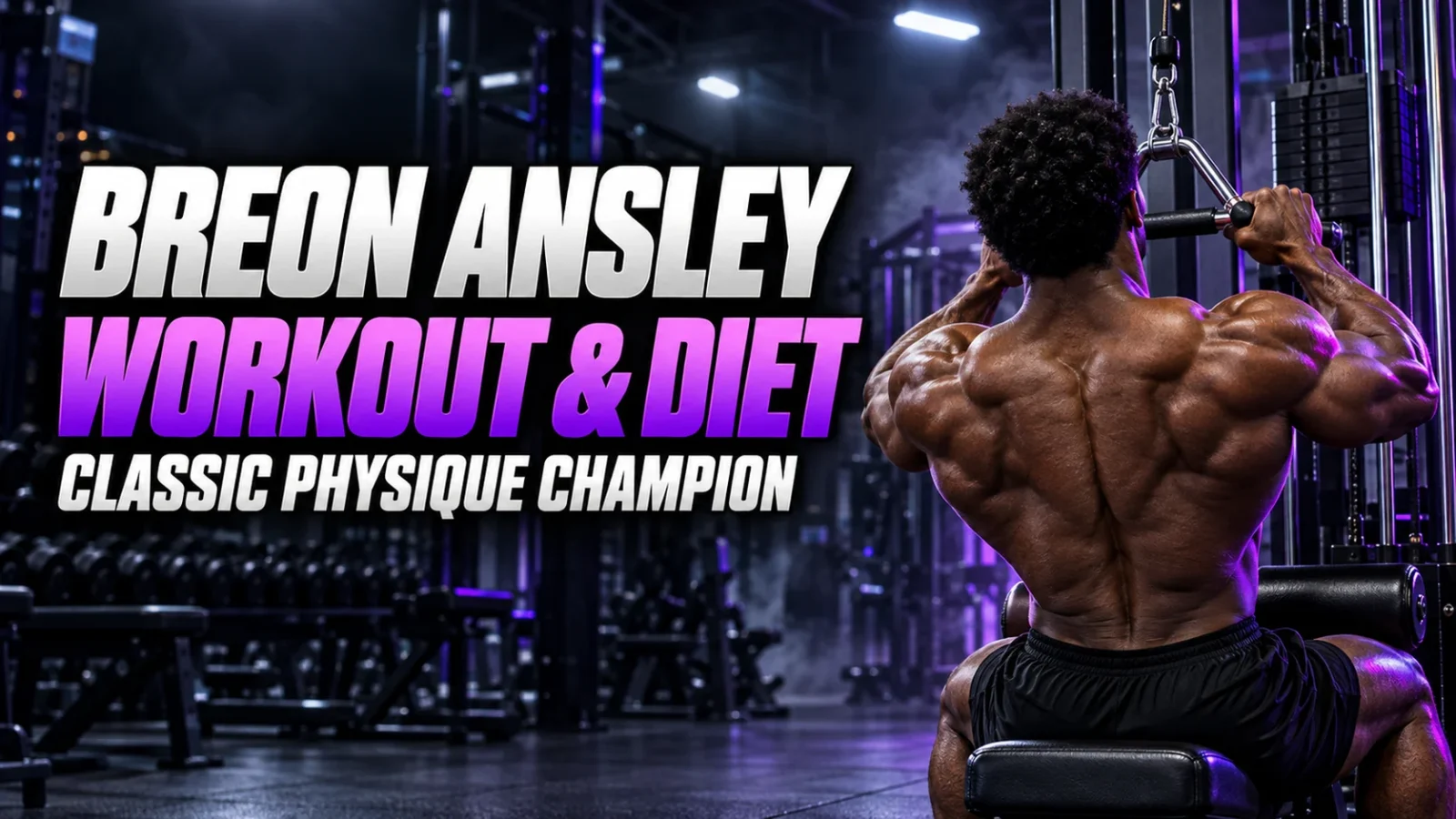
Breon Ansley is an American IFBB Pro bodybuilder and a two-time Classic Physique Olympia champion, with titles in 2017 and 2018. Nicknamed “The Black Swan”, he spent most of his pro career in Classic Physique before announcing a move to the 212 division, where a single 212 lb weight limit lets a 5’7″ athlete like him carry more size.
He is known for a high-volume, high-effort style of training, a back that went from his weakest body part to his favourite, and a long rivalry with Chris Bumstead. Below are his stats, the four-day split reported for him, a sample day of eating, his competition record and what you can take from his approach.
Key Takeaways
- Breon Ansley, born November 13, 1979, won the Classic Physique Olympia in 2017 and 2018 and later announced a move to the 212 division.
- His four-day split covers back, chest and delts, arms, and legs, with back trained in high-rep supersets of 20 to 30 reps.
- Arm day is his biggest session, at about 40 working sets, and he uses a three-reps-per-arm alternating technique.
- He eats five meals a day on a lower-carb, higher-fat diet, does fasted cardio before his first meal and places rice and sweet potato around training.
- Chris Bumstead was runner-up to him in 2017 and 2018, then took the title in 2019 and held it through 2024 before retiring.
Breon Ansley Stats
| Attribute | Detail |
|---|---|
| Full name | Breon Ansley |
| Nickname | The Black Swan |
| Date of birth | November 13, 1979 |
| Age | 46 |
| Place of birth | California, USA |
| Division | Classic Physique (through 2022), then announced a move to 212 |
| Height | 5’7″ (170 cm) |
| Weight | About 185-195 lbs (84-88 kg), as reported; varies with the season |
| Olympia titles | Classic Physique, 2017 and 2018 |
Who is Breon Ansley?
Breon Ansley is an IFBB Pro bodybuilder based in California. He made his name in Classic Physique, the division that rewards shape, proportion and a small waist, with a maximum stage weight set by each competitor’s height.
He has been athletic since childhood. Football was his first love, and he also played tennis and swam. Football earned him a scholarship at Iowa State, where he played defensive end. He was not the tallest player on the field, but his strength and grit earned him a place on the team.
A serious injury ended his football career, and he returned home to pursue acting, appearing in several commercials. He then put his knowledge of training and nutrition to work as a personal trainer, and that is where he discovered bodybuilding.
After winning his class at the 2013 NPC USA Championships, he competed as a pro in the 212 division in 2014. When the IFBB Pro League introduced Classic Physique in 2016, he moved over, won the Prestige Crystal Cup that year and placed fourth at his first Olympia. A year later he was Olympia champion.
The Move to 212
Ansley’s time in Classic Physique ended after the 2022 season. Ahead of 2023 he announced that he would move to the 212 division, having said repeatedly how hard it had become to get down to the Classic Physique weight cap for his height.
The two divisions judge different things. Classic Physique caps weight by height and rewards a flowing, Golden Era look. The 212 division is judged on the same criteria as Open bodybuilding (size, density and conditioning), with one limit for everyone: 212 lb (about 96 kg) on the scale. For a 5’7″ competitor who struggled to make his Classic cap, that means stepping on stage heavier and fuller.
Breon Ansley Measurements
Ansley has not published official tape measurements. These are the figures most often quoted for him; treat them as estimates rather than confirmed numbers.
- Chest: about 50 inches (127 cm)
- Arms: about 19 inches (48 cm)
- Waist: about 31 inches (79 cm)
In Classic Physique, ratios matter more than any single number. A wide back and shoulders over a narrow waist create the V-taper the judges look for, which is why so much of his training goes into his lats and delts.
Breon Ansley Workout Plan
The split reported for Ansley runs over four training days: back; chest and delts; arms; and legs. Each day has its own style. Back gets high-rep supersets, chest and delts are pushed to or close to failure, arms get a very high number of sets, and legs use lower reps. How he spaces his rest days is not specified.
| Day | Focus | Style | Working sets |
|---|---|---|---|
| 1 | Back | Supersets of 20-30 reps, then 15 minutes on the StairMaster | 22 |
| 2 | Chest and delts | Fewer sets, taken to or near failure | 14 |
| 3 | Arms | Straight sets and supersets of 10-16 reps | 40 |
| 4 | Legs | Supersets, mostly 5-15 reps | 17 |
Day 1: Back
Ansley starts his week with back, his favourite body part and, by his own account, his weakest when he began training. He trains it in supersets to keep the intensity high and puts extra emphasis on his upper lats, which widen his V-taper.
Here is what a back workout looks like for him:
| Superset | Exercise | Sets x Reps |
|---|---|---|
| 1 | Lat pulldown | 4 x 20 (30 on the last set) |
| 1 | Row/rear delt machine | 4 x 20 (30 on the last set) |
| 2 | V-bar pulldown | 4 x 20 (30 on the last set) |
| 2 | Seated straight-bar row | 4 x 20 (30 on the last set) |
| 3 | Rack pull | 3 x 20 |
| 3 | One-arm dumbbell row | 3 x 20 |
| Finisher | StairMaster | 15 minutes |
These rep counts are far higher than most back routines use. Each superset pairs a vertical pull for lat width with a row for mid-back thickness, done back to back with little rest. Twenty-rep rack pulls at the end of the session are especially demanding on the lower back and grip.
Day 2: Chest and Delts
For chest and delts, Ansley uses fewer sets but pushes them to failure or close to it. The reported routine lists sets only, without fixed rep targets.
| Exercise | Working sets |
|---|---|
| Barbell incline press | 5 |
| Dumbbell incline press | 3 |
| Machine seated chest press | 2 |
| Pec deck or machine fly | 2 |
| Dips | 1 |
| Dumbbell side lateral raise | 1 |
Opening with two incline presses puts the emphasis on the upper chest. The side delts get only one direct set of lateral raises here, while the presses and dips also work the front delts and triceps.
Day 3: Arms
Ansley is known for an alternating technique on single-arm work. Instead of switching arms every rep, he does three reps with one arm, then three with the other, and keeps going until the set is done. Arm day is the biggest session of his week.
| Exercise | Sets x Reps |
|---|---|
| Machine preacher curl | 2 x 15 warm-up, then 4 x 10-12 |
| Incline dumbbell curl | 4 x 10-12 |
| Wide-grip EZ-bar curl, superset with close-grip EZ-bar curl | 4 x 10-12 each |
| Dumbbell concentration curl | 4 x 10-12 |
| EZ-bar reverse curl | 4 x 10-12 |
| Rope pushdown | 2 x 15-20 warm-up, then 4 x 12-16 |
| Dumbbell skull crusher, superset with dumbbell kickback | 4 x 12-16 each |
| Single-arm overhead cable extension | 4 x 12-16 |
That adds up to 24 working sets for biceps and forearms and 16 for triceps, about 40 in one session and nearly three times his chest-and-delt day. Few lifters can recover from that much arm work in a single day; if you try it, split it over two sessions or cut the sets roughly in half.
Day 4: Legs
| Block | Exercise | Sets x Reps |
|---|---|---|
| Superset 1 | Single-leg extension | 3 x 6-10 |
| Superset 1 | Lying hamstring curl | 3 x 6-8 |
| Superset 2 | Smith machine squat | 3 x 5-9 |
| Superset 2 | Bodyweight Bulgarian split squat | 3 x 9-15 |
| Superset 2 | Sissy squat machine (bodyweight) | 1 x 5 |
| Superset 2 | Walking lunges into weighted sissy squats | 1 set |
| Superset 3 | Standing calf raise | 2 x 5-8 |
| Superset 3 | Seated calf raise | 1 x 5 |
Leg day uses much lower reps than his back day. Opening with leg extensions and hamstring curls warms up the knees and pre-fatigues the quads before the Smith machine squats. The second block chains four movements together, so it works more like a giant set than a classic two-exercise superset.
How to Use Breon Ansley’s Approach
You do not need to copy his sessions set for set. The principles behind them carry over to most lifters:
- High reps can build muscle. A 2017 meta-analysis by Schoenfeld and colleagues found that light and heavy loads build similar amounts of muscle when sets are taken close to failure, while heavier loads build more strength. If you try 20-rep back sets, use supported rows and pulldowns rather than starting with 20-rep rack pulls.
- Count your weekly sets. Research on training volume suggests that around 10 or more hard sets per muscle group per week tends to build more muscle than lower volumes. His 22 back sets and 40 arm sets are far above that and reflect years of training.
- Failure is a tool, not a rule. Studies comparing sets taken to failure with sets stopped a rep or two short generally find similar muscle growth when the total work is similar. Going all-out on every set mainly adds fatigue.
- Supersets save time. Pairs like his pulldown-and-row or extension-and-curl fit more work into a session. Expect the second exercise to be slightly weaker because of the fatigue from the first.
For more ways to train your back, see our guide to cable back workouts. For another Classic Physique approach, compare the Ramon Rocha Queiroz workout routine.
Breon Ansley Diet Plan
Ansley has described eating relatively low in carbs and higher in fat, with carbs coming down further in the weeks before a show. Even so, the sample day below includes rice and sweet potato placed around his training, so it is a lower-carb diet rather than a strict ketogenic one.
He splits his food into five meals and starts the day with about 45 minutes of fasted cardio before his first meal. Here is what a full day of eating looks like for him:
| Meal | Foods | Role |
|---|---|---|
| Meal 1 | 1 cup egg whites, 1 whole egg | Protein and fat only, after fasted cardio |
| Meal 2 (pre-workout) | 6 oz ground chicken, 1 cup jasmine rice | Protein for fullness, carbs to fuel training |
| Meal 3 (post-workout) | 6 oz diced chicken, 1 cup jasmine rice | Refuels after training |
| Meal 4 (around 10:45 pm) | A few ounces of bison, 1 cup sweet potato | Late protein and slower carbs |
| Meal 5 | A few ounces of bison, 1 cup mixed green salad | Protein and vegetables |
As listed, and reading “a few ounces” of bison as 3 to 5 ounces, this day comes to roughly 1,500 to 1,800 calories and about 150 to 170 grams of protein. That is well below what a 185-195 lb man who trains this hard needs to hold his weight, so treat it as a snapshot of a strict prep day, or assume there are extras such as cooking fats, sauces or shakes that are not listed.
Two points from the research are worth knowing if you borrow from his diet. First, fasted cardio is popular in contest prep, but a 2014 study by Schoenfeld and colleagues found similar fat loss with fasted and fed cardio when calories were matched, so do your cardio when it suits you. Second, a 2018 meta-analysis by Morton and colleagues found that the benefit of protein for muscle gains levelled off at around 1.6 grams per kilogram of body weight per day, with up to about 2.2 g/kg a reasonable upper target.
Breon Ansley’s Supplements
Ansley has been a sponsored athlete for a supplement company and has promoted its pre-workout and multivitamin. Sponsorships change over time, so a list of brand-name favourites says more about a deal than about what works.
For most lifters, the evidence supports a short list: protein powder to help reach a daily protein target, creatine monohydrate, which is among the most studied sports supplements for strength and lean mass, and caffeine before training to improve performance. A multivitamin can help fill gaps in a restricted prep diet, but it does not build muscle.

Pros
- Catalog is specifically organized around muscle building, fat loss, testosterone support, and workout performance.
- Range includes creatine, protein, EAAs, beta-alanine, and L-citrulline alongside more specialized formulas.
- Orders of $99+ qualify for free US shipping.
Cons
- Features several strong claims around muscle growth, testosterone, fat loss, and metabolic effects that should be distinguished from independently demonstrated clinical outcomes
- Heavily oriented toward bodybuilding and performance rather than broader nutritional supplementation.
Breon Ansley Bodybuilding Career
Here are Breon Ansley’s main results from his NPC days to the end of his Classic Physique run in 2022:
| Year | Competition | Division | Result |
|---|---|---|---|
| 2013 | NPC USA Championships | Men’s Middleweight | 1st |
| 2014 | IFBB New York Pro | 212 | 16th |
| 2014 | IFBB Europa Phoenix | 212 | 15th |
| 2016 | IFBB Prestige Crystal Cup | Classic Physique | 1st |
| 2016 | Olympia | Classic Physique | 4th |
| 2017 | IFBB New York Pro | Classic Physique | 1st |
| 2017 | Olympia | Classic Physique | 1st |
| 2018 | Arnold Classic | Classic Physique | 1st |
| 2018 | Olympia | Classic Physique | 1st |
| 2019 | IFBB Yamamoto Cup Pro | Classic Physique | 1st |
| 2019 | Olympia | Classic Physique | 2nd |
| 2020 | Olympia | Classic Physique | 3rd |
| 2021 | Olympia | Classic Physique | 3rd |
| 2022 | Arnold Classic | Classic Physique | 4th |
The Rivalry With Chris Bumstead
Ansley’s rivalry with Chris Bumstead shaped the early years of Classic Physique. Ansley won the 2017 and 2018 Olympia titles with Bumstead second both times. Bumstead took the title in 2019, with Ansley runner-up, and went on to win six straight Classic Physique Olympias from 2019 to 2024 before retiring from competition. Ansley placed third in 2020 and 2021.
Off stage, the two have kept a friendly, respectful relationship. Classic Physique titles are separate from the Open Mr. Olympia; for that history, see our complete list of Mr. Olympia winners.
The Bottom Line
Breon Ansley built a two-time Olympia-winning Classic Physique on a demanding four-day split, a disciplined lower-carb diet and years of consistency.
- His training mixes styles: high-rep supersets for back, a few hard sets for chest and delts, very high arm volume and lower-rep leg work.
- His diet is simple and strict: five meals built on lean protein, with rice and sweet potato around training and fasted cardio in the morning.
- Borrow the principles (enough weekly sets, effort close to failure, steady protein) rather than copying an elite pro’s exact sessions.
Frequently Asked Questions
Disclaimer
Please read carefully
The information on this site is for educational and informational purposes only, and is not medical advice. Always consult a qualified healthcare professional before using any supplement or medication, or making changes to your health, fitness, or nutrition routine.
Not medical advice
Content here is not a substitute for professional medical advice.
Consult your doctor
Talk to your doctor before starting any supplement or new routine.
Use at your own risk
We are not responsible for adverse effects from acting on this.
Do your research
Make informed decisions about your own health.
No guarantees
Individual results vary. No claims about outcomes.
Important — Never disregard professional medical advice or delay seeking it because of something you read here. If you think you may have a medical emergency, call your doctor or your local emergency number right away.