Contents13 sections
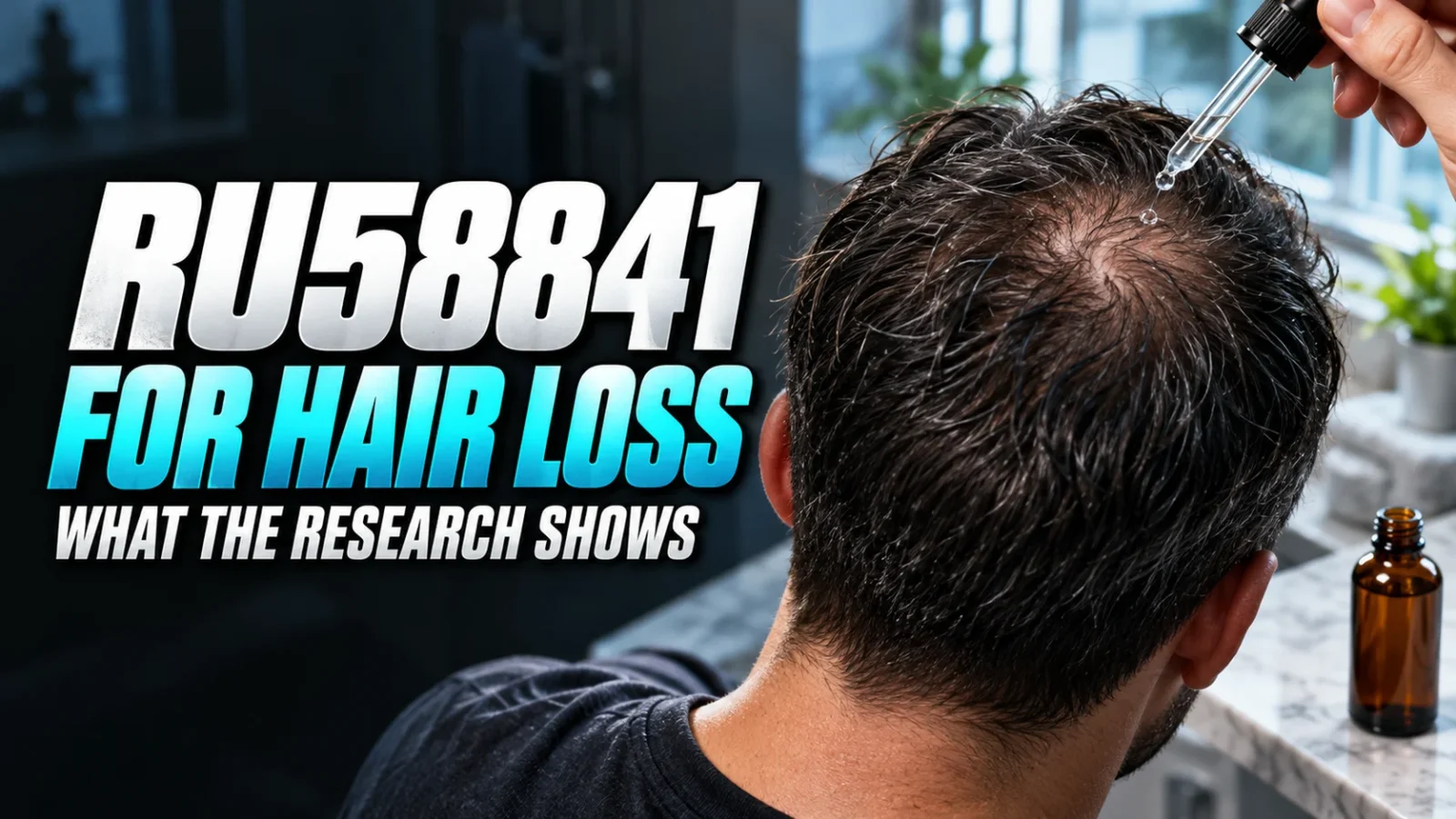
RU58841 comes up constantly in hair loss forums. It is a topical anti-androgen with a loyal following among people who want to protect their hair without taking finasteride, and it has enough unanswered questions to keep it a research compound rather than a medicine.
The French drug company Roussel Uclaf developed it in the 1990s. It was tested on balding human scalp grafted onto mice and in stumptailed macaques, and it later entered early human trials. It never reached Phase III, the human trial results were never published, and it has not been approved anywhere. It is still one of the most discussed topical anti-androgens for male pattern hair loss.
This guide covers what RU58841 is, how it works, what the published research shows (and what it does not), how it compares with finasteride, the doses people report using, side effects, realistic results and its legal status.
Key Takeaways
- RU58841 is a non-steroidal anti-androgen applied to the scalp. It blocks DHT from binding to androgen receptors in hair follicles instead of lowering DHT production.
- It was designed to act locally, which in theory avoids the body-wide hormonal effects of finasteride. That has never been confirmed in published long-term human studies.
- The published evidence is preclinical: balding human scalp grafted onto mice and a stumptailed macaque study both showed better hair growth. The human trial results were never published.
- The widely quoted 50 mg a day (1 ml of a 5% solution) is a community figure, not a dose established in research.
- RU58841 is not approved anywhere. It is sold as a research chemical, product quality varies, and long-term human safety data does not exist.
What Is RU58841?
RU58841, also known as PSK-3841 or HMR-3841, is a non-steroidal anti-androgen (NSAA). Roussel Uclaf developed it in the 1990s as a topical treatment for androgen-dependent skin conditions: androgenetic alopecia (male pattern hair loss), acne and hirsutism. An early paper from the company’s researchers, published in 1994, presented it as a topical anti-androgen for exactly those three conditions.
The HMR name comes from Hoechst Marion Roussel, the group Roussel Uclaf became part of. The drug developer ProStrakan later took the compound into early human trials under the name PSK3841.
Phase III trials never started and development stopped. The reasons were never made public. Commercial priorities and patent timelines are the usual explanations, and that pattern is common in drug development.
Today RU58841 sits in a grey zone. Research chemical suppliers sell it as a raw powder or a premixed topical solution, and in most countries it is not regulated as a prescription drug because it never completed the approval process. It has been studied enough to generate real interest, but not enough to earn regulatory approval.
How Does RU58841 Work?
To understand RU58841, it helps to understand what drives male pattern hair loss in the first place.
Dihydrotestosterone (DHT) is made from testosterone by the enzyme 5-alpha reductase. In people genetically predisposed to androgenetic alopecia, DHT binds to androgen receptors in scalp hair follicles and drives a process called miniaturization. Over successive hair cycles the follicles shrink, the growth (anagen) phase shortens, and the hairs become thinner and shorter until the follicle stops producing visible hair.
RU58841 competes with DHT for those same receptors. Applied to the scalp, it occupies androgen receptors in the follicles so DHT cannot activate them.
The key difference from finasteride is that it does not reduce DHT production. The aim is a local effect at the follicle with little effect on hormones elsewhere in the body. How much of the compound reaches the bloodstream in people has never been published, so this is the design goal rather than a proven fact (see the safety section below).
If the follicle is shielded from DHT, miniaturization can slow or stop, and follicles that are still active may return to longer growth phases. That is why the realistic main expectation is keeping the hair you have, with regrowth a secondary and less predictable benefit.
The same mechanism explains the interest from bodybuilders. Anabolic steroids raise androgen levels and can speed up hair loss in anyone who is genetically susceptible (see steroids that don’t cause hair loss). Many steroids are DHT derivatives that act on the androgen receptor directly, so finasteride, which only blocks the conversion of testosterone to DHT, does little against them. A receptor blocker like RU58841 is at least aimed at the right target, and in theory it counters androgen activity at the scalp without blunting the effects of the compounds being used.
What Does the Research Actually Show?
RU58841 has more research behind it than most research compounds, but almost all of the published work is preclinical. Here is what the key studies found and what kind of evidence each one is.
The 1997 Human Scalp Graft Study
Researchers transplanted scalp grafts from balding men onto testosterone-conditioned nude mice and treated them with a 1% RU58841 solution five days a week. The treated grafts showed a much higher rate of follicle cycling than the controls (28% versus 7%) and higher linear hair growth rates. The authors concluded that the results justified clinical trials in androgenetic alopecia.
This used real human scalp tissue, but it was growing on mice. It is a strong animal model, not a human trial.
The Stumptailed Macaque Study
Stumptailed macaques develop androgen-driven frontal baldness after puberty that closely resembles male pattern hair loss, which makes them a standard primate model. A study in stumptailed macaques applied RU58841 topically to the bald scalp and reported a hair regrowth effect on the treated areas.
This is primate data, which is closer to people than rodent data, but it was designed to measure hair growth. It does not tell us about long-term safety in humans.
The Human Trials (Phase I/II)
ProStrakan took the compound into early human testing under the PSK3841 name, and the trial is listed in a public trial registry. The results were never published in a peer-reviewed journal, and no Phase III trial followed.
That matters. Claims you will see online that the trials proved RU58841 was safe or well tolerated cannot be checked. There is no public human data on how much RU58841 reaches the bloodstream, how often side effects occur, or how well it regrows hair. Why development stopped is not public either.
The Evidence at a Glance
| Evidence | Type | What it found | Limits |
|---|---|---|---|
| Scalp graft study (1997) | Human scalp tissue on mice | More follicle cycling (28% vs 7%) and faster hair growth with a 1% solution | Not a human trial |
| Macaque study | Primate | Hair regrowth on treated bald scalp | Animal data; not a safety study |
| ProStrakan trials (PSK3841) | Early human trials (Phase I/II) | Results never published | No public efficacy or safety data |
| Phase III | Large human trial | Never started | No large-scale evidence exists |
RU58841 vs. Finasteride: How Do They Compare?
This is the comparison most people want, so here it is clearly.
Finasteride inhibits 5-alpha reductase, the enzyme that converts testosterone into DHT. That lowers DHT throughout the body, not only at the scalp. It is effective at slowing follicle miniaturization, but DHT also has roles elsewhere, including in sexual function, and finasteride’s prescribing information lists sexual side effects such as reduced libido and erectile dysfunction in a minority of users.
Post-finasteride syndrome, a reported pattern of sexual, mental and physical symptoms that persist after stopping the drug, is still debated, and it is linked to this body-wide mechanism.
RU58841, by contrast, does not touch DHT production. It competes with DHT at the receptor and is applied only where it is needed. For people who want to protect their hair without lowering DHT body-wide, including bodybuilders who depend on normal androgen signalling, that is the main attraction.
The trade-off is evidence. Finasteride has decades of clinical data, regulatory approval and a well-characterised risk profile, and it is available on prescription. RU58841 has promising but incomplete preclinical research, no approval, no published human trial data and no long-term safety data, and it is only sold by research chemical suppliers with no legally required quality control.
| RU58841 | Finasteride | |
|---|---|---|
| How it works | Blocks androgen receptors in scalp follicles | Blocks 5-alpha reductase, lowering DHT |
| How it is used | Topical solution on the scalp | Daily oral tablet |
| Effect on DHT in the body | Not designed to lower it | Lowers it substantially |
| Approval | Not approved anywhere | FDA-approved for male pattern hair loss |
| Human evidence | Early trials, results never published | Large randomised trials and decades of use |
| Known risks | Long-term risks unknown; scalp irritation; anecdotal systemic effects | Sexual side effects in a minority; persistent symptoms reported |
| Where it comes from | Research chemical suppliers | Prescription |
Neither option is perfect. The right choice depends on how much uncertainty you accept, your side-effect concerns and what is driving the hair loss. A doctor or dermatologist can help you weigh the approved options first.
RU58841 Dosage and Application

RU58841 is applied to the scalp. It is not taken orally. It comes either as a premixed solution or as a raw powder that users dissolve in a carrier, most commonly ethanol with propylene glycol.
Doses Used in Studies
The 1997 scalp graft study used a 1% solution applied five days a week to human scalp tissue on mice. No dose has been established in people, because the human trial results were never published.
Commonly Reported Doses
The figure you will see everywhere is 50 mg once a day, spread over the thinning areas. This is a community figure from hair loss forums, not a research dose. Some users report starting lower to see how they tolerate it, and some split the amount into two applications a day. No research shows which approach works better.
For premixed products, a 5% solution contains 50 mg per millilitre, so 1 ml delivers the 50 mg community figure. It is usually applied with a dropper directly to the affected areas and lightly massaged in.
Storage and Stability
RU58841 is generally described as sensitive to light and heat. Common advice is to keep solutions in a dark bottle in the fridge, and raw powder sealed airtight in the freezer. Published stability data is limited, and degraded or under-dosed product cannot be recognised by eye, which adds to the uncertainty about what is in any given bottle.
Continuous Use
RU58841 is used continuously rather than in cycles. Its effect depends on keeping the scalp’s androgen receptors occupied. When application stops, DHT can bind to them again and any protective effect is expected to fade relatively quickly.
Side Effects and Safety Considerations
The most important point about RU58841’s safety is that long-term human data does not exist. The compound never completed clinical development, and the results of the early human trials were never published, so the kind of safety data that exists for approved medicines is simply not available.
What the Animal Research Shows
RU58841 was designed to work locally, and the scalp graft and macaque studies above showed an effect where it was applied. Neither was designed to measure long-term safety in people.
There is also a reason to doubt that the compound stays entirely in the scalp. A 1994 rat study by Roussel Uclaf researchers on the pharmacokinetics of this group of non-steroidal anti-androgens (Cousty-Berlin and colleagues, Journal of Steroid Biochemistry and Molecular Biology) linked their systemic anti-androgen activity to a common metabolite formed in the body. That is animal data, and it does not show how much reaches the bloodstream in people at the doses users apply, but it is why systemic exposure remains an open question rather than a settled one.
What Users Report
The most commonly reported side effect is scalp irritation, dryness or itching, which is often blamed on the carrier rather than RU58841 itself. Propylene glycol can cause contact irritation in some people, and users often switch to a different carrier or a lower concentration.
There are also anecdotal reports of headaches, fatigue and reduced libido, effects that would point to some systemic exposure. These reports are uncontrolled and cannot prove cause and effect, but they are a reason not to assume RU58841 acts only at the scalp.
Other Precautions
- As with other anti-androgens, it should be kept away from anyone who is or could become pregnant, because blocking androgens can affect the development of a male fetus.
- Research chemicals are not regulated, so the product may not contain what the label says, in strength or purity.
- Anyone with a skin condition on the scalp, or on other medication, should speak to a doctor before applying any research compound.
The honest summary: RU58841 may well be gentler on the body than systemic anti-androgens, but nobody has published the data to show it. Anyone using it is operating where certainty is limited.
What Results Should You Realistically Expect?
Managing expectations matters with any hair loss treatment, and RU58841 is no exception. Everything in this section comes from user reports and the general biology of hair loss, not from published human trials.
The main goal is keeping hair. If follicles are still active but miniaturizing, blocking DHT at the receptor can slow or stop that process.
Users who respond commonly report less daily shedding within the first few weeks. Counting the hairs in the shower drain is a simple way to track this.
Thicker, denser-looking hair, where it happens, is usually reported after three to six months of consistent use, as miniaturized follicles return to longer growth phases and produce thicker hairs.
Regrowth in areas that have been bald for a long time is less likely. Follicles that have been dormant for years respond poorly to every hair loss treatment, not just RU58841, so the earlier treatment starts, the more can realistically be kept.
For steroid users whose hair loss speeds up on cycle, the receptor-level mechanism targets the driver of that loss, which is why RU58841 is popular in that community. Results still depend on genetics and on how far the loss has progressed, and there are no controlled studies in this group.
Photos taken in the same light every month, plus shedding counts, give a fairer picture than the mirror.
RU58841 With Minoxidil and Other Treatments
RU58841 is usually discussed alongside the approved hair loss treatments rather than instead of them.
- Minoxidil works in a different way: it does not affect androgens at all and is thought to lengthen the growth phase and enlarge follicles. Because the mechanisms differ, users often report combining it with RU58841. No published study has tested that combination.
- Finasteride lowers DHT across the body. Some people use RU58841 specifically to avoid it; others use both. Again, the combination has not been studied.
- Natural DHT blockers such as saw palmetto are popular, but the evidence for them is weaker than for the approved drugs. See our guide to natural DHT blockers.
Legal Status
RU58841 sits in a legal grey area in most countries. It was never approved as a drug, so it is not a prescription medicine, and it is generally not a controlled substance.
It is sold as a research chemical. That means it can be bought in many places, but it is not legal to sell or market it for human use. Rules differ between countries, so check the law where you live.
Because these sellers are not regulated, the product may not match the concentration and purity stated on the label. A third-party certificate of analysis (COA) is the best available check on what is in the bottle, but it does not make a product safe to use.
The Bottom Line
RU58841 is a scientifically plausible topical anti-androgen with encouraging preclinical results, but it is not a finished, proven treatment.
- It blocks DHT at the scalp’s androgen receptors instead of lowering DHT across the body, which is why people, steroid users especially, consider it as an alternative to finasteride.
- The published evidence comes from human scalp grafts on mice and a macaque study. The human trial results were never published and Phase III never happened.
- The 50 mg a day figure is a community dose, long-term human safety is unknown, and product quality depends entirely on the seller.
- If you are losing hair, speak to a doctor or dermatologist about approved options such as finasteride and minoxidil first.
Frequently Asked Questions
Disclaimer
Please read carefully
The information on this site is for educational and informational purposes only, and is not medical advice. Always consult a qualified healthcare professional before using any supplement or medication, or making changes to your health, fitness, or nutrition routine.
Not medical advice
Content here is not a substitute for professional medical advice.
Consult your doctor
Talk to your doctor before starting any supplement or new routine.
Use at your own risk
We are not responsible for adverse effects from acting on this.
Do your research
Make informed decisions about your own health.
No guarantees
Individual results vary. No claims about outcomes.
Important — Never disregard professional medical advice or delay seeking it because of something you read here. If you think you may have a medical emergency, call your doctor or your local emergency number right away.