Contents10 sections
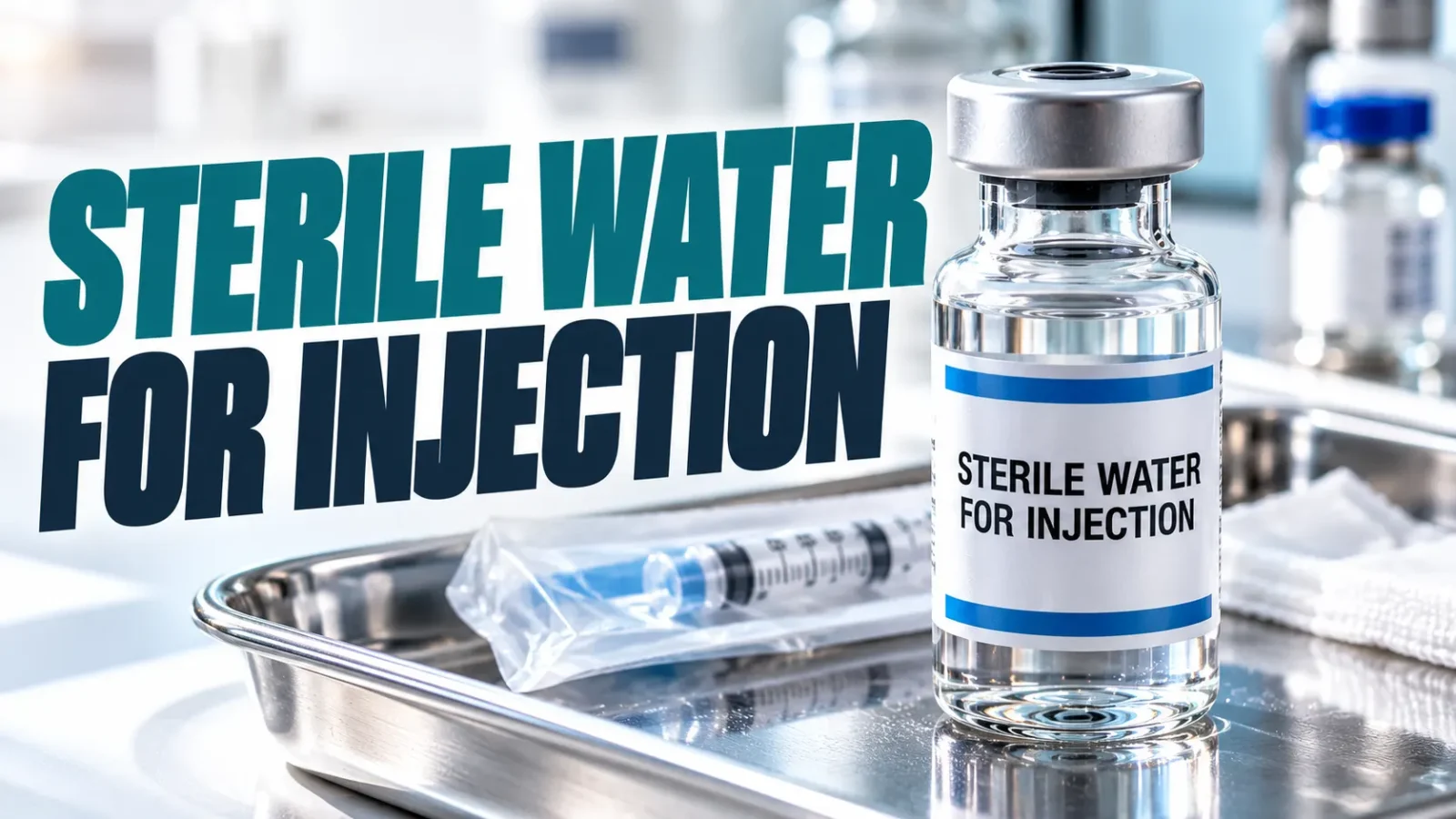
Sterile water for injection is purified water that has been processed to remove all microorganisms, pyrogens and contaminants. It is used in medical and research settings to reconstitute lyophilized (freeze-dried) medications and to dilute concentrated injectable drugs to the correct concentration before administration.
Unlike regular purified or distilled water, sterile water for injection meets pharmaceutical-grade standards established by the United States Pharmacopeia (USP) and the FDA. It is packaged in single-use vials or ampoules to maintain sterility until the moment of use.
This article covers what sterile water for injection is, how it differs from normal saline, its applications, what to look for when buying it and the safety precautions that matter.
Key Takeaways
- Sterile water for injection is pharmaceutical-grade water processed to remove all bacteria, viruses, fungi and pyrogens through distillation or reverse osmosis followed by autoclaving.
- It is used to reconstitute and dilute injectable medications including peptides, antibiotics and vaccines, not for direct intravenous infusion.
- Sterile water contains no electrolytes and is hypotonic. Injecting it directly into the bloodstream in large volumes can cause hemolysis (destruction of red blood cells).
- Normal saline (0.9% sodium chloride) is isotonic and safe for IV infusion and hydration. Sterile water is not a substitute for saline in those applications.
- Once opened, sterile water must be used immediately and any remaining solution discarded to prevent bacterial contamination.
What Is Sterile Water for Injection?
Sterile water for injection is highly purified water (H₂O) that has undergone filtration and sterilization to remove all contaminants. The purification process typically involves distillation or reverse osmosis followed by sterilization methods such as autoclaving, which uses high-pressure steam to eliminate any remaining microorganisms.
The result is water that is:
- Sterile. Free from bacteria, viruses, fungi and spores
- Pyrogen-free. Contains no substances that could induce fever when injected
- Particulate-free. No visible or sub-visible particles
- Electrolyte-free. Contains no sodium, potassium, chloride or other dissolved minerals
- Neutral pH. Approximately pH 7.0
Sterile water is packaged in sealed single-dose vials or ampoules to maintain sterility until opened. It is not the same as distilled water, purified water or tap water. None of those meet the sterility and pyrogen-free requirements necessary for injection into the human body.
Why Is Sterile Water Necessary for Injections?

Using non-sterile water for any injectable preparation introduces serious risks.
Infection prevention. Non-sterile water can contain bacteria, viruses, fungi and endotoxins. Introducing these directly into the bloodstream or subcutaneous tissue can cause infections, sepsis or severe inflammatory reactions. Sterile water eliminates this risk.
Medication integrity. Many medications are supplied as powders or concentrated solutions that require precise dilution before use. Contaminants in non-sterile water can degrade the active compound, reduce efficacy or create harmful byproducts.
Patient safety. The FDA requires that any water used for preparing injectable medications meet USP standards for sterility, pyrogenicity and particulate content. This is not optional. It is a regulatory requirement that exists because the consequences of non-compliance are severe.
Osmotic safety. Sterile water has a neutral pH and, when mixed with medication, produces a solution that can be safely administered without causing tissue damage at the injection site.
Sterile Water vs Normal Saline

Sterile water and normal saline are both used in medical settings, but they are not interchangeable. The key differences matter for patient safety.
| Property | Sterile Water | Normal Saline (0.9% NaCl) |
|---|---|---|
| Composition | Pure H₂O, no electrolytes | 0.9% sodium chloride in water |
| Tonicity | Hypotonic | Isotonic with body fluids |
| IV infusion | Not safe for direct IV use | Safe for IV infusion |
| Reconstitution | Primary use for dissolving medications | Can be used, but not for all medications |
| Wound irrigation | Possible but less common | Standard choice |
| Hydration | Not suitable | Standard IV hydration fluid |
| Hemolysis risk | Yes, if infused directly | No, isotonic with blood cells |
The critical distinction is tonicity. Sterile water is hypotonic, meaning it has a lower solute concentration than blood. When large volumes of hypotonic fluid enter the bloodstream, water moves into red blood cells by osmosis, causing them to swell and burst. This is hemolysis, and it can be fatal.
Normal saline has the same osmotic pressure as blood (0.9% NaCl matches the concentration of sodium chloride in plasma), so it does not cause this effect. This is why normal saline is the standard fluid for IV infusion and hydration.
Sterile water is used specifically for reconstituting and diluting medications that will be administered in small volumes, where the hypotonic nature of the water is offset by the solutes in the medication itself.
Uses of Sterile Water for Injection

Sterile water for injection has four primary applications.
1. Reconstituting lyophilized medications. Many injectable drugs, including certain peptides, antibiotics and vaccines, are supplied as freeze-dried powders. Adding sterile water dissolves the powder and creates an injectable solution at the correct concentration.
2. Diluting concentrated medications. Some drugs are formulated at concentrations higher than what is needed for administration. Sterile water is used to dilute them to the prescribed dosage.
3. IV preparation. Sterile water can be used as a component in preparing IV solutions when combined with appropriate additives (electrolytes, dextrose). It is never infused alone.
4. Laboratory and research use. Sterile water is used in medical and scientific research settings to prepare solutions for experiments where contamination would compromise results.
What to Look for When Buying Sterile Water
Not every product sold as “sterile water” is suitable for injection. Check these points before you buy.
- USP grade. The label should state “Sterile Water for Injection, USP” or an equivalent pharmacopeia standard. Water labeled for irrigation or inhalation is not the same product.
- Single-dose packaging. Sealed ampoules or single-dose vials keep the water sterile until use and remove the contamination risk that comes with reusing a container.
- Volume that matches your needs. Small ampoules (1-10 ml) suit peptide reconstitution and other applications where only small, precise volumes are needed.
- Intact seals and a clear expiration date. Never use a product with a damaged seal, cloudy contents or an expired date.
- The right product for the job. If you need to draw multiple doses from one vial over several weeks, bacteriostatic water is the appropriate choice, not sterile water.
Precautions and Storage
Sterile water for injection requires proper handling to maintain its safety profile.
Never infuse directly. Sterile water without added solutes must not be administered as a direct intravenous infusion. The hypotonic solution will cause hemolysis. It is only used as a diluent or reconstitution vehicle.
Use immediately after opening. Once an ampoule or vial is opened, the contents are no longer guaranteed sterile. Use the water immediately and discard any remaining solution. Never store an opened ampoule for later use.
Follow USP standards. Ensure that any sterile water used for injection meets USP requirements for sterility, pyrogenicity and particulate content. This information should be stated on the product label.
Store properly. Keep sealed ampoules or vials at room temperature (15-30°C / 59-86°F) in a dry location away from direct sunlight. Do not freeze. Check expiration dates before use.
Dispose of equipment properly. Syringes, needles and opened ampoules should be disposed of in appropriate sharps containers. Follow local regulations for medical waste disposal.
Medical supervision. Sterile water for injection should be used under the guidance of a healthcare professional or with appropriate training. Improper use can result in contamination, incorrect medication concentration or adverse reactions.
The Bottom Line
Sterile water for injection is a fundamental part of safe injectable preparation: pharmaceutical-grade, pyrogen-free and sterile, meeting FDA and USP standards for use in human injection.
- Use it to reconstitute and dilute medications, never infuse it directly into the bloodstream.
- Use each ampoule immediately after opening, discard what is left and store sealed containers at room temperature.
- Knowing the difference between sterile water, bacteriostatic water and normal saline prevents potentially dangerous errors.
- For anyone working with injectable peptides or research compounds, choosing USP-grade sterile water is as important as sourcing the compound itself.
Frequently Asked Questions
Disclaimer
Please read carefully
Not medical advice
Content here is not a substitute for professional medical advice.
Consult your doctor
Talk to your doctor before starting any supplement or new routine.
Use at your own risk
We are not responsible for adverse effects from acting on this.
Do your research
Make informed decisions about your own health.
No guarantees
Individual results vary. No claims about outcomes.
Important — Never disregard professional medical advice or delay seeking it because of something you read here. If you think you may have a medical emergency, call your doctor or your local emergency number right away.