
Contents13 sections
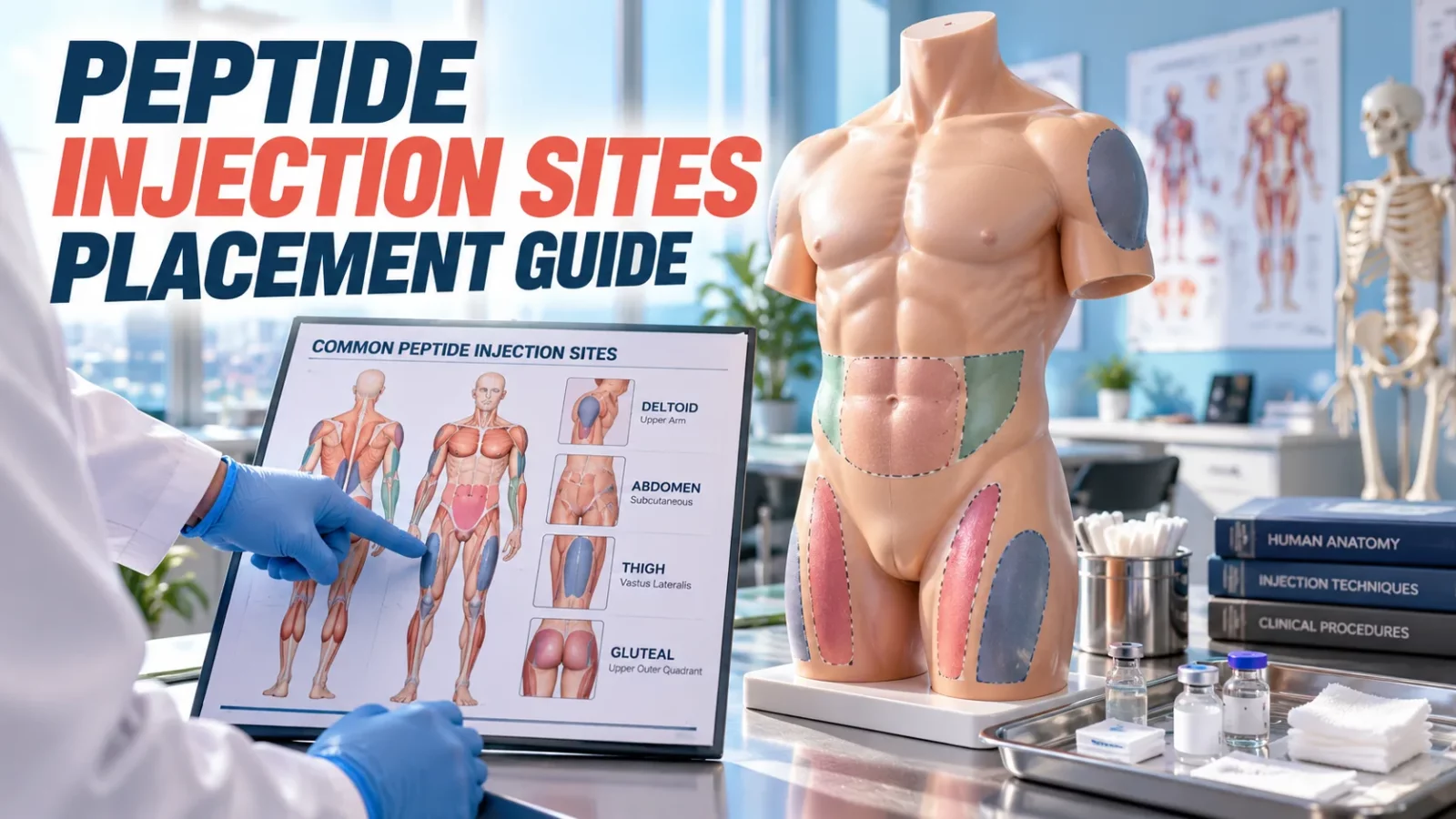
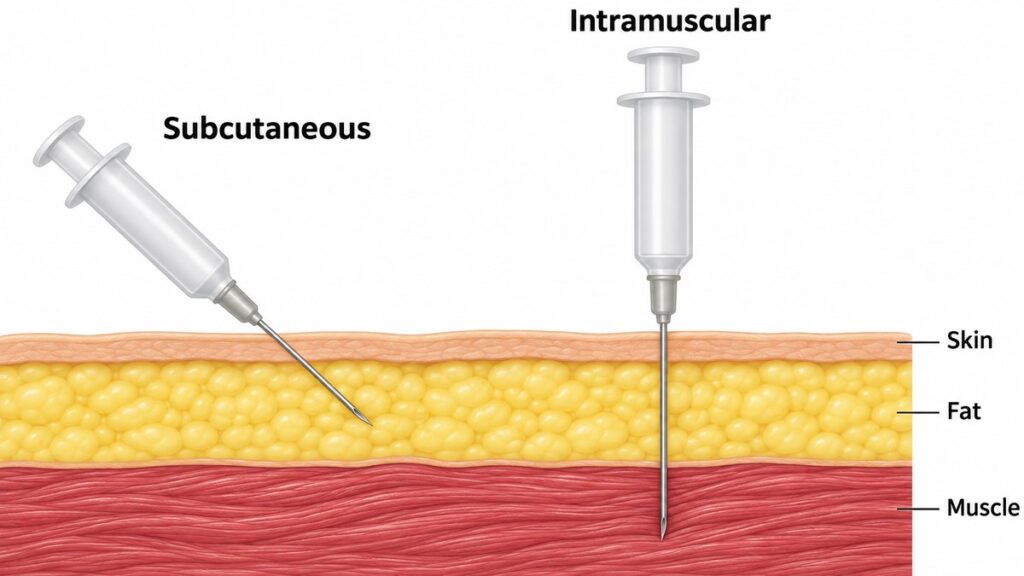
Peptide injection sites fall into two groups. Subcutaneous sites, like the belly and the front of the thigh, put the needle into the fat layer just under the skin. Intramuscular sites, like the deltoid and the hip, put it deeper, into muscle. Which group a site belongs to changes the needle you’d use, the angle, and what can go wrong.
This matters to lifters because most of what the research-peptide world knows about injections is passed along in forums, not taught by a nurse. The clinical rules already exist. Diabetes educators, vaccine programs, and infection-control agencies have spent decades working out where needles go, how to keep them clean, and how to spot trouble early.
This article covers the anatomy of each site, subcutaneous versus intramuscular technique, needle gauge and length, site rotation, hygiene and sterile technique, sharps disposal, and the most common problems: lipohypertrophy, bruising, infection, and when to see a doctor. It uses nursing guidance, the FITTER injection-technique consensus, the CDC, the WHO, and the FDA.
Key Takeaways
- Subcutaneous injections go into the fat under the skin. MedlinePlus lists the belly, the outer upper thighs, and the back or side of the upper arms as the usual sites.
- Intramuscular injections go into muscle. The CDC uses the deltoid and the anterolateral thigh in adults, and nursing research favors the ventrogluteal hip site over the classic “upper outer buttock.”
- Short needles are the first choice under the skin. The FITTER consensus calls 4 mm pen needles and 6 mm syringe needles safe, effective, and less painful.
- Not rotating sites is the biggest risk factor for lipohypertrophy, the rubbery fat lumps that build up where people inject over and over.
- One needle, one syringe, one time. Used sharps go straight into a sharps container, never loose in the trash.
Subcutaneous vs Intramuscular: What’s the Difference?
A subcutaneous (subQ) injection, as MedlinePlus puts it, “is given in the fatty tissue, just under the skin.” An intramuscular (IM) injection passes through that fat and deposits the drug in muscle.
The two layers aren’t interchangeable. In insulin users, the FITTER recommendations in Mayo Clinic Proceedings say IM injections should be avoided, especially with long-acting insulins, “because severe hypoglycemia may result.” The general point holds for any drug: a product meant for the fat layer can behave differently if it lands in muscle, and the reverse is true too. The product’s own instructions decide the route, not the site that’s easiest to reach.
How deep is the fat layer?
Less deep than many people think, especially in lean men. A Current Medical Research and Opinion study by Gibney and colleagues used ultrasound on 388 US adults at four injection sites. Average skin thickness was only 1.9 to 2.4 mm. The fat layer under it averaged 10.8 mm on the arm, 10.4 mm on the thigh, 13.9 mm on the abdomen, and 15.4 mm on the buttocks, and women had about 5.1 mm more than men.
Those are averages. The authors concluded that needles of 8 mm or longer, inserted straight in, “may frequently enter muscle in limbs of males and those with BMI <25.” A standard half-inch insulin syringe needle is 12.7 mm.
Subcutaneous Injection Sites
These are the sites nursing and diabetes guidance use for injections under the skin.
Abdomen
The belly is the most common subQ site. MedlinePlus describes the zone as below the ribs and above the hip bones, “at least 2 in (5.1 cm) away from your belly button.”
- Why it’s used: it usually has the thickest fat layer of the front-of-body sites (13.9 mm on average in the Gibney study), and it’s easy to see and reach.
- What to avoid: the area right around the navel, and any skin that’s scarred, bruised, or lumpy.
Thigh
MedlinePlus lists the “outer side of upper thighs.” The fat layer here averaged 10.4 mm in the ultrasound data, a little thinner than the abdomen. In a lean, muscular leg, that’s the main reason to use a short needle or a pinched skin fold.
Back of the upper arm
The side or back of the upper arm, between the shoulder and elbow, is another MedlinePlus site. It’s hard to pinch and reach with your own hand, so it’s often used when someone else gives the injection. The fat layer averaged 10.8 mm, and it’s often thinner on lean, trained arms.
Upper buttock and flank
The buttocks had the thickest fat layer in the Gibney study, at 15.4 mm on average. They’re hard to see and reach on yourself, which makes clean technique and a consistent spot harder.
Intramuscular Injection Sites
IM sites are chosen to reach muscle while staying away from large nerves and blood vessels. The CDC’s vaccine administration guidance is the most detailed public source on adult IM technique.
Deltoid (upper arm)
The deltoid is the standard adult IM site in the CDC guidance. Immunize.org’s clinical guide, which is based on the CDC’s Pink Book, says to inject “in the central and thickest portion of the deltoid muscle,” above the level of the armpit and “approximately 2–3 fingerbreadths (~2″) below the acromion process,” the bony point of the shoulder. It adds: “do not inject too high (near the acromion process) or too low.”
Too high is the main worry. A 2024 systematic review in the Journal of Shoulder and Elbow Surgery looked at 81 reported cases of shoulder injury after COVID-19 vaccination (known as SIRVA). All 81 had pain, and the most common diagnoses were bursitis (32.1%), adhesive capsulitis (27.2%), and rotator cuff tear or tendinopathy (21.0%). About half of the cases with follow-up fully resolved within weeks to months.
Glute: ventrogluteal vs dorsogluteal
Most people picture the “upper outer quadrant” of the buttock. That’s the dorsogluteal site. Nursing research has moved toward a different spot on the side of the hip, the ventrogluteal site.
A 2023 systematic review in Nursing Open describes the ventrogluteal site as an inverted triangle formed by the iliac crest, the front point of the hip bone (anterior superior iliac spine), and the bony bump at the top of the thigh (greater trochanter), over the gluteus medius and minimus. The review notes that the dorsogluteal site has long been linked to sciatic nerve injury, and that the ventrogluteal site was proposed specifically to avoid it.
- Pain and bleeding: across 17 studies and 1,429 people, ventrogluteal injections caused significantly less pain, bleeding, and bruising (hematoma) than dorsogluteal ones, the review found.
- Fat thickness: an ultrasound study in the International Journal of Nursing Studies found the fat, muscle, and total tissue layers were all thicker at the dorsogluteal site, and fat was thicker in women at both sites. Thicker fat means a needle is more likely to stop short of the muscle.
- Still not foolproof: the Nursing Open review found the ventrogluteal site didn’t significantly cut the risk of an injection ending up in fat instead of muscle.
The ventrogluteal site is located with a hand placed on the hip, which is hard to do on yourself. It’s a site to learn from a nurse, not from a diagram.
Outer thigh (vastus lateralis)
The CDC says the anterolateral thigh “also can be used” for adult IM injections. Immunize.org places it in the outer portion of the middle third of the thigh. It’s the IM site most people can reach on their own.
Peptide Needle Size: Gauge and Length
Gauge is the needle’s thickness, and a higher number means a thinner needle. Length decides which layer the tip ends up in, so it matters more than gauge for getting the right site.
Needles for subcutaneous injections
The 2016 FITTER recommendations, written and vetted by 183 diabetes experts from 54 countries, say the shortest needles (“currently the 4-mm pen and 6-mm syringe needles”) are safe, effective, and less painful, and should be the first choice for everyone. The Gibney ultrasound study backs this up: 4 to 5 mm needles inserted straight in “enter the subcutaneous tissue with minimal risk of IM injection in virtually all adults.”
If a longer needle is used, pinching up the skin helps keep the tip in fat. MedlinePlus says to pinch about an inch of skin and fat, “not muscle,” and to insert at 90 degrees, or at 45 degrees if there isn’t much fat.
Needles for intramuscular injections
The CDC says IM needles are 22 to 25 gauge and go in “at a 90-degree angle to the skin.” For the adult deltoid, it sizes needle length by body weight:
| Adult body weight | Deltoid needle length (CDC) |
|---|---|
| Under 130 lb (60 kg), men and women | 5/8 inch |
| 130 to 152 lb (60 to 70 kg), men and women | 1 inch |
| Women 152 to 200 lb (70 to 90 kg), men 152 to 260 lb (70 to 118 kg) | 1 to 1.5 inches |
| Women over 200 lb (90 kg), men over 260 lb (118 kg) | 1.5 inches |
For the anterolateral thigh, the CDC recommends a 1.5-inch needle, “although a 1-inch needle may be used if the skin is stretched tightly.” The CDC’s vaccine chart notes that a 5/8-inch deltoid needle in people under 130 lb only works if the skin is stretched tight. These figures are for vaccines given by trained staff. They show how much body size changes the right length.
Injection Site Rotation
Rotation means moving each injection to a new spot instead of using the same few square inches. MedlinePlus says to change the site “from one injection to the next, at least 1 in apart,” which keeps the skin healthy and helps absorption.
The strongest evidence comes from insulin users, who inject more often than almost anyone. In a Spanish study of 430 insulin users in Diabetes & Metabolism, only 5% of those who rotated correctly had lipohypertrophy, and 98% of those who had it either didn’t rotate or rotated incorrectly.
A simple rotation pattern
- Pick the zones you’ll use, for example the left and right sides of the abdomen and the front of each thigh.
- Split each zone into smaller sections and move to a new section on a set schedule.
- Within a section, keep each new injection at least an inch from the last one.
- Write it down or use the same order every time, so you’re not guessing.
- Skip any spot that’s bruised, sore, swollen, or lumpy until it has fully healed.
Hygiene and Sterile Technique
Clean technique matters as much as site choice. Most injection-site infections start with something that touched the needle, the vial, or the skin.
Hands and skin
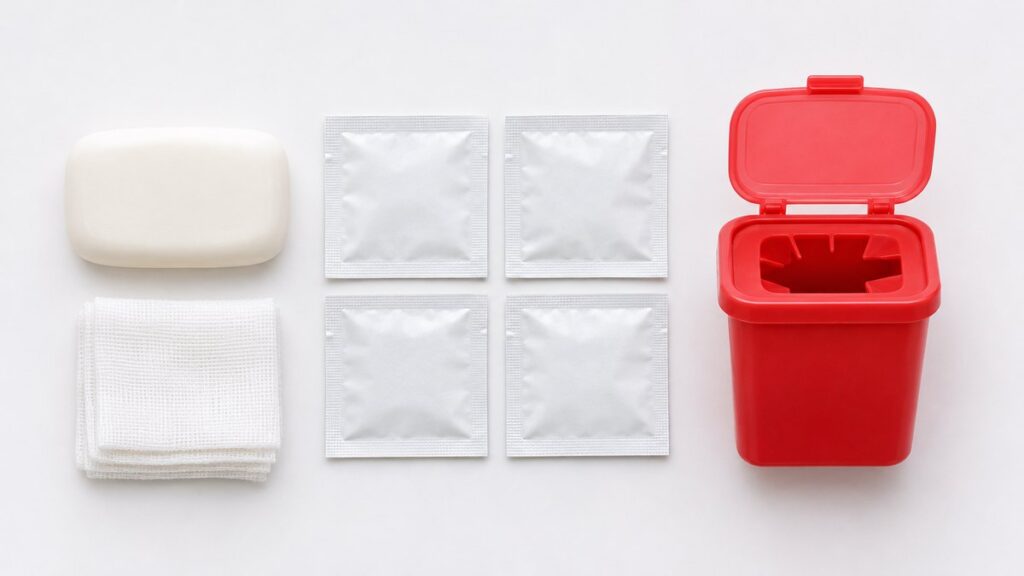
- Wash your hands: MedlinePlus says to use soap and running water “for at least 1 minute,” including between the fingers.
- Clean the site: wipe with an alcohol pad, starting at the injection point and moving outward in a circle.
- Let it dry: let the skin air dry, or pat it with clean gauze, before you inject.
- Don’t pre-soak cotton: the WHO injection toolkit warns that cotton wool kept soaking in a container becomes heavily contaminated with bacteria. Use single-use swabs.
Vials and syringes
- Wipe the stopper: the WHO toolkit advises wiping a vial’s rubber septum with 70% alcohol and letting it air dry before putting a needle through it.
- One needle, one syringe, only one time: that’s the CDC’s core injection-safety rule. It also says “always use aseptic technique” and never to leave a needle in a vial’s stopper for repeated draws.
- Never reuse needles: in the Diabetes & Metabolism study, lipohypertrophy risk rose significantly when needles were used more than five times. A used needle is also duller and no longer sterile.
- Never share: sharing any part of an injection setup can pass on blood-borne infections, which is why the CDC rule is “one time.”
If you’re mixing a powder before injecting, our guides on how to reconstitute peptides and bacteriostatic water cover the vial side in more detail.
What technique can’t fix
Good technique keeps germs from your skin and surroundings out of the vial. It can’t fix a vial that was contaminated before it reached you. The FDA’s page on unapproved GLP-1 drugs says it has warned companies selling products labeled “for research purposes” or “not for human consumption,” and it describes them as “of unknown quality.” For more on the legal side, see our guide to whether peptides are legal.
Sharps Disposal
Used needles are a risk to everyone who handles your trash. The FITTER recommendations say inappropriate disposal of used sharps “poses a risk of infection with blood-borne pathogens.”
The FDA keeps it to two steps:
- Right away: “Place all needles and other sharps in a sharps disposal container immediately after they have been used.”
- When it’s about three-quarters full: dispose of the container “according to your community guidelines.”
The FDA also says not to reuse sharps containers, not to overfill them, and to keep them out of reach of children and pets. Rules differ by state and town, and the FDA points people to Safe Needle Disposal (1-800-643-1643) for local options.
Common Injection Site Problems
Most problems at injection sites are small and local. A few are signs to stop and get checked.
What is lipohypertrophy?
Lipohypertrophy is a buildup of fat tissue under the skin where someone injects repeatedly. It can feel like a rubbery or swollen patch. A 2026 consensus paper in Diabetes Research and Clinical Practice says it affects 29% to 76% of insulin-treated people with diabetes and “remains underrecognized.” It names poor site rotation as the strongest risk you can change.
- How common: a 2021 meta-analysis of 45 studies and 26,865 insulin users in Thérapie found 41.8% had it on exam. A 2026 meta-analysis in BMC Public Health found 70.5% when ultrasound was used, so many cases are missed by touch alone.
- Why it matters: the FITTER experts say lipohypertrophy “distorts insulin absorption,” and that injections shouldn’t go into these lesions.
- How it’s found: the 2026 consensus recommends looking at and systematically feeling injection sites, with ultrasound for cases you can’t feel.
All of this research is in insulin users. No comparable studies exist for research peptides, but the cause (repeated injections in the same small area) is the same.
Bruising
A small bruise usually means the needle passed a tiny blood vessel. Pressing gently with clean gauze afterward is part of the standard MedlinePlus steps. For glute injections, the Nursing Open review found less bleeding and bruising at the ventrogluteal site than the dorsogluteal one. Don’t inject into an existing bruise; let it heal and use another spot in your rotation.
Signs of infection
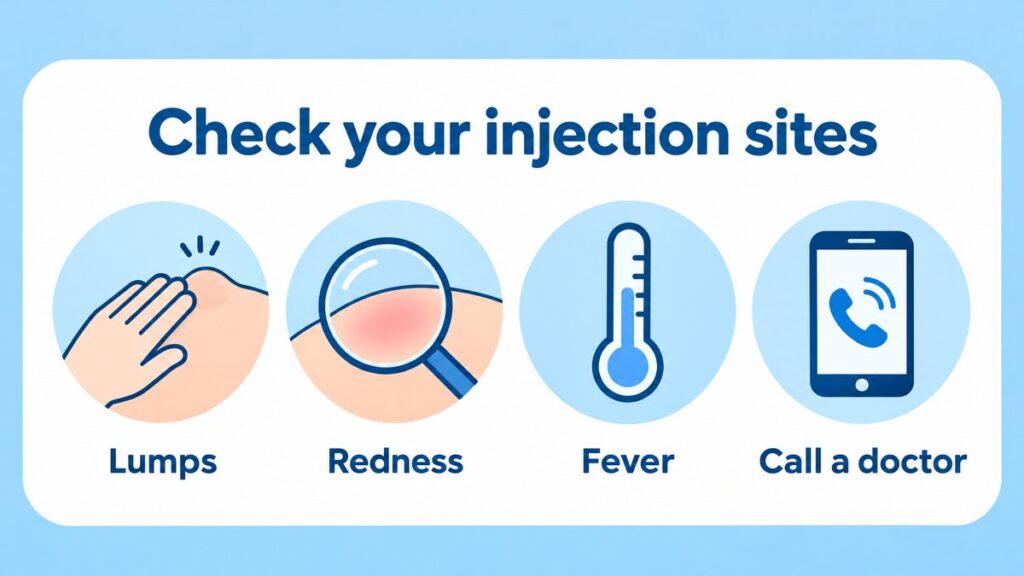
Some soreness after an injection is normal, according to MedlinePlus. Signs of infection are different. MedlinePlus lists “redness, swelling, red streaks and a fever.” Its page on cellulitis, a common skin infection, adds:
- redness that gets bigger as the infection spreads
- warm skin around the red area
- pain or tenderness at the site
- tight, glossy, stretched-looking skin
- fever with chills and sweating
When should you see a doctor?
- Infection signs: MedlinePlus says to contact a provider right away if you have symptoms of cellulitis, such as spreading redness, warmth, or fever.
- Red streaks or a fever that won’t go away: both are listed as reasons to get care quickly.
- A lump that’s hot, painful, or growing: that isn’t the slow, painless thickening of lipohypertrophy and needs to be checked.
- Shoulder pain that doesn’t settle: lasting pain or stiffness after a deltoid injection can be a shoulder injury like those described in the SIRVA review.
- Numbness, tingling, or weakness after a glute injection: nerve injury is the classic complication of a badly placed buttock shot, as the Nursing Open review describes.
- Signs of a severe allergic reaction: trouble breathing, wheezing, swelling of the face, eyes, or tongue, or hives. MedlinePlus says to call 911 or your local emergency number.
What This Means for You
- Match the site to the route. The product’s instructions decide subQ or IM. Don’t switch layers because one site is easier to reach.
- Lean means short. If you’re lean, your fat layer may be only about a centimeter deep, so a short needle or a pinched skin fold keeps a subQ shot out of muscle.
- Rotate on purpose. Use a written pattern and keep each injection at least an inch from the last. It’s the single best way to prevent lipohypertrophy.
- Treat every needle as single-use. New needle, new syringe, clean hands, clean skin, wiped stopper, every time.
- Know the warning signs. Spreading redness, warmth, red streaks, fever, numbness, or trouble breathing are reasons to get medical help, not to wait it out.
For the full process from start to finish, see our step-by-step guide on how to inject peptides.
The Bottom Line
The right peptide injection site depends on the route, and clinical guidance on needle length, rotation, hygiene, and disposal does more for safety than any single “best” spot.
- SubQ sites are the abdomen (2 inches from the navel), the outer upper thigh, and the back of the upper arm.
- IM sites are the deltoid, the outer thigh, and the ventrogluteal hip site, which nursing research favors over the upper outer buttock.
- Short needles and correct rotation are the FITTER experts’ main tools against hitting muscle and building lipohypertrophy.
- Use one needle and one syringe one time, put sharps straight into a container, and get checked for spreading redness, fever, or numbness.
Frequently Asked Questions
Disclaimer
Please read carefully
The information on this site is for educational and informational purposes only, and is not medical advice. Always consult a qualified healthcare professional before using any supplement or medication, or making changes to your health, fitness, or nutrition routine.
Not medical advice
Content here is not a substitute for professional medical advice.
Consult your doctor
Talk to your doctor before starting any supplement or new routine.
Use at your own risk
We are not responsible for adverse effects from acting on this.
Do your research
Make informed decisions about your own health.
No guarantees
Individual results vary. No claims about outcomes.
Important — Never disregard professional medical advice or delay seeking it because of something you read here. If you think you may have a medical emergency, call your doctor or your local emergency number right away.







how can i stop it hitting and injection site hurts and stings with a lump for 24 hours and i am supposed to inject everyday