Contents11 sections
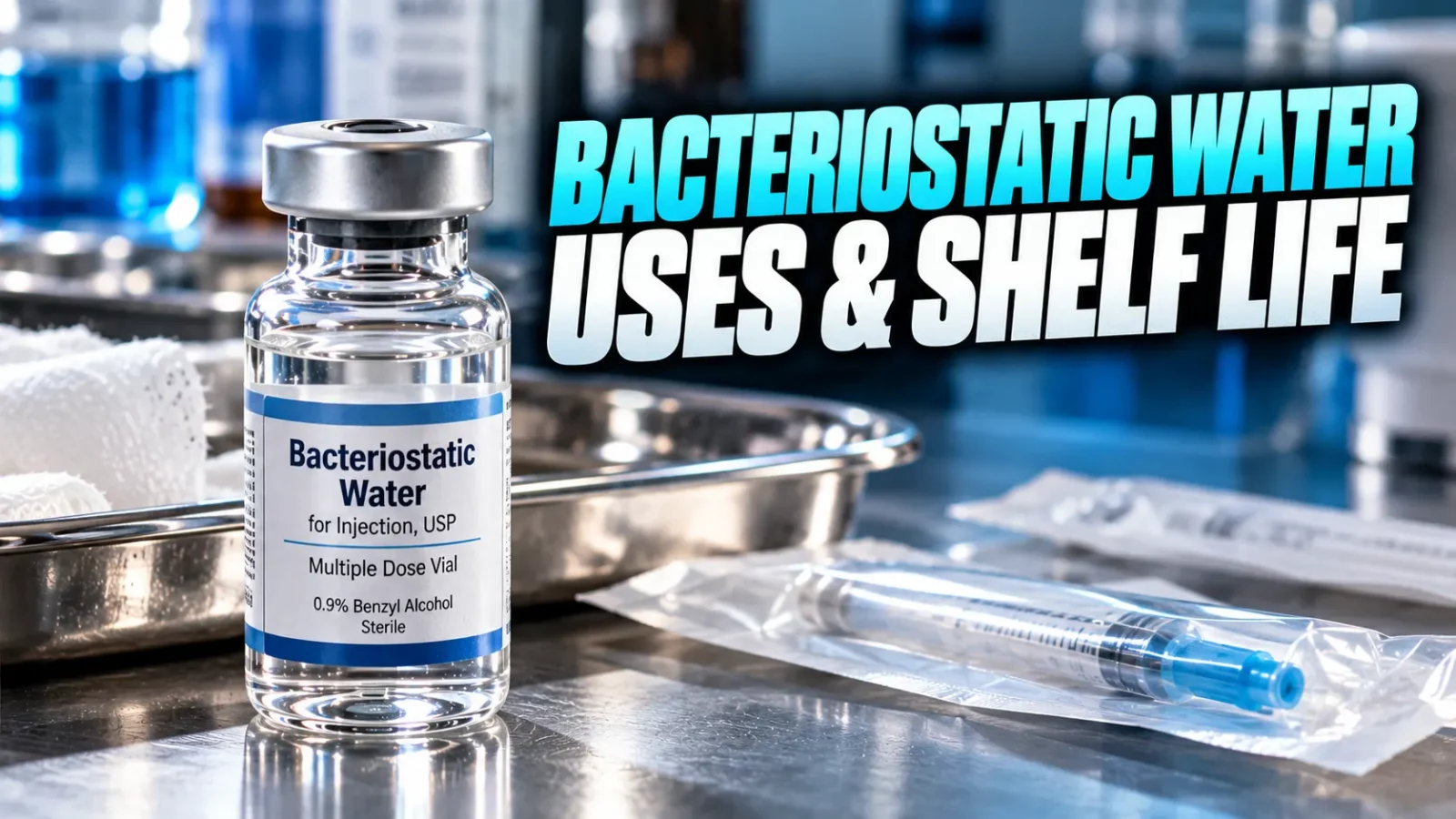
Bacteriostatic water is sterile water for injection that contains 0.9% benzyl alcohol, a preservative that stops bacteria from multiplying once the vial has been opened. It is not a medication and is never injected on its own. Its only job is to dissolve or dilute other injectable drugs, which is why it shows up in hospitals, pharmacies and in discussions about reconstituting lyophilized (freeze-dried) peptides.
Because of the preservative, one vial can be punctured many times, unlike plain sterile water, which is meant for a single use. This guide covers the official labeling, reconstitution, how long an opened vial lasts, who should not receive it and how it compares with sterile water and saline.
Key Takeaways
- Bacteriostatic water is sterile water with 0.9% benzyl alcohol (some products use 1.1%). The preservative inhibits bacterial growth but does not kill bacteria or sterilize anything.
- It has no “dose” of its own. The amount used depends on the drug or peptide being reconstituted and the concentration someone is trying to reach.
- The FDA-approved label says it is not for use in neonates and should not be used in epidural or spinal procedures, because of benzyl alcohol toxicity.
- CDC guidance, based on USP <797>, says an opened multi-dose vial should be dated and discarded within 28 days unless the manufacturer specifies a different date.
- Sterile water without a preservative is a single-use product. Bacteriostatic saline contains sodium chloride and is not interchangeable with bacteriostatic water for every drug.
What Is Bacteriostatic Water?
The official product name is Bacteriostatic Water for Injection, USP. According to the Pfizer (Hospira) prescribing information, it is sterile, non-pyrogenic water for injection containing 0.9% (9 mg/mL) or 1.1% (11 mg/mL) benzyl alcohol added as a bacteriostatic preservative. The pH is 5.7, with an allowed range of 4.5 to 7.0.
“Bacteriostatic” means the preservative stops bacteria from growing and reproducing. It does not mean the solution kills bacteria already present. That distinction matters: benzyl alcohol buys time between punctures of the rubber stopper, but it cannot fix contamination from a dirty needle or an unwiped stopper.
The label describes the product as a pharmaceutic aid used to dilute or dissolve drugs for intravenous, intramuscular or subcutaneous injection. It is supplied in a multiple-dose container “from which repeated withdrawals may be made.”
Why Benzyl Alcohol Is Added
Benzyl alcohol turns a single-use vial into a multi-dose vial. Without a preservative, any bacteria introduced by the first needle puncture could grow freely in the water. With 0.9% benzyl alcohol, that growth is suppressed, so the same vial can be drawn from repeatedly over a limited period.
The tradeoff is that benzyl alcohol is not inert. It is the reason for the neonatal warning and the epidural restriction covered below, and it is the most likely cause of the mild stinging some people notice on injection.
Bacteriostatic Water Is Not Meant to Be Injected Alone
The label is explicit that the product is a diluent. It warns that intravenous use of bacteriostatic water without a solute may cause hemolysis (destruction of red blood cells) because plain water is hypotonic, and that it should not be used for fluid replacement. It exists to carry another drug, not to be given by itself.
How It Is Used in Reconstitution
In clinical settings, bacteriostatic water is used to reconstitute powdered medications such as some antibiotics and hormones, especially when a single vial will be drawn from several times. Pharmacies, clinics, home healthcare providers and research labs use it for the same reason.
In fitness and research circles, it is best known as bacteriostatic water for peptides: lyophilized peptides are shipped as a more stable dry powder and must be dissolved before they can be measured or used.
How Reconstitution Works
Reconstitution is the process of adding a liquid to a powdered drug to turn it into a solution. In general terms, it involves:
- Cleaning the rubber stoppers of both vials with an alcohol swab.
- Drawing a measured volume of bacteriostatic water into a sterile syringe.
- Injecting the water slowly down the inside wall of the powder vial, rather than directly onto the powder.
- Letting the powder dissolve, swirling gently rather than shaking, since vigorous agitation can damage fragile peptides.
- Checking that the solution is clear, with no particles or cloudiness.
Our step-by-step guide on how to reconstitute peptides covers the process in more detail, including syringe types and handling.
What Happens to the Peptide After Mixing
Most peptide reconstitution guidance calls for storing the mixed vial in the refrigerator at 2 to 8°C (36 to 46°F), protected from light. Reconstituted peptides are far less stable than the dry powder, and their usable life depends on the specific compound. The 28-day rule below applies to the opened bacteriostatic water vial itself. It does not guarantee that a peptide dissolved in it stays potent for that long.
How Much Is Used? Why There Is No “Dosage”
People often search for a bacteriostatic water dosage, but the term is misleading. Bacteriostatic water has no dose. It is a solvent, and the amount added to a vial only changes how concentrated the resulting solution is. The amount of active compound in the vial stays the same whether 1 mL or 3 mL of water is added.
The concentration math is simple division:
Concentration = amount of compound in the vial ÷ volume of water added
For example:
| Vial Contents | Water Added | Resulting Concentration | Per 0.1 mL (10 units on a U-100 syringe) |
|---|---|---|---|
| 5 mg | 1 mL | 5 mg/mL | 0.5 mg (500 mcg) |
| 5 mg | 2 mL | 2.5 mg/mL | 0.25 mg (250 mcg) |
| 10 mg | 2 mL | 5 mg/mL | 0.5 mg (500 mcg) |
| 10 mg | 3 mL | 3.33 mg/mL | 0.33 mg (333 mcg) |
Adding more water produces a more dilute solution, which makes small amounts easier to measure accurately on a syringe. Adding less water produces a more concentrated solution and less volume per injection. Neither changes the total amount of compound in the vial.
Common reconstitution volumes in peptide guides fall between 1 and 3 mL, largely because that range works well with 1 mL insulin syringes. Our peptide dosage calculator converts any vial size and water volume into concentration and syringe units, which avoids arithmetic errors. Muscle & Brawn does not recommend doses for any peptide or drug; this section only explains how the concentration is calculated.
How Long Does Bacteriostatic Water Last?
There are two different timelines: the unopened shelf life and the life of a vial once it has been punctured.
Unopened Vials
An unopened vial is good until the expiration date printed on it. The Pfizer label calls for storage at controlled room temperature, 20 to 25°C (68 to 77°F). Refrigeration is not required for the unopened water itself.
Opened Vials: The 28-Day Rule
Once the stopper has been punctured, the clock starts. The CDC’s injection safety guidance, which follows USP General Chapter <797>, states that once a multi-dose vial is opened (needle-punctured) it should be dated and discarded within 28 days, unless the manufacturer states another date for that opened vial. The beyond-use date should also never exceed the manufacturer’s original expiration date.
In practice that means writing the date of first puncture on the vial and discarding it 28 days later, or sooner if the solution turns cloudy, shows particles or the stopper is damaged. The 28-day figure is a contamination-control rule for multi-dose vials in healthcare settings. It is not a guarantee of sterility if the vial has been handled poorly.
Can You Make Your Own Bacteriostatic Water?
No. The product is manufactured under sterile, pyrogen-free conditions and tested to USP standards. Mixing distilled or bottled water with benzyl alcohol at home produces neither, and injecting a homemade solution risks infection, abscess or a fever reaction.
Side Effects and Safety Warnings
Bacteriostatic water is well tolerated in most adults at the small volumes used to reconstitute drugs. Bacteriostatic water side effects mostly come from the benzyl alcohol, from the injection itself or from contamination.
Injection-Site Stinging and Irritation
Mild stinging or burning at the injection site is the most commonly reported complaint. Benzyl alcohol is a known irritant at the injection site, and the slightly acidic pH can add to it. Redness, slight swelling or tenderness usually resolve within a short time. Rotating injection sites helps limit local irritation; our guide to peptide injection sites explains the common subcutaneous locations, and how to inject peptides covers technique.
Persistent pain, spreading redness, warmth, pus or fever at an injection site are signs of possible infection and need medical attention.
Allergic Reactions to Benzyl Alcohol
Hypersensitivity to benzyl alcohol is uncommon but documented. Itching, hives, rash or swelling after an injection may indicate a reaction. Anyone with a known benzyl alcohol allergy should not use products that contain it. Trouble breathing or facial swelling is an emergency.
Not for Use in Neonates
The label carries a boxed warning: NOT FOR USE IN NEONATES. This traces back to 1982. A CDC MMWR report described 16 deaths in premature infants at two medical centers whose catheters had been flushed with bacteriostatic saline containing 9 mg/mL benzyl alcohol. The infants developed metabolic acidosis, respiratory distress and gasping breathing, a pattern that became known as “gasping syndrome.” The FDA advised that flush solutions and diluents containing benzyl alcohol not be used in newborns. The label now says only preservative-free sterile water should be used to prepare or dilute drugs for neonates.
Not for Epidural or Spinal Use
The label also states that preparations containing benzyl alcohol should not be used in epidural or spinal anesthesia procedures. This is a clinical restriction rather than a concern for typical subcutaneous or intramuscular use.
Contamination From Poor Technique
The largest practical risk is contamination. Reusing needles, skipping the alcohol swab, touching the stopper or keeping a vial past 28 days all increase the chance of introducing bacteria that the preservative cannot fully control. Product quality matters too; a vial should be labeled “Bacteriostatic Water for Injection, USP,” list the benzyl alcohol content, carry a lot number and expiration date and have an intact seal. Our guide on how to read a peptide COA explains how to check documentation for the compound being reconstituted.
Bacteriostatic Water vs Sterile Water vs Saline
Bacteriostatic water vs sterile water is the comparison most people search for, but bacteriostatic saline and plain saline are also common diluents. The right choice depends on the drug, since some manufacturers specify a particular diluent and some drugs are incompatible with benzyl alcohol or sodium chloride.
| Feature | Bacteriostatic Water | Sterile Water for Injection | Bacteriostatic Saline (0.9% NaCl) |
|---|---|---|---|
| Base | Sterile water | Sterile water | Sterile 0.9% sodium chloride |
| Preservative | 0.9% benzyl alcohol | None | 0.9% benzyl alcohol |
| Container | Multi-dose | Single-dose | Multi-dose |
| Opened vial life | Up to 28 days (USP <797>) unless the manufacturer says otherwise | Use once, discard remainder | Up to 28 days (USP <797>) unless the manufacturer says otherwise |
| Tonicity on its own | Hypotonic | Hypotonic | Isotonic |
| Safe for neonates | No | Yes (preservative-free) | No |
| Typical use | Reconstituting drugs and peptides drawn from repeatedly | Reconstituting single-use drugs; neonatal preparations | Diluting drugs that need a saline base |
Bacteriostatic Water vs Sterile Water
Sterile Water for Injection contains no preservative. Once the stopper is punctured, nothing slows bacterial growth, so it is labeled for single use and any remainder is discarded. That makes it the right choice when a drug is mixed and used at once, or when the patient is a newborn. Bacteriostatic water is used when a vial will be drawn from several times over days or weeks, which is why it is the usual choice for peptide reconstitution.
Bacteriostatic Water vs Saline
Saline contains 0.9% sodium chloride, which matches the salt concentration of blood. Some drugs are labeled to be reconstituted in saline; others can precipitate or degrade in it. Bacteriostatic saline adds the same benzyl alcohol preservative and carries the same neonatal warning. For any specific drug, the manufacturer’s labeling determines which diluent to use.
Legal Status and Prescription Requirements
Bacteriostatic Water for Injection is an FDA-approved prescription product in the United States, though access varies by state, pharmacy and country, and it is also sold for laboratory use. The legal status of the peptides it is often used with is a separate and more complicated question, covered in our guide on whether peptides are legal.
The Bottom Line
Bacteriostatic water is a simple product with strict rules: sterile water plus 0.9% benzyl alcohol, used only to dissolve or dilute other injectable drugs.
- It has no dose of its own. The volume added only sets the concentration of the drug in the vial.
- Under CDC guidance based on USP <797>, an opened vial is dated and discarded within 28 days unless the manufacturer says otherwise, and never used past its expiration date.
- It is not for use in newborns or in epidural and spinal procedures, and sterile water or saline are not automatic substitutes.
Bacteriostatic Water FAQ
Disclaimer
Please read carefully
The information on this site is for educational and informational purposes only, and is not medical advice. Always consult a qualified healthcare professional before using any supplement or medication, or making changes to your health, fitness, or nutrition routine.
Not medical advice
Content here is not a substitute for professional medical advice.
Consult your doctor
Talk to your doctor before starting any supplement or new routine.
Use at your own risk
We are not responsible for adverse effects from acting on this.
Do your research
Make informed decisions about your own health.
No guarantees
Individual results vary. No claims about outcomes.
Important — Never disregard professional medical advice or delay seeking it because of something you read here. If you think you may have a medical emergency, call your doctor or your local emergency number right away.