Contents9 sections
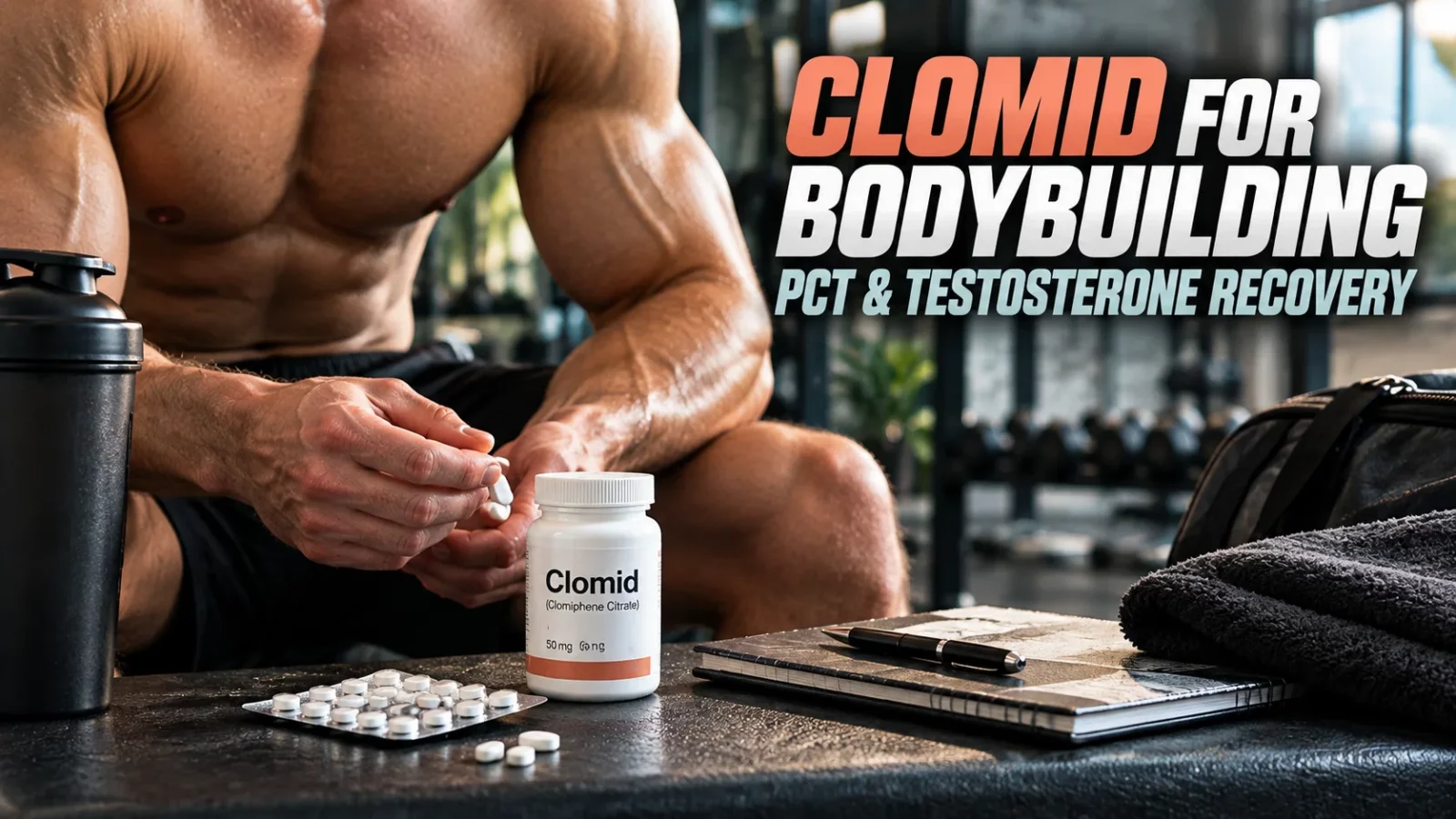
Clomid for bodybuilding is one of the most established post-cycle therapy (PCT) protocols in the steroid-using community. Clomiphene citrate — marketed as Clomid — is a selective estrogen receptor modulator (SERM) that stimulates the hypothalamic-pituitary-gonadal (HPG) axis to restore natural testosterone production after anabolic steroid use. Nearly every steroid cycle concludes with a Clomid PCT protocol designed to prevent the muscle loss, low libido, fatigue, and hormonal dysfunction that follow unsupported recovery.
Originally developed in the 1960s to treat female infertility by inducing ovulation, clomiphene bodybuilding applications emerged as the compound’s ability to stimulate gonadotropin release proved equally valuable for male hormonal recovery. The compound’s mechanism — blocking estrogen receptors in the hypothalamus to trigger increased luteinizing hormone (LH) and follicle-stimulating hormone (FSH) production — directly addresses the hormonal suppression caused by exogenous androgen use.
Key Takeaways
- Clomid (clomiphene citrate) is a SERM that restores natural testosterone production after steroid cycles.
- The compound works by blocking estrogen receptors in the hypothalamus, triggering LH and FSH release.
- Clinical studies demonstrate 2-fold testosterone increases within 2-4 weeks of use.
- Standard Clomid PCT dosage starts at 50-100 mg daily, tapering over 4-6 weeks.
- Side effects include mood changes, visual disturbances, and headaches.
- Clomid should not be taken during a steroid cycle — only after steroid clearance.
How Clomid Works for Testosterone Recovery
During anabolic steroid use, exogenous androgens signal the hypothalamus that testosterone levels are sufficient, suppressing the body’s natural production through negative feedback. LH and FSH output drops, testicular function declines, and natural testosterone production can fall to near-zero levels on prolonged or high-dose cycles.
Clomiphene citrate interrupts this suppression by binding to estrogen receptors in the hypothalamus and pituitary gland. By blocking estrogen’s inhibitory signal, clomiphene bodybuilding protocols force the HPG axis to resume gonadotropin production:
| Step | Mechanism | Effect |
|---|---|---|
| 1 | Clomiphene binds estrogen receptors in hypothalamus | Estrogen’s negative feedback is blocked |
| 2 | Hypothalamus increases GnRH output | Gonadotropin-releasing hormone rises |
| 3 | Pituitary releases LH and FSH | Luteinizing and follicle-stimulating hormones increase |
| 4 | LH stimulates Leydig cells | Testicular testosterone production resumes |
| 5 | FSH stimulates Sertoli cells | Spermatogenesis recovers |
Within 2-3 days of initiating clomiphene therapy, LH and FSH levels begin rising measurably. Full testosterone recovery typically requires 4-6 weeks, though individual timelines vary based on cycle length, compounds used, and individual physiology.
Clinical Evidence for Clomid Testosterone Recovery
Multiple clinical studies support clomiphene’s effectiveness for testosterone restoration in men, providing the scientific foundation for Clomid for bodybuilding use.
A study examining men aged 18-55 found that two weeks of clomiphene administration produced approximately 2-fold increases in testosterone levels in most participants. Some subjects experienced testosterone decline after one month of cessation, supporting the use of tapering protocols rather than abrupt discontinuation.
Longer-term research tracked 125 men with low testosterone (below 400 ng/dL) who used clomiphene for three months. The results showed near-doubling of testosterone levels with no significant changes in cholesterol profiles and no reported side effects during the treatment period.
Extended follow-up data on men using clomiphene for low testosterone demonstrated sustained benefits:
| Timepoint | Average Testosterone Level |
|---|---|
| Baseline | 228 ng/dL |
| After 1 year | 612 ng/dL |
| After 2 years | 562 ng/dL |
| After 3 years | 582 ng/dL |
Bone density improvements were also documented over the three-year period, with no significant adverse effects reported. These findings support clomiphene’s safety profile for extended use when medically supervised.
Clomid Dosage Protocols for PCT
The Clomid dosage for post-cycle therapy depends on the severity of hormonal suppression from the preceding steroid cycle. Heavier cycles with more suppressive compounds require higher initial doses and longer recovery periods.
After Heavy Steroid Cycles
This protocol applies after cycles involving high-dose testosterone, trenbolone, Deca-Durabolin, or stacks of multiple suppressive compounds:
| Phase | Daily Dose | Duration |
|---|---|---|
| Loading | 150 mg daily | 3 days |
| High dose | 100 mg daily | 12 days |
| Medium dose | 50 mg daily | 15 days |
| Taper | 25 mg daily | 15 days |
After Moderate Steroid Cycles
For cycles involving moderate-dose testosterone, Masteron, or single-compound steroid protocols:
| Phase | Daily Dose | Duration |
|---|---|---|
| High dose | 100 mg daily | 15 days |
| Medium dose | 50 mg daily | 15 days |
| Taper | 25 mg daily | 15 days |
After Mild Cycles
For cycles involving mild compounds like Anavar, low-dose testosterone, or short SARMs cycles:
| Phase | Daily Dose | Duration |
|---|---|---|
| Standard dose | 50 mg daily | 30 days |
| Taper | 25 mg daily | 15 days |
Timing Considerations
Post-cycle therapy should not begin while exogenous steroids are still active in the body. The clearance window depends on the ester used:
| Steroid Ester | Wait Before Starting PCT |
|---|---|
| Propionate / Acetate (short esters) | 3-5 days after last injection |
| Enanthate / Cypionate (long esters) | 2 weeks after last injection |
| Undecanoate (very long ester) | 3-4 weeks after last injection |
| Oral steroids (no ester) | 1-3 days after last dose |
Starting Clomid while exogenous androgens are still circulating reduces its effectiveness, as the steroid continues suppressing the HPG axis despite clomiphene’s SERM activity.
Clomid Side Effects
While Clomid for bodybuilding PCT is generally well-tolerated at standard doses, the compound does carry potential side effects that require monitoring.
| Side Effect | Frequency | Notes |
|---|---|---|
| Mood changes | Common | Irritability, emotional volatility, depression; more pronounced at higher doses |
| Visual disturbances | Uncommon | Blurred vision, light sensitivity, visual trails; requires immediate discontinuation if persistent |
| Headaches | Common | Usually mild; dose-dependent |
| Nausea | Occasional | More common at 100-150 mg doses |
| Hot flashes | Occasional | Related to estrogen receptor blockade |
| Testicular discomfort | Rare | Temporary; related to resumed testicular activity |
Visual disturbances are the most clinically concerning side effect. Any persistent changes in vision — blurring, light sensitivity, or visual phenomena — warrant immediate discontinuation and medical evaluation. These effects are typically reversible upon cessation.
The mood-related side effects of Clomid are a primary reason many bodybuilders prefer Nolvadex (tamoxifen) for PCT. While both are SERMs that restore testosterone through similar mechanisms, Clomid tends to produce more pronounced emotional side effects, particularly irritability and mood swings.
Clomid vs Nolvadex for PCT
Both clomiphene (Clomid) and tamoxifen (Nolvadex) are SERMs used for post-cycle therapy. The choice between them — or the decision to combine both — depends on the specific recovery needs.
| Factor | Clomid | Nolvadex |
|---|---|---|
| Mechanism | Estrogen receptor blocker (hypothalamus) | Estrogen receptor blocker (hypothalamus + breast tissue) |
| LH stimulation | Stronger per-dose effect | Moderate but consistent |
| Mood side effects | More pronounced | Generally milder |
| Visual side effects | Possible | Rare |
| Gynecomastia protection | Indirect (via estrogen control) | Direct (blocks breast tissue receptors) |
| Typical PCT dose | 50-100 mg daily | 20-40 mg daily |
| Common duration | 4-6 weeks | 4-6 weeks |
Some Clomid PCT protocols combine both compounds — typically Clomid 50 mg with Nolvadex 20 mg daily — for a synergistic effect that provides stronger LH stimulation alongside direct gynecomastia protection. This combination approach is common after particularly suppressive cycles involving compounds like trenbolone or Deca-Durabolin.
The Bottom Line
Clomiphene citrate effectively restores natural testosterone production by blocking estrogen’s negative feedback on the HPG axis, with clinical data demonstrating sustained Clomid testosterone recovery over multi-year follow-up periods.
- The standard Clomid dosage of 50-100 mg daily for 4-6 weeks addresses most post-cycle recovery needs, though protocols should be adjusted based on cycle severity.
- The primary trade-off with Clomid PCT is its mood-related side effect profile, which is generally more pronounced than Nolvadex.
Frequently Asked Questions
Disclaimer
Please read carefully
The information on this site is for educational and informational purposes only, and is not medical advice. Always consult a qualified healthcare professional before using any supplement or medication, or making changes to your health, fitness, or nutrition routine.
Not medical advice
Content here is not a substitute for professional medical advice.
Consult your doctor
Talk to your doctor before starting any supplement or new routine.
Use at your own risk
We are not responsible for adverse effects from acting on this.
Do your research
Make informed decisions about your own health.
No guarantees
Individual results vary. No claims about outcomes.
Important — Never disregard professional medical advice or delay seeking it because of something you read here. If you think you may have a medical emergency, call your doctor or your local emergency number right away.