
Contents10 sections
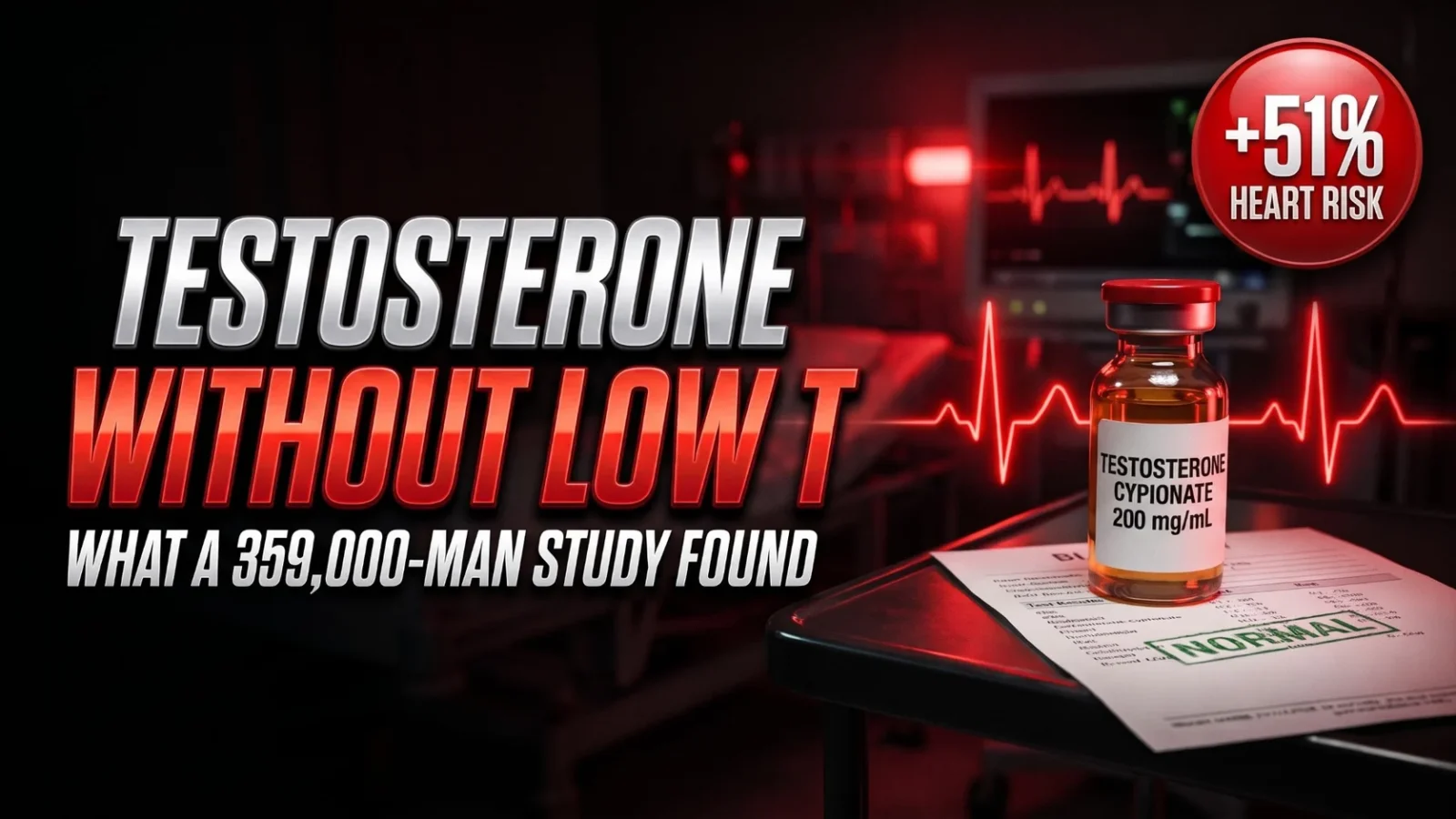
Men who started testosterone therapy without any recorded sign of low testosterone had a 51% higher risk of a heart attack, stroke, cardiac arrest or death over 10 years than men who started it for a documented deficiency. That’s the headline finding of a large study published in eBioMedicine this year, which followed about 359,000 men across 123 healthcare organizations worldwide.
The finding lands at an awkward moment. Testosterone prescribing is rising again, online clinics have made it easy to get, and the FDA has spent the last two years loosening its warnings on testosterone products. This study doesn’t contradict that, but it adds an important condition: the safety data that reassured regulators came from men who actually had low testosterone.
This article explains what the study measured, what it found, what it can’t tell you, and what it means if you’re on TRT or thinking about it.
Key Takeaways
- A 2026 eBioMedicine study compared men who started testosterone with no recorded evidence of low T against men who started it for documented deficiency.
- Over 10 years, major cardiovascular events (heart attack, stroke, cardiac arrest or death) hit 16.5% of the first group and 11.8% of the second, a hazard ratio of 1.51.
- Both groups were on testosterone. The study didn’t compare TRT with no treatment, so it can’t say testosterone itself raises risk in men with normal levels.
- It’s an observational study of health records. Dose, route and how long men stayed on treatment couldn’t be measured.
- The practical message from the authors is simple: confirm low testosterone with proper testing before starting, and keep monitoring after.
What the Study Found
The paper, “Off-label testosterone therapy is associated with higher long-term cardiovascular risk in men,” was published online in eBioMedicine, a Lancet family journal, on July 9, 2026. The first author is Hatim Kerniss, a cardiologist at University Heart Centre Frankfurt, and the senior author is Ralf Ludwig of the University of Lübeck. The full text is free to read.
After matching the two groups on age, health conditions and other factors, the researchers had 113,554 pairs of men. Over up to 10 years of follow-up:
| Outcome | No evidence of low T | Documented low T | Hazard ratio (95% CI) |
|---|---|---|---|
| Major cardiovascular events (MACE) | 16.53% | 11.83% | 1.51 (1.46 to 1.56) |
| Death from any cause | 10.71% | 5.99% | 1.90 (1.80 to 2.00) |
| Heart failure | 8.60% | 7.23% | 1.32 (1.26 to 1.39) |
| Ischemic stroke | 3.84% | 3.29% | 1.23 (1.14 to 1.33) |
| Cardiac arrest | 1.23% | 0.95% | 1.41 (1.23 to 1.61) |
| Heart attack | 4.32% | 4.16% | 1.10 (1.02 to 1.17) |
| Pulmonary embolism | 2.50% | 2.43% | 1.15 (1.05 to 1.25) |
MACE here means a heart attack, an ischemic stroke, a cardiac arrest or death from any cause. A hazard ratio of 1.51 means the men without documented low T had events at about one and a half times the rate of the comparison group.
The heart attack and pulmonary embolism differences were small, and both disappeared when the researchers left out events in the first 90 days. The stroke, cardiac arrest, heart failure and death differences held up better.
The results held up in several checks
The researchers ran the numbers several ways to see whether the finding was fragile:
- Leaving out the first 90 days still showed higher MACE risk (HR 1.36).
- Using only men with recorded lab results, comparing men with a normal testosterone reading against men with two documented low readings, gave almost the same answer (HR 1.52).
- Leaving out men with diabetes made the gap bigger (HR 1.77).
- Capping follow-up at two years still showed raised risk.
- A “negative control” outcome, appendicitis, showed no difference (HR 0.88, not significant). That’s a useful sign that the two groups weren’t simply different in some way that would show up in every outcome.
Who was at the highest risk?
The relative increase was similar in younger and older men, though stroke and cardiac arrest showed stronger links in younger men and the excess in deaths was larger in older men. Among men without documented low T, those whose hematocrit (the share of blood made up of red cells) was above 50% before starting had slightly higher MACE risk than those between 41% and 50% (HR 1.12).
The link was seen across racial and ethnic groups and regions. It was strongest in Asian men and in the Asia-Pacific region, but those groups were small and the authors call those results exploratory.
How the Study Worked
The data came from TriNetX, a network of electronic health records from 123 healthcare organizations across North and South America, Europe, the Middle East, Africa and Asia-Pacific. The researchers included men aged 30 to 75 who started testosterone on or after January 1, 2006.
To make sure they were looking at new users, they excluded anyone who’d used testosterone in the previous three years or who’d already had a heart attack, stroke, heart failure, atrial fibrillation, pulmonary embolism or deep vein thrombosis.
Then they split the men into two groups:
- No evidence of hypogonadism: nothing in the record suggesting low testosterone. That meant no diagnosis code for low testicular function, no recorded low libido, sexual dysfunction or erectile dysfunction, and no lab result showing total testosterone at or below 300 ng/dL or free testosterone at or below 60 pg/mL.
- Evidence of hypogonadism: at least one diagnosis code for low testicular function, or a total testosterone at or below 300 ng/dL, or a free testosterone at or below 60 pg/mL.
Of the 358,957 men who met the criteria, 127,152 (35%) had no recorded evidence of low testosterone when they started. The researchers then used propensity score matching to pair men with similar ages, health conditions and other characteristics before comparing outcomes.
What the Study Can’t Tell You
This is a careful study, but its design has limits that matter for how you read it.
Both groups took testosterone. This is the point most headlines miss. The comparison is men treated off-label versus men treated for a real deficiency. It doesn’t show whether men with normal testosterone who take it are at higher risk than men with normal testosterone who don’t. It also doesn’t say whether men with low T who take testosterone end up better or worse off than if they’d stayed untreated, because they were the reference group, not a separately measured outcome.
It shows an association, not cause and effect. The authors say so directly. Matching can balance the factors that are recorded, but it can’t balance what isn’t. Men who get testosterone without a diagnosis may differ in ways the records don’t capture, such as how they got their prescription, whether they also used other drugs, or how closely anyone monitored them.
“No evidence” isn’t the same as “normal testosterone.” Some men in that group may have had low testosterone that was tested elsewhere or never written in the chart. The lab-only check (HR 1.52) helps here, but the authors still describe the group as a stand-in for prescribing that probably didn’t follow guidelines.
Dose, route and duration are unknown. The records couldn’t show whether men used injections or gels, how much they took, or how long they stayed on it. The authors suggest higher doses or performance-focused use in the off-label group as one plausible explanation, but the data can’t confirm it.
The groups were followed for different lengths of time. Median follow-up was 697 days for the off-label group and 1,448 days for the diagnosed group. The researchers’ statistical methods account for this, and the two-year analysis still showed raised risk, but it’s worth knowing.
The diagnosed group was sicker at the start. Before matching, men with documented low T were far more likely to have high blood pressure (39% vs 14%) and obesity (23% vs 7%). Matching balanced this, but it shows how different the two populations were.
No outside experts appear to have commented on the study publicly. Harvard Health covered it in August and noted that it can’t prove causation.
How This Fits With TRAVERSE and the FDA
If you’ve followed testosterone news, this may seem to clash with the big reassuring trial of the last few years. It doesn’t, once you look at who was studied.
TRAVERSE studied men with confirmed low T
The TRAVERSE trial, published in the New England Journal of Medicine in 2023, randomly assigned 5,246 men aged 45 to 80 to testosterone gel or a placebo. Every man had symptoms of low testosterone and two fasting testosterone readings below 300 ng/dL, and all had existing heart disease or a high risk of it.
Major cardiovascular events were almost identical: 7.0% on testosterone and 7.3% on placebo (HR 0.96). The testosterone group did have more atrial fibrillation, acute kidney injury and pulmonary embolism. The trial was funded by AbbVie, which makes a testosterone gel.
So TRAVERSE showed that testosterone didn’t raise heart attack and stroke risk in men with properly diagnosed deficiency. The new study looks at a different group entirely: men who started without that diagnosis.
The FDA has eased its warnings
In February 2025, the FDA removed the cardiovascular outcomes language from the boxed warning on all testosterone products, citing TRAVERSE. It added warnings about raised blood pressure and kept the limitation that testosterone isn’t approved for low levels caused only by aging.
In June 2026, HHS and the FDA asked manufacturers to make further changes, including dropping that age-related limitation. That request hadn’t been finalized as of this writing.
The direction of travel is toward fewer restrictions. The Kerniss study suggests the evidence behind that shift applies to men with genuine deficiency, and shouldn’t be stretched to men without it.
Why This Matters Now
Testosterone use is climbing. An Epic Research analysis published in July 2026 found the share of men with an active testosterone prescription rose from 0.64% in 2021 to 0.93% in 2025, and every age group from 30 up is above its early-2010s peak. That analysis isn’t peer reviewed and only covers health systems that use Epic, so it likely misses many direct-to-consumer clinics.
Those clinics are where the diagnosis question gets sharpest. In a 2022 secret shopper study in JAMA Internal Medicine, a researcher posing as a man with normal testosterone who wanted to protect his fertility was offered testosterone by 6 of 7 online platforms. Six had no testosterone threshold for starting treatment, and only one asked about recent heart problems. (Testosterone therapy also suppresses sperm production, which is a separate reason it was a poor fit for that patient.)
That doesn’t mean every online clinic cuts corners, and some require blood work before prescribing. But it does mean the testing step is something you should check for, not assume. Our guide to online TRT costs covers what a proper intake should include, and our best online TRT clinic review compares how providers handle it.
What This Means If You’re on TRT or Considering It
None of this means you should stop testosterone if you’re on it. Stopping suddenly has its own effects, and that decision belongs with your doctor. But the study gives you some good questions to ask.
- Was low testosterone actually confirmed? The Endocrine Society’s guideline recommends diagnosing low T only in men with symptoms and consistently low testosterone, confirmed by repeat morning fasting blood tests. One borderline reading, or symptoms alone, isn’t enough.
- Are your levels being monitored? Testosterone and hematocrit should be checked after starting and at regular intervals. In an interview with Healio, Kerniss stressed monitoring hematocrit and getting heart risk factors under control before treatment.
- Is your blood pressure being tracked? The FDA added blood pressure warnings to testosterone labels in 2025.
- Are there alternatives worth discussing? For some men, especially those who want to keep their fertility, options that raise the body’s own production may be worth a conversation. Our enclomiphene vs TRT comparison covers the trade-offs.
If you have normal testosterone and you’re thinking about TRT to feel better, train harder or look better, this study is a reason to slow down. It doesn’t prove harm, but it’s the largest look yet at men in exactly your situation, and the signal points the wrong way.
The Bottom Line
Men who started testosterone without a documented deficiency had about 50% more heart attacks, strokes, cardiac arrests and deaths than men treated for real low T, though the study can’t prove testosterone caused the gap.
- The study matched 113,554 pairs of men from health records in 123 organizations and followed them for up to 10 years.
- Both groups were on testosterone, so the comparison is off-label versus guideline-based use, not treatment versus none.
- The reassuring TRAVERSE trial studied men with confirmed low T, and its results shouldn’t be stretched to men with normal levels.
- The safest path is a confirmed diagnosis before starting and regular checks of testosterone, hematocrit and blood pressure after.
Frequently Asked Questions
Disclaimer
Please read carefully
Not medical advice
Content here is not a substitute for professional medical advice.
Consult your doctor
Talk to your doctor before starting any supplement or new routine.
Use at your own risk
We are not responsible for adverse effects from acting on this.
Do your research
Make informed decisions about your own health.
No guarantees
Individual results vary. No claims about outcomes.
Important — Never disregard professional medical advice or delay seeking it because of something you read here. If you think you may have a medical emergency, call your doctor or your local emergency number right away.