Contents18 sections
KPV is a three-amino-acid peptide (lysine-proline-valine) that matches the tail end of alpha-melanocyte-stimulating hormone (α-MSH). It is sold as a research peptide in capsules, injectable vials and creams, mostly for gut and skin inflammation, and some lifters look at it to recover from minor injuries.
The research is real but early. Most of it comes from cell cultures and mouse models of colitis, plus test-tube work on bacteria. There are no published controlled trials in people, and KPV is not an approved medicine.
This guide covers what KPV is, how it works, what the studies found, the doses users commonly report (in micrograms, not milligrams), side effects, and how it compares with BPC-157 and TB-500.
Key Takeaways
- KPV is the last three amino acids (lysine-proline-valine) of alpha-MSH, a hormone made mainly in the pituitary gland and also in skin and immune cells.
- In cell and mouse studies, KPV calms inflammation by blocking NF-κB signalling. Gut and immune cells take it up through the PepT1 transporter.
- Oral KPV reduced chemically induced colitis in mice, and test-tube studies show activity against Staphylococcus aureus. None of this has been confirmed in human trials.
- Commonly reported doses are in micrograms: about 200-500 mcg a day by mouth or injection. No human dose has been established.
- KPV is not FDA-approved. Users mostly report mild short-term side effects, but its long-term safety in people is unknown.
What Is KPV?
KPV is a tripeptide made of lysine (K), proline (P) and valine (V). The sequence matches the last three amino acids, the C-terminal end, of alpha-melanocyte-stimulating hormone (α-MSH). α-MSH is cut from a larger precursor protein, pro-opiomelanocortin (POMC), mainly in the pituitary gland, and it is also made in skin and immune cells. The KPV sold for research is made synthetically.
Researchers became interested in KPV because much of α-MSH’s anti-inflammatory activity was traced to this short fragment. α-MSH also darkens the skin and affects appetite through melanocortin receptors, but those effects depend on a different part of the molecule, the central His-Phe-Arg-Trp sequence, which KPV does not contain.
KPV is small enough to be carried into cells by PepT1, a transporter that normally moves di- and tripeptides from digested protein into the cells lining the small intestine (1). PepT1 is also found in immune cells, and it appears in the colon during chronic inflammation. That is why oral KPV has been studied for inflammatory bowel disease.
How Does KPV Work?
In laboratory and animal research, KPV acts as an anti-inflammatory and antimicrobial peptide, and it has been studied for wound healing (2). Its best-described effect is on NF-κB, a protein complex that switches on many inflammatory genes.
In human airway cells, KPV built up in the cell nucleus and blocked the binding of the NF-κB subunit p65 (RelA) to importin-α3, the carrier protein that moves p65 into the nucleus (3). With less p65 reaching the nucleus, the cells sent out fewer inflammatory signals.
NF-κB drives the production of pro-inflammatory cytokines and chemokines, including interleukin-1 and interleukin-6, so dampening it lowers inflammation close to its source. In intestinal cells, KPV also reduced the activation of MAP kinase pathways, another set of inflammatory signals (1).
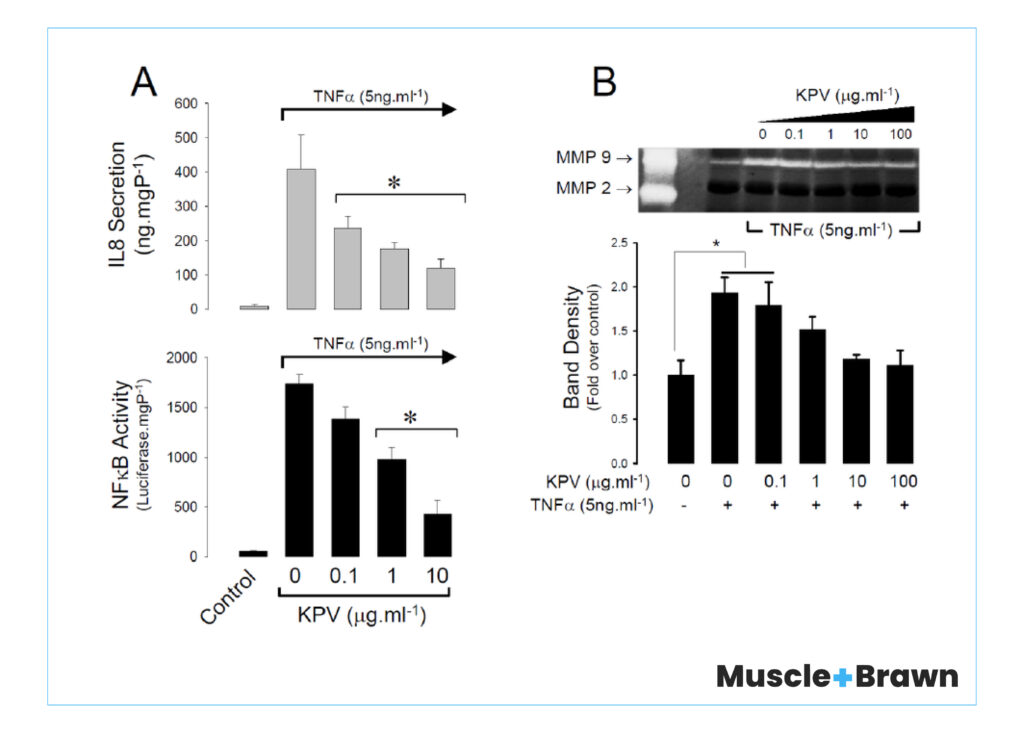
In one rabbit study, KPV eye drops helped injured corneas heal (4). The reduced scarring and collagen effects often quoted for KPV come from studies of its parent hormone, α-MSH, not KPV itself. No human wound-healing trial has been published.
KPV also has antimicrobial activity in the test tube. Along with α-MSH, it inhibited colony formation by Staphylococcus aureus over a broad range of concentrations (5). Lab activity like this does not show that KPV prevents or treats infections in people.
Benefits of KPV: What the Research Shows
Almost all KPV research comes from cell cultures and animals, mostly mouse models of colitis. The table sums up the main findings and the type of evidence behind each one.
| Area | What was found | Type of evidence |
|---|---|---|
| Gut inflammation | Oral KPV reduced chemically induced (DSS and TNBS) colitis and lowered inflammatory cytokines (1) | Mouse and cell studies |
| Colon-targeted delivery | KPV in nanoparticles aimed at the inflamed colon reduced colitis and helped the gut lining heal (6) | Mouse study |
| Airway inflammation | Reduced NF-κB inflammatory signalling in human airway cells (3) | Cell study |
| Wound healing | Faster healing of injured corneas in one rabbit study (4); the scarring data are for α-MSH, not KPV | One animal study |
| Bacteria | Inhibited Staphylococcus aureus colony formation (5) | Test-tube study |
| People | No published controlled trials | None |
Gut Inflammation (Mouse Studies)
Ulcerative colitis and Crohn’s disease are the two main forms of inflammatory bowel disease (IBD). In ulcerative colitis, chronic inflammation damages the lining of the colon and weakens its barrier against gut bacteria.
In the study that identified PepT1 as KPV’s way into cells, KPV given in drinking water reduced the severity of two types of chemically induced colitis in mice (DSS and TNBS) and lowered levels of inflammatory cytokines (1). In human intestinal cell lines, it blocked NF-κB and MAP kinase signalling.
A later mouse study packed KPV into nanoparticles designed to release it in the inflamed colon. Given by mouth, it reduced inflammation and helped the colon lining heal (6).
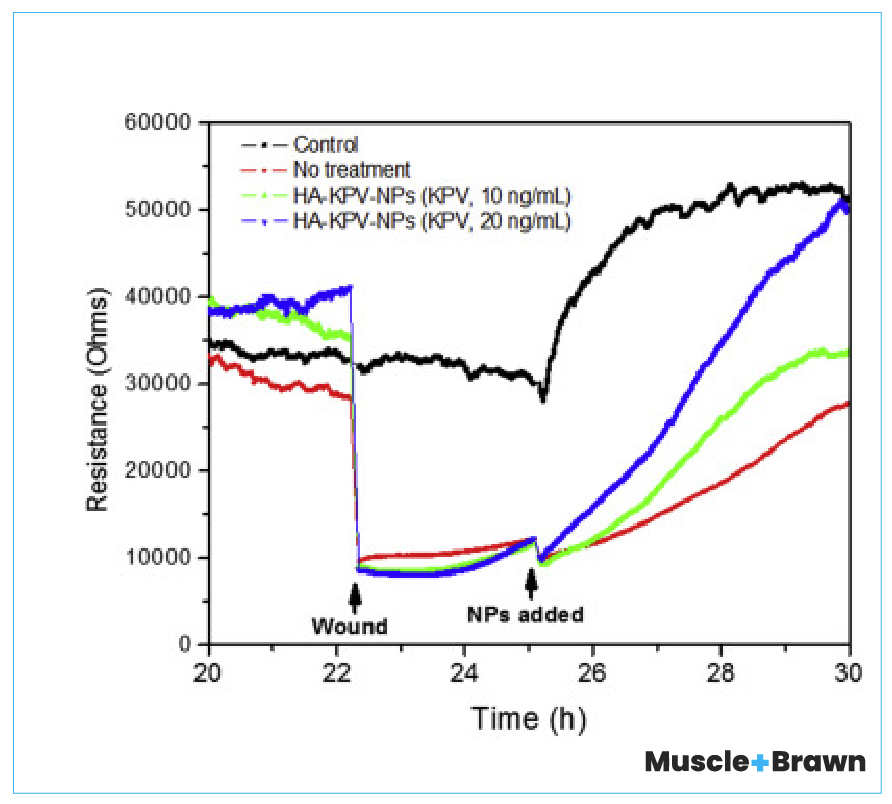
One mouse study of colitis-associated colon cancer also reported fewer tumors in mice given KPV. That is a single animal model of inflammation-driven cancer. It does not show that KPV prevents cancer in people, and there are no human data on this.
These animal results are promising, but KPV has not been tested in people with IBD. It is not a replacement for prescribed IBD treatment.
Skin and Wound Healing
α-MSH is made in the skin and helps regulate inflammation there, so KPV has been explored for skin problems. One rabbit study found faster healing of corneal wounds (4), but no published study has tested KPV on skin wounds or scarring. KPV creams are still sold for inflammatory skin problems such as dermatitis, eczema, psoriasis and acne.
Support for these skin uses is limited to lab and animal research and user reports (see below). No controlled human trial of topical KPV has been published.
Airway Inflammation (Cell Studies)
In human bronchial epithelial cells, KPV reduced inflammatory signalling through the NF-κB mechanism described above (3). That has led researchers to suggest it for inflammatory lung disease. Any benefit for asthma, allergies or other lung conditions is theoretical until it is tested in people.
Is KPV Peptide Legal?
KPV is not an approved medicine in the US. The FDA has not approved it for any use by any route, whether oral, injected or topical.
It is mostly sold online as a research chemical labelled “not for human consumption.” The FDA has also reviewed whether compounding pharmacies may prepare it, and that status can change, so check the current rules where you live.
Tested athletes should be careful. WADA’s S0 category bans pharmacological substances that are not approved for human therapeutic use, which would likely cover KPV.
Who Is Interested in KPV?
KPV mostly draws interest from three groups. For each of them, the research behind it is animal and cell data:
- People with skin irritation, rashes or slow-healing cuts, usually using topical creams
- People interested in gut health or gut inflammation, usually using oral capsules
- Lifters and athletes curious about recovery from minor injuries
Anyone with a diagnosed condition such as ulcerative colitis, Crohn’s disease, psoriasis or rheumatoid arthritis should not swap prescribed treatment for KPV, and should talk to their doctor before adding it. There are no safety data in pregnancy, breastfeeding or children.
Forms of KPV
KPV is sold in three main forms:
| Form | Usually discussed for | Notes |
|---|---|---|
| Oral capsules | Gut inflammation | Relies on PepT1 uptake in the gut |
| Topical cream | Skin irritation, rashes, small wounds | Applied directly to the affected skin |
| Injectable (powder in a vial) | General inflammation, recovery | Mixed with bacteriostatic water and injected under the skin |
No study has compared these forms in people, so claims that one works “instantly” or better than another are not backed by evidence.
How KPV Is Used
Creams are applied to the affected area of skin. Capsules are taken by mouth, and users report taking them with or without food.
Injectable KPV comes as a freeze-dried powder that is mixed with bacteriostatic water and injected subcutaneously, into the fat just under the skin. Our guide on how to inject peptides covers sterile technique and injection sites.
KPV Dosage
There are no human dose-finding studies for KPV, so there is no established dose. The figures below are commonly reported by vendors and users. They are not doses tested in clinical trials, and they are not a recommendation.
Watch the unit: oral KPV is dosed in micrograms (mcg), not milligrams (mg). Capsules are commonly sold at 250 mcg each, and a “250 mg” dose would be 1,000 times higher.
| Form | Commonly reported dose | Commonly reported frequency |
|---|---|---|
| Oral capsules | 250-500 mcg | Once or twice a day |
| Subcutaneous injection | 200-500 mcg | Once a day |
| Topical cream | A thin layer on the affected skin | Strength varies by product |
Our peptide dosage chart shows which peptides have human dosing data. KPV is one of those that does not.
KPV Cycle Length
There is no studied cycle length. Users commonly report taking capsules (250 mcg once or twice a day) or daily injections (200-500 mcg) for several weeks, or until the problem they are targeting settles. Topical creams are usually used until the skin irritation, itching or swelling clears.
Because long-term safety is unknown, open-ended daily use is the least studied way to take it.
KPV Peptide Stacks
KPV is often combined with other research peptides, most commonly BPC-157. Ready-mixed BPC-157 and KPV blends are sold, and some vendors sell a four-peptide blend, often called KLOW, that combines KPV with GHK-Cu, BPC-157 and TB-500.
No study has tested KPV together with other peptides, so the benefits and safety of these stacks are unknown.
KPV User Reviews
User reports on forums describe topical KPV for rashes, eczema and acne, and some mention temporary skin staining. These are anecdotes: they can’t show whether KPV works or how often side effects happen.
KPV Side Effects Explained
Because KPV has not been studied in people, there is no reliable picture of its side effects or long-term safety. What exists comes from animal studies and user reports:
- Topical use: users report temporary staining of the skin, which fades with washing over a few days. Local irritation is possible with any cream.
- Injections: redness, swelling or mild pain at the injection site. These come from the injection itself rather than from KPV, and poor sterile technique adds a risk of infection.
- Product quality: research chemicals are not regulated like medicines, so contamination, an inaccurate dose or the wrong compound in the vial are real risks.
KPV lacks the part of α-MSH that acts on melanocortin receptors, so it is not expected to tan the skin or change appetite the way melanotan peptides can. That has not been confirmed in human safety studies. For a wider view, see our guide to the side effects of peptides.
Where Can I Buy KPV Peptide?
KPV is sold as a research chemical, so quality depends entirely on the supplier. Ask for a recent third-party certificate of analysis (COA) for the exact batch, with identity and purity testing. Our guide on how to read a peptide COA explains what to check.
SwissChems has sold KPV as 250 mcg capsules. Check its current range and the batch COA before buying anything.

Pros
- Exceptional purity & testing (≥98%)
- Pharmaceutical-style packaging for stability
- Broad catalog across peptides & nootropics
- Strong reputation & consistency across years
Cons
- Some items frequently out of stock due to high demand
- Limited long-term data for some compounds
KPV vs. Other Peptides
KPV vs. BPC-157
BPC-157 is a synthetic 15-amino-acid peptide based on a sequence from a protein found in gastric juice. Like KPV, it is studied for healing and gut inflammation, and like KPV, its evidence comes mostly from animal studies.
The two work differently. In animals, BPC-157’s healing effects are linked to new blood vessel growth (angiogenesis) and repair of tendons, ligaments, muscle and the gut lining. KPV’s main effect is anti-inflammatory, through NF-κB, and its research focuses on the gut and skin.
KPV vs. TB-500
TB-500 is a synthetic peptide based on thymosin beta-4, a 43-amino-acid protein the body uses to regulate actin, part of the cell’s internal scaffolding, and to help cells move into damaged tissue. It is mainly studied in animals for muscle, tendon and wound repair.
KPV is much smaller, just three amino acids, and is studied mainly as an anti-inflammatory for the gut and skin. Both are made synthetically for sale, and neither has been tested in controlled human trials for these uses.
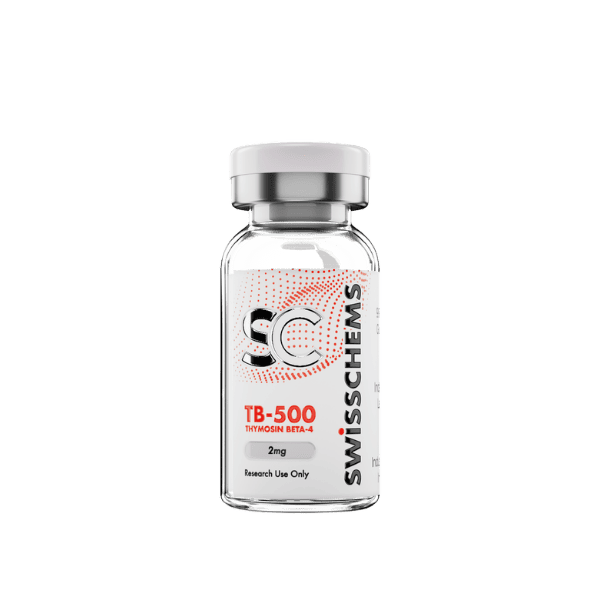
Overview
- Form: Lyophilized powder
- Researched Dosage: 2 mg to 5 mg per week, often split into two doses, during a 4-6 week loading phase; then 2 mg to 2.5 mg every 1-2 weeks for maintenance
- Typical Cycle: 4-8 weeks
- Cost: $23.96-$25.16
- Stacking Options: BPC-157, GHK-Cu, CJC-1295/Ipamorelin
Pros
- Thought to help regulate actin, a protein involved in cell movement and structure, which may help with tissue repair and recovery.
- Animal studies suggest it may speed up healing in muscle, tendon, ligament and skin, and may reduce inflammation.
- Commonly paired with BPC-157 because the two peptides are believed to support recovery in different ways.
Cons
- May encourage new blood vessel growth and cell migration, which raises a theoretical concern about speeding up existing tumors. Long-term human safety data is very limited.
- Not an approved human medication. The FDA lists it as a bulk substance with potential safety risks (Category 2), and WADA bans it for tested athletes.
The Bottom Line
KPV is an interesting anti-inflammatory peptide with solid cell and mouse research behind it, but it has not been tested in controlled human trials.
- In cell and mouse studies, KPV blocks NF-κB inflammatory signalling and reduced chemically induced colitis. Test-tube work also shows activity against Staphylococcus aureus.
- Benefits for skin, wounds and airways rest on animal, cell and anecdotal evidence. There is no evidence that KPV prevents cancer in people.
- Commonly reported doses are in micrograms (about 200-500 mcg a day), not milligrams, and no human dose has been established.
- KPV is not FDA-approved and its long-term safety is unknown. Anyone with a diagnosed condition should keep their prescribed treatment.
Frequently Asked Questions
Disclaimer
Please read carefully
The information on this site is for educational and informational purposes only, and is not medical advice. Always consult a qualified healthcare professional before using any supplement or medication, or making changes to your health, fitness, or nutrition routine.
Not medical advice
Content here is not a substitute for professional medical advice.
Consult your doctor
Talk to your doctor before starting any supplement or new routine.
Use at your own risk
We are not responsible for adverse effects from acting on this.
Do your research
Make informed decisions about your own health.
No guarantees
Individual results vary. No claims about outcomes.
Important — Never disregard professional medical advice or delay seeking it because of something you read here. If you think you may have a medical emergency, call your doctor or your local emergency number right away.