Contents15 sections
Arachidonic acid (ARA) is an omega-6 fatty acid that sits in the membrane of almost every cell in your body, including your muscle fibers. When you train hard, your muscles release it and turn it into prostaglandins, the signaling molecules behind the short burst of inflammation that kicks off repair and growth.
That is the idea behind ARA supplements: more ARA in your muscles means a stronger repair signal after each workout, and over time, more growth. It is a non-hormonal approach, which is why ARA has a place in the Natty Plus Protocol.
The evidence is thinner and more mixed than most marketing suggests, though. This guide covers what ARA is, how it actually works, what the human trials found, the doses used in studies, side effects, and our pick if you decide to try it.
Key Takeaways
- Arachidonic acid is an omega-6 fatty acid your body turns into prostaglandins, the signals that drive the inflammation and repair response after hard training.
- ARA promotes inflammation; it does not reduce it. The goal of supplementing is to amplify the short-term signal from training, not to calm sore joints.
- Two small trials in resistance-trained men gave mixed results: one found better anaerobic power only, the other reported more lean mass, upper-body strength and power.
- The studies used 1,000-1,500 mg of ARA per day for 7-8 weeks. There is no data on longer use.
- ARA is a non-hormonal nutrient that needs no PCT, but “natural” is not the same as risk-free: people with inflammatory conditions should avoid it unless a doctor agrees.
What Is Arachidonic Acid?
Arachidonic acid is a 20-carbon omega-6 polyunsaturated fatty acid. Your body makes it from linoleic acid, the essential omega-6 fat found in seed oils, nuts and seeds, and you also get it directly from meat, poultry, eggs and some fish. It is even added to many infant formulas, because breast milk naturally contains it.
Most of your ARA is stored in the phospholipids that make up cell membranes, with large amounts in muscle, the brain, the liver and immune cells. When a cell is stressed or stimulated, for example by a hard set of squats, enzymes release ARA from the membrane and convert it into a family of signaling molecules called eicosanoids.
A common mix-up is worth clearing up here. Eicosanoids are not the same thing as eicosapentaenoic acid (EPA). EPA is an omega-3 fatty acid from fish oil. Like ARA, it has 20 carbons and can be turned into eicosanoids, but EPA competes with ARA for the same enzymes and produces signals that are generally far less inflammatory. ARA and EPA sit on opposite sides of the inflammation balance.
The eicosanoids made from ARA include prostaglandins, thromboxanes and leukotrienes. Together they drive inflammation, pain, fever, blood clotting and immune responses. A few ARA products, such as lipoxins, help switch inflammation off once the job is done, but the main effect of having more ARA available is to amplify inflammatory signaling, not dampen it. Research on ARA’s roles in the body shows this signaling is part of normal tissue repair, including in skeletal muscle.
That repair role is why bodybuilders became interested in ARA. The inflammation that follows a hard workout is not just damage; it is part of the signal that tells muscle to adapt.
How Does Arachidonic Acid Work?
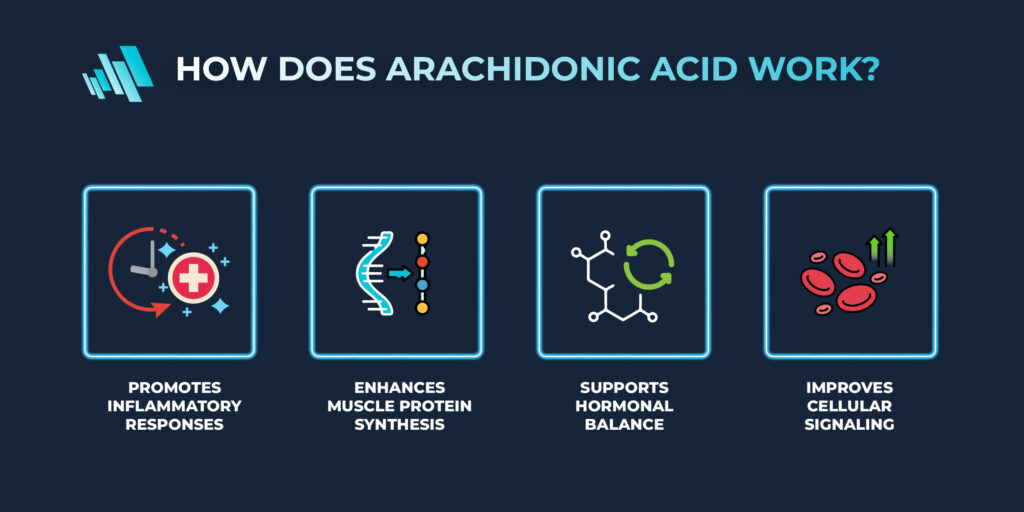
After a demanding session, stressed muscle fibers release ARA and the COX enzymes (COX-1 and COX-2) turn it into prostaglandins such as PGE2 and PGF2α. These prostaglandins help regulate muscle protein synthesis and the activity of satellite cells, the stem cells that repair and add to muscle fibers.
Several lines of research support this role:
- Cell studies: adding ARA to muscle cells in culture made them grow larger, an effect that depended on COX-2.
- Animal studies: in mice, blocking COX-2 slowed muscle regeneration after injury and reduced growth in overloaded muscle.
- Human studies: in young men, over-the-counter doses of ibuprofen or acetaminophen blunted the rise in muscle protein synthesis after a hard eccentric workout, and a later trial in young adults found high daily doses of ibuprofen reduced muscle growth over eight weeks of training.
The picture is not simple, though. In older adults training for 12 weeks, the same painkillers did not reduce muscle gains, and the drug groups actually gained more. The prostaglandin signal seems to matter, but how much depends on age, dose and context.
The supplement theory follows from this: ARA supplements raise the amount of ARA in blood and tissue, so each workout may produce a larger prostaglandin response. Claims that ARA supplements “switch on” mTOR come mainly from cell and animal research; in people, the effect on anabolic signaling is not established. There is also no good human evidence that ARA raises testosterone or other anabolic hormones.
What the Research Shows
Only a handful of controlled trials have tested ARA supplements for training results. The two most cited ones were both done in young, resistance-trained men.
Roberts and Colleagues: 1,000 mg per Day for 50 Days
In this double-blind trial published in the Journal of the International Society of Sports Nutrition, 31 resistance-trained men took either 1,000 mg of ARA per day or a placebo during 50 days of structured weight training, four days a week.
The ARA group improved peak anaerobic power on a Wingate cycle sprint test more than the placebo group. Changes in body composition and in strength on the bench press and leg press were not significantly different between the groups.
De Souza and Colleagues: 1,500 mg per Day for 8 Weeks
A later trial published in PLoS One gave about 30 resistance-trained men 1,500 mg of ARA per day or a placebo for eight weeks of periodized training. The researchers reported greater gains in lean body mass, upper-body strength and peak power with ARA than with placebo. The same paper looked at anabolic signaling in rats rather than in the men themselves.
What the Results Mean
| Trial | Participants | Dose and length | Main findings vs placebo |
|---|---|---|---|
| Roberts et al. | 31 trained men | 1,000 mg/day, 50 days | Better peak anaerobic power; no significant difference in strength or body composition |
| De Souza et al. | About 30 trained men | 1,500 mg/day, 8 weeks | Greater gains in lean mass, upper-body strength and peak power |
Both trials point to a possible benefit for power output, and one points to extra lean mass and strength. But they were small, short and gave different answers on the outcomes most people care about. There are no trials in women, beginners or older adults, and no trial has shown that ARA shortens recovery time between workouts or helps joints.
The fair summary: ARA is a plausible, modest add-on for experienced lifters, not a proven muscle builder.
Our Pick: The Best Arachidonic Acid Supplement
Enhanced Labs Arachidonic Acid – 120 Capsules
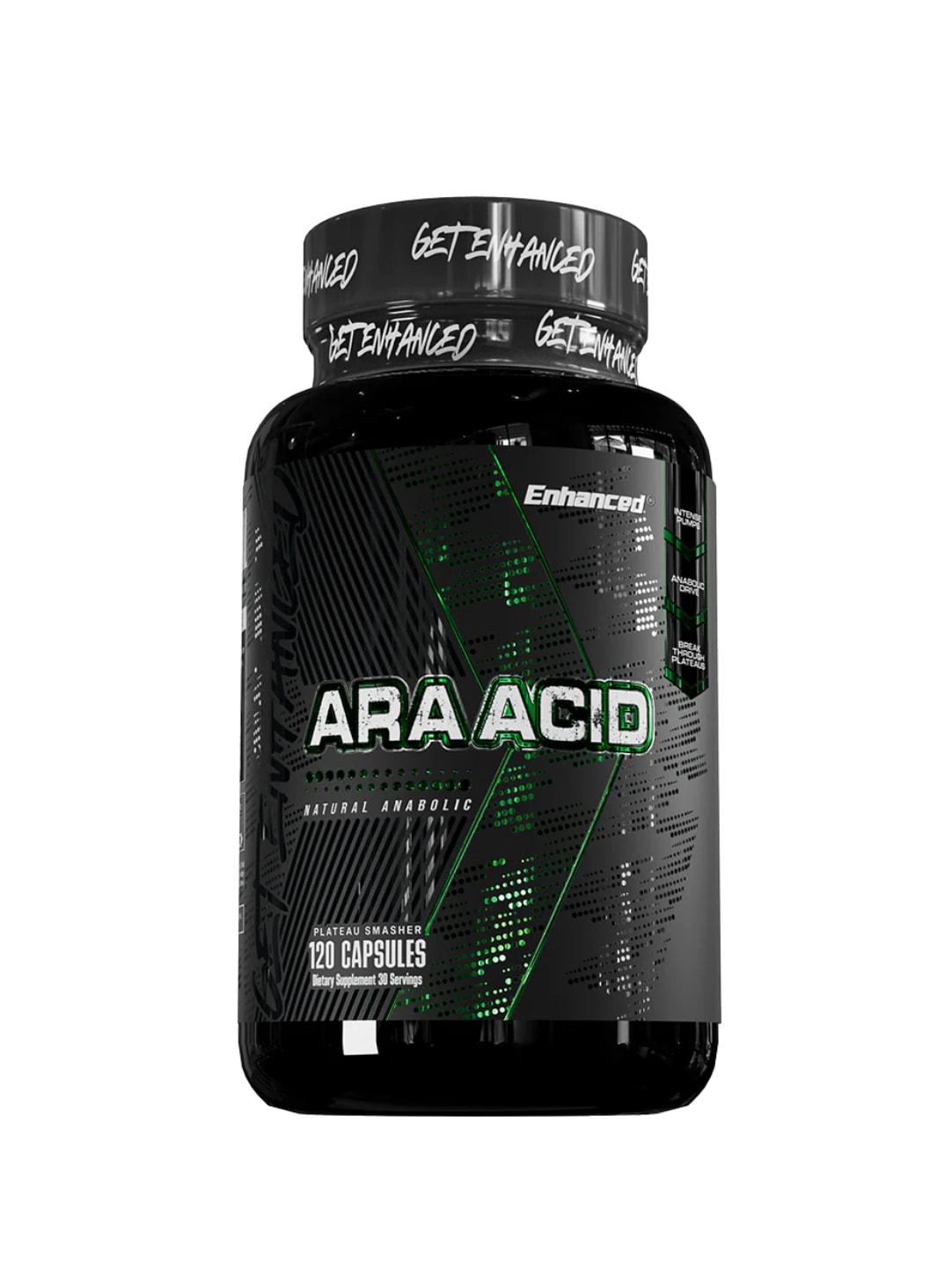
Our pick is the arachidonic acid supplement from Enhanced Labs, a capsule product built for lifters who want to support their training response without hormones. It is a straightforward way to get ARA into the range used in the research, and it fits the Natty Plus approach of non-hormonal support on top of solid training and nutrition.
To be clear about the evidence: there are no published trials of this specific product. The results above come from studies of ARA itself. Check the label for how much ARA each serving provides and compare it with the 1,000-1,500 mg per day used in the trials.
| Product overview | Details |
|---|---|
| Form | 120 capsules |
| Best suited to | Experienced lifters looking for a non-hormonal add-on |
| How to take | As directed on the label, with meals |
| Length of use in studies | 7-8 weeks |
| Possible side effects | Digestive upset; more soreness or joint aches in people prone to inflammation |
| Pairs well with | Creatine monohydrate and enough daily protein |

Pros
- Catalog is specifically organized around muscle building, fat loss, testosterone support, and workout performance.
- Range includes creatine, protein, EAAs, beta-alanine, and L-citrulline alongside more specialized formulas.
- Orders of $99+ qualify for free US shipping.
Cons
- Features several strong claims around muscle growth, testosterone, fat loss, and metabolic effects that should be distinguished from independently demonstrated clinical outcomes
- Heavily oriented toward bodybuilding and performance rather than broader nutritional supplementation.
Potential Benefits of Arachidonic Acid Supplements
Muscle Growth
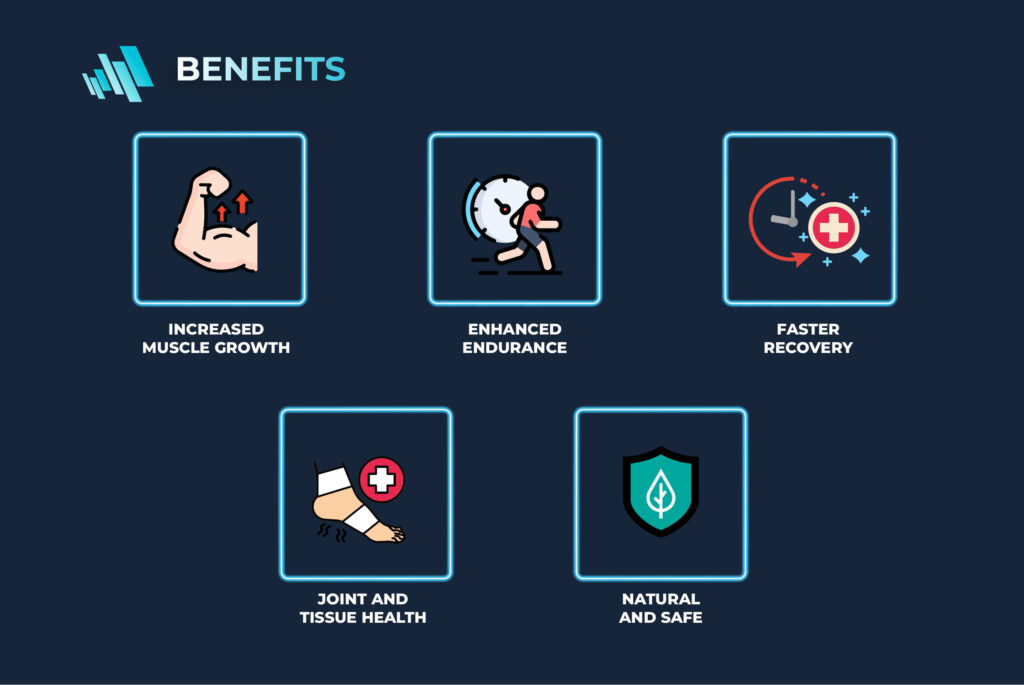
ARA does not help you “overcome” inflammation. It amplifies the inflammatory signal that is part of how muscle adapts to training. One of the two trials reported extra lean mass over eight weeks; the other did not. Any added growth is likely to be modest, and there is no evidence that ARA lowers body fat.
Strength and Power
Power output is the most consistent finding: both trials reported better peak power with ARA than with placebo. Strength results were split, with one trial showing greater upper-body strength gains and the other showing no difference. ARA has not been shown to improve endurance.
Recovery
ARA’s role in muscle repair signaling is real, but that is not the same as faster recovery. No trial has shown that ARA lets you train a muscle again sooner. Because the mechanism is more inflammation after training, more short-term soreness is a plausible trade-off rather than less.
Joint Health: A Common Misconception
ARA is often sold as good for joints, but its main products, prostaglandins and leukotrienes, are among the molecules that drive joint inflammation and pain. That is exactly why anti-inflammatory painkillers, which block the COX enzymes that process ARA, ease arthritis pain. If joint comfort is your goal, omega-3s and the options in our guide to the best joint supplements are a better fit.
Non-Hormonal, but Not Risk-Free
ARA does not act on androgen receptors and does not suppress your natural testosterone, so it needs no PCT. It is a nutrient you already eat every day, which is why it fits the Natty Plus Protocol. Still, “natural” does not mean risk-free: the human safety data cover doses up to about 1,500 mg per day for around eight weeks in healthy young men, and nothing longer.
Doses Used in Studies and Typical Cycle
ARA supplements are not approved to treat any condition, so there is no official dose. The figures below are the amounts found in ordinary diets, the doses used in studies and commonly reported use, not medical advice.
| Source | Daily ARA | Notes |
|---|---|---|
| Ordinary diet | Roughly 100-250 mg (estimates) | Depends mostly on how much meat and eggs you eat |
| Roberts et al. trial | 1,000 mg | 50 days with resistance training |
| De Souza et al. trial | 1,500 mg | 8 weeks with resistance training |
| Commonly reported use | 1,000-1,500 mg, split with meals | About 8 weeks, then a break of 4 weeks or more |
Take ARA with meals to improve absorption and reduce stomach upset. Because it works by building up in cell membranes over weeks, the exact time of day is unlikely to matter much. The on-and-off cycling pattern is common practice, not something research has tested, and there is no data on what happens beyond eight weeks.
ARA will only add to a program that already works. Progressive training, enough protein and calories, and good sleep do far more for muscle growth than any fatty acid; our guide to creatine monohydrate covers the supplement with the strongest evidence.
Who Might Consider Arachidonic Acid Supplements?
- Experienced lifters: the trials were done in resistance-trained men, so this is the group the evidence actually covers. ARA makes most sense when your training and diet are already in order and progress has slowed.
- Natty Plus followers: people who want non-hormonal support without the suppression and risks of SARMs or steroids.
- Not beginners: new lifters gain far more from consistent training, food and sleep, and the trials did not include them.
- Older adults: no trial has tested ARA supplements against age-related muscle loss. Resistance training and enough protein have much better evidence; talk to a doctor before adding ARA.
ARA is a poor choice for anyone with arthritis, asthma, inflammatory bowel disease or another inflammatory condition, for people under 18, and for anyone who is pregnant or breastfeeding, unless a doctor advises otherwise.
Pros and Cons of Arachidonic Acid
| Pros | Cons |
|---|---|
| Non-hormonal, with no testosterone suppression and no PCT | Evidence comes from two small, short trials with mixed results |
| Both trials reported better peak power in trained men | Promotes inflammation by design, so it can aggravate inflammatory conditions |
| One trial reported extra lean mass and upper-body strength | No safety or results data beyond about eight weeks |
| A nutrient already present in a normal diet | Effects are modest compared with training, protein and creatine |
| Well tolerated in short trials in healthy men | Regular use of anti-inflammatory painkillers may blunt the intended effect |
Side Effects of Arachidonic Acid

Short human trials at up to 1,500 mg per day have not reported serious side effects in healthy men. The main things to watch for:
- Digestive issues: stomach discomfort, bloating or indigestion, mostly when capsules are taken on an empty stomach. Taking them with meals usually helps.
- More inflammation: this is how ARA works, so more soreness or joint aches are possible. It can worsen arthritis, asthma and other inflammatory conditions.
- Blood clotting: ARA is the raw material for thromboxane, which helps platelets clump. Short studies in healthy people have not shown meaningful effects on clotting, but anyone on blood thinners should check with a doctor first.
- Allergic reactions: rare, but stop taking it and get medical advice if you notice a rash, itching or breathing problems.
Consult a healthcare professional before starting ARA, especially if you have a health condition, take medication or are unsure about the dose.
Arachidonic Acid vs. Other Supplements
ARA vs. Omega-3 Fatty Acids
Omega-3s (EPA and DHA) and ARA pull in opposite directions. Omega-3s compete with ARA for the same enzymes and produce less inflammatory signals, which is why they are studied for heart health, joint comfort and chronic inflammation. ARA does the opposite: it boosts the inflammatory response that follows training.
Typical Western diets already contain far more omega-6 than omega-3 fat, so most people benefit from eating more omega-3s regardless. Many lifters keep taking fish oil while using ARA. In theory, high doses of EPA could blunt part of ARA’s effect, but no study has tested the combination.
ARA vs. Creatine
Creatine raises the phosphocreatine stored in muscle, which helps regenerate ATP, the energy source for short, intense efforts. It is one of the most researched supplements in sport, with consistent benefits for strength and lean mass. The evidence for ARA is far thinner. They work in different ways and can be taken together, but if you only take one, creatine is the clear first choice.
ARA vs. SARMs
SARMs (selective androgen receptor modulators) bind to androgen receptors and can produce much larger gains in muscle, but they are research compounds that are not approved for human use, and they suppress natural testosterone. ARA is a dietary fatty acid that works through the normal response to training. Its effects are much smaller, and so is the hormonal risk.
Is Arachidonic Acid Supplement Legal?
Yes. Arachidonic acid is sold legally as a dietary supplement in the United States and many other countries, and it is not a controlled substance. It is not on the WADA prohibited list. Tested athletes should still choose third-party tested products, because any supplement can be contaminated, and rules on supplements vary by country.
The Bottom Line
Arachidonic acid is a real part of how muscle responds to training, but the case for supplementing it rests on two small trials with mixed results.
- ARA promotes inflammation by design. It is not an anti-inflammatory or joint supplement, and people with inflammatory conditions should avoid it unless a doctor agrees.
- The trials used 1,000-1,500 mg per day for 7-8 weeks in trained men: both reported better peak power, and one reported extra lean mass and strength.
- As a non-hormonal add-on it fits the Natty Plus Protocol for experienced lifters, but training, protein and creatine should come first.
Frequently Asked Questions
Disclaimer
Please read carefully
The information on this site is for educational and informational purposes only, and is not medical advice. Always consult a qualified healthcare professional before using any supplement or medication, or making changes to your health, fitness, or nutrition routine.
Not medical advice
Content here is not a substitute for professional medical advice.
Consult your doctor
Talk to your doctor before starting any supplement or new routine.
Use at your own risk
We are not responsible for adverse effects from acting on this.
Do your research
Make informed decisions about your own health.
No guarantees
Individual results vary. No claims about outcomes.
Important — Never disregard professional medical advice or delay seeking it because of something you read here. If you think you may have a medical emergency, call your doctor or your local emergency number right away.