
Contents14 sections
Testosterone is the base of most anabolic steroid cycles. It is not the strongest compound milligram for milligram, and it is not the “driest,” but it is the hormone most other compounds are built around, and it is the best-studied anabolic steroid in controlled human trials.
There is a reason most first cycles start with testosterone. Its effects are more predictable than those of harsher compounds, and in trials even moderate weekly doses added measurable muscle. Its side effects are just as predictable: it shuts down natural testosterone and sperm production, raises red blood cell counts, lowers HDL cholesterol and converts to both estrogen and DHT.
This guide covers the testosterone cycles most commonly reported for each goal, how the esters (propionate, enanthate, cypionate and Sustanon) differ, what dose-response studies found, the side effects and bloodwork that matter, and what the research says about post-cycle therapy (PCT). Nothing here is a recommendation to use testosterone without a prescription.
Key Takeaways
- Testosterone is the base of most steroid cycles and the best-studied anabolic steroid. In a 20-week trial, fat-free mass rose with the dose: by 3.4, 5.2 and 7.9 kg at 125, 300 and 600 mg a week.
- Enanthate and cypionate are the usual esters for longer cycles and TRT. Propionate is shorter-acting and used mainly for cutting. Sustanon 250 is a blend of four esters.
- The most commonly reported first cycle is 300-500 mg of enanthate or cypionate a week for 10-12 weeks. These are user-reported figures, not medical doses.
- Harms rise with the dose too: hemoglobin went up and HDL cholesterol went down as the dose increased. Bloodwork and blood pressure checks are how users track this.
- Testosterone shuts down natural testosterone and sperm production. PCT may speed recovery, but a full recovery is not guaranteed, and the odds fall as more compounds are added.
What Are the Best Testosterone Cycles?
The best testosterone cycle depends on the goal. Testosterone is the base of most bodybuilding cycles, and the table below summarizes the testosterone cycles most commonly reported for each goal. These figures come from user reports and coaching literature, not clinical trials, and they are not recommendations.
| Goal | Ester Most Often Used | Commonly Reported Weekly Dose | Commonly Reported Length |
|---|---|---|---|
| First cycle | Enanthate or cypionate | 300-500 mg | 10-12 weeks |
| Cutting or contest prep | Propionate | About 350 mg (100 mg every other day) | 8-10 weeks |
| Off-season mass | Enanthate, cypionate or Sustanon 250 | 400-600 mg, often as the base for a second compound | 12-16 weeks |
| TRT (prescribed, not a cycle) | Cypionate or enanthate; Sustanon in some countries | Set by a doctor from blood levels, often 100-200 mg every 1-2 weeks | Ongoing, with monitoring |
Users prefer propionate for cutting because blood levels rise and fall quickly, which they report makes water retention easier to manage. Enanthate and cypionate need fewer injections and give steadier blood levels, so they are the usual choice for longer cycles.
Types of Testosterone: The Esters Compared
Every injectable form delivers the same hormone. What changes is the ester: a chemical chain attached to the testosterone molecule that slows its release from the oil after injection. A short ester is released and cleared quickly; a long ester releases slowly and lasts longer. The ester also adds weight, so part of every milligram is ester rather than testosterone.
| Ester | Commonly Cited Half-Life | Testosterone Content | Commonly Reported Schedule |
|---|---|---|---|
| Propionate | About 1 day | About 83% | Every other day |
| Enanthate | About 4-5 days | About 72% | Twice a week |
| Cypionate | About 8 days | About 70% | Twice a week |
| Sustanon 250 (four-ester blend) | No single figure: days to weeks | About 70% (about 176 mg per mL) | Every 3-4 days |
| Undecanoate (injection) | Long-acting (weeks) | About 63% | TRT only: every 10-14 weeks after the first doses |
Half-life figures vary between sources. They depend on the oil, the injection volume and the site, and bodybuilding sources often quote longer figures for enanthate (7-10 days) than pharmacology references do. The practical point is the same: the shorter the ester, the more often it has to be injected to keep blood levels steady.
Testosterone Propionate
The shortest of the common esters. Blood levels rise within a day or two and fall quickly, so it is commonly injected every other day. That suits short cutting cycles, and it clears fast if side effects appear. The trade-offs are frequent injections and, as many users report, more pain at the injection site. See our guide to the testosterone propionate cycle.
Testosterone Enanthate
The ester used in the main dose-response trials covered below, and a common choice for a first cycle. Users commonly split the weekly dose into two injections to keep levels steadier. More detail is in our testosterone enanthate cycle guide.
Testosterone Cypionate
Very close to enanthate in practice. Its ester is slightly longer, and clinicians dose the two the same way. It is the most commonly prescribed injectable for TRT in the US. For cycles, the two are interchangeable for most purposes.
Sustanon 250
A blend of four esters in each mL: 30 mg propionate, 60 mg phenylpropionate, 60 mg isocaproate and 100 mg decanoate. The short esters raise levels quickly and the long ones keep them up for weeks. Its prescribing information gives a usual medical dose of one injection every three weeks, but bodybuilders commonly report injecting it every few days to smooth out the peaks and troughs. It is not approved in the US. Our Sustanon 250 guide covers it in depth.
Other Forms
Testosterone undecanoate injections (Aveed in the US, Nebido elsewhere) last around 10 weeks or more per shot and are used for TRT, not cycles; Aveed carries a boxed warning about oil microembolism reactions and anaphylaxis. Gels, patches, pellets and oral undecanoate capsules are also TRT products, designed to deliver replacement doses.
What the Research Shows About Testosterone Doses
Most cycle advice comes from forums. Testosterone is the exception: two controlled trials from Shalender Bhasin’s research group tested the kind of doses used in cycles.
The 1996 Trial: 600 mg a Week for 10 Weeks
In a 1996 trial in the New England Journal of Medicine, 43 healthy men were given 600 mg of testosterone enanthate or placebo every week for 10 weeks, with or without supervised weight training. Men who took testosterone and trained gained an average of 6.1 kg of fat-free mass. Men on testosterone who did not train still gained more muscle size and strength than men on placebo, and testosterone plus training beat either one alone. The researchers reported no change in mood or behavior in any group, but the trial was short and the men were screened and monitored.
The 2001 Dose-Response Study: 25 to 600 mg a Week
The follow-up study is the closest thing to clinical data on testosterone cycle doses. Researchers gave 61 young men a drug that switched off their own testosterone production, then weekly testosterone enanthate at one of five doses for 20 weeks, without a supervised training program.
| Weekly Dose (Enanthate) | Average Blood Testosterone on Treatment | Change in Fat-Free Mass (20 Weeks) |
|---|---|---|
| 25 mg | 253 ng/dL | No significant gain |
| 50 mg | 306 ng/dL | No significant gain |
| 125 mg | 542 ng/dL | +3.4 kg |
| 300 mg | 1,345 ng/dL | +5.2 kg |
| 600 mg | 2,370 ng/dL | +7.9 kg |
Leg press strength, leg power and thigh muscle volume also rose with testosterone levels, and changes in fat mass were inversely related to the dose. Muscle biopsies from the same study showed the gain came from larger muscle fibers, not just water.
The side effects were dose-dependent too. Hemoglobin rose and HDL (“good”) cholesterol fell as the dose went up. A later analysis that added older men (aged 60 to 75) on the same doses found hemoglobin and hematocrit climbed even more steeply in the older group.
What this means for cycles: the commonly reported first-cycle range of 300-500 mg a week sits between the 300 and 600 mg arms of this study. More testosterone did produce more muscle, but each step up also produced more unwanted change, and none of these trials lasted longer than 20 weeks or tested stacks of several drugs.
Commonly Reported Testosterone Cycles
The cycles below describe how testosterone is commonly run, based on user reports. They are not clinical protocols. No trial has tested these exact schedules, and the people running them are usually not under medical supervision.
Testosterone-Only First Cycle (10-12 Weeks)
| Weeks | Compound | Commonly Reported Dose |
|---|---|---|
| 1-12 | Testosterone enanthate or cypionate | 300-500 mg/week, split into two injections |
| After the cycle | PCT (see below) | Started about 2 weeks after the last injection |
This is the most commonly described first cycle. Users typically report the first visible changes after 3-4 weeks, as the long ester builds up, with most of the gain in weight and strength by the end. Part of the early weight gain is water.
Testosterone Propionate Cutting Cycle (8-10 Weeks)
| Weeks | Compound | Commonly Reported Dose |
|---|---|---|
| 1-8 (up to 10) | Testosterone propionate | 100 mg every other day (about 350 mg/week) |
| After the cycle | PCT | Started 2-3 days after the last injection |
Propionate is usually run in shorter cycles while dieting, to help hold on to muscle in a calorie deficit. Because the ester clears quickly, PCT is commonly reported to start within a few days of the last injection.
Sustanon 250 Cycle (12 Weeks)
| Weeks | Compound | Commonly Reported Dose |
|---|---|---|
| 1-12 | Sustanon 250 | 250-500 mg/week, split into two or three injections |
| After the cycle | PCT | Started about 3 weeks after the last injection, because the decanoate ester clears slowly |
TRT Doses Are Not Cycles
Testosterone replacement therapy (TRT) restores normal levels in men with diagnosed low testosterone. Prescribed doses of cypionate or enanthate are usually around 100-200 mg every one to two weeks, adjusted by a doctor to keep blood levels in the normal range. A cycle aims well above normal. Some users “cruise” on TRT-level doses between cycles, which keeps natural production suppressed the whole time and is not a medical treatment.
What Testosterone Actually Is
Testosterone is the main male androgen, the hormone most responsible for muscle mass, bone density, libido, drive and red blood cell production. About 95% of a man’s testosterone is made in the testes by Leydig cells; the rest comes from the adrenal glands. For a full profile, see our testosterone compound page.
It is a steroid hormone (C19H28O2) made from cholesterol. The body makes most of its own cholesterol, so dietary cholesterol rarely limits production, but diet still matters: a 2021 meta-analysis of intervention studies found that low-fat diets were linked to modestly lower testosterone in men.
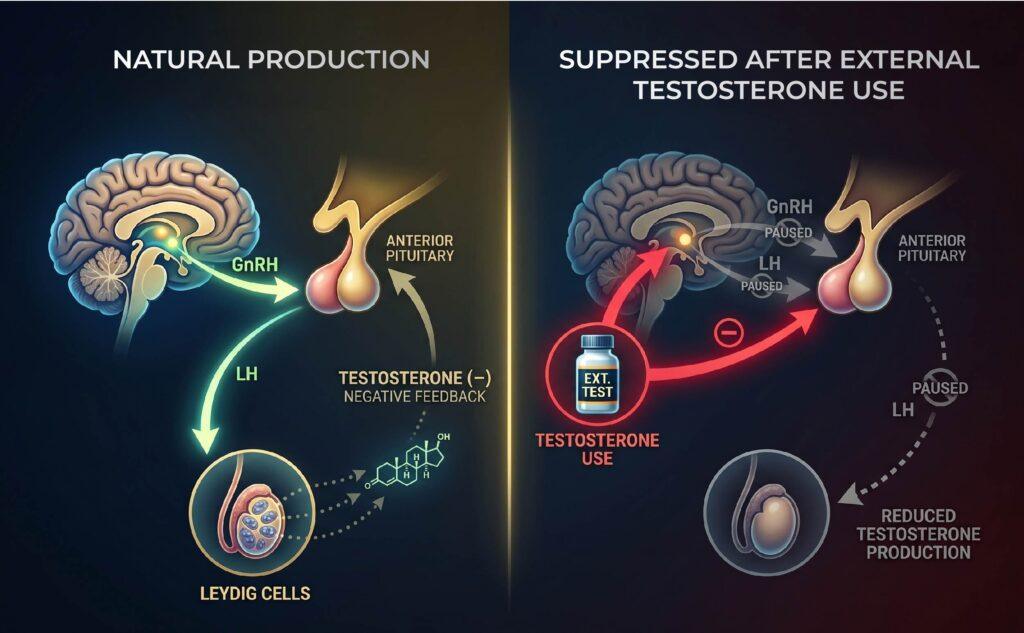
Production is controlled by a feedback loop called the hypothalamic-pituitary-gonadal (HPG) axis, often written HPTA (hypothalamic-pituitary-testicular axis) in bodybuilding circles. Here’s how it works:
- The hypothalamus in the brain releases gonadotropin-releasing hormone (GnRH) in pulses throughout the day.
- GnRH tells the pituitary gland to release two hormones: luteinizing hormone (LH) and follicle-stimulating hormone (FSH).
- LH travels to the testes and signals the Leydig cells to produce testosterone.
- FSH, together with testosterone made inside the testes, supports sperm production by the Sertoli cells.
- As testosterone (and the estradiol made from it) rises, the hypothalamus and pituitary cut back GnRH and LH output. This is a classic negative feedback loop.
This loop is why chronic stress, poor sleep, severe under-eating and heavy drinking can all lower testosterone: the testes depend on signals from the brain.
It is also why testosterone from injections or gels shuts down natural production. The brain senses high levels and stops sending LH and FSH, so the testes make less testosterone and less sperm, and they shrink over time.
What Testosterone Converts Into
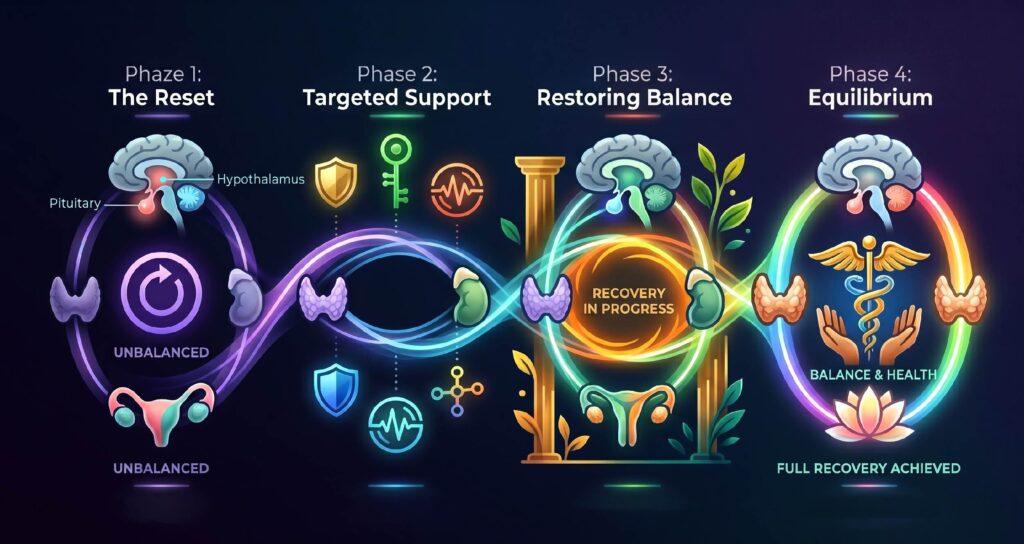
Testosterone also works through two hormones it is converted into. Both get blamed for side effects, and both do essential work.
Dihydrotestosterone (DHT)
A small share of testosterone, commonly cited as about 5-10%, is converted to dihydrotestosterone (DHT) by the enzyme 5-alpha reductase. DHT binds the androgen receptor more strongly than testosterone and is several times more potent. It drives many visible “male” traits and a few less welcome ones:
- Facial and body hair growth
- Deepening of the voice (during puberty)
- Male pattern hair loss (in genetically susceptible men)
- Sebum and oil production in the skin
- Prostate growth
DHT is not a villain. It is essential for normal male development. Blocking it with drugs such as finasteride can protect the hairline, but a minority of men report lower libido or erectile problems, and some report symptoms that persist after stopping (sometimes called post-finasteride syndrome), though how common this is remains debated. Anyone considering a DHT blocker should discuss it with a doctor who knows hormones.
Estradiol (Estrogen)
Testosterone is also converted to estradiol by the enzyme aromatase, which is active in fat tissue among other sites. The old bodybuilding idea that estrogen should be crushed is wrong.
The clearest evidence comes from a 2013 New England Journal of Medicine study by Finkelstein and colleagues. Men had their own hormone production switched off and were given different doses of testosterone gel, with or without anastrozole to block estrogen production. Low androgens mainly explained losses of lean mass, muscle size and strength, while low estrogen mainly explained gains in body fat. Both hormones played a part in sexual desire.
In men, healthy estradiol levels support:
- Libido and sexual function
- Bone density
- Control of body fat
The problems happen at both extremes. On a cycle, high estradiol is commonly linked to water retention and can cause gynecomastia. Too little, usually from overusing aromatase inhibitors such as anastrozole, harms bone over time and is commonly linked to low libido, joint aches and low mood, though direct evidence for the last two in men is limited. Bloodwork, not guesswork, is the way to tell which problem is which.
What Are the Side Effects of Testosterone?
Side effects depend heavily on dose, genetics, lifestyle, ancillary drugs, and how long and how often testosterone is used. Like all anabolic-androgenic steroids, it suppresses natural hormone production. Common side effects include:
- Testicular shrinkage and reduced sperm production
- Acne and oily skin
- Higher hemoglobin and hematocrit (thicker blood)
- Lower HDL (“good”) cholesterol, with LDL (“bad”) cholesterol often rising, especially when oral steroids are added
- Higher blood pressure
- Water retention, bloating and gynecomastia from conversion to estradiol
- Faster hair thinning or male pattern baldness in men prone to it, through DHT
- Mood changes, from irritability to, in a minority, hypomania
Blood and Heart
Hematocrit rises with dose, as the dose-response studies showed. Doctors prescribing TRT check it regularly, and Endocrine Society guidelines advise stopping testosterone if hematocrit goes above 54% until it comes back down.
Blood pressure can rise as well. The FDA label for Xyosted, a weekly testosterone enanthate injection given under the skin, carries a boxed warning that it can raise blood pressure and with it the risk of major cardiovascular events.
At replacement doses, the TRAVERSE trial, published in 2023, found no increase in major heart events with testosterone gel versus placebo in more than 5,000 middle-aged and older men with low testosterone, although atrial fibrillation, pulmonary embolism and acute kidney injury were more common. Cycle doses are a different matter. In a 2017 Circulation study by Baggish and colleagues, long-term steroid users had an average left ventricular ejection fraction (a measure of the heart’s pumping function) of 52%, compared with 63% in non-users, and more coronary artery plaque, which rose with lifetime steroid dose.
Fertility
Testosterone has been tested as a male contraceptive, which shows how strongly it shuts down sperm production. In a World Health Organization trial, weekly injections of 200 mg of testosterone enanthate stopped sperm production completely in more than half of the men within six months. Counts recovered after the injections stopped, but recovery can take months, and after long or repeated cycles it is not guaranteed.
Mood
Responses vary a lot from person to person. Of 50 men who reached 600 mg a week of testosterone cypionate in a randomized trial by Pope and colleagues, 84% showed minimal psychiatric change, 12% became mildly hypomanic and 4% became markedly hypomanic.
Bloodwork
Regular bloodwork is standard practice among experienced users. Markers commonly tracked before, during and after a cycle include:
- Complete blood count: hemoglobin and hematocrit
- Lipids: HDL, LDL (or ApoB) and triglycerides
- Hormones: total testosterone, estradiol, LH and FSH
- Liver and kidney: ALT, AST and kidney function
- Fasting glucose
- Blood pressure: measured regularly, including at home
Bloodwork can flag problems early. It cannot show changes in heart structure, and it does not make a cycle safe.
Designing a Testosterone Cycle
Planning a testosterone cycle involves more than choosing a weekly dose. After the ester (see the comparison above), the two big decisions are whether anything else is added and which health checks are built in.
Running Testosterone Solo vs Stacking Compounds
Beginners commonly start with testosterone alone to learn how they respond to estrogen conversion, androgenic effects and suppression. More experienced users may add compounds such as nandrolone phenylpropionate (NPP), boldenone (Equipoise), Primobolan or Masteron, depending on whether the goal is mass, recomposition or contest prep.
Each added compound brings its own side effects and makes the cycle harder to manage. In the 2023 recovery data covered below, men who had used more compounds were also less likely to recover fully.
Health Monitoring
The plan should include the checks, not just the doses: bloodwork before starting, around mid-cycle and after PCT, plus regular blood pressure readings. Users who see hematocrit, blood pressure or lipids moving the wrong way commonly lower the dose or stop.
PCT for Testosterone
Outside testosterone tells the brain to stop sending LH and FSH, so natural testosterone and sperm production fall. When a cycle ends, those signals can stay low for weeks to months, leaving a stretch of low testosterone.
Post-cycle therapy (PCT) is the practice of taking drugs that help restart those signals. None of them is approved for this use. The main options are:
- SERMs (selective estrogen receptor modulators) such as clomiphene (Clomid) or tamoxifen (Nolvadex). They block estrogen’s feedback at the brain, so it releases more LH and FSH.
- HCG (human chorionic gonadotropin), which acts like LH directly on the testes. It is commonly used during a cycle or in the last weeks before starting SERMs, rather than as PCT on its own.
- HMG (human menopausal gonadotropin), which supplies FSH activity and is used in fertility treatment to restore sperm production, under a doctor’s care.
Commonly Reported PCT Protocols
| PCT Drug | Commonly Reported Protocol | Duration |
|---|---|---|
| Tamoxifen (Nolvadex) | 40 mg/day in weeks 1-2, 20 mg/day in weeks 3-4 | 4 weeks |
| Clomiphene (Clomid) | 50 mg/day in weeks 1-2, 25 mg/day in weeks 3-4 | 4 weeks |
Start times are commonly reported as about 2 weeks after the last enanthate or cypionate injection, about 3 weeks after Sustanon and 2-3 days after propionate, so that the injected testosterone has mostly cleared.
 SERMs & AIs
Overview
- Form: Oral capsules (25 mg each, 60 capsules)
- Researched Dosage: 25 mg to 50 mg daily for PCT
- Typical Cycle: 4-6 weeks
- Cost: $69.95
- Stacking Options: Tamoxifen, HCG, Enclomiphene
Pros
- A SERM that blocks estrogen at the hypothalamus, prompting the body to make more LH, FSH and its own testosterone.
- Studies in men with low testosterone found it raised testosterone while preserving sperm production, unlike TRT.
- It is oral, inexpensive and has been in medical use since 1967, so its effects are well documented.
Cons
- About a third of each dose is zuclomiphene, a long-lasting isomer linked to mood swings, irritability and low mood.
- Blurred vision, floaters and light sensitivity have been reported; visual symptoms are a reason to stop.
- It is FDA-approved only for female infertility, so use in men is off-label, and this product is sold for research use only.
 SERMs & AIs
Overview
- Form: Oral Capsules
- Dosage: 25-40 mg daily for PCT or for gyno flare-ups
- Typical Cycle: 4-6 weeks
- Cost: $81.95
- Stacking Options: Higher testosterone doses or post-cycle recovery
Pros
- Large mortality benefit in ER-positive breast cancer; five years of adjuvant treatment cuts recurrence roughly by half and breast cancer mortality by about a third, with the effect persisting well past the treatment period
- Works in premenopausal and postmenopausal women alike, unlike aromatase inhibitors, which makes it the default for younger patients
- Bone-protective in postmenopausal women, since it acts as a partial estrogen agonist in bone — the reverse of anastrozole's main liability
Cons
- Endometrial hyperplasia and a two-to-three-fold increase in endometrial cancer risk in postmenopausal women, requiring investigation of any abnormal bleeding
- Elevated risk of venous thromboembolism and pulmonary embolism, particularly around surgery or immobility
- Hot flashes, vasomotor symptoms and mood effects are common; CYP2D6 status and strong inhibitors such as certain SSRIs can reduce conversion to the active metabolite
What the Evidence Says
The best recent data comes from a 2023 study of 641 men seen at a UK clinic after stopping anabolic steroids. Only 48% had fully recovered their reproductive hormones. PCT was linked to faster short-term recovery, but men who had used more compounds were less likely to recover, and the authors did not endorse PCT, calling instead for proper research.
Recovery can be incomplete years later. In a 2016 Danish case-control study, former users who had stopped about 2.5 years earlier still had lower testosterone than men who had never used, and 27% were below the reference range. Our full guide to PCT for testosterone covers recovery in more depth.
Is Testosterone Legal?
United States: Testosterone is a Schedule III controlled substance. It is legal only with a valid prescription, and possessing it without one is a crime.
United Kingdom: Anabolic steroids, including testosterone, are Class C drugs. Possession for personal use is not an offense, but supply, and importing by post or courier, are illegal.
Sport: Testosterone is on the WADA Prohibited List at all times, in and out of competition.
The Bottom Line
Testosterone is the base of most steroid cycles and the best-studied anabolic steroid, but the same trials that show its dose-dependent muscle gains also show dose-dependent harms.
- In controlled trials, fat-free mass rose with the dose, up to 7.9 kg at 600 mg a week over 20 weeks, while hemoglobin rose and HDL cholesterol fell.
- Enanthate and cypionate suit longer cycles and TRT, propionate suits shorter cutting cycles, and Sustanon blends both. The ester changes the timing, not the hormone.
- Every cycle suppresses natural testosterone and sperm production. Recovery after stopping is often slow, sometimes incomplete, and less likely after stacks, so bloodwork before, during and after matters as much as the cycle itself.
Frequently Asked Questions
Disclaimer
Please read carefully
The information on this site is for educational and informational purposes only, and is not medical advice. Always consult a qualified healthcare professional before using any supplement or medication, or making changes to your health, fitness, or nutrition routine.
Not medical advice
Content here is not a substitute for professional medical advice.
Consult your doctor
Talk to your doctor before starting any supplement or new routine.
Use at your own risk
We are not responsible for adverse effects from acting on this.
Do your research
Make informed decisions about your own health.
No guarantees
Individual results vary. No claims about outcomes.
Important — Never disregard professional medical advice or delay seeking it because of something you read here. If you think you may have a medical emergency, call your doctor or your local emergency number right away.