Contents14 sections
GHK-Cu copper peptide is a small, naturally occurring peptide that binds copper and helps the body repair skin and other tissue. Your blood carries it, but levels fall as you age. That’s why GHK-Cu has become one of the most popular ingredients in anti-aging skincare and, more recently, an injectable peptide for people interested in recovery and longevity.
The lab research on GHK-Cu is extensive and genuinely interesting. The human research is much thinner. This guide covers what GHK-Cu is, how it works, what the evidence actually shows for skin, hair, healing and longevity, the doses people commonly report, and the risks, especially for injectable use.
Key Takeaways
- GHK-Cu is a three-amino-acid peptide (glycine, histidine, lysine) bound to copper. It was discovered in human plasma in 1973, and levels decline with age.
- In lab and animal studies, GHK-Cu increases collagen, elastin and glycosaminoglycans, speeds wound healing and shifts the activity of thousands of genes toward tissue repair.
- Human evidence comes mostly from small studies of topical skin creams. A 2026 systematic review called the clinical literature “thin and fragmented.”
- Injectable GHK-Cu has no published human trials. The FDA has flagged a possible risk of immune reactions from injectable GHK-Cu and says human safety data are limited.
- Doses for injection are commonly reported at 1 to 2 mg a day, but these come from community practice, not studies.
What Is GHK-Cu?
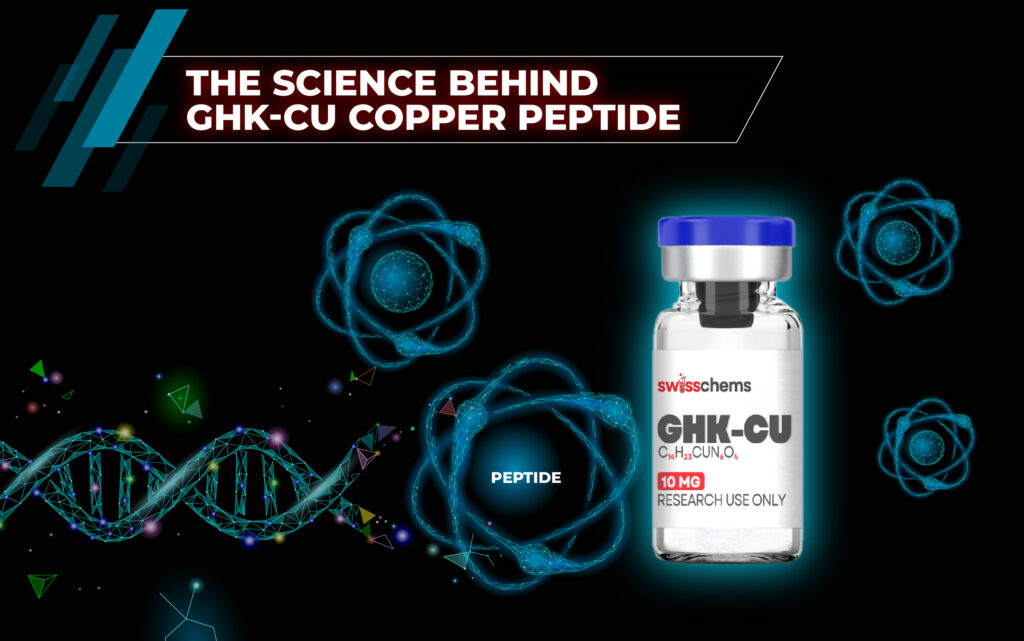
GHK-Cu (glycyl-L-histidyl-L-lysine copper) is a tripeptide, meaning it’s made of three amino acids, bound to a copper ion. Biochemist Loren Pickart first identified GHK in human plasma in 1973 while studying why blood from young people made old liver cells behave more like young ones.
GHK is found in plasma, saliva and urine. It grabs copper easily and carries it into cells, where copper is needed by enzymes that build collagen and fight oxidative damage. Levels of GHK fall with age, which is one reason it became a target for anti-aging research.
You’ll find GHK-Cu in three forms:
- Topical serums and creams, sold as cosmetics. This is the most common and best-studied form.
- Injectable vials of powder, sold online for research use only and injected under the skin.
- Oral capsules, which are rare and have little support, since peptides are mostly broken down during digestion.
Our GHK-Cu compound profile has the quick reference facts.
How GHK-Cu Works
It Builds and Remodels Connective Tissue
In wound studies in rats, GHK-Cu increased collagen, glycosaminoglycans and decorin, the building blocks of skin and connective tissue. It also adjusted the enzymes that break down old tissue (matrix metalloproteinases) and their inhibitors. That two-way effect matters: healing needs damaged tissue cleared away as well as new tissue built.
It Supports Skin Cells
In cultured human skin cells, GHK-Cu increased the growth of keratinocytes, the main cells of the outer skin, and raised markers linked to their ability to keep dividing. Earlier work showed it also stimulates fibroblasts, the cells that make collagen.
It Changes Gene Activity
The most cited claim about GHK-Cu is that it affects thousands of human genes. This comes from the Broad Institute’s Connectivity Map, a database of how compounds change gene activity in cultured cells. Reviews by Pickart’s group report that GHK can raise or lower the activity of at least 4,000 human genes, generally in the direction of repair.
One independent study backs part of this. Lung researchers found a gene pattern linked to emphysema that GHK reversed in the Connectivity Map, and GHK restored normal collagen remodeling in lung cells taken from people with COPD.
Two caveats: these are cell studies, not effects measured in people, and much of the GHK review literature comes from Pickart and colleagues, who also develop copper peptide skincare products.
Benefits of GHK-Cu: What the Evidence Shows

| Benefit | Strength of Evidence | What It’s Based On |
|---|---|---|
| Skin firmness and wrinkles | Moderate | Small human studies of topical creams, plus lab studies |
| Wound healing | Moderate in animals, limited in humans | Animal wound models and early human reports |
| Hair growth | Weak | Lab and ex vivo hair follicle studies |
| Anti-inflammatory and antioxidant effects | Weak in humans | Cell and animal studies |
| Longevity | Speculative | Gene-expression data from cultured cells |
Skin Firmness and Wrinkles
This is where GHK-Cu has the most human data. A review of GHK and tissue remodeling describes controlled studies on aged skin in which topical GHK-Cu tightened skin, improved elasticity and firmness, and reduced fine lines, wrinkles, sun damage and dark spots. Most of these were small cosmetic studies, and several were presented at conferences rather than published in full.
Not every trial has been positive. In a randomized study of 13 patients after CO2 laser resurfacing, a skincare routine with GHK-Cu did no better than one without it for redness or wrinkles.
A 2026 systematic review summed up the state of the evidence: four decades of preclinical work, but human trials that are “thin and fragmented,” mostly small studies of facial creams.
Wound Healing and Tissue Repair
GHK-Cu speeds healing in many animal models, including skin wounds, stomach and intestinal ulcers and bone. The tissue-remodeling review also reports human use in wound care and better results in hair transplants. Large, modern human trials are missing.
Hair Growth
GHK-Cu shows up in many hair serums, but the direct evidence is limited. A Seoul National University study found that a closely related copper peptide (AHK-Cu) lengthened human hair follicles grown in the lab and helped dermal papilla cells survive. That’s a promising mechanism, not proof that a serum or injection regrows hair. The original version of this article said GHK-Cu blocks DHT. We couldn’t find published evidence for that, so we’ve removed it. If you’re losing hair on a cycle, see our guide to SARMs and hair loss.
Anti-Inflammatory and Antioxidant Effects
In cell and animal studies, GHK-Cu lowers inflammatory signals and supports antioxidant enzymes that need copper to work. A 2018 review by Pickart and Margolina covers these effects in detail. They haven’t been confirmed in human trials.
Longevity
The longevity case for GHK-Cu rests on two facts: GHK levels fall with age, and in cell studies, GHK shifts gene activity toward repair. That’s a reasonable hypothesis, not a demonstrated effect. No study has shown that GHK-Cu slows aging or extends life in people.
Topical vs Injectable GHK-Cu

| Topical (Serums and Creams) | Injectable (Research Vials) | |
|---|---|---|
| Legal status (US) | Sold as a cosmetic | Not approved; sold for research use only |
| Human studies | Small cosmetic studies | None published |
| Main use | Skin and scalp | Whole-body recovery and longevity (claimed) |
| Main risks | Skin irritation | Injection reactions, possible immune response, contamination |
| Cost | Low to moderate | Moderate |
Topical GHK-Cu has trouble passing through the outer layer of skin, which is why some products pair it with microneedling. Injectable GHK-Cu reaches the bloodstream, which is why users choose it, but that also means any impurity or immune reaction affects the whole body.
GHK-Cu Dosage: What Users Commonly Report
There are no clinical studies of injectable GHK-Cu dosing. The figures below are commonly reported in the peptide community and are not recommendations.
| Use | Commonly Reported Dose | Commonly Reported Cycle |
|---|---|---|
| Skin and general anti-aging | 1 to 2 mg a day, injected under the skin | 4 to 8 weeks, then a break of similar length |
| Recovery and tissue repair | 1 to 2 mg a day, sometimes up to 3 mg | 4 to 6 weeks |
| Topical skin or scalp use | Applied once or twice a day as directed on the product | Ongoing |
A word on copper: copper makes up about 16% of GHK-Cu’s weight, so a 2 mg dose carries roughly 0.3 mg of copper. For comparison, the US recommended daily intake for adults is 0.9 mg and the upper limit is 10 mg. A typical dose is unlikely to cause copper overload on its own, but people with Wilson’s disease or other copper disorders should avoid GHK-Cu.
Injectable GHK-Cu comes as a powder you mix with bacteriostatic water. Our peptide reconstitution calculator works out the volume per dose, and our guides to how to inject peptides and peptide injection sites cover the technique.
GHK-Cu Stacks

Users commonly stack GHK-Cu with other repair peptides. No study has tested these combinations, so the reasoning is based on each peptide’s separate research.
- GHK-Cu + BPC-157: BPC-157 is studied mainly for tendon, ligament and gut healing in animals. Users pair it with GHK-Cu to cover both connective tissue and skin.
- GHK-Cu + TB-500: TB-500 is a fragment of thymosin beta-4, studied for cell migration and wound repair. It’s a popular addition for injury recovery.
- “GLOW” blends: Some sellers combine GHK-Cu, BPC-157 and TB-500 in one vial. These blends are convenient but make it impossible to adjust each peptide separately.
For more combinations by goal, see our guide to the best peptide stack.
GHK-Cu Side Effects and Risks

Topical GHK-Cu is generally well tolerated. Injectable GHK-Cu has no published safety data in humans, so the risks below come from user reports, the FDA’s review and basic pharmacology.
- Injection site reactions: Redness, swelling, itching or a stinging feeling are the most commonly reported effects. Users often describe GHK-Cu injections as more painful than other peptides.
- Possible immune reactions: The FDA notes that compounded injectable GHK-Cu “may pose risk for immunogenicity due to the potential for aggregation,” meaning clumped peptide could trigger the immune system. It also states that there are limited human data on safety.
- Fatigue or lightheadedness: Reported by some users in the first days of use. The cause isn’t known.
- Skin irritation (topical): Mild redness or tingling, especially when combined with strong acids or retinoids.
- Copper overload: Unlikely at commonly reported doses, as explained above, but a real concern for people with copper metabolism disorders or those also taking copper supplements.
- Quality and contamination: Research-use peptides aren’t made under pharmaceutical standards, so the dose and purity depend entirely on the seller.
People who are pregnant or breastfeeding, have a history of cancer, or have Wilson’s disease should not use injectable GHK-Cu. Anyone else should talk to a doctor first.
Is GHK-Cu Legal?
Topical GHK-Cu is legal and widely sold in the US as a cosmetic ingredient. Injectable GHK-Cu is not an approved drug. It’s sold online labeled “for research use only,” which means it isn’t intended for human use.
The FDA reviewed injectable GHK-Cu after it was nominated for use by compounding pharmacies. As of April 2026, those nominations were withdrawn, and the FDA lists GHK-Cu with the safety concerns noted above. That doesn’t make it an approved drug, and compounding pharmacies still can’t freely use it. Rules differ by country, so check where you live.
Where to Buy GHK-Cu
Topical GHK-Cu serums are sold by many skincare brands and are the low-risk way to try it. For readers who buy research peptides anyway, we link to SwissChems, which sells GHK-Cu in 10 mg and 50 mg vials and kits and lists HPLC lab reports on its product page. These reports are supplied by SwissChems, and we haven’t tested its products ourselves. SwissChems sells GHK-Cu for research use only. Match the batch number on your vial to the report before you use anything.

Pros
- Exceptional purity & testing (≥98%)
- Pharmaceutical-style packaging for stability
- Broad catalog across peptides & nootropics
- Strong reputation & consistency across years
Cons
- Some items frequently out of stock due to high demand
- Limited long-term data for some compounds
For how we compare sellers, see our guide to the best peptide vendors.
Who Might Consider GHK-Cu?
- People focused on skin aging: Topical GHK-Cu has the best evidence for firmness, fine lines and sun damage, and it carries little risk.
- People with thinning hair: GHK-Cu scalp serums are a reasonable low-risk add-on, but don’t expect them to replace proven treatments.
- Lifters interested in recovery: Injectable GHK-Cu is popular for joint and tissue repair, but this use has no human trials behind it. Weigh that against the unknowns.
The Bottom Line
GHK-Cu copper peptide is a natural repair signal that declines with age.
- In the lab, it builds collagen, speeds wound healing and pushes thousands of genes toward repair. In people, the evidence is strongest for topical use on aging skin, and even there the studies are small.
- Claims about hair regrowth, whole-body healing and longevity are still based on cell and animal research, and injectable GHK-Cu has no published human trials.
Frequently Asked Questions
Disclaimer
Please read carefully
The information on this site is for educational and informational purposes only, and is not medical advice. Always consult a qualified healthcare professional before using any supplement or medication, or making changes to your health, fitness, or nutrition routine.
Not medical advice
Content here is not a substitute for professional medical advice.
Consult your doctor
Talk to your doctor before starting any supplement or new routine.
Use at your own risk
We are not responsible for adverse effects from acting on this.
Do your research
Make informed decisions about your own health.
No guarantees
Individual results vary. No claims about outcomes.
Important — Never disregard professional medical advice or delay seeking it because of something you read here. If you think you may have a medical emergency, call your doctor or your local emergency number right away.