Contents12 sections
If you tried to place an order with Peptide Sciences and found nothing but a short notice on the homepage, you are not imagining things.
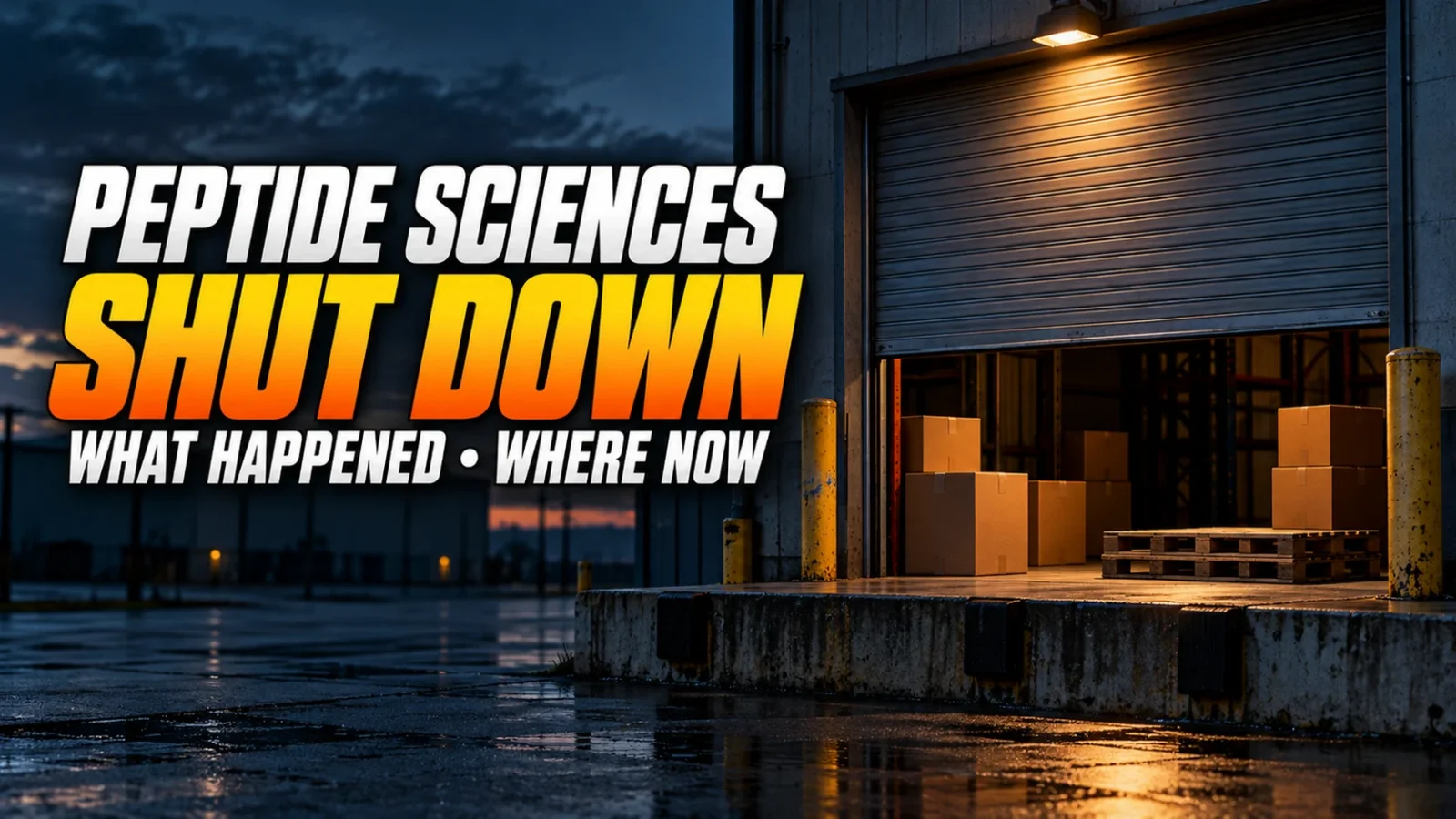
Peptide Sciences, one of the best-known research peptide suppliers in the United States, has shut down. The storefront is gone, customer support has stopped responding, and the only public statement is a brief homepage notice, in place by early March 2026, calling the closure voluntary.
For researchers, athletes and longevity-focused buyers who sourced from Peptide Sciences for years, that raises two questions: what happened, and where do you go now? This article covers what is known about the shutdown, the regulatory pressure on vendors like Peptide Sciences and what has changed since, the quality concerns that surfaced before it closed, and what to look for in a replacement supplier.
Key Takeaways
- Peptide Sciences has shut down and no longer takes orders. Its only statement, a short homepage notice in place by early March 2026, called the closure voluntary and gave no reason.
- The closure followed years of pressure on research peptide vendors: FDA restrictions on popular peptides, warning letters, a federal raid on another vendor, and legal action by Eli Lilly and Novo Nordisk against sellers of copies of their GLP-1 drugs.
- Independent testing of Peptide Sciences products was uneven: ipamorelin, PT-141 and BPC-157 scored well, while CJC-1295, tesamorelin and retatrutide received failing grades.
- The rules are shifting: in 2026 the FDA moved to take 12 peptides off its Category 2 list, and its advisers backed six peptides for compounding. Those steps are not approvals, and the advisory votes are not final.
- Whichever vendor replaces it, ask for a lot-matched certificate of analysis from an independent lab before you buy, and avoid relying on a single supplier.
What Was Peptide Sciences?
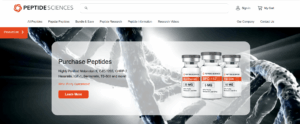
For many buyers, Peptide Sciences was the first name that came up when looking for research peptides in the United States.
The company built its reputation on a broad catalog that covered most of the compounds circulating in the research community: growth hormone secretagogues, tissue repair peptides, fat-loss compounds and, later, GLP-1 analogues such as semaglutide and retatrutide.
Compared with smaller vendors, the site looked polished and professional. Orders generally shipped on time, packaging was consistent, and customer service usually responded when issues came up. In a market where quality varies widely, that made Peptide Sciences something of a default option and one of the safer-looking starting points.
Like other companies in this space, it labeled its products strictly as research chemicals, not intended for human consumption.
When Peptide Sciences Shut Down: The Only Public Statement
The message left on the Peptide Sciences homepage was extremely brief. It read:
“After careful consideration, Peptide Sciences has made the decision to voluntarily shut down operations and discontinue the sale of our research products. We are deeply grateful for your trust and support.”
That was the entire announcement. The company did not publish an exact closing date, and the notice gave no reason, no timeline and no guidance for customers with open orders or store credit. Support channels stopped responding around the same time, leaving many customers unsure whether pending orders would ever be filled.
The word voluntary has drawn attention. In this market, “voluntary” exits have often come when a company expected enforcement and chose to leave before regulators acted. There is no public evidence either way for Peptide Sciences, and the company has not explained its decision.
Why Did Peptide Sciences Shut Down? The Regulatory Context
To understand why Peptide Sciences may have closed, you have to look at the wider regulatory environment. Research peptide vendors had been under growing pressure for several years.
In 2023, the FDA placed BPC-157, TB-500 and a long list of other popular peptides in Category 2 of its list of bulk substances for compounding, the category for substances it says may present significant safety risks. In practice, that kept licensed compounding pharmacies from preparing them. The agency cited concerns about immunogenicity, peptide-related impurities and the lack of safety data from formal clinical trials.
The GLP-1 market tightened at the same time. The FDA declared the tirzepatide shortage over in October 2024 (and confirmed that decision in December 2024), then declared the semaglutide shortage over in February 2025. That ended the temporary allowance that had let pharmacies compound copies of both drugs. Eli Lilly and Novo Nordisk have also sued compounders, med spas and other sellers of copies of their drugs, and Lilly filed a complaint with the US International Trade Commission (ITC) against vendors selling imported tirzepatide.
Enforcement then reached research vendors directly. In December 2024, the FDA issued warning letters to four peptide sellers: Prime Peptides, Xcel Peptides, SwissChems and Summit Research. In June 2025, a federal raid hit Amino Asylum, and its website went offline. The message to every vendor in this space was hard to miss.
Peptide Sciences may have read that environment and chosen to exit before becoming the subject of an enforcement action. Whether any legal pressure was applied privately is not publicly known. The timing and the terse notice are consistent with a company stepping back from an increasingly difficult position, but that is an inference, not a confirmed reason.
The Timeline at a Glance
| When | What happened |
|---|---|
| 2023 | FDA places BPC-157, TB-500 and other popular peptides in Category 2, which keeps compounding pharmacies from using them |
| October 2024 | FDA declares the tirzepatide shortage over (confirmed in December 2024) |
| December 2024 | FDA warning letters to Prime Peptides, Xcel Peptides, SwissChems and Summit Research |
| February 2025 | FDA declares the semaglutide shortage over |
| June 2025 | Federal raid on Amino Asylum; its site goes offline |
| February 2026 | HHS Secretary Robert F. Kennedy Jr. announces plans to ease the peptide restrictions |
| By early March 2026 | Peptide Sciences replaces its storefront with a shutdown notice |
| April 2026 | FDA announces it will remove 12 peptides, including BPC-157 and TB-500, from Category 2 |
| July 2026 | FDA advisory committee backs six of seven peptides for compounding (advisory, not final) |
Quality Concerns: What Third-Party Testing Showed
Beyond regulation, independent testing raised separate questions about what Peptide Sciences had been selling.
The third-party testing platform Finnrick analyzed 123 samples of Peptide Sciences products across ten different peptides. Around the time of the shutdown, its results looked like this:
| Peptide | Finnrick grade | Detail |
|---|---|---|
| Ipamorelin | A | Average 9.2 out of 10 across nine tests |
| PT-141 | A | Rated A |
| BPC-157 | A | Average 7.8 out of 10 |
| CJC-1295 | E | Average 4.3 out of 10 |
| Tesamorelin | E | Rated E |
| Retatrutide | E | 37 samples collected between December 2024 and March 2026; a counterfeit was flagged among the samples in November 2025 |
The counterfeit flag is a reminder that a vial carrying a vendor’s name is not always that vendor’s product. Even so, the spread of results is wide for a company that many buyers treated as the safe choice.
Whether quality issues played any part in the closure is not known. But the testing record adds an important dimension to the story: the company’s reputation for reliability did not hold evenly across its catalog, particularly for newer and more complex compounds.
What Happens to Pending Orders and Store Credit?
Peptide Sciences has not announced any process or timeline for open orders, refunds or store credit. When a vendor in this space closes without a transition plan, customers with outstanding orders or balances are usually left with no recourse through the vendor itself, and store credit is unlikely to be honored.
If you paid for an order that was never fulfilled, contact your bank or card issuer as soon as possible and ask about disputing the charge. Whether that is still possible depends on how much time has passed and on your card issuer’s rules, so do not wait for a reply from Peptide Sciences.
Where to Buy Peptides Now: What to Look For
The Peptide Sciences shutdown does not mean the peptide market has disappeared. It means the field of established vendors has thinned and due diligence matters more than before. Here is what to check before you trust a replacement supplier. Our guide to the best peptide vendors and how to vet them covers each check in more depth.
Third-party testing with verifiable COAs
A certificate of analysis should come from a named, independent laboratory, not an in-house test, and should show HPLC purity plus mass spectrometry confirming the compound’s identity. The lot number on the certificate should match the lot number on your vial, and the best suppliers let you cross-check results with the lab directly. Our guide on how to read a peptide COA walks through each line.
Where products are stored and shipped from
Ask where products are warehoused and shipped from. Domestic stock shortens transit times and reduces the risk of customs seizures.
Transparency about sourcing and manufacturing
Vendors who are vague about where their peptides are synthesized or how purity is verified are a risk. Reputable suppliers answer these questions directly.
Responsive and professional customer support
The silence from Peptide Sciences after it closed showed how much active communication matters. Test a vendor’s support with a question before you place a significant order.
Caution with GLP-1 drugs sold as research chemicals
Semaglutide, tirzepatide and retatrutide sold as “research chemicals” are where enforcement has been heaviest, from FDA warning letters to drugmaker lawsuits. A vendor that still sells them openly is telling you how seriously it takes compliance in general.
The Bigger Picture: Where the Peptide Industry Is Heading
The Peptide Sciences shutdown is one chapter in a longer story. The FDA has shown it will act against vendors selling under the “research use only” label, drugmakers have shown they will go to court and to the ITC to protect their patented drugs, and the room for grey-market operations has narrowed.
At the same time, the rules are moving. In February 2026, HHS Secretary Robert F. Kennedy Jr. announced plans to ease the restrictions on most of the peptides placed in Category 2. Since Peptide Sciences closed, two concrete steps have followed:
- April 2026: the FDA announced it would remove 12 peptides, including BPC-157, TB-500, GHK-Cu and melanotan II, from its Category 2 list.
- July 2026: the FDA’s Pharmacy Compounding Advisory Committee voted to recommend six of the seven peptides it reviewed, including BPC-157, TB-500, KPV, MOTS-c, epitalon and semax, for the list of substances compounding pharmacies may use. It voted against DSIP. FDA staff had recommended against all seven.
None of this makes these peptides approved drugs. The committee’s votes are advisory, the FDA makes the final decision, and peptides sold online as research chemicals are still unapproved products. Ipamorelin, GHRP-2, GHRP-6, kisspeptin-10 and ibutamoren (MK-677) stayed on Category 2 after the April changes.
For buyers, these changes are worth tracking. If the FDA does add peptides such as BPC-157 to the list compounders may use, a prescription filled by a licensed compounding pharmacy would become the most legally defensible and quality-controlled route to them, as it already is for peptides such as sermorelin.
The research peptide market will keep existing, but the window that let Peptide Sciences and vendors like it operate openly is narrowing. The question for buyers is no longer just where to find the cheapest supplier, but which vendors have the documentation and compliance to still be around in two years.
A Starting Point After Peptide Sciences: SwissChems
With Peptide Sciences gone, many former customers are looking for a vendor that still operates openly and consistently. One name that comes up often is SwissChems.
SwissChems has built a reputation as one of the more structured suppliers in the research compound space. Its catalog covers peptides, SARMs, nootropics and ancillaries from one checkout, and many compounds Peptide Sciences sold are available there, including BPC-157, TB-500, CJC-1295 and ipamorelin. For buyers who relied on Peptide Sciences for catalog depth, that matters.
Documentation is where the two differ. SwissChems publishes a purity specification on its listings and states that batches are third-party tested, but it does not publish dated, lot-matched certificates of analysis by default the way Peptide Sciences often did. Ask for the certificate for your lot number before you order; how quickly it arrives tells you a lot.
SwissChems also has a regulatory history. It was one of the four vendors that received an FDA warning letter in December 2024. That letter concerned marketing language on two products, semaglutide and retatrutide, and both have since been removed from its catalog.
None of this replaces your own due diligence, and one lesson of the Peptide Sciences shutdown is not to depend on a single supplier. If you want a starting point, SwissChems has the broadest catalog of the established vendors still operating. Our Peptide Sciences alternatives guide compares several vendors side by side.

Pros
- Exceptional purity & testing (≥98%)
- Pharmaceutical-style packaging for stability
- Broad catalog across peptides & nootropics
- Strong reputation & consistency across years
Cons
- Some items frequently out of stock due to high demand
- Limited long-term data for some compounds
The Bottom Line
Peptide Sciences is gone, and its exit is one sign of a research peptide market being reshaped by regulators, drugmakers and independent testing.
- The company closed in early 2026 with a one-paragraph notice calling the shutdown voluntary. It gave no reason and no guidance for open orders, so an unfulfilled order is best taken up with your card issuer.
- Its reputation for reliability was not uniform: independent testing graded some peptides A and others, including retatrutide, E.
- The 2026 changes (Category 2 removals in April, advisory votes in July) may open a prescription route for some peptides, but none of them approves a peptide as a drug.
- Whatever vendor you consider, ask for a lot-matched certificate from an independent lab, check how the vendor handles compliance, and spread your risk across more than one supplier.
Frequently Asked Questions
Disclaimer
Please read carefully
The information on this site is for educational and informational purposes only, and is not medical advice. Always consult a qualified healthcare professional before using any supplement or medication, or making changes to your health, fitness, or nutrition routine.
Not medical advice
Content here is not a substitute for professional medical advice.
Consult your doctor
Talk to your doctor before starting any supplement or new routine.
Use at your own risk
We are not responsible for adverse effects from acting on this.
Do your research
Make informed decisions about your own health.
No guarantees
Individual results vary. No claims about outcomes.
Important — Never disregard professional medical advice or delay seeking it because of something you read here. If you think you may have a medical emergency, call your doctor or your local emergency number right away.