Contents8 sections
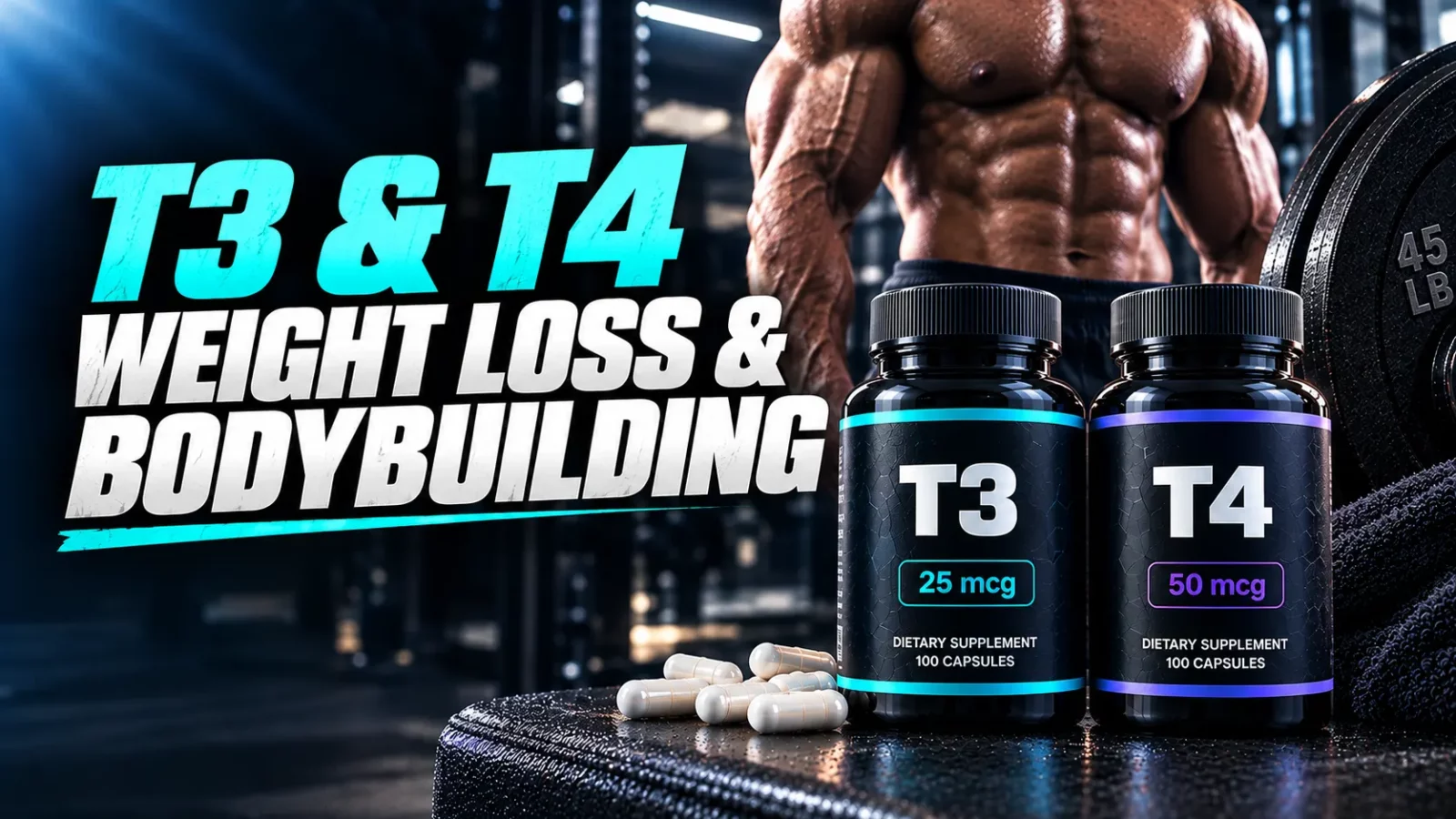
T3 and T4 are the two biologically active thyroid hormones responsible for regulating metabolism, energy production, and body composition. In bodybuilding and fitness, synthetic versions of these hormones — Cytomel (T3) and Synthroid (T4) — are used during contest prep to accelerate fat loss beyond what diet and training alone can achieve.
T3 (triiodothyronine) is the more metabolically active hormone, roughly five times more potent than T4 (thyroxine) at the cellular level. The body produces approximately 10-22 mcg of T3 and 94-110 mcg of T4 daily, with about 80% of circulating T3 created through conversion from T4 in peripheral tissues.
Key Takeaways
- T3 (Cytomel) is the primary thyroid hormone used by bodybuilders for fat loss, typically dosed at 25-50 mcg daily for 8 weeks.
- T4 (Synthroid) is milder and can be combined with T3 in a 1:2 ratio for more stable thyroid levels.
- Both require gradual tapering — starting and stopping abruptly can cause thyroid storm or rebound hypothyroidism.
- Common side effects include elevated heart rate, sweating, muscle loss, and reduced insulin sensitivity.
- Post-cycle thyroid recovery requires specific nutrients (iodine, selenium, L-tyrosine) and blood work monitoring.
How T3 and T4 Work
The thyroid gland, located at the base of the neck, produces T4 in larger quantities and T3 in smaller amounts. T4 functions primarily as a precursor — approximately 40% is converted into T3 through deiodination (removal of an iodine group) in tissues throughout the body.
T3 is the hormone that directly increases metabolic rate. It acts on cells to increase oxygen consumption and energy expenditure, affecting virtually every tissue in the body including muscle, fat, heart, and brain.
Hypothyroidism vs Hyperthyroidism
| Condition | Thyroid Activity | T3/T4 Levels | TSH Levels | Effect on Body Composition |
|---|---|---|---|---|
| Hypothyroidism | Underactive | Low | High | Fat gain, difficulty losing weight |
| Normal | Balanced | Optimal range | Normal | Normal metabolism |
| Hyperthyroidism | Overactive | High | Low | Rapid weight loss, muscle wasting |
When bodybuilders take exogenous T3, they are deliberately inducing a mild hyperthyroid state to increase metabolic rate and accelerate fat burning. This is effective for fat loss but carries the risk of muscle catabolism if dosing is too aggressive or protein intake is insufficient.
T3 Dosage for Bodybuilding
Standard Protocol
| Phase | Dosage | Duration |
|---|---|---|
| Start | 12.5 mcg daily | Days 1-3 |
| Ramp up | Increase by 12.5 mcg every 3 days | Until target reached |
| Peak | 25-50 mcg daily | Through end of prep |
| Taper down | Decrease by 12.5 mcg every 3 days | Post-competition |
The gradual ramp-up is essential to avoid thyroid storm — a dangerous condition where the combination of endogenous and exogenous thyroid hormone creates an excess that overwhelms the body.
Administration Notes
- Cycle length: 8 weeks maximum. Longer cycles increase the risk of sustained suppression of natural thyroid production.
- Timing: Take on an empty stomach, typically first thing in the morning. T3 has a half-life of approximately 24 hours.
- Maximum dosage: Most coaches cap T3 at 50 mcg daily. Doses above 75 mcg significantly increase the risk of muscle loss and cardiovascular side effects.
- Forms available: Tablets (Cytomel brand or generic), liquid (research chemical), capsules. Tablets and liquids allow more precise dosing than capsules.
Why Bodybuilders Prefer T3 Over T4
Cytomel weight loss protocols dominate bodybuilding prep because T3 is roughly 5 times more potent than T4 at the cellular level. Since the body only converts approximately 40% of T4 into T3, taking T4 alone requires significantly higher doses to achieve the same metabolic effect. T3 provides a more direct and predictable fat-burning response.
T3 and T4 Combination Protocols
Some competitors use a T3:T4 combination rather than T3 alone. The rationale is that adding T4 provides a more physiological hormone profile and may reduce the risk of thyroid suppression compared to T3 monotherapy.
Recommended Ratio
The standard T3:T4 combination uses a 1:2 ratio:
| Component | Dose at Peak |
|---|---|
| T3 | 50 mcg |
| T4 | 100 mcg |
| Maximum daily volume (liquid) | 0.5 mL |
Research on T3:T4 combination therapy for hypothyroidism has shown improvements in quality of life and cognitive function compared to T4 monotherapy in some patients, and bodybuilders have adapted this approach for performance use.
Liquid combination products typically contain 100 mcg T3 and 200 mcg T4 per mL in a 30 mL bottle. The ramp-up and taper-down follow the same gradual protocol as T3 alone, scaled proportionally.
Cutting Stacks with T3
Clenbuterol + T3
The most common T3 and T4 bodybuilding cutting stack pairs Clenbuterol with T3. Clenbuterol is a beta-2 agonist that increases thermogenesis and metabolic rate through a different pathway than thyroid hormones, creating a synergistic fat-burning effect.
| Compound | Protocol |
|---|---|
| Clenbuterol | Start at 20 mcg daily, increase by 20 mcg every 2 weeks, max 120 mcg |
| T3 | Standard 12.5-50 mcg ramp protocol (8 weeks) |
| Timing | Clen before fasted morning cardio; T3 on empty stomach |
| Cycle structure | Start clen 12-16 weeks out; add T3 for the final 8 weeks |
Some coaches recommend a 2-days-on, 1-day-off Clenbuterol schedule to maintain receptor sensitivity and prevent adrenal fatigue.
Clenbuterol + Yohimbine + T3
A more aggressive stack alternates Clenbuterol and Yohimbine HCL alongside T3:
- Days 1-2: Clenbuterol (20-120 mcg) + T3
- Days 3-4: Yohimbine HCL (5 mg, 1-2x daily) + T3
- Repeat: Alternate throughout prep
Yohimbine is an alpha-2 adrenergic antagonist that mobilizes stubborn fat deposits, particularly in the lower abdomen and lower back. It should be taken before fasted cardio or training, and users should test tolerance before adding it to a prep stack as sensitivity varies significantly.
T3 and T4 Side Effects
The T3 dosage bodybuilding community uses (25-50 mcg) places the body in a mild hyperthyroid state. Research confirms that supraphysiological thyroid hormone levels increase protein catabolism alongside the desired lipolytic effects. While effective for fat loss, this carries several risks:
| Side Effect | Mechanism | Severity |
|---|---|---|
| Elevated heart rate | Increased cardiac output from thyroid stimulation | Moderate — monitor resting HR |
| Muscle catabolism | Increased protein breakdown at higher doses | Moderate — increase protein intake to offset |
| Excessive sweating | Elevated metabolic rate and thermogenesis | Mild |
| Reduced insulin sensitivity | Thyroid-mediated glucose metabolism changes | Moderate — affects carb loading pre-contest |
| Sleep disturbances | CNS stimulation from elevated thyroid levels | Mild to moderate |
| Anxiety and irritability | Hyperthyroid CNS effects, compounded by caloric restriction | Mild to moderate |
Thyroid Storm
Thyroid storm occurs when exogenous T3 combines with the body’s still-active endogenous production to create dangerously high thyroid hormone levels. Symptoms include nausea, excessive sweating, elevated body temperature, rapid heart rate, and severe agitation.
Management: Reduce dosage by 25-50% and continue the gradual ramp-up from the lower starting point. The body typically suppresses endogenous thyroid production within several days to 2 weeks of starting exogenous T3, after which the risk of thyroid storm decreases. Never maintain a dosage below 25 mcg during a cycle, as this may cause fluctuations in thyroid levels.
Contraindications
Individuals with existing thyroid disorders (hypothyroidism or hyperthyroidism) should not use T3 or T4 for Cytomel weight loss purposes without direct medical supervision. The interaction between exogenous thyroid hormones and existing thyroid dysfunction can worsen the underlying condition.
Thyroid Recovery After T3
Restoring natural thyroid production after a T3 cycle is critical. The thyroid gland suppresses its own hormone output when exogenous T3 is present, and recovery can take several weeks to months depending on cycle length and dosage.
Recovery Nutrients
The following micronutrients support thyroid recovery and hormone production:
| Nutrient | Role in Thyroid Function |
|---|---|
| Iodine | Essential building block for T3 and T4 synthesis |
| Selenium | Required for T4-to-T3 conversion (deiodination) |
| L-Tyrosine | Amino acid precursor for thyroid hormone production |
| Zinc | Supports TSH signaling and hormone synthesis |
| Magnesium | Cofactor in thyroid enzyme reactions |
| Iron | Required for thyroid peroxidase enzyme activity |
| Vitamin D | Modulates thyroid autoimmune response |
| B-complex vitamins | Support cellular energy metabolism during recovery |
Blood Work Monitoring
A complete thyroid panel should be obtained before starting a T3 cycle and every 4-8 weeks post-cycle until values normalize. The panel should include:
- Free T3 (fT3): Confirms active thyroid hormone levels have recovered
- Free T4 (fT4): Confirms precursor hormone production is restored
- TSH: Confirms pituitary signaling has normalized (may be the last to recover)
- Reverse T3 (rT3): Identifies conversion issues that can mimic hypothyroid symptoms
Most athletes recover full thyroid function within 4-8 weeks of properly tapering off T3. Prolonged suppression (3+ months) may indicate thyroid damage from excessive dosing or insufficient recovery time between cycles.
The Bottom Line
T3 and T4 for weight loss are effective tools in competitive bodybuilding prep, providing a direct increase in metabolic rate that accelerates fat burning during aggressive caloric deficits.
- T3 (Cytomel) is the more commonly used compound due to its significantly higher potency, while T3:T4 combinations offer a more physiological approach.
- The key to safe T3 T4 bodybuilding use is respecting the taper protocol (both up and down), limiting cycle length to 8 weeks, keeping the T3 dosage bodybuilding ceiling at 50 mcg, and supporting thyroid recovery post-cycle with targeted nutrition and blood work monitoring.