Contents12 sections
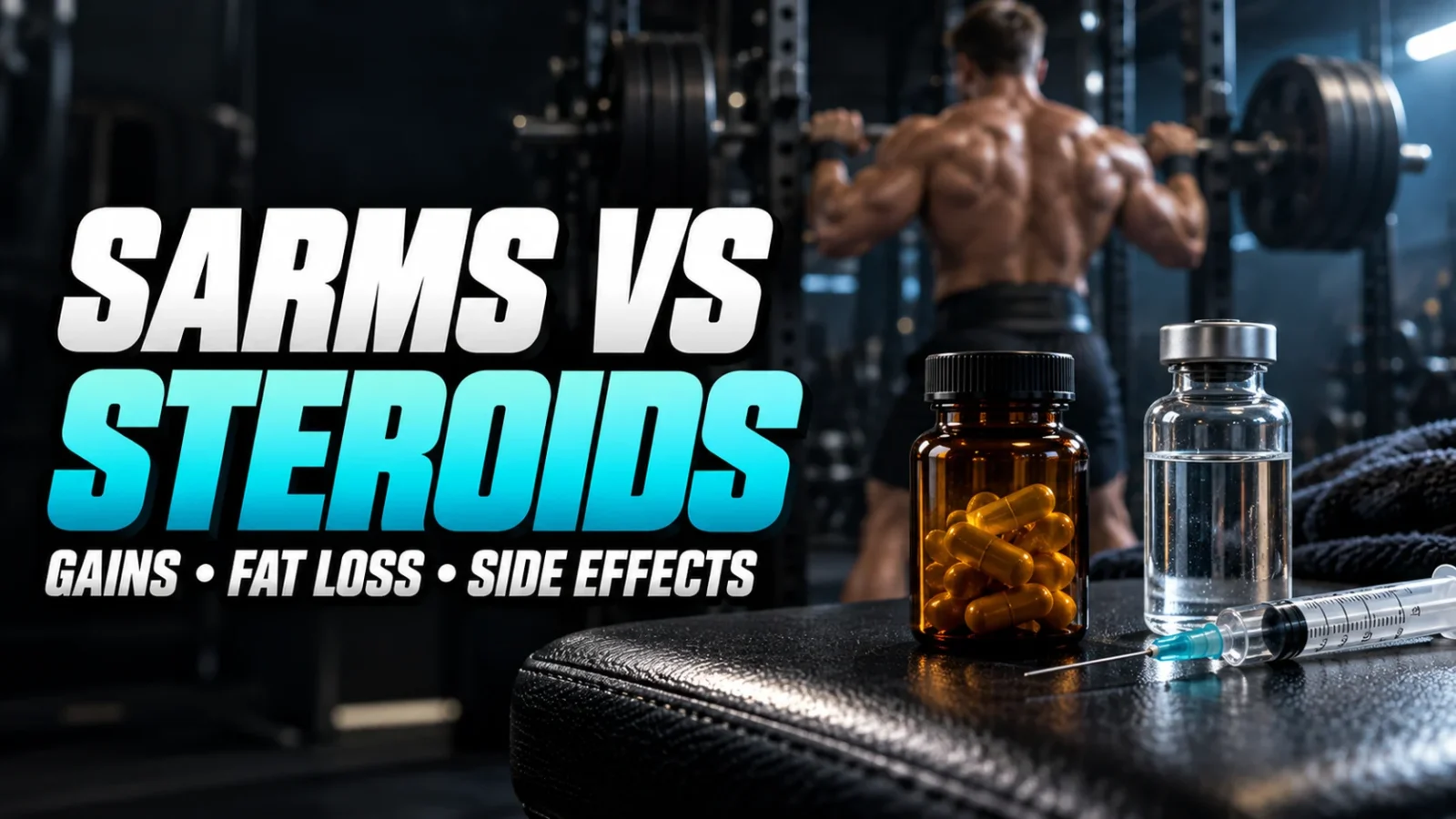
SARMs vs steroids is one of the oldest arguments in the gym. One camp says SARMs give you most of the gains with none of the downsides. The other says nothing beats testosterone and Deca.
Both camps are partly right. Steroids build more muscle, and the evidence for that is solid. SARMs were designed to be gentler, and on some side effects they are. But the popular claim that SARMs don’t suppress testosterone or touch your cholesterol is simply false.
Below we compare the two on muscle gain, fat loss, side effects and legal status, using the human studies that exist and flagging where the evidence is only animal data or user reports.
Key Takeaways
- Steroids build more muscle than SARMs. High-dose testosterone added several kilograms of fat-free mass in controlled trials, while SARM trials show gains of around 1-1.5 kg at low clinical doses.
- SARMs do suppress natural testosterone. In a placebo-controlled trial, LGD-4033 lowered total testosterone, SHBG and HDL cholesterol in a dose-dependent way at doses well below what users commonly report taking.
- Most SARMs are nonsteroidal, so they don’t convert to DHT or estrogen. That lowers the risk of estrogenic side effects and DHT-driven hair loss, but androgen-receptor side effects are still possible.
- Oral steroids carry the best-documented liver risks, but SARMs aren’t liver-safe either: case reports link ostarine, LGD-4033 and RAD-140 to drug-induced liver injury.
- Steroids are controlled substances in the US and SARMs are unapproved research chemicals. Both are banned by WADA, and SARMs have almost no long-term safety data in healthy people.
What are SARMs?
SARMs (selective androgen receptor modulators) are compounds developed by pharmaceutical researchers for conditions like muscle wasting, cancer-related weight loss, osteoporosis and age-related muscle loss. None has been approved as a medicine by the FDA.
Like testosterone, they work by switching on the androgen receptor, which then changes gene activity inside the cell and drives muscle protein synthesis. The “selective” part is the goal: strong action in muscle and bone, weaker action in tissues like the prostate and skin.

Most SARMs, including ostarine, LGD-4033 and RAD-140, are nonsteroidal. They don’t have the steroid ring structure, so the enzyme 5-alpha reductase can’t turn them into DHT (dihydrotestosterone), and aromatase can’t turn them into estrogen. That is the real reason their androgenic and estrogenic side effects tend to be milder.
What they don’t do is escape the body’s hormone feedback loop. Any compound that activates androgen receptors strongly enough to build muscle also tells the brain that there are plenty of androgens around, and natural testosterone production drops. We cover the data below.
SARMs also lower HDL (“good”) cholesterol in clinical trials, so the old claim that they spare your blood lipids doesn’t hold up either.

Pros
- Exceptional purity & testing (≥98%)
- Pharmaceutical-style packaging for stability
- Broad catalog across peptides & nootropics
- Strong reputation & consistency across years
Cons
- Some items frequently out of stock due to high demand
- Limited long-term data for some compounds
What are Steroids?
“Anabolic steroids”, or more precisely anabolic-androgenic steroids, means testosterone and the synthetic hormones derived from it. Lifters use them to build muscle, gain strength or hold on to muscle while dieting.

The parent compound is testosterone, the main male sex hormone. Most other steroids are small chemical edits of it, and each edit changes how the drug behaves in the body.
Take nandrolone (Deca). It is testosterone without the carbon-19 methyl group, the small one-carbon branch attached at position 10 of the steroid skeleton, which is why it’s called 19-nortestosterone. That small change matters. In the prostate, skin and scalp, 5-alpha reductase turns nandrolone into a weaker androgen (dihydronandrolone) instead of a stronger one like DHT, and nandrolone converts to estrogen far less than testosterone does. The result is a drug that is more anabolic relative to its androgenic effects.

As you can see, the two molecules look almost identical on paper, but in the body testosterone and nandrolone behave quite differently.
Like SARMs, many steroids started as medicines. Oxymetholone (Anadrol) was developed to treat anemia and was later studied in HIV-associated muscle wasting. Testosterone itself is prescribed today for men with diagnosed hypogonadism.
The big practical difference is history. Steroids aren’t new like SARMs. They have been prescribed, used and studied for decades, so their side effects are well documented. Most of what we know about SARMs at bodybuilding doses comes from short trials, case reports and user experience.
SARMs vs Steroids: How do SARMs work compared to Steroids?
SARMs and steroids bind the same androgen receptor. SARMs don’t skip the prostate or any other tissue, because the receptor is the same everywhere. The difference lies in what happens after binding: a SARM-receptor complex recruits different helper proteins in different tissues, so it acts strongly in muscle and bone and more weakly elsewhere.
There is a second reason. In the prostate and scalp, testosterone’s effect is amplified by its conversion to DHT. SARMs don’t get that boost, so their action in those tissues is smaller.
That is also why testosterone suppression is still part of the picture. Suppression doesn’t depend on whether a compound is a hormone. It depends on androgen receptor activity in the hypothalamus and pituitary, and SARMs act there too, more so at the doses lifters use.

YK-11 is the exception to the nonsteroidal rule. As the structure shows, it is built on a steroid skeleton derived from DHT, so it is not dramatically different from testosterone. Its reputation for blocking myostatin comes from cell-culture work, where it raised follistatin in muscle cells; there are no human trials.
So, compared to steroids, SARMs are a more targeted way of activating androgen receptors, not a different mechanism. And in total effect, they are weaker than steroids.
Which builds more muscle?
On muscle growth, steroids have the upper hand. By most accounts, competitive bodybuilders build their cycles around steroids, not S-23, YK-11 or ostarine, and the research points the same way.
There are no head-to-head trials of a SARM against a steroid. Two well-known studies, one on testosterone and one on Ligandrol (LGD-4033), give a rough idea of the difference:
| Compound | Dose studied | Duration | Result |
|---|---|---|---|
| Testosterone enanthate (Bhasin et al., 1996) | 600 mg per week | 10 weeks | About 3.2 kg more fat-free mass without training; about 6.1 kg with strength training |
| LGD-4033 (Basaria et al., 2013) | 1 mg per day | 21 days | About 1.2 kg more lean body mass |
The testosterone data come from a placebo-controlled trial in healthy men; the LGD-4033 data come from a 21-day trial in healthy young men. The studies differ in length, dose and design, so this is not a clean comparison. Per week, the gains even look closer than the totals suggest.
The stronger argument is what each body of research shows overall. Testosterone’s effect on muscle rises with the dose and has been tested at doses far above replacement in controlled trials. SARM trials have only tested low clinical doses and report modest gains, and there are no controlled data showing any SARM matching a high-dose steroid cycle.
Steroids also raise red blood cell production, which can help endurance. But too high a hematocrit thickens the blood, and it is one of the main safety markers doctors watch in men on testosterone therapy.
The trade-off is simple: the more powerful the compound, the bigger the side effects. That means deeper testosterone suppression, worse cholesterol, more strain on the heart and, with orals, on the liver.
SARMs sit lower on both scales: smaller gains and, in most cases, milder side effects. Their long-term safety is still unknown, and their legal status varies by country.
Which can aid Fat Loss more?
Fat loss still comes down to a calorie deficit. Compounds can tilt the odds by helping you keep muscle while dieting or by raising energy expenditure, but they don’t replace the diet.
On the SARM side, the compound people usually mean is Cardarine (GW-501516). Strictly speaking it isn’t a SARM at all: it’s a PPAR-delta agonist that shifts the body toward burning fat for fuel. Users widely report fat loss and better endurance, and short human studies reported better blood lipids. But its development was abandoned after it caused cancer in long-term rodent studies, which is covered in our article on Cardarine side effects and cancer risk.
True SARMs such as ostarine and LGD-4033 help mostly indirectly, by helping you hold on to muscle in a deficit. More muscle also burns slightly more energy at rest.


Overview
- Form: Liquid solution
- Researched Dosage: 10 mg to 20 mg daily (0.5-1 ml)
- Typical Cycle: 6-8 weeks
- Cost: $69.96
- Stacking Options: Ostarine (MK-2866), SR9009, MK-677
Pros
- In mouse studies it raised running endurance a lot, even without exercise training, which earned it the nickname “exercise in a pill.”
- Doesn’t act on androgen receptors, so it isn’t expected to suppress natural testosterone the way SARMs can.
Cons
- Development was stopped after long-term rodent studies found tumors in the liver, bladder, stomach, skin and other organs.
- No long-term human safety data, it isn’t approved for any medical use, and WADA lists it as a banned metabolic modulator.
Most of the fat-loss drugs bodybuilders use aren’t steroids either. Clenbuterol is a beta-2 agonist, T3 is thyroid hormone, and ECA is ephedrine, caffeine and aspirin. They raise energy expenditure, but they also put strain on the heart, and excess T3 breaks down muscle as well as fat.
Among actual steroids, compounds like Winstrol, trenbolone and Masteron are popular in cutting phases, mainly because they help preserve muscle and give a harder look. Good human data on direct fat loss from these drugs are lacking.
There are no studies comparing SARMs and steroids for fat loss. Going by mechanism and by what lifters actually use, the steroid-plus-fat-burner approach is more powerful, and it is also clearly riskier.
What about Side Effects?
This is where SARMs are supposed to win, and in some areas they do. SARMs were specifically designed to have fewer of the typical steroid side effects, hence the name “selective”. But fewer side effects is not the same as none. Here is how the two compare, point by point.
1) Testosterone Shutdown

Hypogonadism means the testes produce too little testosterone. It can happen with age or illness, but in lifters a common cause is the use of external hormones.
When you take testosterone or a derivative such as Anavar, the brain senses high androgen levels and cuts the signals to the testes: LH and FSH (luteinizing hormone and follicle-stimulating hormone). Natural testosterone and sperm production drop, often to very low levels during a cycle.
After the cycle, it can take weeks to months for the system to recover. During that gap, men can have symptoms of low testosterone: low libido, fatigue, low mood and muscle loss. That’s why many steroid users run a PCT (post-cycle therapy) to speed up recovery.

Commonly reported PCT protocols use a SERM such as tamoxifen (Nolvadex) or clomiphene (Clomid). These block estrogen’s feedback at the pituitary so that LH and FSH rise again. They are prescription drugs, and a doctor should be involved.
 SERMs & AIs
Overview
- Form: Oral Capsules
- Dosage: 25-40 mg daily for PCT or for gyno flare-ups
- Typical Cycle: 4-6 weeks
- Cost: $81.95
- Stacking Options: Higher testosterone doses or post-cycle recovery
Pros
- Large mortality benefit in ER-positive breast cancer; five years of adjuvant treatment cuts recurrence roughly by half and breast cancer mortality by about a third, with the effect persisting well past the treatment period
- Works in premenopausal and postmenopausal women alike, unlike aromatase inhibitors, which makes it the default for younger patients
- Bone-protective in postmenopausal women, since it acts as a partial estrogen agonist in bone — the reverse of anastrozole's main liability
Cons
- Endometrial hyperplasia and a two-to-three-fold increase in endometrial cancer risk in postmenopausal women, requiring investigation of any abnormal bleeding
- Elevated risk of venous thromboembolism and pulmonary embolism, particularly around surgery or immobility
- Hot flashes, vasomotor symptoms and mood effects are common; CYP2D6 status and strong inhibitors such as certain SSRIs can reduce conversion to the active metabolite
The old line that SARMs don’t shut you down is wrong. They aren’t hormones, but that isn’t what matters: suppression follows androgen receptor activity in the brain, and SARMs activate those receptors.
The best data come from a placebo-controlled trial of LGD-4033 in 76 healthy young men (Basaria et al., 2013). Over just 21 days at 0.1 to 1 mg a day, it lowered total testosterone, SHBG and HDL cholesterol in a dose-dependent way, and at 1 mg a day it also lowered free testosterone and FSH. Levels returned to baseline after the drug was stopped. Commonly reported bodybuilding doses are 5 to 10 times higher and run for 8 weeks or more.
RAD-140 has no published trial in healthy men, so there are no controlled suppression data. The evidence is user blood work and case reports. Users who test commonly report lower testosterone and LH, and RAD-140 is generally treated as one of the more suppressive SARMs, alongside LGD-4033 and S-23.
In short, suppression with SARMs is usually milder than with a steroid cycle and depends on the compound and the dose. At commonly reported doses it is real enough that many users run a PCT; our guide to PCT for SARMs covers what the evidence shows.
2) Estrogen

Men need some estrogen. Estradiol supports libido, erectile function, bone density and healthy cholesterol. In a healthy man, it is made from testosterone by an enzyme called aromatase.
On a steroid cycle, more testosterone is available for aromatase, so estradiol rises too. Too much can cause water retention, gynecomastia (breast tissue growth), mood changes and libido problems.
Some users respond by taking an aromatase inhibitor such as Aromasin. But pushing estrogen too low brings its own problems, including worse cholesterol, low libido and joint pain.
Aromasin

Aromasin is the brand name for exemestane, a drug from the aromatase inhibitor (AI) family, alongside Arimidex (anastrozole). Both are breast cancer drugs.
The main difference is how they work. Exemestane is steroidal and binds aromatase permanently, while anastrozole is nonsteroidal and blocks it reversibly. Steroid users have traditionally reached for Arimidex, and many now prefer Aromasin, but there is no good trial evidence that one is better for bodybuilders. Our Aromasin vs Arimidex comparison goes into the details.
Outside of contest prep, many experienced users avoid AIs unless they have estrogen-related symptoms or high estradiol on blood work. Estrogen also plays a role in growth: in cattle, implants that combine trenbolone with estradiol produce more growth than trenbolone alone. That is animal data, but it fits the general picture that balance matters more than suppression.
This is a clear point for SARMs. Nonsteroidal SARMs aren’t converted by aromatase, so they don’t raise estradiol and don’t call for an AI. The flip side: a suppressive SARM lowers your own testosterone, and with it your estradiol, so low-estrogen symptoms are possible on a strong SARM cycle.
3) Liver Damage
Oral steroids such as Anavar, Winstrol and Anadrol are 17-alpha-alkylated, a chemical change that lets them survive their first pass through the liver. The cost is liver strain.
Oral anabolic steroids have been linked to raised liver enzymes, cholestatic jaundice, peliosis hepatis (blood-filled cavities in the liver) and liver tumors, including adenomas and hepatocellular carcinoma. Injectable testosterone carries far less liver risk.
SARMs were once marketed as liver-safe. That hasn’t held up. Published case reports describe drug-induced liver injury, often with jaundice, in people using ostarine, LGD-4033 and RAD-140, and the FDA has warned that SARMs can cause liver toxicity.
In clinical trials at low doses of up to 3 mg a day, ostarine was generally well tolerated. The case reports involve users taking unregulated products, often at higher doses or in stacks, so the real risk is hard to pin down. On current evidence, oral steroids are the bigger liver threat, but SARMs aren’t free of it.
4) Other Side Effects
Here is how the rest compares. Treat it as a general guide: individual compounds and doses vary a lot.
| Side effect | SARMs | Steroids | Edge |
|---|---|---|---|
| Testosterone suppression | Dose-dependent; shown in trials for LGD-4033 | Strong on almost any cycle | SARMs |
| Hair loss | No DHT conversion, but androgen receptor activity can still trigger shedding in men prone to male-pattern baldness | Common in prone men, especially with DHT-derived and strongly androgenic compounds | SARMs |
| Acne | Reported by some users | Common, especially with androgenic compounds | SARMs |
| Prostate growth | Less prostate stimulation in animal studies; long-term human data lacking | Testosterone and DHT stimulate prostate growth | SARMs (likely) |
| Estrogenic effects (gyno, water retention) | Not converted to estrogen | Common with aromatizing steroids | SARMs |
| HDL cholesterol | Lowered in clinical trials | Lowered, often sharply with orals | Both negative |
| Aggression and mood | Little data; some user reports | Usually mild, but a minority of men on high doses have marked mood changes | SARMs (likely) |
| Long-term data | Very little | Decades of clinical and observational data | Steroids |
Overall, SARMs come out ahead on most side effects, which is what they were designed for. Two things keep it from being a clean win: suppression and lower HDL still happen, and there is very little long-term data on SARMs in healthy people at the doses lifters use.
Are they Legal?
Steroids: in the US, anabolic steroids are Schedule III controlled substances. Testosterone is prescribed legally as testosterone replacement therapy (TRT) for men with diagnosed hypogonadism, at replacement doses. Having steroids without a prescription is a crime.
SARMs: they aren’t approved for any medical use. They are sold as research chemicals “not for human consumption”, and selling them as dietary supplements is illegal. The rules differ by country, and some countries require a prescription; see Are SARMs legal? for a country-by-country list.
Sport: both are banned. SARMs and anabolic steroids are on the WADA Prohibited List at all times, in and out of competition, and anti-doping labs test for them.
So, which is better?
Neither, in the abstract. It depends on what you’re weighing.
If the question is raw muscle-building power, steroids win. If it’s the side-effect burden at commonly used doses, SARMs generally come out ahead. They are not the side-effect-free shortcut they were sold as, though: they suppress testosterone, lower HDL and have been linked to liver injury.
There is an old saying in the gym: if you still have to ask whether you should take steroids, you aren’t ready. The same goes for SARMs. Get your training, diet and sleep in order first, get blood work done, and talk to a doctor before taking any of these compounds.
The Bottom Line
Steroids build more muscle and SARMs usually cause fewer side effects, but neither is safe, and the idea that SARMs leave your hormones alone is a myth.
- High-dose testosterone produced several kilograms of lean mass in controlled trials; SARM trials show modest gains at low clinical doses, and no study shows a SARM matching a steroid cycle.
- SARMs suppress testosterone and lower HDL cholesterol in a dose-dependent way, as shown for LGD-4033, and RAD-140 is widely reported to be suppressive too.
- Because most SARMs don’t convert to DHT or estrogen, their androgenic and estrogenic side effects are milder than those of steroids.
- Oral steroids carry the best-documented liver risk, but SARMs have also been linked to liver injury, and their long-term effects in healthy people are unknown.
Frequently Asked Questions
Disclaimer
Please read carefully
The information on this site is for educational and informational purposes only, and is not medical advice. Always consult a qualified healthcare professional before using any supplement or medication, or making changes to your health, fitness, or nutrition routine.
Not medical advice
Content here is not a substitute for professional medical advice.
Consult your doctor
Talk to your doctor before starting any supplement or new routine.
Use at your own risk
We are not responsible for adverse effects from acting on this.
Do your research
Make informed decisions about your own health.
No guarantees
Individual results vary. No claims about outcomes.
Important — Never disregard professional medical advice or delay seeking it because of something you read here. If you think you may have a medical emergency, call your doctor or your local emergency number right away.